
AI Marketing Consultant: What They Do and When to Hire One
What does an AI marketing consultant actually do? Core deliverables, consultant vs agency, when to hire one by AI maturity stage, and the questions to ask.
Most marketing teams already use AI. Far fewer can say what it has done for revenue. That gap is why more leaders are looking for outside help: according to Semrush, US searches for "ai marketing consultant" average about 480 a month, with another 390 for "ai marketing consultant near me" (Semrush US database, October 2026). This guide covers what an AI marketing consultant actually does, how the role differs from an agency or an in-house hire, when it makes sense to bring one in, and the questions that separate real operators from tool resellers.
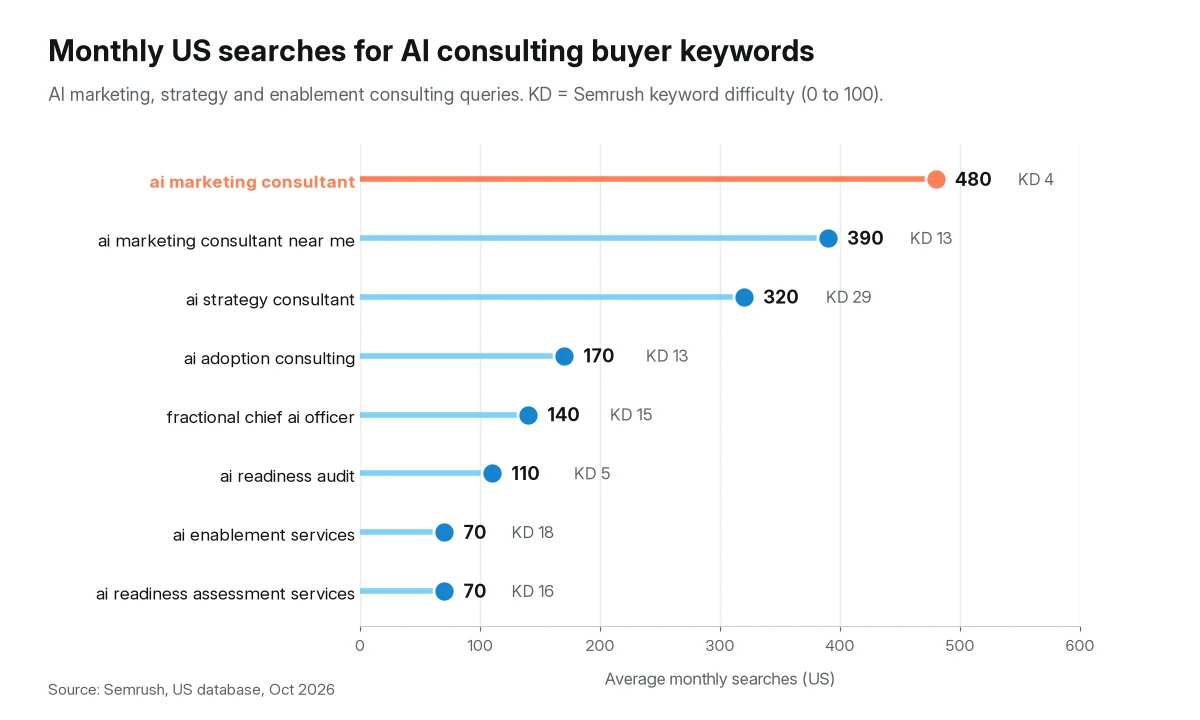
Monthly US searches for AI marketing and AI enablement consulting keywords. Source: Semrush, US database, Oct 2026.
What Does an AI Marketing Consultant Do?
An AI marketing consultant helps a marketing team decide where AI will improve results, then helps it put those uses into practice safely and measure them. The job is part strategist, part operator, and part teacher.
A good consultant does not start with tools. They start with your workflows, your data, and the outcomes you are accountable for (pipeline, revenue, cost per acquisition), then work back to which AI uses are worth funding. The output is a sequenced plan, not a software shopping list.
You will see the same work sold as AI strategy consulting, AI adoption consulting, AI enablement services, or a fractional chief AI officer. The titles vary. Judge the offer on deliverables and on who does the work.
What an AI Marketing Consultant Should Deliver
Whatever the title, a credible engagement covers five things. If a proposal skips one, ask why.
-
A readiness assessment. Where your team sits today: which tools are in use, by whom, for what, and with what results. Our AI Enablement Ladder™ gives this a shared language, from Stage 1 Experimentation to Stage 4 Optimisation.
-
A data and stack inventory. AI is only as useful as the data it can reach. Expect a review of your CRM, analytics, ad platforms, and content library, and a clear view of what is missing before more advanced work can start.
-
A prioritized use case plan. Two or three projects ranked by business impact, effort, and risk, each with a stated success metric. A list of 40 "AI opportunities" with no ranking is not a plan.
-
Governance before scale. An acceptable use policy, rules for customer and proprietary data, and enterprise tier tools with data processing agreements. This protects the brand while the team experiments.
-
Enablement that stays behind. Documented workflows, a shared prompt library, brand voice guidance, and training, so the capability lives with your team after the consultant leaves.
AI Marketing Consultant vs Agency vs In-House Hire
The right model depends on whether you need direction, execution, or both. Here is how the three options usually compare.
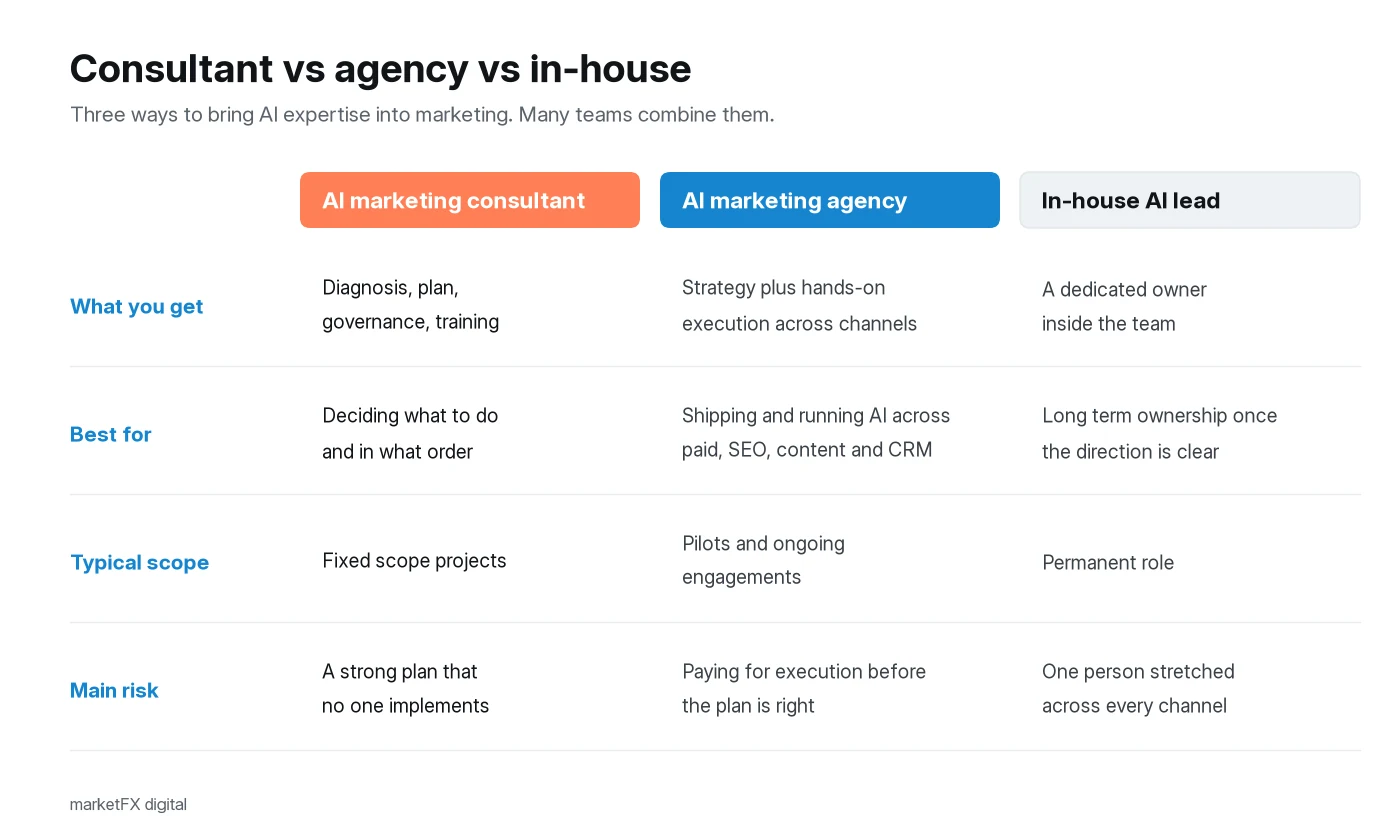
Three ways to bring AI expertise into marketing. The table below has the same comparison in text.
| Dimension | AI marketing consultant | AI marketing agency | In-house AI lead |
|---|---|---|---|
| What you get | Diagnosis, plan, governance, training | Strategy plus hands-on execution across channels | A dedicated owner inside the team |
| Best for | Deciding what to do and in what order | Shipping and running AI across paid, SEO, content, and CRM | Long term ownership once the direction is clear |
| Typical scope | Fixed scope projects | Pilots and ongoing engagements | Permanent role |
| Main risk | A strong plan that no one implements | Paying for execution before the plan is right | One person stretched across every channel |
Many teams combine them: an outside partner sets direction and builds the first workflows, and an internal owner takes over as the work matures. If you are weighing the broader structure, our comparison of a marketing agency vs an in-house team covers the trade offs in more depth. And if the real gap is senior marketing leadership rather than AI specifically, a fractional CMO may be the better first hire.
When to Hire an AI Marketing Consultant, by Stage
What you need from outside help changes as your team matures. Hiring for the wrong stage is the most common way to waste the budget.
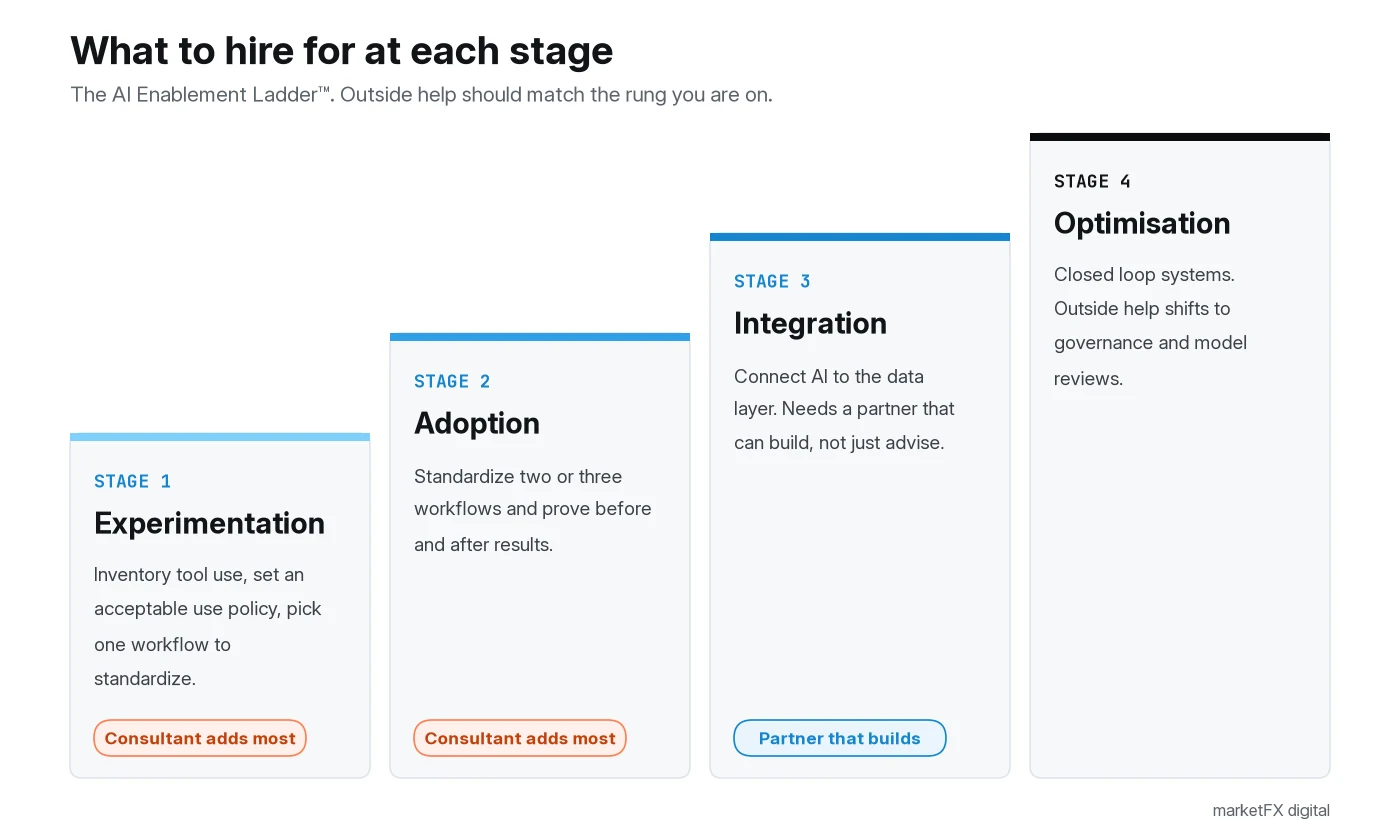
- Stage 1 Experimentation. People use different tools with no shared workflow or measurement. You need a consultant to inventory tool use, set an acceptable use policy, and pick the one workflow worth standardizing first.
- Stage 2 Adoption. AI is built into two or three named workflows with light measurement. You need help proving before and after results and choosing which workflow should move closer to your data.
- Stage 3 Integration. AI runs in the data layer: audience scoring, bidding, content scoring, attribution. This is integration and engineering work, and it usually needs a partner that can build, not just advise.
- Stage 4 Optimisation. Closed loop systems learn from production results. Outside help shifts to governance, model reviews, and evaluating new capabilities against the current stack.
Stage 1 and Stage 2 are where a consultant usually adds the most, because the biggest early gains come from choosing the right first projects. We explain the gap between adoption and integration in AI in Marketing: What Actually Changes.
Questions to Ask Before You Hire
Use these on the first call. Good consultants answer them directly.
- How do you assess where we are today, and what do we get at the end? Look for a fixed scope assessment with a written, prioritized plan.
- Which business metric will each recommendation move? If the answer is "productivity" with no baseline, push for specifics.
- How do you handle our customer data? Expect enterprise tier tools, data processing agreements, and access that is scoped and logged.
- Are you tied to any software vendor? Tool agnostic advice is worth more than a reseller margin.
- Who does the work after the sale? Ask whether the senior person on the call stays on the engagement.
- What happens after your plan? Someone has to implement it. Ask whether they build, hand off to your team, or both.
- What won't you promise? No one can guarantee a percentage lift before seeing your data and workflows.
Red Flags
- Tool first recommendations. A plan that starts with "buy this platform" skipped the diagnosis.
- No baseline. Without before and after measurement, no one can prove the work paid off.
- Activity metrics. Prompts written, tokens used, and tools deployed are inputs. Report on pipeline, revenue, and cost.
- Guaranteed results. Projections should be stage specific and stated with their assumptions, never promised.
- No governance. Advice that lets customer or proprietary data flow into consumer AI tools creates risk you will own.
How to Scope the First Engagement
Start small and fixed. A short readiness assessment answers the most important question (where are we, and what should we do next?) before you commit to a long engagement.
That is how we structure AI work at marketFX. An AI Readiness Audit runs two weeks at a fixed fee and identifies your current Ladder stage and the top three leverage projects. An AI Pilot then runs for 60 to 90 days on a single workstream, with a measurement framework built in. Only when a pilot proves its value does a 6 to 12 month AI Enablement Engagement make sense. You can see how this connects to GEO, paid media, content, and analytics on our AI marketing services page.
If you want to self-assess first, download the AI Enablement Ladder™ assessment, a 20 question PDF you can run with your team in about 30 minutes. And if your priority is how AI engines describe your brand rather than how your team uses AI, start with our guide to AEO services or our marketing audit, which covers AI visibility alongside paid media, SEO, analytics, and conversion.
Related services
FAQs
Frequently Asked Questions
- What does an AI marketing consultant do?
- An AI marketing consultant assesses how your team uses AI today, identifies the uses most likely to improve revenue or efficiency, sets governance for data and tools, and helps your team put the first projects into practice with clear measurement.
- Should I hire an AI marketing consultant or an AI marketing agency?
- Hire a consultant when you need a diagnosis and a plan. Hire an agency when you also need the work built and run across channels. Many teams start with a fixed scope assessment and then decide.
- When is the right time to hire an AI marketing consultant?
- Usually in Stage 1 Experimentation or Stage 2 Adoption of the AI Enablement Ladder™, when tools are in use but results are not measured and no one has decided which workflows to standardize.
- What is the difference between an AI marketing consultant and a fractional chief AI officer?
- A consultant typically works on a defined project, such as an assessment or a pilot. A fractional chief AI officer is an ongoing part time leadership role that owns AI direction across the business, not only marketing.
- Can an AI marketing consultant guarantee results?
- No. A credible consultant sets a baseline, projects results with stated assumptions, and measures against business outcomes. Guaranteed percentage lifts before anyone has seen your data are a red flag.
Get an Honest Read on Your AI Stage
Book a strategy call. We will tell you where your team sits on the AI Enablement Ladder™ and which one or two AI projects are worth funding first, even if you don't hire us.