
Programmatic Advertising
A Programmatic Advertising Agency That Counts Working Media, Not Impressions
A programmatic advertising agency plans, buys and optimizes automated ad placements across display, video and other open web inventory, using audience and contextual data to decide where each impression goes. marketFX runs programmatic as part of one paid media system: curated supply, strict quality controls, location-aware targeting and reporting tied to revenue in your CRM, not to impressions served.
Book a Strategy Call See how it starts
Why programmatic budgets leak
Programmatic is efficient at buying impressions and inefficient at making sure those impressions matter. Every dollar passes through a chain of platforms, fees and checks before an ad reaches a person, and at each step some value can fall away: fees taken by intermediaries, ads that load where nobody can see them, traffic that is not human, and placements on low quality sites built mainly to sell ads.
The scale of that leak has been measured. In its 2023 Programmatic Media Supply Chain Transparency Study, the Association of National Advertisers (ANA) found that only 36% of every dollar entering a demand-side platform effectively reached consumers. About 29% went to transaction costs such as platform fees, and about 35% was lost to non-viewable, invalid, non-measurable and made-for-advertising traffic (ANA, Complete Report release, December 2023). Made-for-advertising sites alone took 15% of spend and 21% of impressions in the study (ANA, First Look release, June 2023).
The industry has improved since then, but unevenly. The difference now is execution. Advertisers who actively manage quality keep far more of every dollar than those who buy on price alone.
The marketFX Working Dollar Path™
The marketFX Working Dollar Path™ is how we audit and run programmatic spend. It follows one dollar through five checkpoints, from the budget you approve to the outcome you can see in your CRM, and assigns a control to each one. Many programmatic reports stop at delivery metrics. We manage to the last checkpoint.
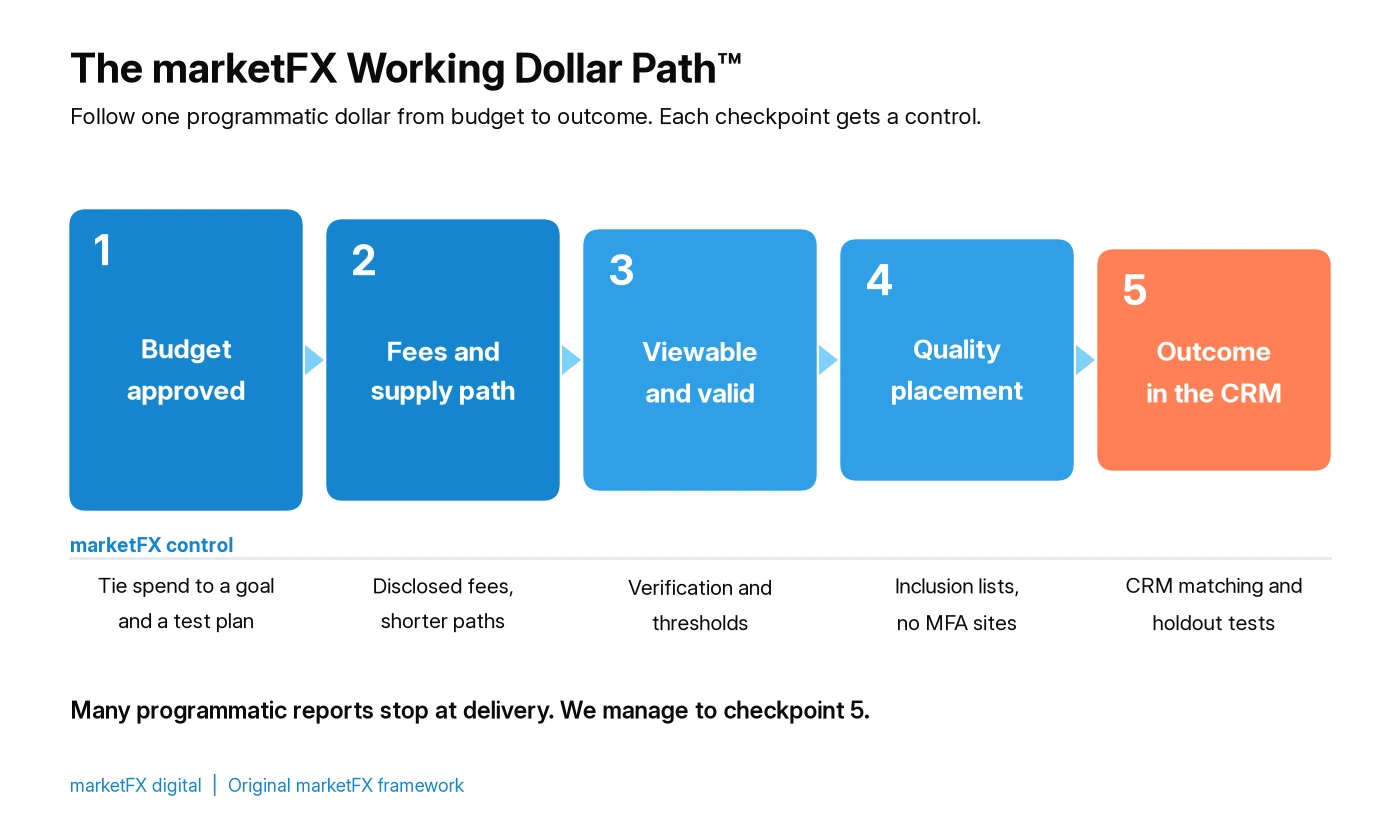
marketFX Working Dollar Path™. Every checkpoint has an owner and a control.
| Checkpoint | What can leak | Our control |
|---|---|---|
| 1. Budget approved | Spend set by last year's plan, not by goal | Budget tied to a business outcome and a test plan before launch |
| 2. Fees and supply path | Layers of platform and reseller fees | Fee transparency, shorter supply paths and private marketplace deals where they earn their price |
| 3. Viewable, valid and measurable | Ads never seen, non-human traffic, impressions nobody can verify | Verification on every buy, viewability and invalid traffic thresholds, exclusions updated weekly |
| 4. Quality placement | Made-for-advertising sites, cluttered pages, unsafe content | Inclusion lists, curated supply and placement reviews before scale |
| 5. Outcome in the CRM | Results judged on clicks or platform-reported conversions | Conversion tracking, CRM matching and holdout tests to show what programmatic actually added |
What the latest data says about programmatic quality
Quality now separates programmatic winners from everyone else. In the ANA's Q4 2025 Programmatic Transparency Benchmark, leading advertisers converted 56.7% of programmatic spend into impressions that met preset quality criteria: fraud-free, measurable, viewable and not made for advertising. Lower performing advertisers converted 37.5%. ANA case studies in the same release showed that optimizing toward quality-adjusted metrics rather than CPM alone cut cost per conversion by nearly 40%, even when nominal CPMs rose (ANA, Q4 2025 Programmatic Transparency Benchmark, February 2026).
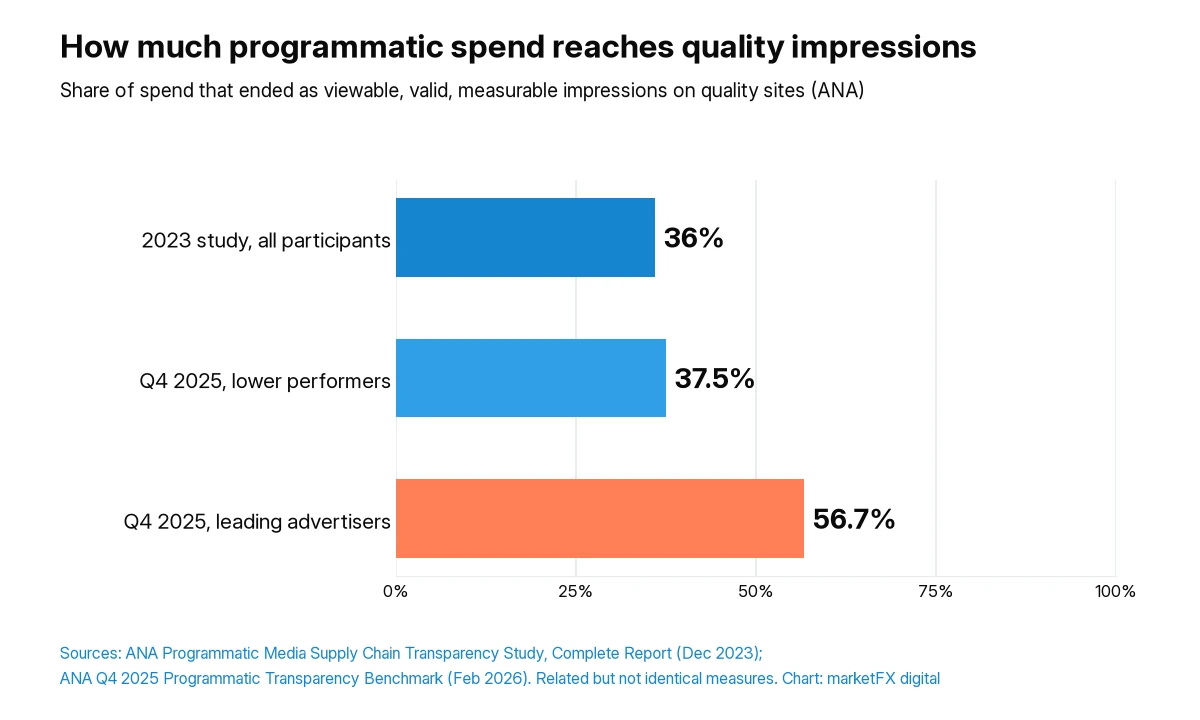
Sources: ANA Programmatic Media Supply Chain Transparency Study, Complete Report (December 2023) and ANA Q4 2025 Programmatic Transparency Benchmark (February 2026). The two studies use related but not identical measures.
| Group | Share of spend | Source |
|---|---|---|
| All participants, 2023 study | 36% | ANA Programmatic Media Supply Chain Transparency Study, 2023 |
| Lower performing advertisers, Q4 2025 | 37.5% | ANA Q4 2025 Programmatic Transparency Benchmark |
| Leading advertisers, Q4 2025 | 56.7% | ANA Q4 2025 Programmatic Transparency Benchmark |
The same benchmark found private marketplaces accounted for more than 92% of median spend, and connected TV made up about 40% of total programmatic spend in Q4 2025. Curation is now the baseline, not the premium option.
Programmatic advertising services we run
Every engagement is scoped to your goals, budget and markets. The core work covers:
- Media planning. Choosing formats and inventory, such as display and online video, by what each needs to do in the funnel, not by what is easiest to buy.
- Audience strategy. First-party audiences and CRM lists first, then contextual and in-market segments, with exclusions for current customers where they waste spend.
- Location-aware targeting. For multi-location and franchise brands, geography set around real trade areas, with budgets and reporting broken out by market.
- Supply curation. Private marketplace deals, inclusion lists and supply path choices that favor quality over the lowest CPM.
- Brand safety and verification. Independent verification, viewability and invalid traffic thresholds, and placement reviews on a set cadence.
- Creative testing. Planned tests on message, format and length with a clear hypothesis, so learnings carry over to search and social.
- Measurement. Conversion tracking, CRM matching and, where the budget supports it, holdout or geo tests to show incremental lift.
Programmatic sits inside the same team that runs our paid media services, SEO, CRM and analytics, so a prospecting audience reached in programmatic can be followed into search, social retargeting and the CRM.
Signal vs Noise™ in programmatic reporting
We report the numbers that change budget decisions. Delivery metrics still matter, but they are diagnostics, not results.
| Decision-grade | Vanity |
|---|---|
| Share of spend reaching viewable, valid, quality placements | Total impressions served |
| Cost per quality impression | Lowest CPM |
| Incremental lift from holdout or geo tests | View-through conversions with long windows |
| CRM-matched leads, sales and revenue by market | Platform-reported conversions alone |
| Fees as a share of media, disclosed | Blended rates with no fee breakdown |
Every programmatic engagement starts with an audit
Before we change anything, we trace your current spend along the Working Dollar Path™. That means reviewing the supply paths and fees you are paying, checking verification data for viewability, invalid traffic and made-for-advertising exposure, reviewing placement reports domain by domain, and testing whether programmatic conversions can be matched to real outcomes in your CRM. The output is a written plan that separates quick fixes, such as exclusions and frequency caps, from structural changes, such as moving to curated supply or rebuilding measurement.
If you already work with an agency, the audit can run independently. Our paid media audit and strategy covers every platform in your current plan and ends with a 90-day reallocation and test roadmap.
How marketFX runs programmatic
We run programmatic as one channel in an integrated plan, alongside our Google Ads and performance marketing work, with shared audiences and one measurement framework. Attribution and incrementality are handled with the same rigor we apply across channels, explained on our marketing attribution page. Across managed paid media portfolios, marketFX reported an average 4.1x ROAS in 2025, and across our client work we report 94% client retention, more than 20 years driving growth and more than $20 million in revenue tracked.
For multi-location and franchise brands, we plan programmatic by market, so each location's trade area gets the right reach and each market's results can be compared fairly.
See how much of your programmatic budget is working
30 minutes. We will look at where your programmatic dollars go and tell you what we would fix first, even if you do not hire us.
FAQs
Programmatic Advertising FAQ
- What does a programmatic advertising agency do?
- A programmatic advertising agency plans and buys automated ad placements across display, video and other open web inventory through demand-side platforms. It manages audiences, supply and brand safety, optimizes bids and creative, and reports results. A good agency also controls fees and quality so more of your budget reaches real people on quality sites.
- How is programmatic different from Google Ads or Meta Ads?
- Google Ads and Meta Ads sell inventory inside their own platforms. Programmatic buys across many publishers and apps through open exchanges and private marketplace deals, which gives more reach and format choice but adds more intermediaries and more quality risk. That is why supply curation, verification and fee transparency matter more in programmatic than in search or social.
- How do you prevent ad fraud and low quality placements?
- We use independent verification on every buy, set thresholds for viewability and invalid traffic, buy mainly through curated supply and inclusion lists, and review placement reports on a set cadence. Made-for-advertising sites and placements that fail quality checks are excluded and the exclusions are updated as new data comes in.
- How much does programmatic advertising management cost?
- Cost depends on media budget, the number of formats and markets, how much creative is needed, and the verification and measurement setup. We scope engagements after the audit and share pricing in writing after a brief scoping call. We disclose platform and data fees so you can see what share of spend goes to working media.
- Is programmatic advertising a good fit for multi-location brands?
- Often, yes. Programmatic can target each location's trade area, run different budgets by market and report results market by market, which suits brands with many locations. It also makes geo holdout tests practical, so you can measure what programmatic adds in some markets against similar markets where it is paused.
- How do you measure programmatic results?
- We match programmatic exposure and conversions to outcomes in your CRM, track quality metrics such as cost per quality impression, and use holdout or geo tests where the budget supports them. Platform-reported view-through conversions are treated as a signal, not as proof that programmatic caused the sale.
Read next
- Paid Media Agency and PPC ManagementHow programmatic fits with search, social and video in one paid media plan.Read more
- Paid Media Audit and StrategyAn independent audit of every paid platform with a 90 day roadmap.Read more
- Marketing Attribution AgencyHow we measure what programmatic actually adds to revenue.Read more