
Server-Side Tracking
Server-Side Tracking Services That Make Your Conversion Data Add Up
Server-side tracking services move your analytics and conversion tracking off the visitor's browser and onto a server you control, then send clean, consented events to GA4, Google Ads, Meta, Microsoft Ads, LinkedIn and your CRM. marketFX sets up server-side tracking as part of one measurement program: a server container on your own subdomain, conversion APIs with deduplication, consent controls and CRM matching, checked against real leads and revenue before anyone trusts the numbers.
Book a Strategy Call See how it starts
Why browser-only tracking undercounts what marketing produces
Most websites still send every analytics and ad platform event straight from the visitor's browser. That setup worked when browsers kept cookies for months and few people blocked scripts. It is much weaker now.
Safari's Intelligent Tracking Prevention deletes cookies created in JavaScript, and other script-writable storage, after seven days without user interaction with the site (WebKit, Tracking Prevention in WebKit). Ad blockers and privacy browsers stop many tags from loading at all. Consent banners, correctly, stop tags from firing for people who decline. And each new pixel slows the page a little more.
The result shows up in three places:
- Ad platforms optimize on partial data. Smart Bidding, Advantage+ and Performance Max learn from the conversions they receive. Missing conversions mean worse bidding.
- Reports disagree with the CRM. GA4, each ad platform and your sales system tell three different stories, so leadership stops trusting any of them.
- Double counting creeps in. When a browser pixel and a server event both report the same purchase without a shared ID, the same sale gets counted twice.
Server-side tracking does not bring back data from people who said no to tracking. It makes the data you are allowed to collect more complete, more accurate and easier to control.
The marketFX Clean Signal Path™
The marketFX Clean Signal Path™ is the five-stage sequence we use to design and check a server-side tracking setup. Every conversion should pass through all five stages before an ad platform or a dashboard uses it.
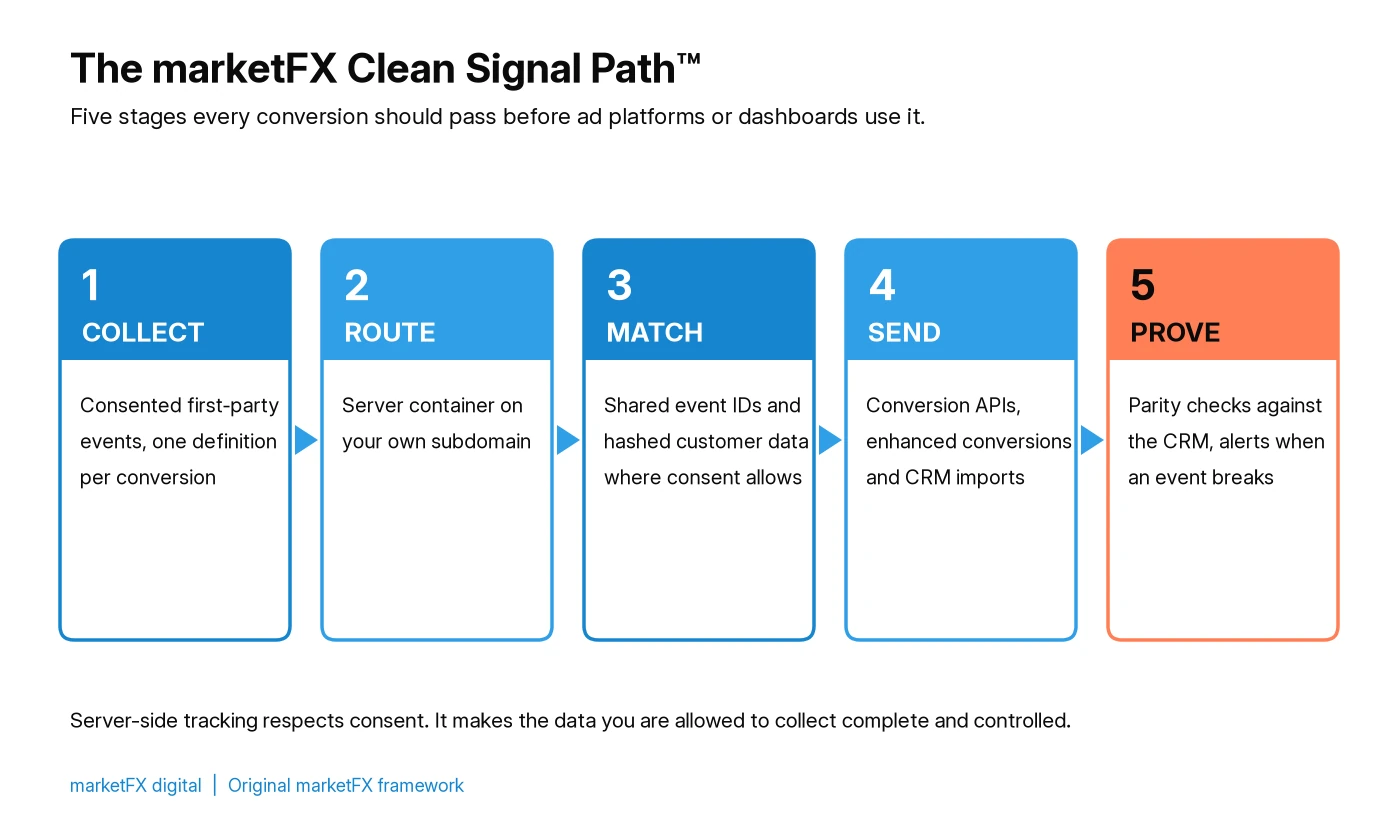
| Stage | What breaks without it | What we put in place |
|---|---|---|
| 1. Collect | Events fire before consent, or conversion definitions differ by platform | A measurement plan with one definition per conversion, and consent mode connected to every tag |
| 2. Route | Dozens of third-party scripts on the page, each blocked or cut short separately | A server-side Google Tag Manager container on your own subdomain, sized to your traffic |
| 3. Match | Platforms cannot tie a conversion to a click, or count it twice | Shared event IDs for deduplication and hashed customer data where consent allows |
| 4. Send | Platforms only see on-site form fills, not qualified leads or revenue | Conversion APIs, enhanced conversions and offline imports of CRM stages |
| 5. Prove | Nobody notices when tracking breaks after a site release | Parity checks against the CRM, before and after volume comparisons and alerts |
Attribution: the marketFX Clean Signal Path™ is an original marketFX framework for measurement design. It is not a vendor ranking.
What changes when tracking moves server-side
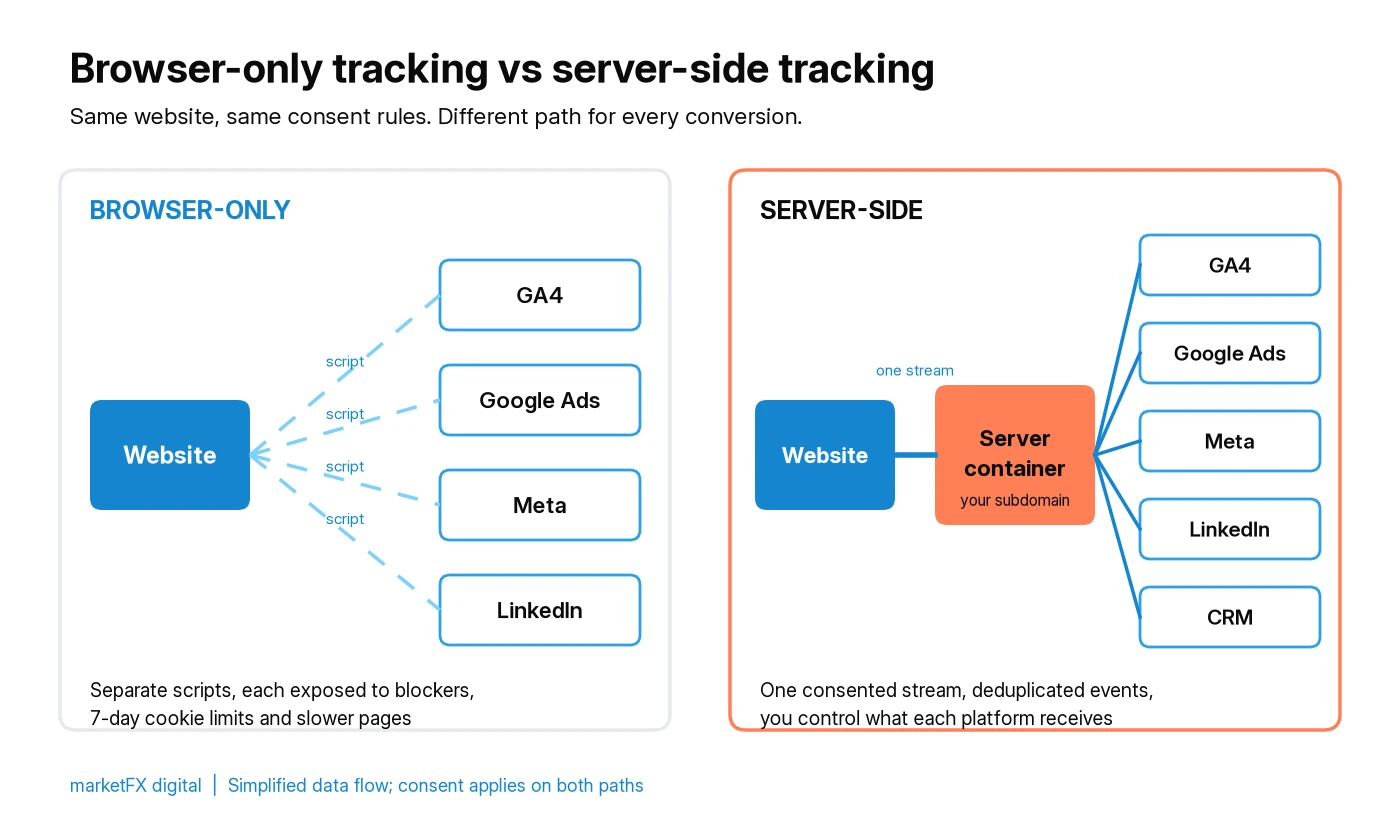
| Area | Browser-only tracking | Server-side tracking |
|---|---|---|
| Where events are sent from | The visitor's browser, one script per platform | Your server container, from one consented stream |
| Cookie lifetime | Script-set cookies can be cut to seven days in Safari | First-party setup on your own subdomain gives more durable measurement within browser rules |
| Data control | Each vendor script collects what it collects | You decide which fields each platform receives |
| Page speed | More tags, more weight | Fewer scripts in the browser |
| Deduplication | Often missing | Shared event IDs across browser and server events |
| CRM outcomes | Rarely sent back to ad platforms | Qualified leads and revenue sent back as offline conversions |
Google describes server-side tagging as a way to improve page performance, add privacy controls and improve data quality using the same tag, trigger and variable model as web containers (Google, Server-side tagging). Meta recommends sending the same event_id from the browser pixel and the Conversions API so duplicate events can be removed (Meta, Deduplicate pixel and server events).
Server-side tracking services we deliver
Every engagement is scoped to your site, platforms and CRM. The core work covers:
- Tracking audit and measurement plan. What is tracked, missing or counted twice today, and one written definition for every conversion that matters.
- Server-side Google Tag Manager. A server container on your own subdomain, hosted on Google Cloud or a managed host, connected to your web container.
- Conversion APIs. Meta Conversions API, Google Ads enhanced conversions, Microsoft Ads enhanced conversions and LinkedIn Conversions API, with deduplication.
- GA4 data quality. Event taxonomy, cross-domain tracking and server-side events so GA4 agrees with the platforms on what counts.
- Consent and privacy. Consent mode connected to every tag, documented data flows and clear rules on what each vendor receives.
- CRM feedback loop. Qualified leads, booked calls and closed revenue sent back to ad platforms as offline conversions, so bidding learns from outcomes rather than form fills.
- QA and monitoring. Before and after volume checks across browsers, parity checks against the CRM and alerts when a site release breaks an event.
For multi-location and franchise brands, events carry the location they belong to, so leads, calls and bookings can be reported market by market. See our multi-location and franchise marketing approach.
Signal vs Noise™ in tracking reports
We judge a tracking setup by whether it changes budget decisions, not by how many tags it fires.
| Decision-grade | Vanity |
|---|---|
| Share of CRM leads and sales matched to a marketing source | Number of tags installed |
| Platform conversions within an agreed tolerance of CRM records | Platform-reported conversions alone |
| Duplicate rate after deduplication | Raw event counts |
| Cost per qualified lead and revenue by channel | Cost per form fill |
| Time to detect and fix a broken event | "Tracking is installed" |
Every server-side tracking engagement starts with an audit
Before we build anything, we map your current tracking along the Clean Signal Path™. That means reviewing every tag, pixel and conversion action, checking how consent is applied, testing whether platform conversions match leads and sales in your CRM, and finding where events are missing or counted twice. The output is a written measurement plan and a build sequence that separates quick fixes, such as broken conversion actions and duplicate tags, from structural work, such as the server container and CRM imports.
If you want a wider review first, our marketing analytics consulting covers GA4, conversion tracking, dashboards and attribution together, and can hand off to your team or lead implementation.
How marketFX runs server-side tracking
Tracking is not a side project for us. It is the foundation every channel depends on, so it sits inside the same team that runs our paid media services, SEO, CRM and analytics. Clean signals feed Google Ads and Meta Ads bidding, and the same data supports our marketing attribution work. Across managed paid media portfolios, marketFX reported an average 4.1x ROAS in 2025, and across our client work we report 94% client retention, more than 20 years driving growth and more than $20 million in revenue tracked.
Find out what your tracking is missing
30 minutes. We will look at how your conversions reach GA4, your ad platforms and your CRM, and tell you what we would fix first, even if you do not hire us.
FAQs
Server-Side Tracking FAQ
- What are server-side tracking services?
- Server-side tracking services set up and maintain a tracking system that sends analytics and conversion events from a server you control instead of directly from each visitor's browser. The work usually includes a server-side Google Tag Manager container, conversion APIs for ad platforms, deduplication, consent controls, CRM connections and ongoing monitoring.
- Is server-side tracking worth it?
- It is usually worth it if you spend meaningfully on paid media, rely on automated bidding or see large gaps between platform conversions and your CRM. Better conversion data helps bidding and reporting. Very small sites with one channel and simple goals may get more from fixing basic conversion tracking first.
- Does server-side tracking get around consent or privacy rules?
- No. Server-side tracking should respect the same consent choices as browser tracking. Done properly, it gives you more control, because you decide exactly which data each vendor receives. We connect consent mode to every tag and document the data flows so your legal and privacy teams can review them.
- What is the difference between server-side tracking and a conversion API?
- Server-side tracking is the overall setup: events go from your site to a server container, which forwards them to each platform. A conversion API, such as the Meta Conversions API, is one platform's way of receiving those server events. Most server-side setups send to several conversion APIs plus GA4.
- How long does a server-side tracking setup take?
- It depends on how many platforms, conversion types and systems are involved, and how clean the current setup is. A focused setup for a few platforms moves faster than one that includes CRM imports, several domains or many locations. We give you a build sequence and timeline after the audit.
- How much do server-side tracking services cost?
- Cost depends on site complexity, the number of platforms and conversions, hosting needs, CRM integration and whether you want ongoing monitoring. Hosting for the server container is a separate running cost based on traffic. We scope engagements after the audit and share pricing in writing after a brief scoping call.
- Will server-side tracking fix my attribution?
- It fixes the data attribution depends on, which is the first step. Cleaner, deduplicated conversions with CRM outcomes make every attribution model more reliable. Deciding how credit is shared across channels, and testing what each channel adds, is the next step, covered by our marketing attribution work.
Read next
- Marketing Analytics ConsultingThe wider GA4, tracking and dashboard review this work sits inside.Read more
- Marketing Attribution AgencyHow clean conversion data feeds attribution and incrementality.Read more
- Paid Media Agency and PPC ManagementThe paid media programs that bid on these conversion signals.Read more