
Social Media Management
Social Media Management Agency for Multi-Location and Growth Brands
A social media management agency plans, creates, publishes and manages your brand's social channels so that posts, comments and reviews turn into attention, trust and customers you can see in your CRM. marketFX runs social media management for multi-location, franchise and growth brands inside one integrated team: platform strategy, content calendars, brand and location pages, community and reputation management, influencer and ambassador programs, social listening and paid and organic social working together.
Book a Strategy Call See how it starts
Why social media is hard to manage at scale
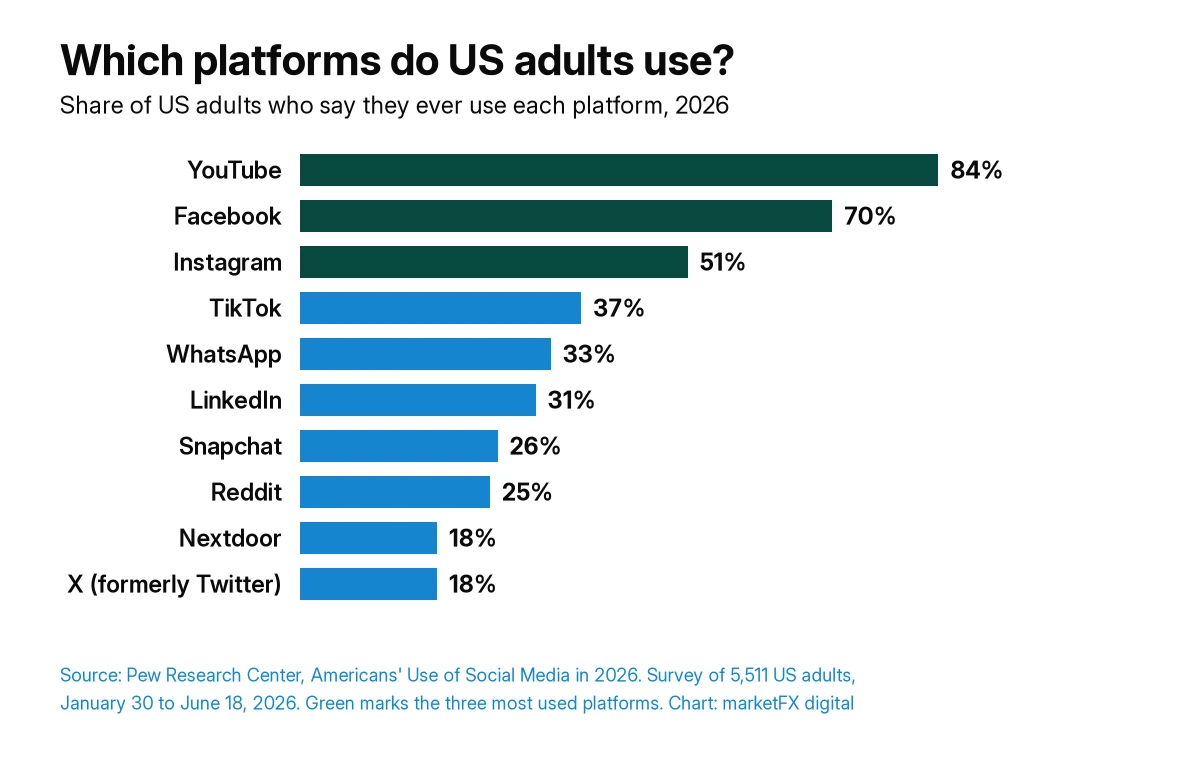
Social is where most of your customers already spend time. In Pew Research Center's 2026 survey, 84% of US adults said they use YouTube, 70% use Facebook and 51% use Instagram, with TikTok at 37% and LinkedIn at 31% (Pew Research Center, Americans' Use of Social Media in 2026). Every one of those platforms has its own formats, its own audience and its own pace, and multi-location brands have to show up on them as one brand and as every local business at the same time.
Most social programs go wrong in one of three ways:
- Posting without a role for each platform. The same post goes everywhere, so it fits nowhere, and nobody can say what each channel is supposed to do for the business.
- Local pages left to chance. Some locations post every day, others have not posted in a year, and the brand looks different in every market.
- Reports that stop at likes. Follower counts and engagement go up while nobody checks whether social is bringing in visits, leads or bookings.
| Platform | US adults who use it | Ages 18 to 29 | Ages 50 to 64 |
|---|---|---|---|
| YouTube | 84% | 95% | 85% |
| 70% | 69% | 71% | |
| 51% | 79% | 41% | |
| TikTok | 37% | 65% | 31% |
| 33% | 37% | 36% | |
| 31% | 41% | 32% | |
| Snapchat | 26% | 56% | 13% |
| 25% | 40% | 18% | |
| Nextdoor | 18% | 10% | 19% |
| X (formerly Twitter) | 18% | 31% | 17% |
Source: Pew Research Center survey of 5,511 US adults, January 30 to June 18, 2026.
The age split matters as much as the totals. Facebook reaches adults of every age almost evenly, while Instagram, TikTok and Snapchat skew sharply younger. Choosing platforms by who your customers are, not by what is popular, is the first decision in any social program.
The marketFX Social Signal Loop™
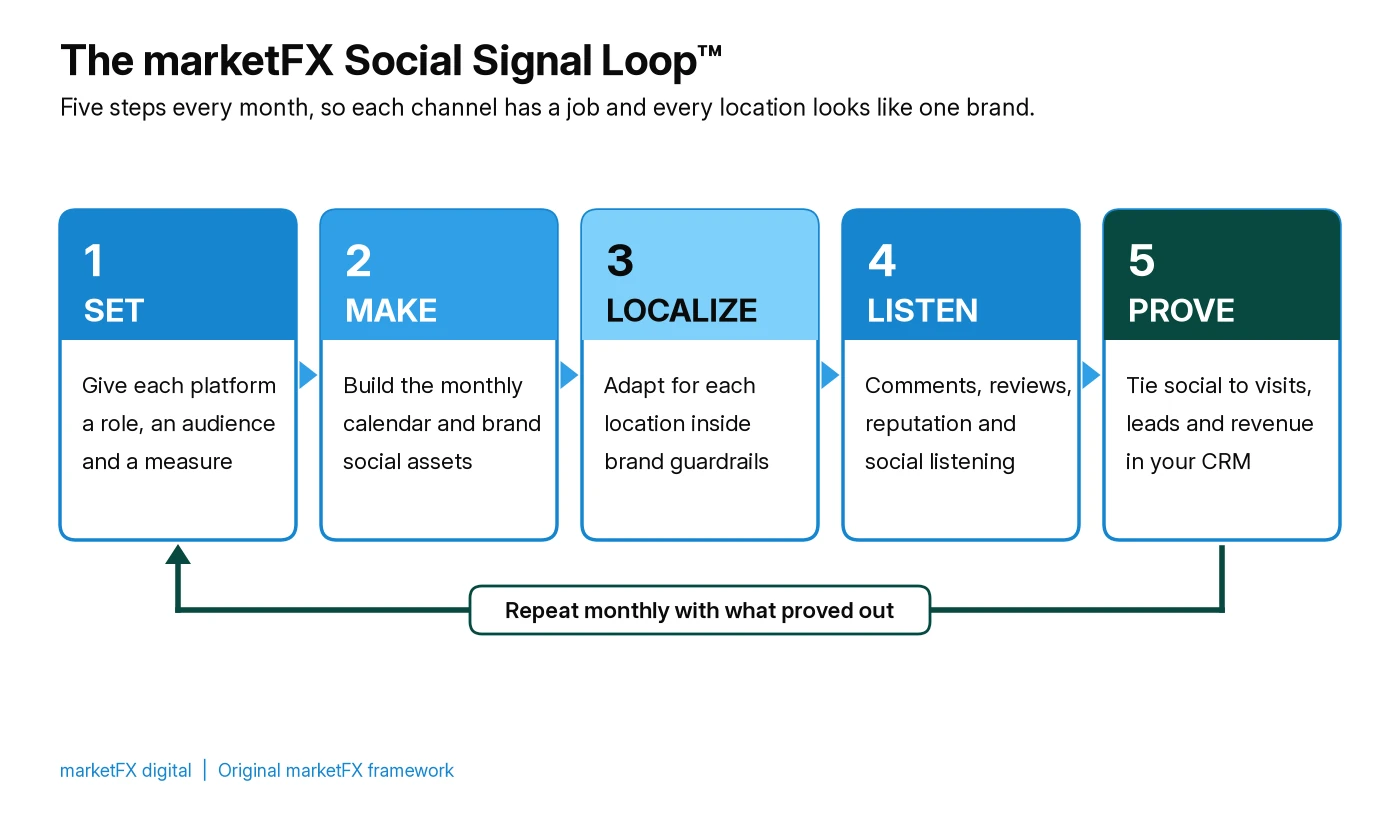
The marketFX Social Signal Loop™ is the five-step method we use to run social media so that every channel has a job, every location looks like the same brand and every month ends with evidence of what social did for the business. The loop repeats each month, and each turn uses what the last one proved.
| Step | What goes wrong without it | What we put in place |
|---|---|---|
| 1. Set | The same post on every platform and no idea what each channel is for | A role, an audience and a measure for each platform, based on where your customers are and what each channel does best |
| 2. Make | Last-minute posting and a feed that looks different every week | A monthly content calendar, content pillars and brand-aligned social assets planned ahead and approved in one pass |
| 3. Localize | Some locations active, others silent, and off-brand local posts | Brand templates and local content plans for each location, with clear guardrails and approvals |
| 4. Listen | Unanswered comments, slow replies to reviews and missed conversations | Community engagement, review responses, reputation monitoring and social listening across your brand and competitors |
| 5. Prove | Reports that stop at likes and follower counts | Tracking from social to site visits, leads and bookings in your CRM, reported next to engagement rather than replaced by it |
Attribution: the marketFX Social Signal Loop™ is an original marketFX framework for social media management. It is not a vendor ranking.
Social media management services we deliver
Every engagement is scoped to your goals, platforms and number of locations. The core work covers:
- Platform strategy. Which platforms to use, the job each one does, the audience it reaches and how success is measured.
- Content calendars and assets. Monthly calendars, content pillars, captions and brand-aligned social assets, including short-form video concepts and scripts.
- Brand and location pages. Consistent profiles, templates and local content plans for each location, so every page looks like the same brand.
- Community and reputation management. Replies to comments and messages, review responses and monitoring, with an escalation path for anything sensitive.
- Influencer and ambassador programs. Finding, briefing and managing creators, employees and local ambassadors who can speak for the brand.
- Social listening and competitive benchmarking. What people say about your brand, your category and your competitors, and what that means for content and service.
- Paid and organic alignment. Organic posts that prove a message become paid ads, and paid audiences inform what organic content to make next.
Paid social runs through the same team that runs your Meta Ads, LinkedIn Ads and content strategy, so organic and paid social are planned as one program.
Which platforms should your brand be on?
Be on the platforms where your customers already spend time and where your content can do a clear job, not on every platform. A smaller set of channels run well beats a long list run thinly.
| Platform | Typical role | Best fit |
|---|---|---|
| Local community, events, reviews and offers for each location | Local and multi-location brands reaching adults of every age | |
| Visual brand building, Reels and creator content | Consumer, retail, hospitality and lifestyle brands | |
| TikTok | Short-form video reach with younger audiences | Brands with products or services that show well on camera |
| Thought leadership, hiring and B2B relationships | B2B companies, franchise development and recruiting | |
| YouTube | Longer video, how-to content and search on YouTube itself | Brands with explainable products and services |
| Nextdoor | Neighborhood presence and recommendations | Home services and local businesses |
Your Google Business Profile is not a social network, but for local brands it does similar work: posts, photos, questions and reviews that nearby customers see before they visit. We manage it alongside your local social pages so the two tell the same story.
Social media management for franchise and multi-location brands
Franchise and multi-location brands need social at two levels: a brand voice that stays consistent everywhere, and local pages that feel like the business down the street. Most problems come from the gap between them, either a brand that controls everything and sounds generic locally, or locations that post freely and drift off brand.
We close that gap with a hub and local model. The brand team owns strategy, guidelines, templates and the core calendar. Each location gets a local content plan, local photos and events, and fast replies to its own community and reviews. Approvals are set up front, so locations know what they can post and the brand knows nothing off brand goes live. Results are reported by location and rolled up for the brand, which shows where social is working and where a location needs help. This is part of our wider multi-location and franchise marketing work.
Signal vs Noise™ in social media reporting
We judge social by what it changes in the business, not by how busy the feed looks.
| Decision-grade | Vanity |
|---|---|
| Site visits, leads and bookings from social, tracked into the CRM | Follower count |
| Review volume, rating and response time by location | Likes on individual posts |
| Branded search and direct traffic in markets where social is active | Impressions without context |
| Response time to comments and messages | Posting frequency alone |
| Organic posts that become winning paid ads | Engagement rate without business outcomes |
Every social engagement starts with an audit
Before we change anything, we review your current social presence along the Social Signal Loop™. That means checking which platforms you are on and what each one is doing, how brand and location pages look, how often you post and what performs, how fast comments, messages and reviews get a reply, what people say about you and your competitors, and whether any of it is tracked to visits and leads. The output is a written plan that says which platforms to focus on, what each one should do, how locations will be handled and how success will be measured.
If you want a wider review first, our marketing audit services cover social alongside search, paid media and tracking.
How marketFX runs social media management
Social is not a separate silo for us. It sits inside the same team that runs search, paid media, content, CRM and analytics, so social builds the demand that search captures, the best organic posts become paid ads, followers are followed up through CRM and automation, and reporting connects social to revenue. Across our client work we report 94% client retention, more than 20 years driving growth and more than $20 million in revenue tracked.
Find out what social could do for your brand
30 minutes. We will look at your current social channels, your locations and your reporting, and tell you what we would change first, even if you do not hire us.
FAQs
Social Media Management Agency FAQ
- What does a social media management agency do?
- A social media management agency plans, creates, publishes and manages a brand's social channels. The work usually covers platform strategy, content calendars, content creation, community management, review responses, social listening and reporting. A good agency ties results to visits, leads and revenue, not only to followers and likes.
- What is the difference between social media management and social media marketing?
- Social media management usually means running your organic channels: planning content, posting, replying to comments and monitoring what people say. Social media marketing is broader and includes paid social advertising, influencer programs and campaigns. We run both as one program, so organic content and paid ads support each other.
- How much does a social media management agency cost?
- Cost depends on the number of platforms, the number of locations, how much content is needed and whether paid social and community management are included. We scope the work after an audit and share pricing in writing after a brief scoping call, so you pay for what your brand needs rather than a fixed package.
- How do you manage social media for franchise and multi-location brands?
- We use a hub and local model. The brand team owns strategy, guidelines, templates and the core calendar. Each location gets a local content plan, local photos and events, and fast replies to its own community and reviews, inside clear approval rules. Results are reported by location and rolled up for the brand.
- Which social media platforms should my business be on?
- Be on the platforms where your customers spend time and where your content can do a clear job. Pew Research Center's 2026 data shows Facebook reaches adults of every age almost evenly, while Instagram, TikTok and Snapchat skew younger and LinkedIn reaches professionals. A few channels run well usually beat many run thinly.
- Do you create the content or do we?
- We plan the calendar, write captions and produce brand-aligned social assets, including short-form video concepts and scripts. Many brands also have photos, footage or team members who can appear on camera, and we build that into the plan. Locations can add local photos and events inside the brand guidelines.
- How do you measure social media results?
- We track visits, leads and bookings from social into your CRM, review volume and response times by location, and branded search in markets where social is active. Engagement and reach are reported too, but they sit next to business results rather than replacing them.