
AI Enablement Services: What to Buy and How to Compare
What AI enablement services include for marketing teams, how to place your team on a maturity model, audit vs build, and how to compare providers.
Quick Answer
AI enablement services help marketing teams move from ad-hoc AI tool use to shared workflows, reliable data, governance and measured business outcomes. A complete engagement usually includes a readiness audit, a prioritized roadmap, workflow builds, training and handover, governance, and outcome measurement. Use a maturity model such as the marketFX AI Enablement Ladder™ to decide what to buy first.
Most marketing teams already use AI. Far fewer have redesigned the work around it. McKinsey's latest global survey finds that 88% of respondents say their organizations regularly use AI in at least one business function, yet nearly two-thirds say they have not yet begun scaling AI across the enterprise (McKinsey). Stanford HAI's 2025 AI Index, summarizing earlier McKinsey survey waves, reports that generative AI use in at least one business function jumped from 33% in 2023 to 71% in 2024 (Stanford HAI). Tools spread fast. Shared workflows, data access, governance and outcome measurement do not.
That gap is what AI enablement services are built to close. Demand for outside help shows up in search too. US searches for "ai enablement" average about 880 a month, with related commercial queries for services, consulting, readiness audits and fractional AI leadership sitting under that head term (Semrush, US, Oct 2026, cached). This guide covers what AI enablement services should include for marketing teams, how to place your team on a maturity model, how readiness work differs from implementation and training, and how to compare providers. It links to our AI Enablement Ladder™ when you want the full stage definitions.
What Are AI Enablement Services?
AI enablement services are the strategy and hands-on work that help a marketing team adopt AI in a way that sticks: shared workflows, reliable data, governance and measured business outcomes. The product is not a software license. It is a change in how the team works.
Enablement sits between buying another tool and hiring a full-time AI lead. A provider audits how the team uses AI today, picks the few uses worth funding, builds the operating pieces (prompts, procedures, integrations, training), and leaves measurement and ownership with you. Titles vary. You will see the same work sold as AI enablement consulting, AI adoption consulting, AI readiness assessment services, or a fractional chief AI officer. Judge the offer on deliverables and on who does the work after the kickoff call.
This is different from hiring an AI marketing consultant. A consultant engagement is usually advice-led: diagnosis, plan, governance and coaching. AI enablement services are delivery-led: the engagement is expected to leave working workflows, documented handovers and a measurement baseline behind. Many providers do both. The distinction still matters when you compare scopes.
It is also different from buying AI for search visibility. GEO, AEO and AI search optimization help AI engines cite your brand. Enablement helps your team use AI inside its own marketing work. Both can matter. They solve different problems. For how AI changes marketing practice more broadly, see AI in Marketing: What Actually Changes.
What Should AI Enablement Services Include?
A complete AI enablement engagement for a marketing team usually covers six parts: a readiness audit, a prioritized roadmap, workflow builds, training and handover, governance, and outcome measurement. Smaller scopes can cover fewer parts, as long as the proposal says which ones and why.
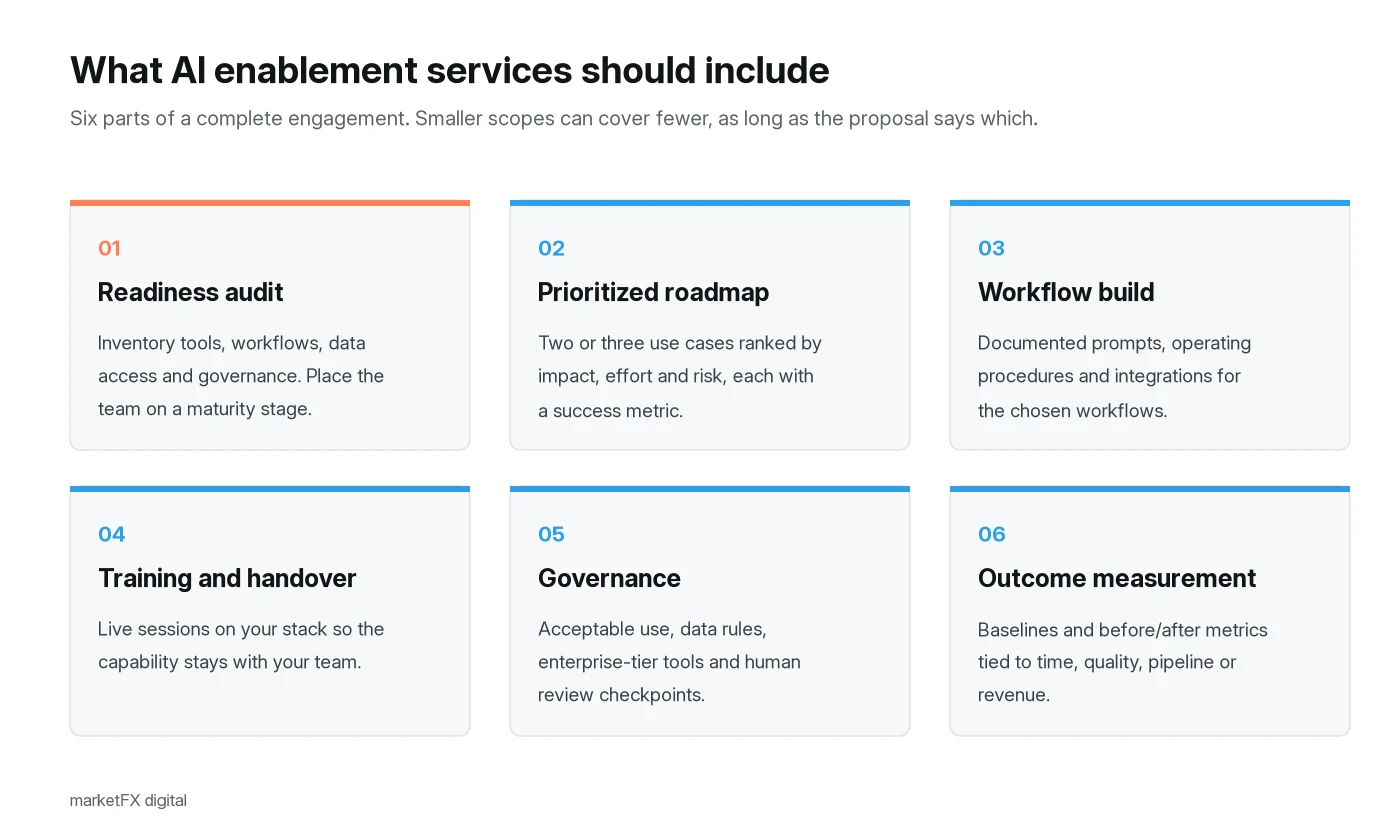
Six parts of a complete AI enablement engagement. Smaller scopes can cover fewer, as long as the proposal says which.
| Part | What you get | Why it matters |
|---|---|---|
| Readiness audit | Inventory of tools, workflows, data access and governance, plus a named maturity stage | Stops you buying Stage 3 work when you are still at Stage 1 |
| Prioritized roadmap | Two or three use cases ranked by impact, effort and risk, each with a success metric | A list of 40 opportunities with no ranking is not a plan |
| Workflow build | Documented prompts, operating procedures and integrations for the chosen workflows | Enablement without a working workflow is just a slide deck |
| Training and handover | Live sessions on your stack so the team can run the system | Capability should stay with you after the provider leaves |
| Governance | Acceptable use policy, data rules, enterprise-tier tools and human review checkpoints | Protects the brand while the team scales |
| Outcome measurement | Baselines and before/after metrics tied to time, quality, pipeline or revenue | Activity metrics (prompts, tokens, tools) are inputs, not proof |
If a proposal leads with a tool recommendation and skips the audit and the success metric, ask for a rewrite. Tool choice belongs after the workflow and the data picture are clear.
How Do You Place Your Team on an AI Maturity Model?
Place your team on a maturity model by judging shared workflows, data access, governance and measured outcomes, not by counting how many AI tools people have tried. The marketFX AI Enablement Ladder™ uses four stages: Stage 1 Experimentation, Stage 2 Adoption, Stage 3 Integration and Stage 4 Optimisation.
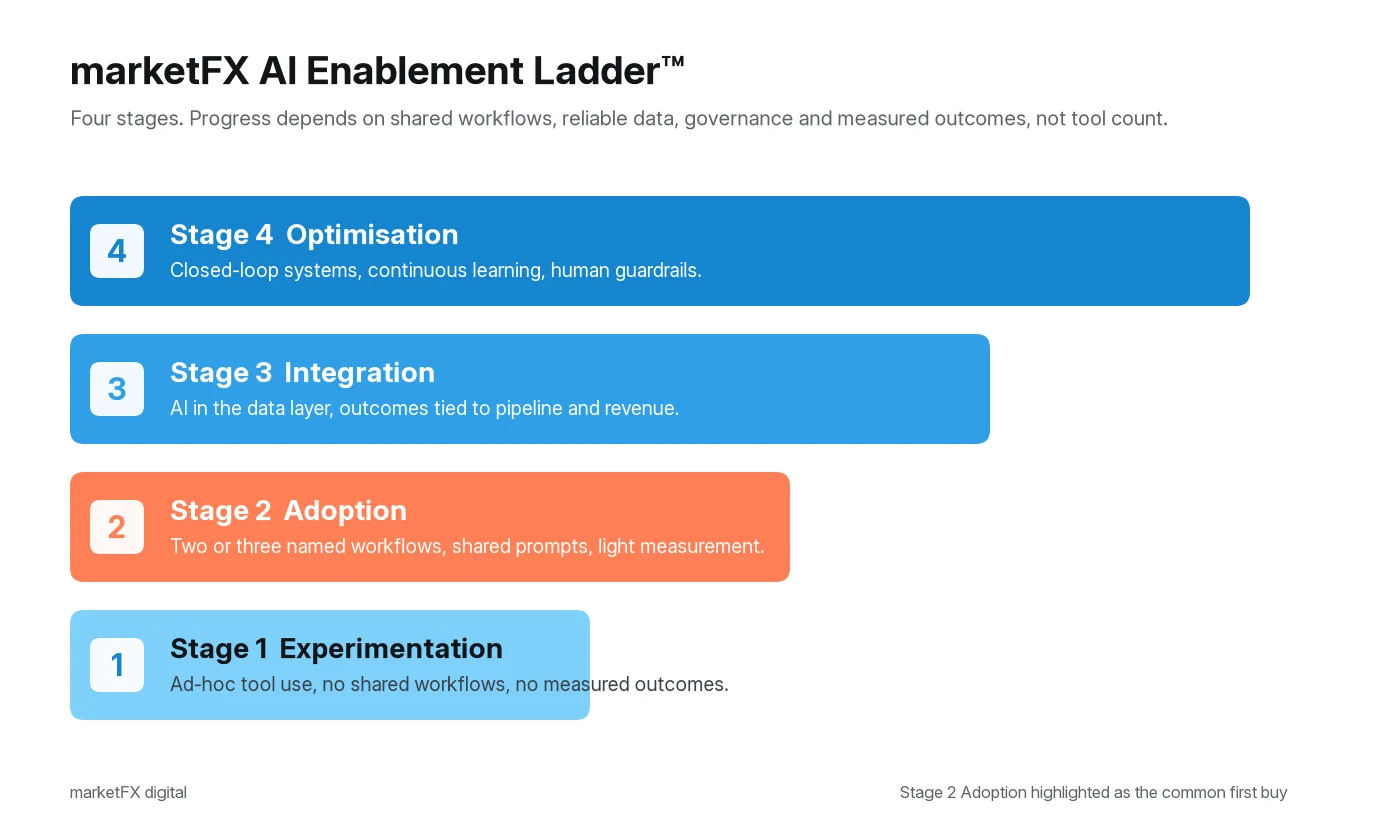
The marketFX AI Enablement Ladder™. Progress depends on shared workflows, reliable data, governance and measured outcomes, not tool count.
| Stage | What it looks like | What to buy first |
|---|---|---|
| Stage 1 Experimentation | Ad-hoc tool use across the team, no shared workflows, no measured outcomes | Readiness audit, acceptable use policy, one workflow to standardize |
| Stage 2 Adoption | Two or three named workflows, shared prompt library, light measurement | Before/after proof on those workflows, training, roadmap for what integrates next |
| Stage 3 Integration | AI in the data layer, outputs feeding bidding, segmentation or personalization, business KPIs | Integration and build work, not another prompt workshop |
| Stage 4 Optimisation | Closed-loop systems, continuous learning, humans set direction and guardrails | Governance, model reviews and evaluation of new capabilities against the stack |
Buying for the wrong stage is the fastest way to waste the budget. A Stage 1 team that buys a custom model build usually gets a project that never ships. A Stage 3 team that buys another prompt workshop usually already knows how to write prompts. Match the scope to the rung you are on, then to the rung you need next.
McKinsey's finding that high performers redesign workflows, rather than layering tools on top of broken processes, is the practical test (McKinsey). If the proposal does not change how work moves through the team, it is unlikely to change results.
Which AI Enablement Keywords Are Buyers Searching?
Buyers use several labels for the same job. The commercial cluster around AI enablement is smaller than the head term, but it is more specific about wanting outside help.
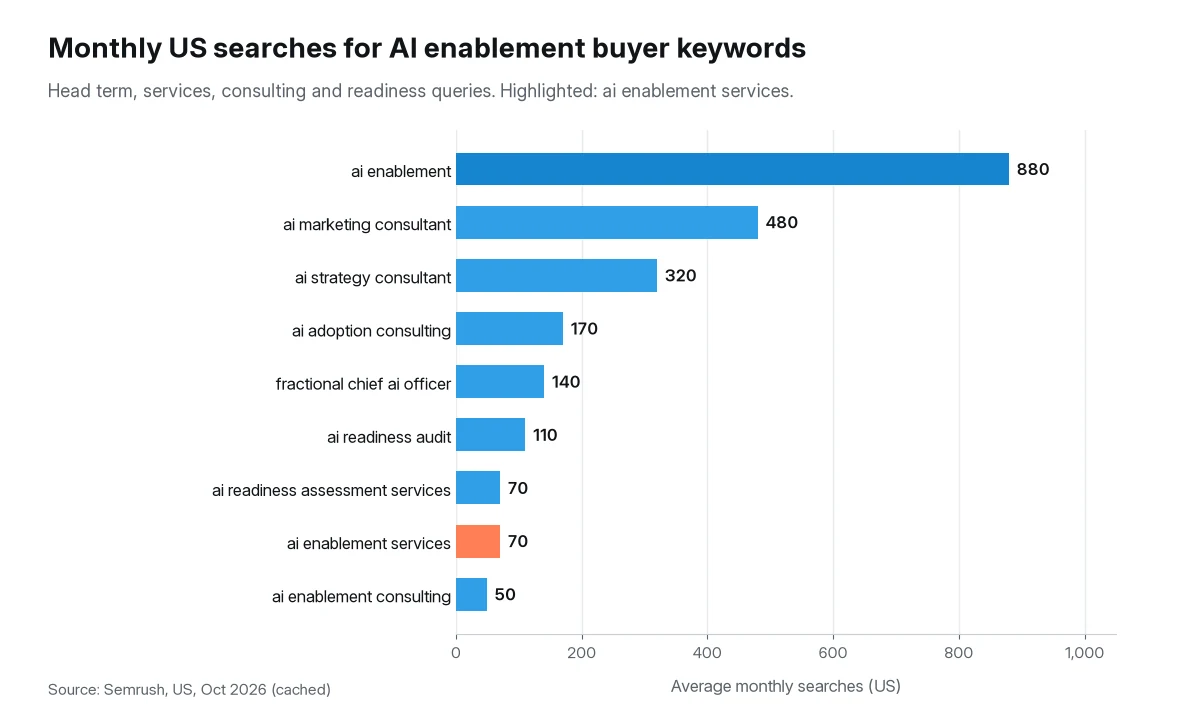
Monthly US searches for AI enablement buyer keywords. Source: Semrush, US, Oct 2026 (cached).
| Search term | US monthly searches | What buyers usually mean |
|---|---|---|
| ai enablement | 880 | Head term: moving a team from experiments to lasting capability |
| ai marketing consultant | 480 | Advice-led help for marketing AI decisions (separate post) |
| ai strategy consultant | 320 | Prioritization and plan, often before build work |
| ai adoption consulting | 170 | Getting people and workflows to use AI consistently |
| fractional chief ai officer | 140 | Part-time senior AI leadership inside the org |
| ai readiness audit | 110 | Fixed-scope diagnosis of stage, gaps and next investments |
| ai enablement services | 70 | Delivery-led enablement for a team or function |
| ai readiness assessment services | 70 | Assessment product, often the front door to a larger engagement |
| ai enablement consulting | 50 | Consulting-led version of the same work |
A related harder term, "ai readiness assessment," averages about 1,600 US searches a month with much higher difficulty (Semrush, US, Oct 2026, cached). It is useful context, not the primary target of this guide. "AI marketing consultant" already has its own post; this article links there instead of competing with it.
What Is the Difference Between a Readiness Audit, Implementation and Training?
A readiness audit diagnoses where you are and what to do next. Implementation builds the workflows and integrations. Training and handover make sure your team can run what was built. Most strong enablement programs use all three in sequence. Buying only one of them is fine when that is the real gap.
| Engagement type | Main output | Best when | Watch for |
|---|---|---|---|
| Readiness audit / assessment | Stage diagnosis, prioritized projects, written plan | You need a clear first investment before committing to a build | Findings with no owners, order or success metrics |
| Implementation / workflow build | Working workflows, integrations, documentation | The audit already named the one or two projects to ship | Build work with no handover or measurement |
| Training and handover | Live sessions, playbooks, shared prompt libraries | Systems exist but only a few people can run them | Generic tool demos disconnected from your stack |
| Ongoing enablement retainer | Roadmap execution, reviews, continuous improvement | Pilots worked and you want Stage 3+ progress | Vague monthly hours with no stage targets |
Public service pages in this category often sell a short diagnostic first, then a build module, then ongoing support. That pattern matches how teams actually climb: diagnose, prove one workflow, then scale. An AI readiness audit is usually the cheapest way to avoid funding the wrong thing.
How Do AI Enablement Services Differ From an AI Marketing Consultant?
AI enablement services are scoped to leave working capability inside the marketing team. An AI marketing consultant is scoped to leave a clear plan, governance and coaching, with less assumption that the same person builds every workflow. Overlap is common. The buying question is whether you need advice, delivery, or both.
| Factor | AI enablement services | AI marketing consultant |
|---|---|---|
| Primary output | Working workflows, training and measurement | Diagnosis, prioritized plan and coaching |
| Best when | You know you need hands-on build and handover | You need to decide what to fund first |
| Typical risk | Paying for execution before the stage diagnosis is right | A strong plan that nobody implements |
| Ownership after | Your team runs the shipped workflows | Your team still needs builders for Stage 3 work |
If your gap is senior marketing leadership rather than AI specifically, a fractional CMO may be the better first hire. If your gap is AI search visibility rather than internal enablement, start with GEO or AI search work instead. For the consultant buying path in detail, use our guide to an AI marketing consultant.
How Much Do AI Enablement Services Cost?
AI enablement services are usually sold as a fixed-fee readiness audit, a scoped pilot or build, an ongoing enablement retainer, or fractional AI leadership time. Cost depends on your current stage, how many workflows are in scope, how much integration work is required, and whether training and governance are included.
Public agency pages in this category often price a short assessment as a one-time project, a workflow build as a fixed module, and ongoing support as a monthly retainer. Exact numbers vary widely by scope and seniority, so treat any figure you see online as a starting band, not a quote. Ask every provider to price the same scope: the same stage diagnosis, the same number of workflows, the same training hours and the same measurement plan.
Compare proposals on what you will own at the end: the audit document, prompt libraries, operating procedures, tool accounts, baselines and training recordings. A low monthly fee that only holds workshops is a different product from a pilot that ships one measured workflow.
How Do You Compare AI Enablement Providers?
Compare AI enablement providers by asking them to show their method on your team, not by their label or their tool logos. A strong provider places you on a maturity model, names two or three projects worth funding, explains what it will build versus what it will advise, and refuses to guarantee a revenue percentage before seeing your data and workflows.
Questions worth asking in the first call:
- How do you assess our current stage, and what do we get in writing? Look for a fixed-scope audit with a named stage and a prioritized plan.
- Which business metric will each recommendation move? If the answer is "productivity" with no baseline, push for specifics.
- What will you build, and what will you only advise? Enablement without a handover plan creates dependency.
- How do you handle our customer and proprietary data? Expect enterprise-tier tools, data processing agreements, and scoped access.
- Are you tied to any software vendor? Tool-agnostic advice is worth more than a reseller margin.
- Who does the work after the sale? Ask whether the senior person on the call stays on the engagement.
- What won't you promise? No one can guarantee a percentage lift before seeing your workflows and data.
Walk away from tool-first pitches, activity-only metrics, missing governance, and guarantees that ignore your stage. For how marketFX packages AI work across enablement, GEO, paid media, content and analytics, see our AI marketing agency page.
How marketFX Approaches AI Enablement
We use the AI Enablement Ladder™ inside client work so leadership can answer two questions: where are we today, and what should we fund next? Progress is judged on shared workflows, reliable data, governance and measured outcomes, not on how many tools are installed.
The engagement shape on our AI marketing services page is deliberate. An AI Readiness Audit runs about two weeks at a fixed fee and identifies your current Ladder stage and the top three leverage projects. An AI Pilot then runs for 60 to 90 days on a single workstream, with a measurement framework and internal documentation. Only when a pilot proves its value does a 6 to 12 month AI Enablement Engagement make sense. Audit fees apply to a continued engagement. We do not sell recurring discovery.
Across our work we report 94% client retention, more than 20 years driving growth, and more than $20 million in revenue tracked for clients. If you want a second opinion on your stage before buying anything, book a strategy call. We will tell you which rung you are on and what the next one or two investments should be, even if you do not hire us.
Related services
FAQs
Frequently Asked Questions
- What are AI enablement services?
- AI enablement services help a marketing team move from ad-hoc AI tool use to shared workflows, reliable data, governance and measured business outcomes. A complete engagement usually includes a readiness audit, a prioritized roadmap, workflow builds, training and handover, governance, and outcome measurement. The goal is capability that stays with your team, not a temporary demo.
- How long do AI enablement services take?
- A readiness audit often runs about two weeks. A single-workflow pilot commonly runs 60 to 90 days. Broader enablement that moves a team toward integration usually takes several months, because workflows, data access and measurement have to change together. Agree on leading indicators for the first phase so nobody judges the work only on month-one revenue.
- How much do AI enablement services cost?
- Cost depends on your current maturity stage, how many workflows are in scope, how much integration is required, and whether training and governance are included. Providers usually sell a fixed-fee audit, a scoped pilot or build, an ongoing retainer, or fractional leadership time. Ask every provider to price the same scope so proposals are comparable.
- What is the difference between Stage 1 Experimentation and Stage 2 Adoption?
- Stage 1 Experimentation is ad-hoc tool use with no shared workflows or measured outcomes. Stage 2 Adoption means AI is formally embedded in two or three named workflows, with shared prompts, light measurement and basic governance. The jump from Stage 1 to Stage 2 is usually the highest-value early buy: standardize one high-cost workflow and prove the before/after result.
- How are AI enablement services different from an AI marketing consultant?
- Enablement services are delivery-led: they are expected to leave working workflows, documentation and training behind. An AI marketing consultant is usually advice-led: diagnosis, plan, governance and coaching. Many providers offer both. Choose based on whether your next gap is deciding what to fund, or shipping and handing over the work.
- Do we need more AI tools to get started with enablement?
- Usually no. Most Stage 1 and Stage 2 gains come from standardizing workflows, prompts, governance and measurement on tools the team already uses. Buying another platform before the workflow and data picture are clear is a common way to stall. Tool decisions belong after the readiness audit, not before it.
- What should an AI readiness audit include?
- A useful AI readiness audit inventories current tools and workflows, reviews data access and governance, places the team on a maturity stage, and returns a short prioritized list of projects with success metrics and owners. If the deliverable is only a slide deck of tool recommendations, it is not an audit.