
Fractional CMO vs Marketing Agency: Which One Do You Need?
Fractional CMO vs marketing agency: who owns decisions vs delivery, when to hire each first, how they work together, and how to find your gap.
Quick Answer
A fractional CMO is a part-time senior leader who decides strategy, budget, KPIs and which vendors do what. A marketing agency delivers the channel work: paid media, SEO, content, CRM and analytics. Hire a fractional CMO first when nobody owns marketing decisions. Hire an agency first when strategy is clear and you need execution capacity. Many companies use both, with the CMO directing the agency.
Most companies that ask this question already spend real money on marketing. There is usually an agency or two, a couple of tools, an internal marketer who is stretched thin, and a leadership team that cannot get a straight answer on what is working. The instinct is to hire another vendor. Sometimes that is right. Often the missing piece is a person who owns the decisions, and no amount of extra execution fixes that.
This guide compares the two options on what they actually own, when each one should come first, how they work together, and how they stack up against a full-time CMO, an interim CMO and a marketing consultant. It also introduces the marketFX Decide, Direct, Deliver Model™, a simple way to find the gap in your current setup before you buy anything. If you already know you need senior leadership, our fractional CMO services page covers that engagement in detail.
What Is the Difference Between a Fractional CMO and a Marketing Agency?
A fractional CMO owns marketing decisions. A marketing agency owns marketing delivery. The fractional CMO sets strategy, allocates budget, defines KPIs, governs vendors and reports to leadership on a part-time basis. The agency runs the channels inside a scope: campaigns, rankings, content, automation and dashboards. One answers "what should we do and is it working." The other answers "how do we run this channel well."
That split sounds obvious on paper. In practice the lines blur, because good agencies give strategic advice and good fractional CMOs roll up their sleeves. The useful test is accountability. Ask who gets held responsible when total marketing results miss the plan, and who only gets held responsible for their own channel numbers.
| Dimension | Fractional CMO | Marketing agency |
|---|---|---|
| Core job | Decide priorities, budget and KPIs | Execute channels and campaigns |
| Accountable for | Total marketing contribution to revenue | Deliverables and metrics inside its scope |
| Sits | Inside your leadership team | Outside, as a supplier or partner |
| Budget role | Sets and reallocates it | Spends what it is given, recommends changes |
| Vendor role | Selects, briefs and reviews vendors | Is one of the vendors |
| Typical engagement | Retainer for a set number of senior hours per month | Retainer, project fee or percentage of media |
| Best when | Nobody senior owns marketing decisions | Strategy is clear and you need capacity or depth |
Neither option is better in the abstract. A company with a strong VP of Marketing and no paid search expertise does not need a fractional CMO. A company with five agencies and no one checking their work does not need a sixth.
What Is the marketFX Decide, Direct, Deliver Model™?
The marketFX Decide, Direct, Deliver Model™ splits marketing work into three layers and asks one question about each: who is the named owner today? Decide covers strategy, budget and KPI definitions. Direct covers vendor governance, briefs, cadence and channel trade-offs. Deliver covers the campaigns, content, automation and analytics work itself. The empty layer tells you what to hire.
Attribution: the Decide, Direct, Deliver Model™ is an original marketFX framework for diagnosing marketing leadership gaps. It is a planning tool, not a third-party standard.
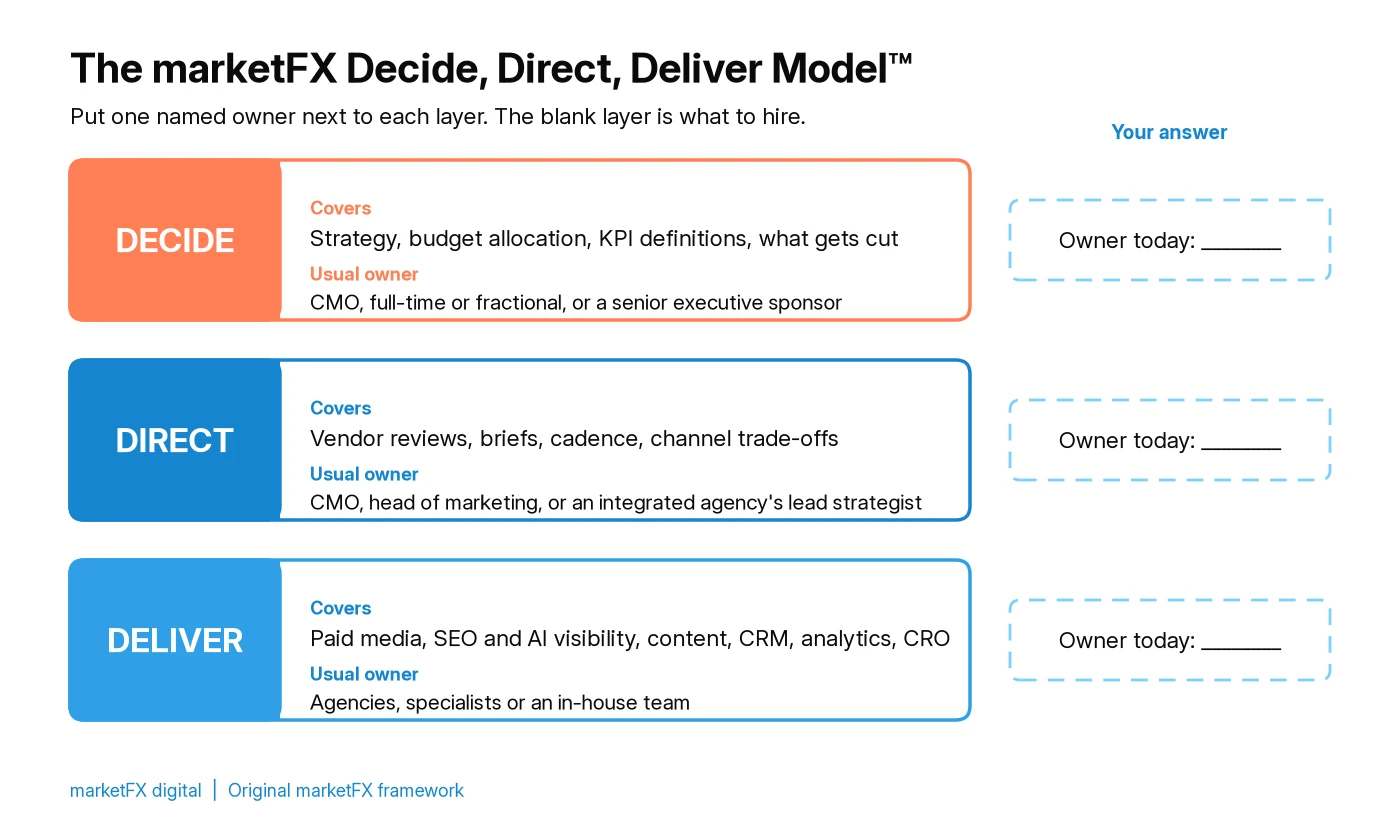
marketFX Decide, Direct, Deliver Model™. Put one name next to each layer. The blank one is your gap.
| Layer | What it covers | Usual owner | Signs it is empty |
|---|---|---|---|
| Decide | Strategy, positioning, budget allocation, KPI definitions, what gets cut | CMO (full-time or fractional) or a senior executive sponsor | Budgets roll forward from last year, every channel claims credit, no one says no |
| Direct | Vendor selection and reviews, briefs, meeting cadence, channel trade-offs, reporting rhythm | CMO, head of marketing, or the lead strategist in an integrated agency | Vendors brief themselves, reports do not reconcile, conflicts escalate to the CEO |
| Deliver | Paid media, SEO and AI visibility, content, CRM and lifecycle, analytics builds, CRO tests | Agencies, specialists or an in-house team | Good plans stall, launches slip, the internal team is stuck in production work |
Run it with your leadership team in fifteen minutes. If Decide is blank, the answer is senior leadership, fractional or full-time. If Deliver is thin while Decide and Direct are covered, you need an agency or specialists. If Direct is the blank, which is the most common pattern in companies with several vendors, either a fractional CMO or an integrated agency with a senior strategist can fill it, and the choice comes down to whether you want the decision owner inside your team or inside your partner.
When Should You Hire a Fractional CMO First?
Hire a fractional CMO first when marketing spend is meaningful but no one senior owns the decisions. The clearest signals are budgets that keep growing without a clear link to revenue, several vendors reporting different numbers, a CEO acting as the de facto marketing lead, and a board asking for a single view of marketing performance that nobody can produce.
A fractional CMO also makes sense at specific moments:
- Between full-time CMOs. The seat is open and the search will take months. Someone needs to keep budget, vendors and reporting under control in the meantime.
- Before a big marketing decision. You are about to pick a new agency, rebuild the website, switch CRMs or make a senior marketing hire. A fractional leader can set the brief and evaluate the options before you commit.
- After a funding event or acquisition. New owners want a 90-day plan and clean reporting quickly, and the existing team is too close to the work to reset it.
- When the internal team is strong but junior. Your marketers execute well and need someone who has seen this stage of growth to set priorities with conviction.
The Spencer Stuart data in the callout above is a useful reminder that many large companies run without an enterprise-wide marketing leader at all, and that the seat turns over every few years where it does exist. Mid-market companies feel the same gap with fewer people to absorb it.
The trap is hiring a fractional CMO and expecting execution. A part-time leader working a set number of hours a month cannot also run your paid search, write your content and build your dashboards. Plan for delivery capacity alongside the leadership role, either internal or external.
When Is a Marketing Agency the Better First Hire?
An agency is the better first hire when someone senior already owns strategy and the real constraint is execution capacity or channel depth. If your head of marketing knows exactly what needs to happen in paid media, SEO or CRM and simply does not have the people or expertise to do it, adding a fractional CMO just adds a layer.
Common signs you need an agency first:
- You have a clear plan and KPIs, and the plan keeps slipping because the team is at capacity.
- A specific channel needs specialist skills you do not have in-house, such as technical SEO, AI search visibility, paid media at scale, or lifecycle automation.
- You need speed. Agencies can usually start faster than a new hire can be recruited and ramped.
- Your measurement is decent and you can judge results yourself.
The risk with leading with an agency is that the agency starts filling the Decide layer by default. That is not a bad thing if the agency is set up for it, with senior strategists, shared measurement and accountability for total outcomes. It becomes a problem when a channel specialist starts making budget calls across channels it does not run. For a deeper look at that pattern, see why fragmented marketing agencies destroy ROI.
Can a Fractional CMO and an Agency Work Together?
Yes, and for many growing companies that combination is the most practical setup. The fractional CMO owns Decide and most of Direct. The agency, or a small number of agencies, owns Deliver. The CMO sets the brief, holds the agency to decision-grade KPIs and reallocates budget when the evidence says so. The agency brings the execution depth and tooling.
For this to work, three things need to be written down:
- Decision rights. Who approves budget shifts, new channels, creative direction and vendor changes. The agency recommends; the CMO decides.
- One scoreboard. Shared definitions for a qualified lead, revenue attribution and reporting windows, so the CMO and the agency look at the same numbers.
- A fixed cadence. A weekly working session and a monthly performance review with leadership. Without a cadence, the fractional leader ends up chasing updates instead of making decisions.
There is a second version of "both" that buyers often miss: an integrated agency that includes senior strategy as part of the engagement. In that model the agency covers Direct and Deliver, and a senior strategist works with your executive team on Decide. It suits companies that want one accountable team rather than a leader plus several vendors. We compare that structure in detail in integrated vs fragmented marketing agencies.
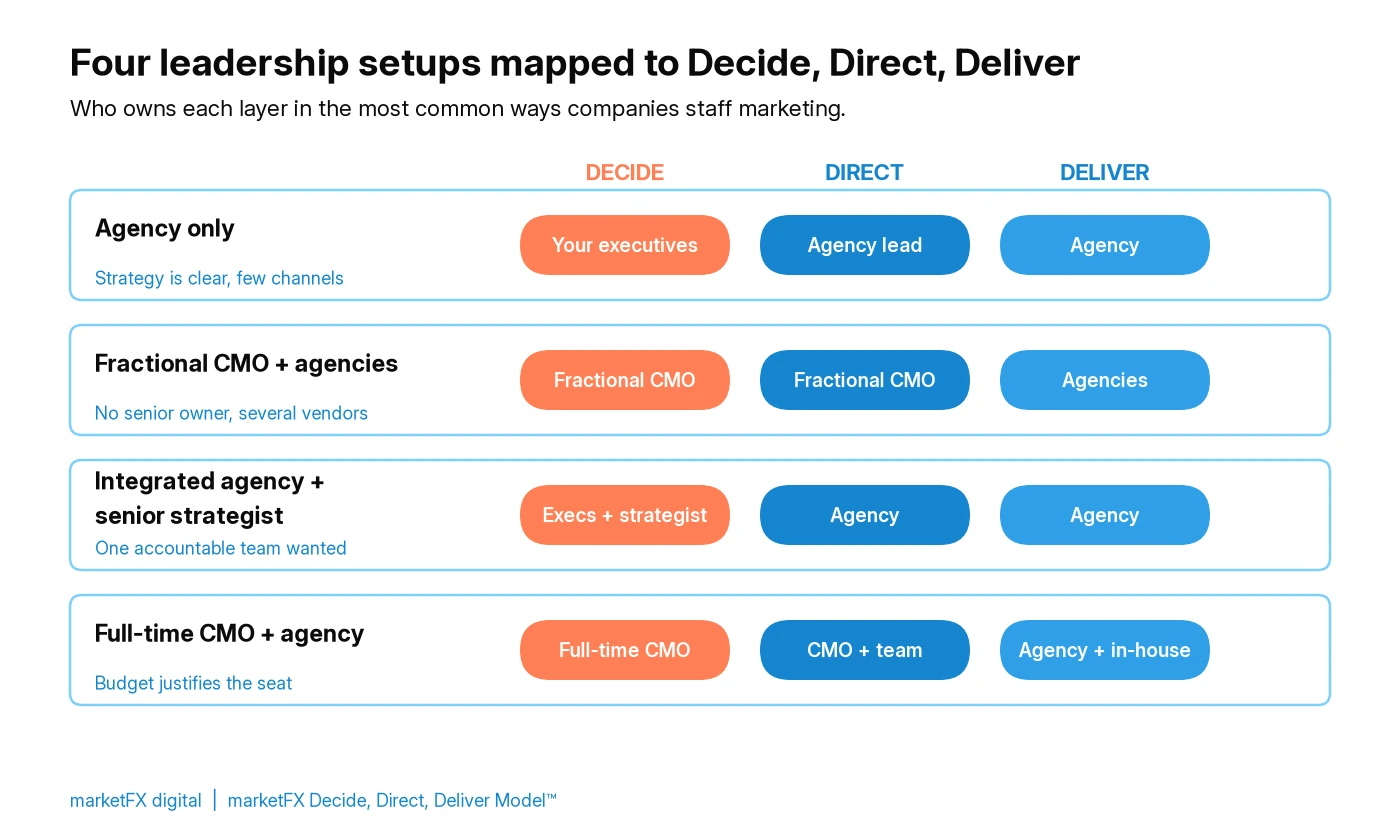
Four common setups mapped to the Decide, Direct, Deliver Model™.
| Setup | Decide | Direct | Deliver | Best when |
|---|---|---|---|---|
| Agency only | Your executive team | Agency account lead | Agency | Strategy is clear and one or two channels drive most results |
| Fractional CMO plus agencies | Fractional CMO | Fractional CMO | One or more agencies | No senior marketing owner and several vendors to govern |
| Integrated agency with senior strategist | Your executives with the agency strategist | Agency | Agency | You want one accountable team and your executives keep final say |
| Full-time CMO plus agency | Full-time CMO | CMO and internal team | Agency and in-house staff | Marketing is a core growth engine and the budget justifies the seat |
Fractional CMO vs Agency vs Full-Time CMO: How Do They Compare?
A full-time CMO owns Decide and Direct permanently and builds the internal team. A fractional CMO covers the same layers for a defined number of hours and usually for a defined phase. An agency covers Deliver and, depending on the agency, part of Direct. The right choice depends on how central marketing is to growth and how much senior time the work actually needs.
| Factor | Fractional CMO | Marketing agency | Full-time CMO |
|---|---|---|---|
| Layers owned | Decide and Direct | Deliver, sometimes part of Direct | Decide and Direct, builds Deliver team |
| Time commitment | Set hours per month | Scoped to channels and deliverables | Full-time, permanent |
| Speed to start | Usually weeks | Usually weeks | Typically months for search and ramp |
| Cost structure | Monthly retainer | Retainer, project or media percentage | Salary, bonus, equity and benefits |
| Builds internal team | Advises and helps hire | No | Yes |
| Main risk | Not enough hours for the scope | Optimizes its channel, not the whole | Expensive mis-hire and turnover |
A useful rule: if the job requires daily presence, managing a sizable internal team and owning brand across every touchpoint, it is a full-time role. If the job is to set direction, fix measurement, govern vendors and hand over a working system, a fractional leader for a defined phase is often the more efficient buy. Many companies use a fractional CMO to build the foundation and then hire full-time into a clearer role. For the related question of building in-house versus hiring an agency, see marketing agency vs in-house team.
How Is a Fractional CMO Different From an Interim CMO or a Marketing Consultant?
An interim CMO fills a vacant full-time seat temporarily, often close to full-time hours, and focuses on continuity until a permanent hire lands. A fractional CMO is part-time by design and may stay for a year or longer. A marketing consultant advises on a defined problem, such as positioning or a channel plan, and usually does not own ongoing decisions, vendors or results.
| Role | Time | Owns ongoing decisions | Typical use |
|---|---|---|---|
| Fractional CMO | Part-time, ongoing | Yes | Senior leadership without a full-time seat |
| Interim CMO | Near full-time, temporary | Yes, until a permanent hire | Covering a vacancy or transition |
| Marketing consultant | Project-based | No, advises | A defined question or plan |
The titles get used loosely, so judge by the scope of work rather than the label. If the proposal does not include budget authority, vendor governance and a reporting line to leadership, it is consulting, whatever it is called.
Where Does Marketing Budget Actually Go?
Agencies and labor are a smaller share of marketing budgets than most executives assume, which is one reason the leadership question matters. In Gartner's 2025 CMO Spend Survey, paid media took 30.6% of marketing budgets, martech 22.4%, labor 21.9% and agencies 20.7%, with total marketing budgets flat at 7.7% of company revenue.
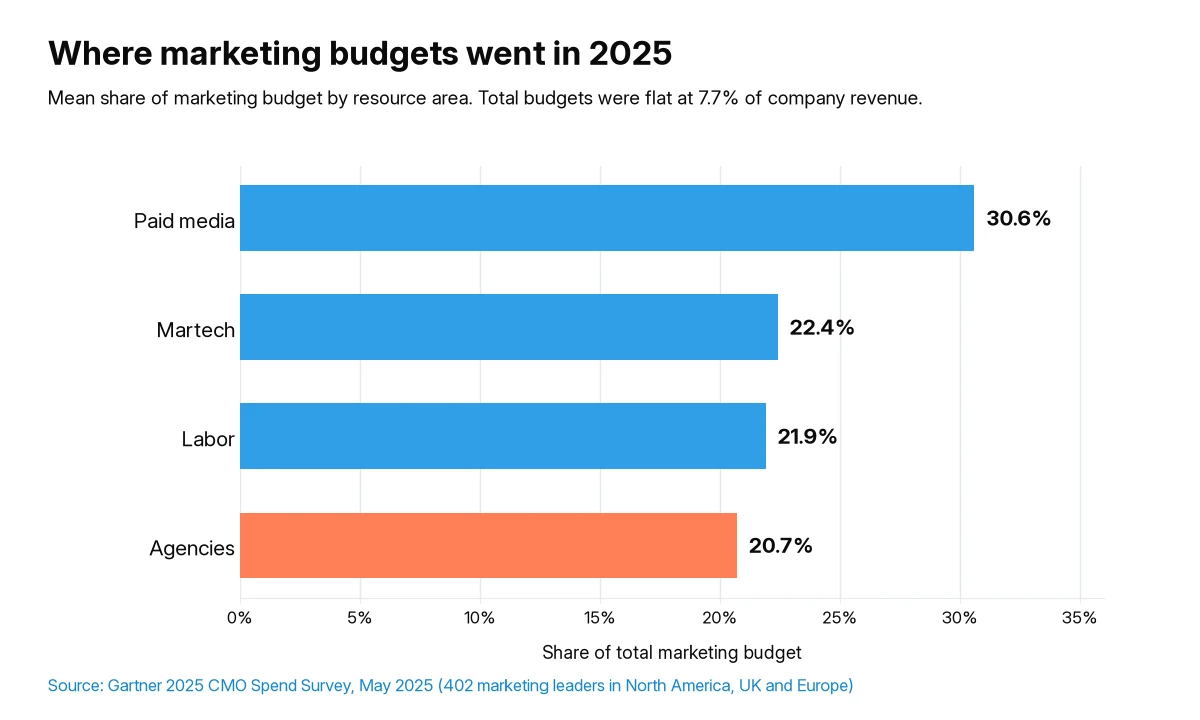
Share of marketing budget by resource area, 2025. Source: Gartner 2025 CMO Spend Survey (May 2025).
| Resource area | Share of marketing budget |
|---|---|
| Paid media | 30.6% |
| Martech | 22.4% |
| Labor | 21.9% |
| Agencies | 20.7% |
The same Gartner release reports that 39% of CMOs planned to cut agency budgets, with eliminating unproductive agency relationships and streamlining agency rosters as top actions (Gartner, 2025 CMO Spend Survey). That is Direct layer work. Someone has to decide which vendors earn their fee, and that decision is hard to make well from inside one of the vendors. Gartner's respondents skew toward large companies, so treat the split as directional for mid-market budgets.
How Do Costs Compare Between a Fractional CMO and an Agency?
Compare cost by the layer you are buying, not by the monthly invoice. A fractional CMO retainer buys senior decision time. An agency retainer buys execution capacity and channel expertise. The total cost question is what it takes to cover all three layers, and how much waste each option removes.
How the main models usually work:
- Fractional CMO: a monthly retainer tied to a set number of senior hours. Most marketFX fractional CMO engagements run between thirty and sixty hours per month, set by company size and channel complexity.
- Agency: a monthly retainer by scope, a project fee, or a percentage of media spend for paid channels. Our breakdown of marketing agency cost in 2026 walks through how each model behaves.
- Full-time CMO: salary, bonus, benefits and often equity, plus recruiting cost and ramp time.
The honest comparison often surprises people. A fractional CMO who cuts one underperforming vendor, fixes measurement and moves budget to the channels that actually produce revenue can pay for the role. An agency that adds capacity without anyone owning Decide can increase spend without improving results.
What Should You Ask Before Choosing?
Ask questions that reveal which layer each option will really own. These work whether you are interviewing a fractional CMO, an agency or both.
- Who will own total marketing results, by name? You want a person, not a department.
- What decisions will you make, and which will you only recommend? This exposes the gap between Decide and Deliver.
- How will you review the vendors we already have? A fractional CMO should have a method. An agency should be comfortable being reviewed.
- What will the first 90 days produce? Look for a written plan with owners, milestones and a measurement fix, not a list of tactics.
- Which metrics will you report, and how will they tie to revenue? Decision-grade metrics such as qualified pipeline, customer acquisition cost and contribution beat impressions and clicks. Our guide to choosing a marketing analytics agency covers what good measurement looks like.
- How many hours or people are actually assigned? For a fractional CMO, check the hours against the scope. For an agency, check who does the work after the pitch.
- What happens when you leave? You should own the accounts, data, documentation and plans.
If you are not sure where your gaps are, a marketing audit is a low-risk way to map current spend, vendors and measurement before you commit to either model.
How marketFX Approaches This Decision
marketFX can play either role. Some clients engage us for fractional CMO services to own strategy, vendor governance and executive reporting. Others engage us as an integrated team across digital marketing strategy, paid media, SEO and AI visibility, CRM and analytics. Across our client work we report 94% client retention, more than 20 years driving growth and more than $20 million in revenue tracked.
We start with the same Decide, Direct, Deliver conversation recommended above, and sometimes the answer is that you need neither of us in a given role. If you want an outside read on where your gap sits, book a strategy call.
Related services
FAQs
Frequently Asked Questions
- What is the main difference between a fractional CMO and a marketing agency?
- A fractional CMO owns marketing decisions: strategy, budget allocation, KPIs and vendor governance, on a part-time basis. A marketing agency owns delivery: running paid media, SEO, content, CRM or analytics inside a defined scope. The CMO is accountable for total marketing results. The agency is accountable for its own deliverables and channel metrics.
- Should I hire a fractional CMO or an agency first?
- Hire a fractional CMO first if no one senior owns marketing decisions, budgets are growing without a clear link to revenue, or you manage several vendors with no one reviewing them. Hire an agency first if strategy and KPIs are already clear and the constraint is execution capacity or specialist channel skills.
- Can a fractional CMO manage my existing agencies?
- Yes. Vendor governance is one of the core parts of the role. A fractional CMO sets briefs, defines shared KPIs, reviews each agency's scope, spend and results, and recommends whether to keep, renegotiate, replace or consolidate. Agree on decision rights early so agencies know who approves budget and scope changes.
- How many hours does a fractional CMO work?
- It depends on company size, channel complexity and the phase of work. Most marketFX fractional CMO engagements run between thirty and sixty hours per month, covering strategy sessions, vendor reviews, analytics oversight, executive reporting and roadmap planning.
- Is a fractional CMO cheaper than a full-time CMO?
- Usually, because you pay for a set number of senior hours rather than a full salary, bonus, benefits and equity, and you avoid a long recruiting process. The better question is whether the work needs full-time presence. If it does, a fractional arrangement will run short of hours.
- What is the difference between a fractional CMO and an interim CMO?
- An interim CMO temporarily fills a vacant full-time seat, often at close to full-time hours, until a permanent hire starts. A fractional CMO is part-time by design and can stay engaged for a long period. Both own decisions, unlike a marketing consultant, who advises on a defined question.
- Do I need both a fractional CMO and an agency?
- Many growing companies do. The fractional CMO owns strategy and governance, and the agency delivers the channel work. The alternative is an integrated agency that includes senior strategy, which covers direction and delivery in one team while your executives keep final decisions. Map your gaps with the Decide, Direct, Deliver Model™ before choosing.