
How to Choose a Marketing Analytics Agency: What One Should Deliver
How to choose a marketing analytics agency and what it should deliver: tracking, GA4 and CRM reconciliation, attribution, testing, reporting and cost.
Quick Answer
A marketing analytics agency sets up, checks, and connects the data behind your marketing so leaders can make budget decisions from it. The work covers conversion tracking, GA4 and tag management, CRM and revenue reconciliation, attribution, incrementality testing, and dashboards. The best agencies start with a measurement audit and agreed definitions, then build reporting that ends in a decision rather than another chart.
Most companies already have plenty of marketing data. Google Analytics, Google Ads, Meta, the CRM, the call tracking tool, and the finance system each report a number, and those numbers rarely agree. A marketing analytics agency is worth hiring when that disagreement is costing you decisions: when the leadership meeting spends more time arguing about whose number is right than deciding where the next dollar goes.
This guide explains what a marketing analytics agency should deliver, how attribution, incrementality testing, and marketing mix modeling fit together, what drives cost, and the questions to ask before you hire one.
What Does a Marketing Analytics Agency Do?
A marketing analytics agency makes your marketing data accurate, connected, and usable for decisions. In practice that means five kinds of work:
- Tracking and data collection. Setting up and auditing GA4, tag management, conversion tracking, server-side tracking, UTM parameters, and consent mode, so the right events fire once and only once.
- Data reconciliation. Matching ad platform conversions, analytics sessions, CRM leads and opportunities, and revenue from finance or point of sale, and agreeing what counts as a lead, a customer, and revenue.
- Attribution and measurement. Choosing and documenting an attribution model, then checking it with incrementality tests or a marketing mix model where the budget justifies it.
- Reporting and dashboards. Building views in tools such as Looker Studio or Power BI that show the metrics leaders use, such as cost per qualified lead, customer acquisition cost, ROAS, and MER.
- Insight and recommendations. Turning the numbers into specific changes to budget, channels, campaigns, and landing pages.
A "digital marketing analytics agency" and a "marketing analytics services" provider usually mean the same thing. The useful distinction is scope: some providers stop at dashboards, while a full service connects tracking, CRM data, and revenue before any dashboard is built. If your problem is that nobody trusts the numbers, a dashboard on top of broken tracking only makes the wrong numbers easier to see. That is the theme of our earlier post on why your Google Analytics dashboard is lying to you.
Why Do Companies Hire a Marketing Analytics Agency?
Companies hire a marketing analytics agency when their data exists but does not change decisions. Gartner's 2022 survey of 377 marketing analytics users found that analytics influenced only 53% of marketing decisions (Gartner, September 15, 2022). The top reasons respondents gave were data problems, specifically that "data are inconsistent across sources" and "data are difficult to access." The survey also pointed to how decisions get made once the data arrives.
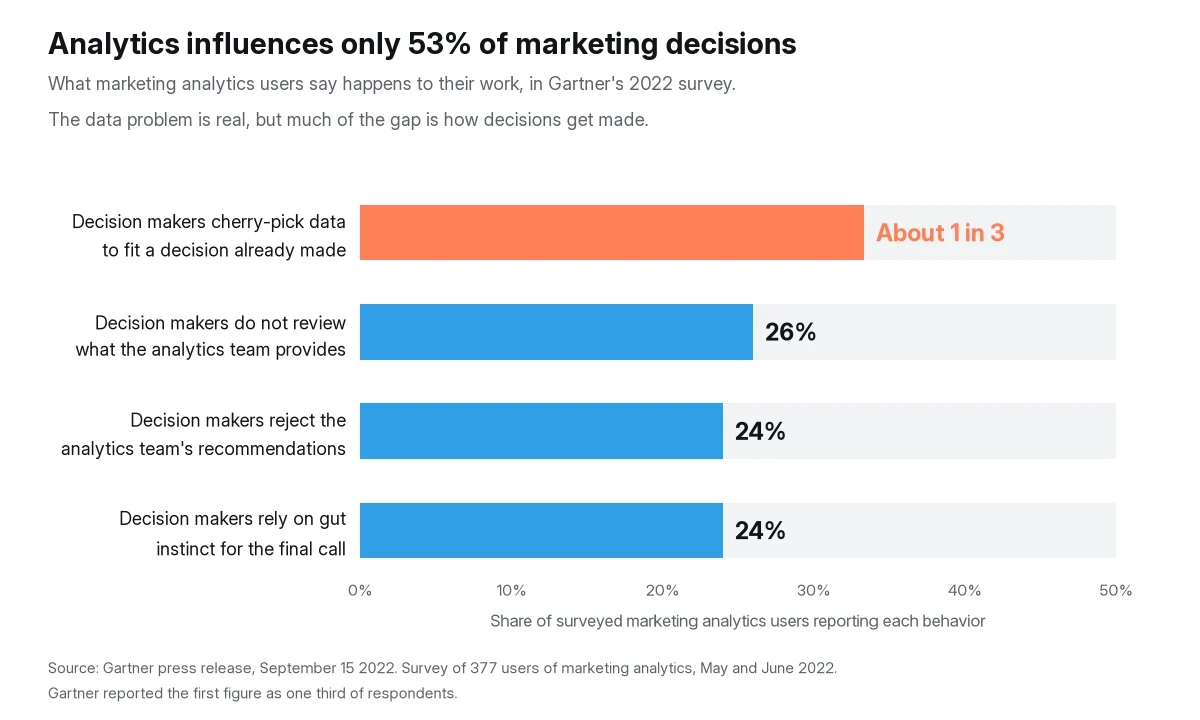
Analytics influences only 53% of marketing decisions, and much of the gap is how decisions get made. Source: Gartner, September 15, 2022.
| What respondents reported | Share of respondents |
|---|---|
| Marketing decisions influenced by analytics | 53% |
| Decision makers cherry-pick data to fit a decision already made | One third |
| Decision makers do not review what the analytics team provides | 26% |
| Decision makers reject the analytics team's recommendations | 24% |
| Decision makers rely on gut instinct for the final call | 24% |
The same pattern shows up in Nielsen's research. Nielsen reported that 85% of marketers are confident in their ability to measure ROI, while only 32% measure ROI holistically across traditional and digital channels, and 38% now name sales or ROI as their top measure of success (Nielsen, October 9, 2025).
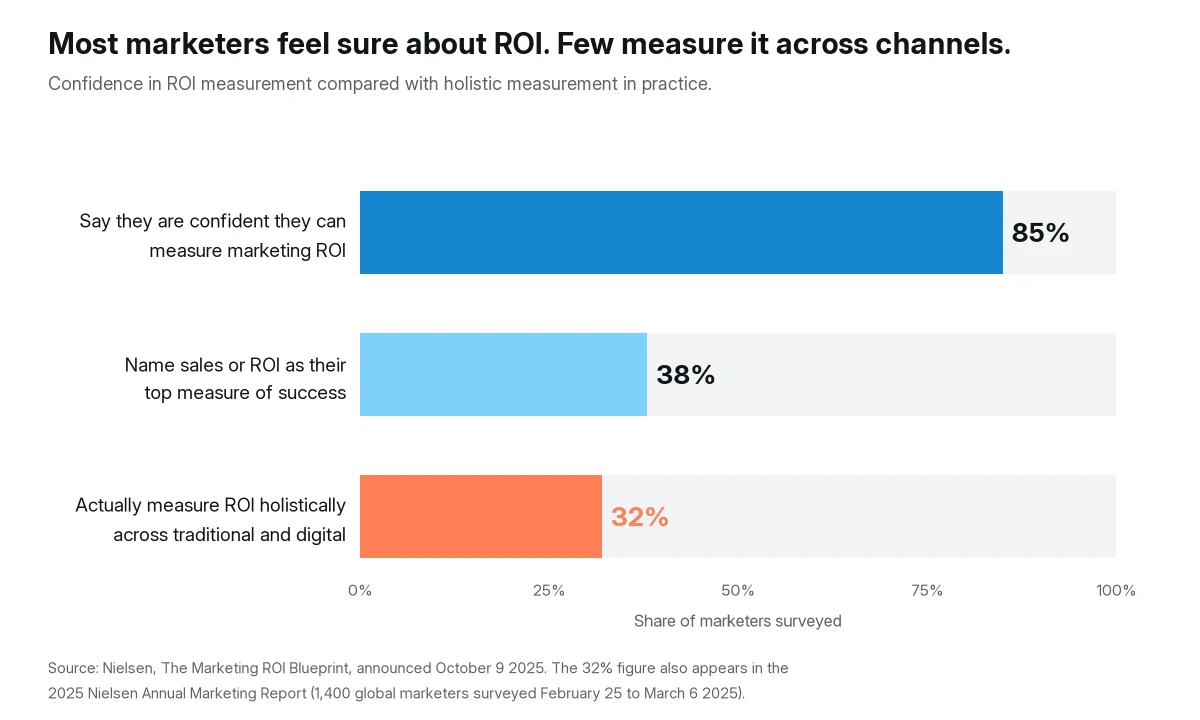
Confidence in ROI measurement compared with holistic measurement in practice. Source: Nielsen, The Marketing ROI Blueprint, October 2025.
| What marketers reported | Share of marketers |
|---|---|
| Confident they can measure marketing ROI | 85% |
| Prioritize sales or ROI as their top success metric | 38% |
| Measure ROI holistically across traditional and digital media | 32% |
Put together, these studies describe the job. A good marketing analytics agency fixes the data problems, then builds a process where agreed metrics are set before a campaign starts and the reporting is designed around the decisions leaders actually make. Gartner's own recommendation to CMOs includes setting KPIs and metrics before launching a campaign to combat cherry-picking, and tracking which decisions were made based on analytics.
What Should a Marketing Analytics Agency Deliver?
A complete marketing analytics engagement should move through five stages: collect, reconcile, attribute, test, and decide. We call this the marketFX Decision-Grade Analytics Model. Each stage depends on the one before it, and the last stage feeds back into the first, because every decision raises the next question worth tracking.
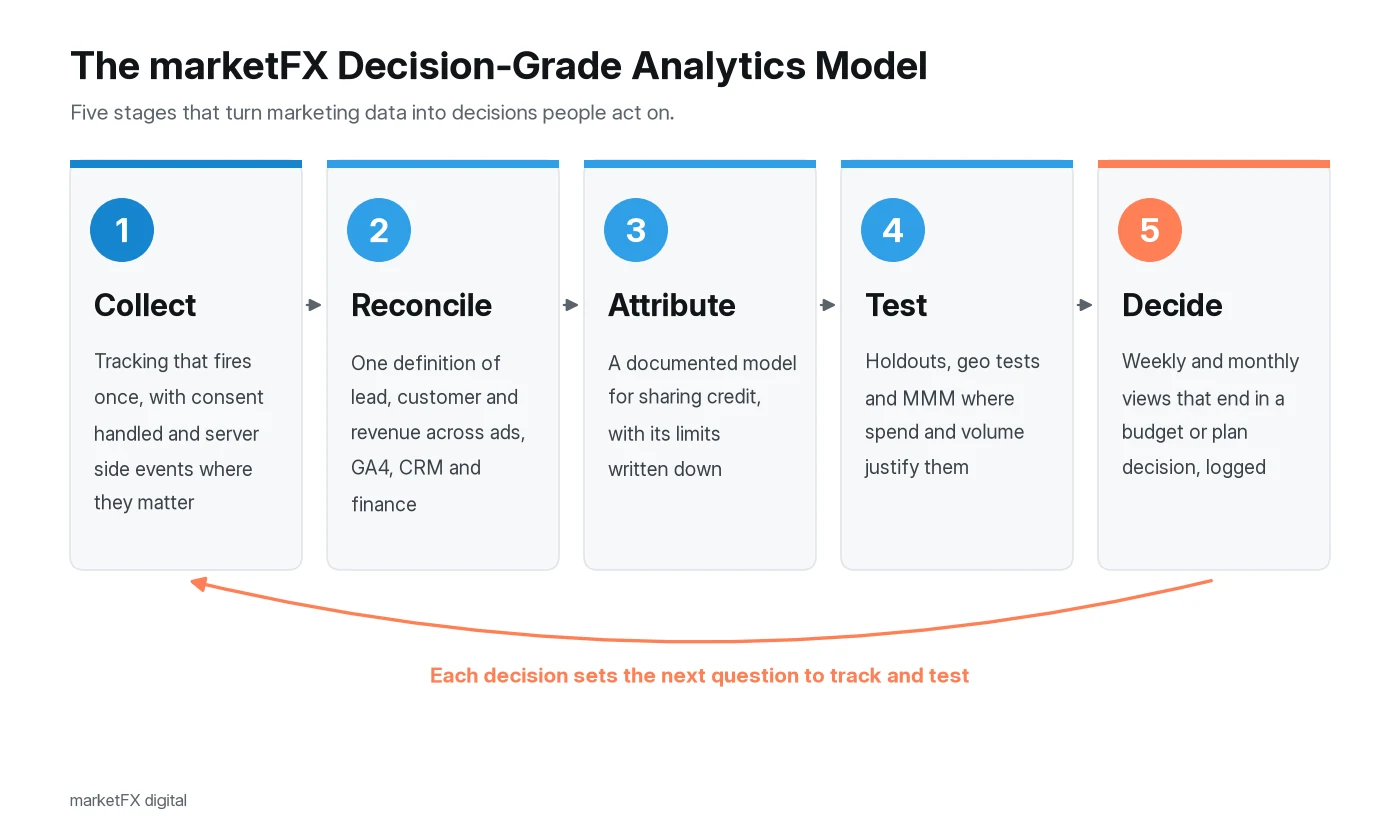
The marketFX Decision-Grade Analytics Model. Each decision sets the next question to track and test.
| Stage | What it covers | Question it answers |
|---|---|---|
| 1. Collect | GA4, tag management, conversion tracking, server-side events, consent, UTMs, call tracking | Are we capturing the right actions, once each? |
| 2. Reconcile | Shared definitions of lead, customer, and revenue across ad platforms, GA4, CRM, and finance | Do marketing, sales, and finance agree on the numbers? |
| 3. Attribute | A documented attribution model, lookback windows, and known limits | How is credit shared across channels, and what does that miss? |
| 4. Test | Holdout and geo tests, and marketing mix modeling where spend and data allow | Did the marketing cause results that would not have happened anyway? |
| 5. Decide | Weekly operating views, monthly executive views, and a log of decisions made | What will we change in budget, channels, or plan? |
Stage 1: Collect
Everything else depends on collection. The agency should audit what fires today: GA4 events and key events, Google Ads and Meta conversion tags, enhanced conversions, form and call tracking, and whether consent banners and consent mode are set up correctly. Duplicate conversions are common, for example a thank you page and a form submit both counting the same lead, and they quietly inflate every platform's results. Where browser tracking is unreliable, server-side events help recover signal. The output of this stage is a tracking plan: what is measured, where, and who owns it.
Stage 2: Reconcile
This is the stage most providers skip and the one that matters most to leadership. Ad platforms count conversions, GA4 counts key events, the CRM counts leads and opportunities, and finance counts revenue. They will never match exactly, so the goal is agreed definitions and a known, explained gap. A good agency gets marketing, sales, and finance in a room to agree what a lead, a qualified lead, a customer, and revenue mean, then decides which system is the source of truth for each. If your CRM is part of the problem, CRM and marketing automation work often sits alongside analytics.
Stage 3: Attribute
Attribution shares credit for a conversion across the touchpoints before it. GA4 now offers a narrower set of models than it used to. Google removed the first click, linear, time decay, and position-based models from GA4 in 2023, and properties using them moved to data-driven attribution (Google Analytics Help, Select attribution settings). That makes it more important to document which model your reports use, what lookback windows are set, and what attribution cannot see, such as people who saw an ad but never clicked. Our marketing attribution page covers how we approach this.
Stage 4: Test
Attribution shows correlation. Testing shows cause. An incrementality test holds back spend from a group of people or regions and compares the results, which answers whether a channel created sales that would not have happened anyway. Marketing mix modeling looks at spend and sales over time to estimate each channel's contribution. Not every company needs both on day one, and a good agency will say when your spend or data volume is too low for a test to give a clear answer.
Stage 5: Decide
Dashboards come last, and they should be built around decisions. A weekly operating view helps channel managers act on pacing, cost per qualified lead, and conversion rate. A monthly executive view connects spend to pipeline, revenue, customer acquisition cost, and blended efficiency. Keeping a short log of what was decided and why helps the next round of tracking and testing focus on the questions that matter.
What Is the Difference Between Attribution, Incrementality, and Marketing Mix Modeling?
Attribution, incrementality testing, and marketing mix modeling (MMM) answer different questions, and a good marketing analytics agency uses them together. Attribution shares credit across touchpoints for day to day optimization. Incrementality testing proves whether a specific channel or tactic caused extra results. MMM estimates how the total budget should be split across channels.
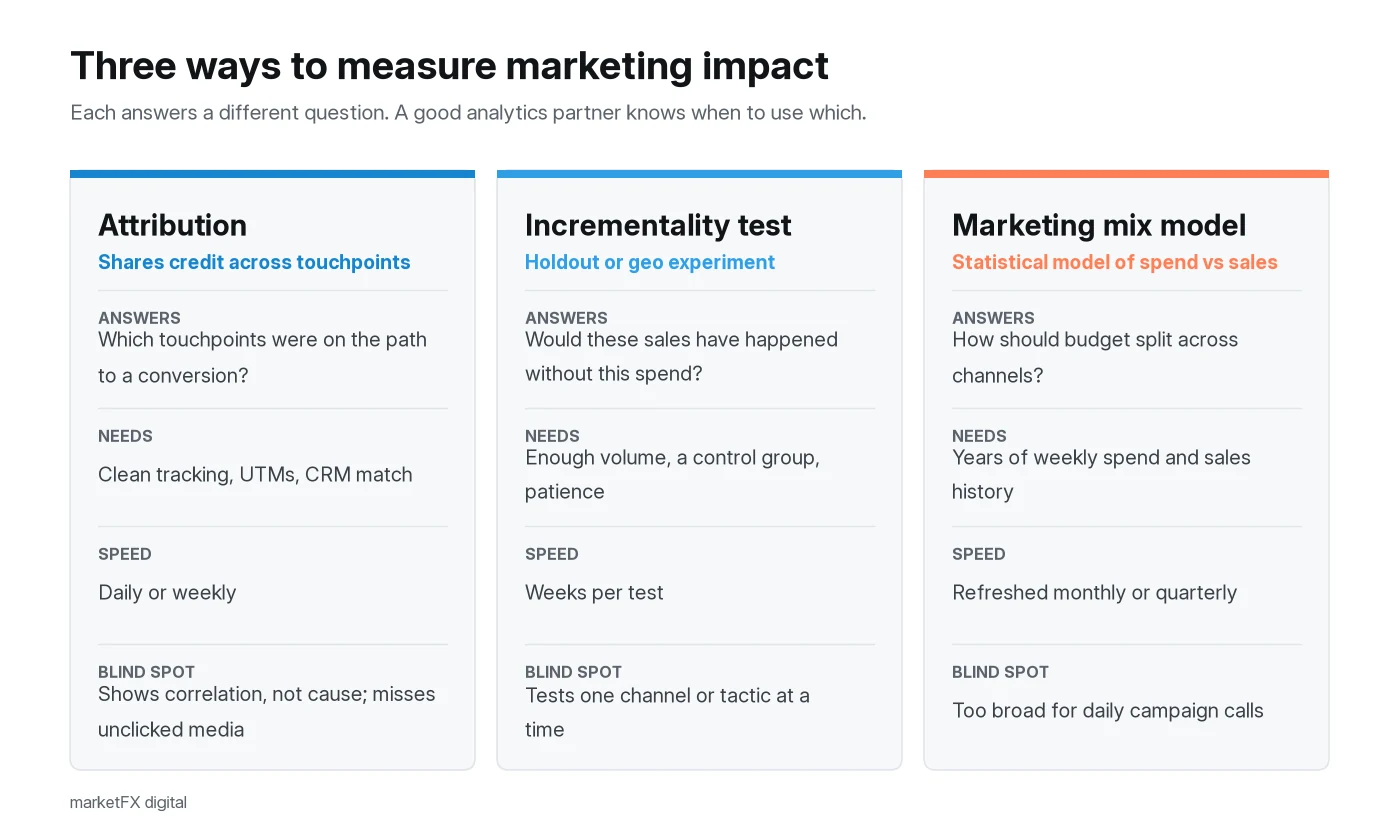
Three ways to measure marketing impact. Each answers a different question.
| Method | Question it answers | What it needs | How often | Blind spot |
|---|---|---|---|---|
| Attribution | Which touchpoints were on the path to a conversion? | Clean tracking, UTMs, CRM match | Daily or weekly | Shows correlation, not cause; misses media people saw but did not click |
| Incrementality test | Would these sales have happened without this spend? | Enough volume, a control group, patience | Weeks per test | Tests one channel or tactic at a time |
| Marketing mix model | How should budget split across channels? | Years of weekly spend and sales history | Refreshed monthly or quarterly | Too broad for daily campaign calls |
MMM has become more accessible. In January 2025 Google made Meridian, its open source marketing mix model, available to everyone (Google, January 29, 2025). Open source tools lower the software barrier, but the model still depends on clean, consistent spend and sales data, which is why Stages 1 and 2 come first. If you are searching for a "marketing mix modeling agency" or a "marketing attribution agency", ask how the provider combines these methods rather than relying on one.
How Has Marketing Measurement Changed Since 2023?
Three changes matter most when you evaluate a marketing analytics agency today.
GA4 is the default and its attribution options are narrower. GA4 has replaced Universal Analytics, and Universal Analytics data stopped being accessible starting the week of July 1, 2024 (Google Analytics Help, GA4 has replaced Universal Analytics). GA4 reports now offer data-driven attribution and last click models only (Google Analytics Help, Select attribution settings). Comparing old rules-based reports with new ones can mislead, so an agency should explain how your reporting baseline changed.
Privacy and consent shape what you can see. Consent banners, consent mode, browser restrictions, and ad blockers all reduce what client-side tracking captures. First-party data, server-side events, and CRM conversion imports make up some of the gap. An agency should tell you plainly how much of your data is modeled versus observed.
Measurement now spans more surfaces. AI assistants and AI search now send some visitors to websites, and those visits can be segmented in GA4 by referral source. Being mentioned in AI answers, often called AI citations, is harder to measure than clicks, so expect a partner to be honest about what is tracked and what is estimated.
Marketing Analytics Agency vs Consultant vs Software: Which Do You Need?
The right choice depends on whether your main gap is tools, skills, or ongoing capacity. Many companies use a mix.
| Option | Best for | What you get | Watch for |
|---|---|---|---|
| Analytics software or a dashboard tool | Teams with clean data and an in-house analyst | Faster reporting on top of data you already trust | Tools do not fix tracking or definitions |
| Marketing analytics consultant | A one-time audit, a measurement plan, or an attribution decision | A diagnosis, a roadmap, and recommendations | You still need someone to implement and maintain it |
| Marketing analytics agency | Ongoing tracking, reporting, and analysis across several channels | Implementation plus a recurring reporting and insight rhythm | Check who does the work and whether reporting ties to revenue |
| In-house analytics hire | Large, steady programs with complex data | Deep knowledge of your business | One person rarely covers tracking, data engineering, and modeling |
If you want a defined diagnosis and plan first, marketing analytics consulting is usually the starting point. If you need the ongoing work done, look at a full marketing analytics and reporting engagement. Either should begin with an audit, and if you are unsure where the gaps are, a broader marketing audit can look at analytics alongside channels and spend.
What Does the First 90 Days With a Marketing Analytics Agency Look Like?
A well run engagement usually follows the model above in order. The exact timing depends on how many systems you have and how much needs fixing, so treat this as a typical sequence rather than a promise.
- Measurement audit. Review GA4, tag management, conversion tracking, ad platform conversions, CRM data, and call or offline tracking. List what is broken, duplicated, or missing.
- Definitions and source of truth. Agree on lead, qualified lead, opportunity, customer, and revenue with marketing, sales, and finance, and decide which system owns each number.
- Tracking fixes. Repair and deduplicate conversions, align platform and server-side events, and fix UTM and naming conventions.
- KPI framework and dashboard wireframe. Sketch what the weekly and monthly views will show before building them.
- Reporting build. Build the dashboards and a recurring review rhythm.
- Measurement roadmap. Decide which attribution questions to settle and which incrementality tests or modeling work comes next.
At the end, you should have a measurement audit, a KPI framework, a data source map, working dashboards, and a written plan for the next quarter. If a provider cannot describe deliverables like these in plain terms, ask why.
How Much Does a Marketing Analytics Agency Cost?
Marketing analytics agency cost depends on scope, the number of data sources, and how much needs fixing before reporting can start. Engagements are usually priced as a one-time audit or setup project, an ongoing monthly retainer, or both. We do not publish standard prices here because two companies with the same ad spend can need very different amounts of work.
What drives the cost:
- Number of data sources. GA4 plus one ad platform is simpler than several ad platforms, a CRM, call tracking, point of sale, and offline sales.
- State of the tracking. Broken or duplicated conversions mean a setup project before ongoing work.
- Number of locations, brands, or regions. Location-level reporting multiplies the setup and checking.
- Reporting depth. Platform summaries take less time than reporting reconciled to CRM pipeline and finance revenue.
- Testing and modeling. Incrementality tests and marketing mix modeling add analysis time and need more data.
- Ongoing analysis. A monthly dashboard refresh is different from a recurring review where someone interprets results and recommends changes.
Compare proposals stage by stage against the model above before comparing fees. A lower price that skips reconciliation usually leaves you with the same argument about numbers, just in a nicer dashboard. For a wider view of how agency pricing works, see how much a marketing agency costs.
What Should Multi-Location and Franchise Brands Look For?
Multi-location and franchise brands need marketing analytics that reports by location, not only in total. National numbers can look healthy while individual locations struggle, and location managers or franchisees need to see their own results.
Look for an agency that can:
- Tag campaigns, calls, and forms by location so leads land in the right place in the CRM.
- Connect online activity with offline results such as store visits, bookings, calls, or point of sale data.
- Separate brand-level spend from local spend so each is judged fairly.
- Build a location view that rolls up into a regional and national view.
This is a common gap. Our multi-location and franchise marketing work is built around it, and the same thinking runs through our full funnel marketing strategy guide.
What Questions Should You Ask Before Hiring a Marketing Analytics Agency?
Ask questions that reveal how the agency works, not just which tools it uses:
- What do you audit first, and what does the audit deliverable look like?
- How do you reconcile ad platform conversions with GA4, our CRM, and revenue?
- Who decides the definitions of a lead, a qualified lead, and revenue, and how?
- Which attribution model will our reports use, and what will it miss?
- When would you recommend an incrementality test or marketing mix modeling, and when would you say our data is not ready?
- How do you handle consent, privacy, and modeled data in reporting?
- What will the weekly and monthly reports show, and who are they built for?
- Do we own the accounts, tags, dashboards, and data if we part ways?
- Who will do the work day to day, and who reviews it?
- How will we know the engagement is working after the first quarter?
Red flags include a pitch that starts with dashboards before an audit, reports built only on platform-reported conversions, a single attribution model presented as the truth, and dashboards or data you would not own.
How marketFX Approaches Marketing Analytics
At marketFX, analytics is the measurement layer that connects every channel we run, from search to paid media to CRM. Our marketing analytics and reporting service starts with a measurement audit of your analytics, tag management, conversion tracking, and CRM. We then agree definitions for leads, customers, and revenue with marketing, sales, and finance, and build dashboards last: a weekly operating view and a monthly executive view, in tools such as GA4, Google Tag Manager, Power BI, and Looker Studio.
If you need a diagnosis and plan first, our marketing analytics consulting covers GA4 review, conversion tracking parity and deduplication, CRM reporting, attribution logic, and a 90-day analytics improvement plan. For budget decisions across channels, our marketing attribution work audits and reconciles the source of truth before selecting a model and testing its assumptions. And if paid media is where the numbers disagree most, a paid media audit or our guide to PPC management services is a practical next step.
If you want reporting your leadership team will actually use, book a strategy call. We will look at your tracking, your CRM, and how your marketing numbers connect to the revenue your finance team sees.
Related services
FAQs
Frequently Asked Questions
- What does a marketing analytics agency do?
- A marketing analytics agency sets up and audits tracking, connects ad platform, GA4, CRM, and revenue data, agrees definitions for leads and revenue, chooses and documents attribution, runs incrementality tests or marketing mix modeling where it makes sense, and builds dashboards. The goal is reporting that leaders trust enough to make budget decisions from.
- How much does a marketing analytics agency cost?
- Cost depends on the number of data sources, the state of your tracking, how many locations or brands you report on, reporting depth, and whether testing or modeling is included. Engagements are usually a one-time audit or setup project, an ongoing monthly retainer, or both. Compare proposals by scope before comparing fees.
- What is the difference between a marketing analytics agency and a consultant?
- A marketing analytics consultant usually delivers a diagnosis and plan, such as an audit, a KPI framework, and a measurement roadmap. A marketing analytics agency usually implements and maintains the work over time, including tracking fixes, dashboards, and recurring analysis. Many companies start with consulting and move to ongoing agency support.
- What should a marketing analytics audit include?
- A marketing analytics audit should review GA4 setup, tag management, conversion tracking and duplicates, ad platform conversions, consent setup, UTM conventions, CRM data, and call or offline tracking. It should end with a written list of issues, agreed definitions to settle, a data source map, and a prioritized plan for fixes and reporting.
- What is the difference between attribution and incrementality?
- Attribution shares credit for a conversion across the touchpoints that came before it, which helps with day to day optimization but shows correlation, not cause. Incrementality testing holds back spend from a group or region and compares results, which shows whether a channel caused sales that would not have happened anyway.
- Do I need marketing mix modeling?
- Marketing mix modeling helps when you spend across several channels, including offline media, and have a long history of consistent weekly spend and sales data. It estimates how budget should split across channels. Smaller programs or companies with messy data usually get more value from fixing tracking and running targeted incrementality tests first.
- How long does it take to see results from a marketing analytics agency?
- Early value usually comes from the audit and tracking fixes, which often reveal duplicated or missing conversions. Agreed definitions, working dashboards, and a measurement roadmap follow. The timing depends on how many systems you have and how much needs fixing, so ask for a written plan with deliverables for the first quarter.