
PPC Management Services: What They Should Include for Google and Meta Ads
What PPC management services should include in 2026: tracking, Google and Meta ads, Performance Max, landing pages, attribution, cost, and how to choose.
Quick Answer
PPC management services plan, run, and improve paid ads on platforms such as Google, Meta, LinkedIn, and YouTube. A complete service covers conversion tracking, account and campaign structure, keywords and audiences, bids and budgets, ad creative, landing pages, testing, and reporting tied to revenue. In 2026, with Google and Meta automating most bidding and targeting, the biggest difference between providers is how well they feed and check that automation.
Paid ads are one of the fastest ways to put an offer in front of buyers, and one of the fastest ways to lose money without noticing. Google and Meta both make it easy to launch a campaign in an afternoon. They also make it easy to spend a budget on clicks that never become customers, because the platforms report their own results.
This guide is for marketing leaders and owners deciding whether to hire PPC management services, what to expect from them, and how to tell a good provider from a busy one. It covers what a complete service includes, how Google Ads and Meta ads management differ, what to check in Performance Max and Advantage+, how cost works, and the questions to ask before you sign.
What Are PPC Management Services?
PPC (pay per click) management services are outsourced help with planning, running, and improving paid advertising, where you pay when someone clicks or sees your ad. The term started with Google search ads, but most buyers now use it for all paid media: search, Shopping, YouTube, Performance Max, Meta (Facebook and Instagram), LinkedIn, Microsoft Advertising, and sometimes TikTok and programmatic display.
The job has changed a lot. Before automated bidding became standard, much of a PPC manager's week went to adjusting keyword bids by hand. Today Google's Smart Bidding and Meta's Advantage+ make most of those decisions in real time. That shifts the work toward three things the platforms cannot do for you:
- Feeding the algorithms accurate data. Automated bidding optimizes toward whatever you tell it is a conversion. If that signal is a form fill that sales never follows up, or a duplicate purchase event, the system gets very good at buying the wrong thing.
- Setting the guardrails. Budgets, exclusions, brand protection, audience signals, and creative decide where automation is allowed to spend.
- Proving what worked. Every platform takes credit for the same sale. Someone has to reconcile ad platform reports with your CRM, your analytics, and your bank account.
A provider that only talks about bid adjustments and click-through rates is selling the 2015 version of the job.
What Should PPC Management Services Include?
A complete PPC management service should cover five layers, built from the bottom up: measure, structure, spend, convert, and prove. We call this the marketFX Measure-First PPC Model. Each layer depends on the one below it, so a provider that starts with new campaigns before fixing tracking is building on sand.
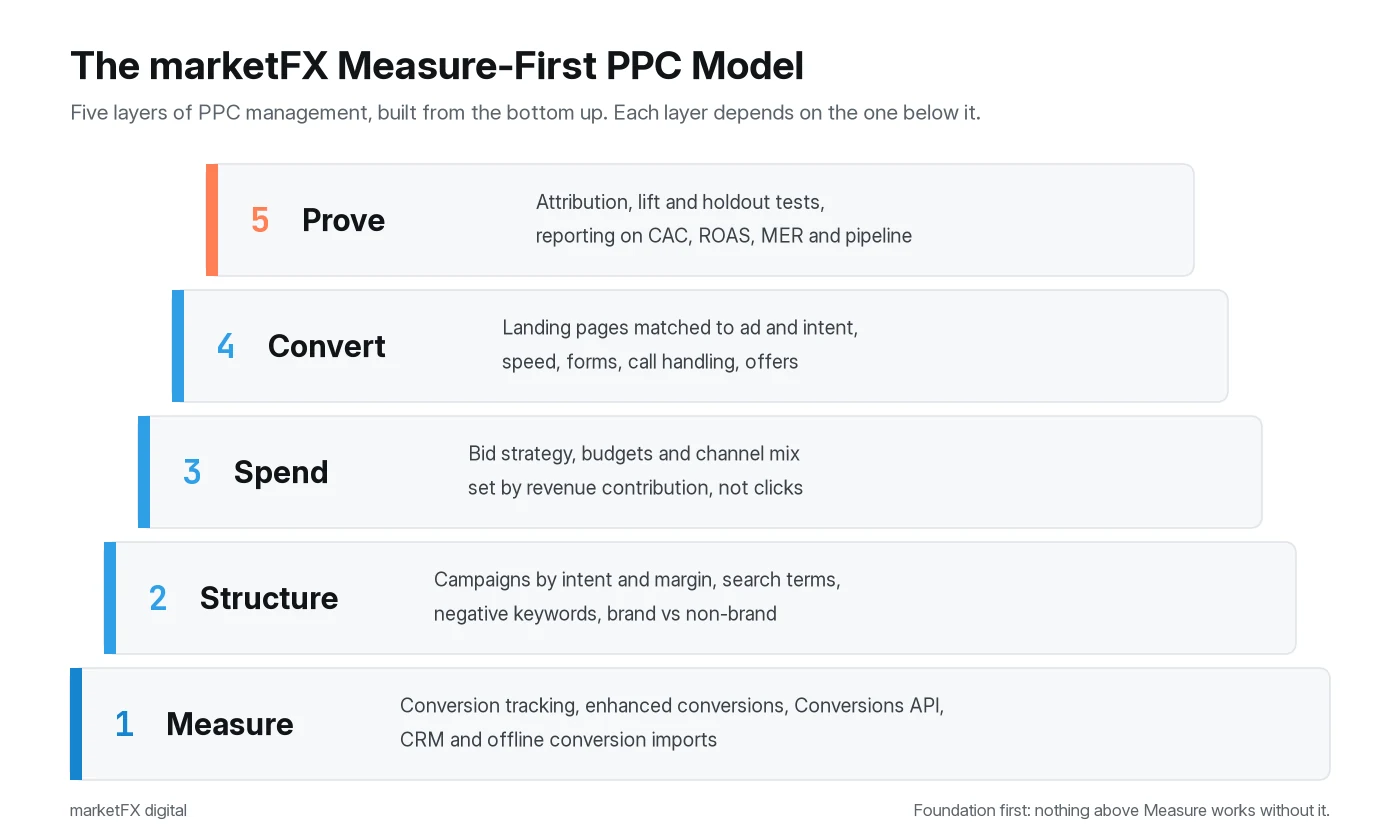
The marketFX Measure-First PPC Model. Each layer depends on the one below it.
| Layer | What it covers | Question it answers |
|---|---|---|
| 1. Measure | Conversion tracking, enhanced conversions, Meta Conversions API, CRM and offline conversion imports | Are we counting the right results, once each? |
| 2. Structure | Campaigns split by intent and margin, search terms, negative keywords, brand vs non-brand | Is each dollar going to the search or audience we meant? |
| 3. Spend | Bid strategy, budgets, and channel mix set by revenue contribution | Is budget flowing to what makes money, not what gets clicks? |
| 4. Convert | Landing pages matched to the ad and intent, speed, forms, call handling, offers | Does the click turn into a lead or sale? |
| 5. Prove | Attribution, lift and holdout tests, reporting on CAC, ROAS, MER, and pipeline | Did the ads create revenue that would not have happened anyway? |
Layer 1: Measure
Everything starts with conversion tracking. A good provider audits it before touching a campaign: which actions count as conversions, whether purchases or leads are counted once, whether values are passed, and whether the numbers in Google Ads and Meta match your CRM within a reasonable margin.
Two platform features matter most in 2026:
- Google enhanced conversions. Google describes enhanced conversions as a feature that supplements your existing tags by sending hashed first party conversion data, such as email addresses, using SHA256 (Google Ads Help). There is a version for web conversions and a version for leads that close offline, which matters for any business where the sale happens on a call or in a store.
- Meta Conversions API. The Conversions API sends events from your server to Meta alongside the browser pixel. In April 2026 Meta said its internal data showed advertisers with a Conversions API setup for web events saw an average 17.8% lower cost per result than those without one (MediaPost, April 15, 2026). That is Meta's own figure, so treat it as a direction rather than a promise for your account.
Add consent mode where it applies and server-side tracking where browser tags lose data. For lead generation, the most valuable step is usually importing qualified leads or closed deals from your CRM, so the platforms learn which clicks became revenue instead of which clicks filled a form.
Layer 2: Structure
Structure decides where money is allowed to go. That means campaigns separated by intent (people searching your brand vs people searching the problem), by margin or service line, and by geography for multi-location brands. It also means weekly search term review and a maintained negative keyword list, so you stop paying for job seekers, free tool hunters, and competitor names you did not mean to bid on.
Layer 3: Spend
Bid strategy and budgets should follow revenue contribution. A campaign with a lower cost per lead is not better if those leads rarely close. Good providers set targets from your unit economics: what a customer is worth, what you can afford to pay to win one (customer acquisition cost), and how quickly you need payback. Then they move budget between Google, Meta, and other channels based on that math, not on which platform reports the best ROAS.
Layer 4: Convert
The ad only earns the click. The landing page earns the lead. A PPC service should either improve landing pages or work closely with whoever does: message match between ad and page, load speed on mobile, short forms, visible phone numbers with call tracking, and an offer that fits the intent of the search. This is where conversion rate optimization and paid media meet, and it is often the cheapest way to lower cost per acquisition.
Layer 5: Prove
Platform dashboards overlap. If Google, Meta, and your email tool each claim the same sale, adding up their numbers overstates results. Proof means comparing platform data with your CRM and finance numbers, tracking blended metrics such as MER (total revenue divided by total marketing spend), and running holdout or geo tests to measure incrementality when budgets are large enough. We cover the measurement side in more depth in why your Google Analytics dashboard is lying to you.
Where Is Paid Media Budget Going in 2026?
Paid budgets are shifting from search toward social and video. In 2025, US social media ad revenue grew 32.6% to $117.7 billion and passed search advertising, which grew 11.0% to $114.2 billion, according to the IAB / PwC Internet Advertising Revenue Report. Search still matters for high intent demand, but a PPC plan that only covers Google search now misses a large share of where buyers spend time.
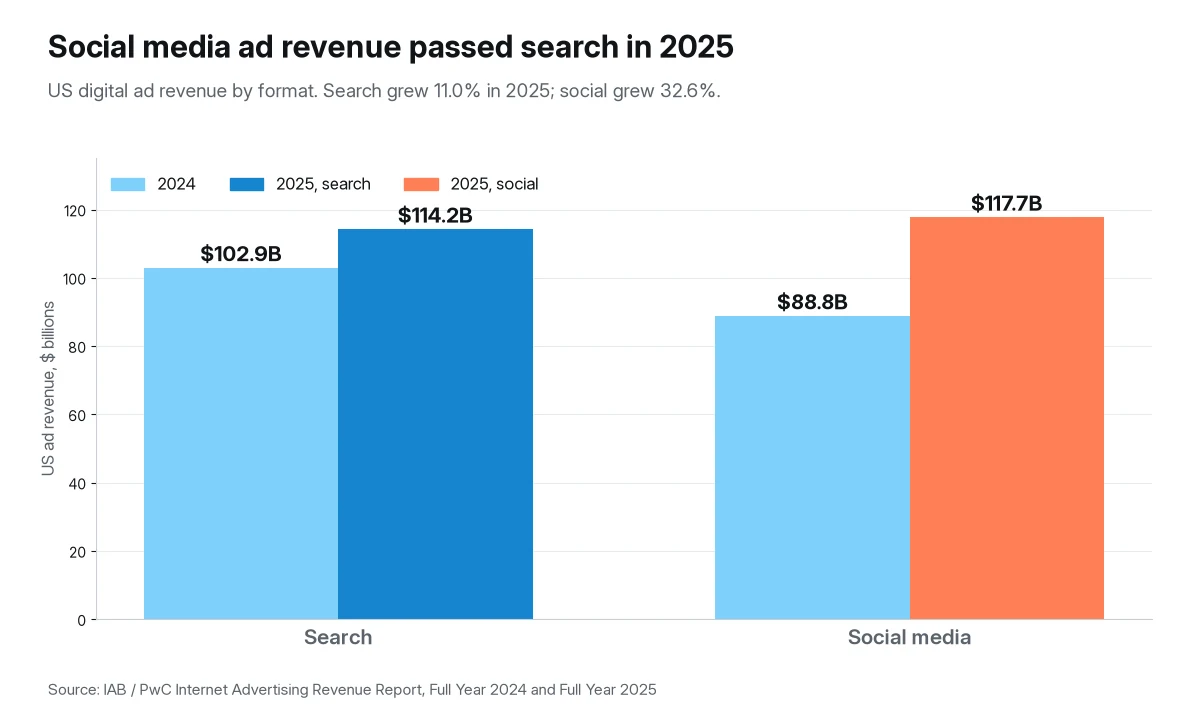
US search and social media ad revenue, 2024 and 2025. Source: IAB / PwC Internet Advertising Revenue Report, Full Year 2024 and Full Year 2025.
| Format | 2024 | 2025 | 2025 growth |
|---|---|---|---|
| Search | $102.9B | $114.2B | 11.0% |
| Social media | $88.8B | $117.7B | 32.6% |
The IAB categories overlap (social video also counts as video, for example), so these are not shares of a single pie. The direction is still clear, and the same report put total US internet ad revenue at $294.6 billion in 2025. For a buyer, the practical point is that PPC management services increasingly need to cover search and social together, with one view of which channel creates demand and which one captures it. That connected approach is what we describe in our full-funnel marketing strategy guide.
How Is Google Ads Management Different From Meta Ads Management?
Google Ads management mostly captures existing demand: people already searching for what you sell. Meta ads management mostly creates demand: it reaches people who match a profile but are not searching yet. That changes what the provider spends time on, how results are judged, and how long they take to show.
| Google Ads management | Meta ads management | |
|---|---|---|
| Main job | Capture people already searching | Reach and persuade people before they search |
| Main levers | Keywords, search terms, negatives, bids, Shopping feeds, landing pages | Creative, offers, audience signals, placements, landing pages |
| Main automation | Smart Bidding, Performance Max, broad match | Advantage+ campaigns, Advantage+ audience and placements |
| Key tracking | Google tag, enhanced conversions, offline conversion imports | Meta pixel plus Conversions API, offline events |
| Typical risk | Paying for irrelevant searches and brand traffic you would get anyway | Optimizing to cheap engagement that never buys |
| How to judge it | Cost per qualified lead or sale, search term quality, impression share | Cost per result, new customer share, lift tests, blended MER |
Most businesses need both, in a ratio that depends on how much people already search for what they sell. A provider should explain how each platform's results feed the other: for example, social ads that create brand searches later captured by Google. That relationship is one reason last-click reports undervalue social and overvalue branded search.
LinkedIn ads deserve a mention for B2B. Targeting by job title, company, and industry makes it a direct way to reach a buying committee. A complete service should be able to say when LinkedIn fits and when it does not.
What Should a PPC Manager Check in Performance Max?
Performance Max is Google's campaign type that runs across Search, Shopping, YouTube, Display, Discover, Gmail, and Maps from one campaign. It can work well, but it needs guardrails. In 2025 Google added several of the controls advertisers had asked for, and a good PPC manager should be using them.
According to Google Ads Help (August 7, 2025), Performance Max now supports:
- Campaign-level negative keywords and negative keyword lists, which apply to Search and Shopping inventory, so brand and irrelevant terms can be excluded across campaigns.
- Search terms reporting for all Performance Max campaigns, so you can see what people searched before clicking.
- Up to 50 search themes per asset group, up from 25, to guide where Search ads show.
- Channel performance reporting, which shows results by channel inside the campaign.
- Device and age targeting controls, plus reporting on assets created by final URL expansion that you can now remove.
What to check in practice:
- Brand cannibalization. Without brand exclusions, Performance Max can take credit for people who were already searching your company name. Compare brand search results before and after launch.
- Channel mix. Use channel performance reporting to see how much went to Search and Shopping vs YouTube and Display, and whether those placements produced real leads or sales.
- Conversion goals. Make sure the campaign optimizes to the conversion you value most, ideally qualified leads or purchase value, not every page view or micro action.
- Final URL expansion. Check which pages Google is sending traffic to. A careers page or blog post rarely converts like a service page.
- New customer goals. If growth matters more than repeat sales, use new customer acquisition settings and check the reporting.
The same discipline applies to Meta. In February 2025 Meta streamlined Advantage+ setup across sales, app, and leads campaigns and introduced Advantage+ leads campaigns (Search Engine Land, February 7, 2025). Automation helps most when the conversion signal is strong, the creative is varied, and exclusions such as existing customers are set on purpose.
How Much Do PPC Management Services Cost?
PPC management cost has two parts: the ad spend you pay Google, Meta, and other platforms, and the management fee you pay the provider. Fees are usually a percentage of ad spend, a flat monthly fee, or a hybrid with a minimum. The right budget depends on your click costs, which vary widely by industry.
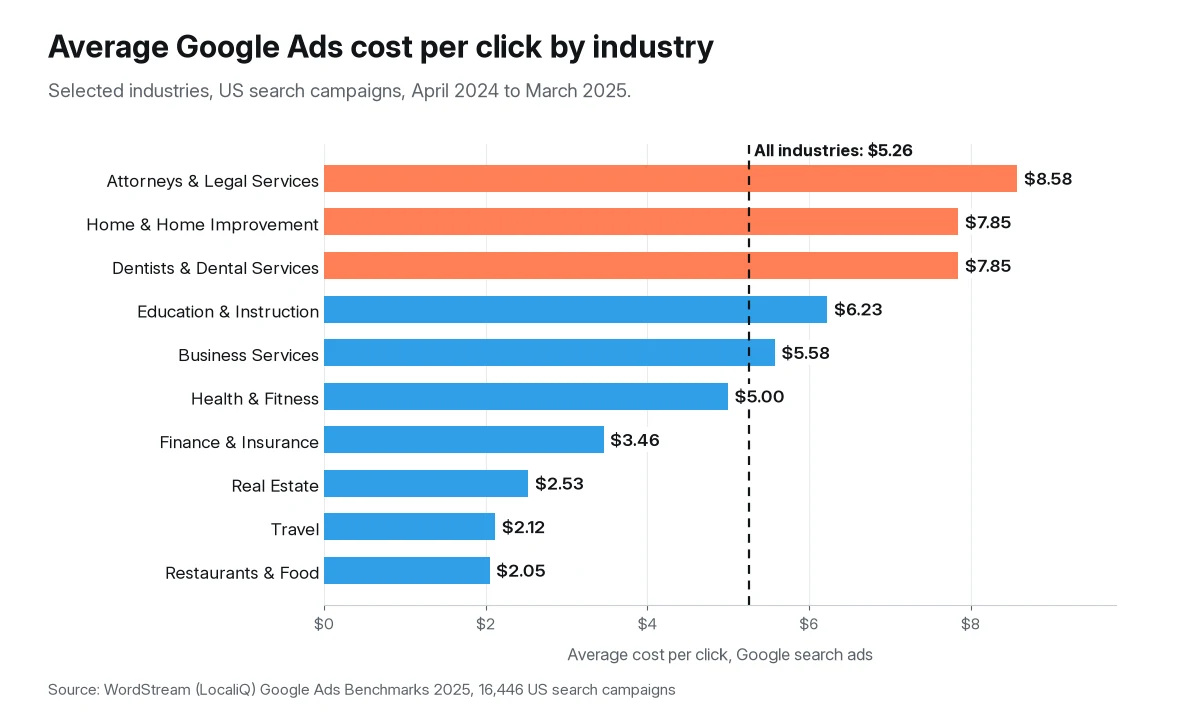
Average Google search ads cost per click for selected industries. Source: WordStream (LocaliQ) Google Ads Benchmarks 2025.
| Industry | Average CPC |
|---|---|
| Attorneys & Legal Services | $8.58 |
| Dentists & Dental Services | $7.85 |
| Home & Home Improvement | $7.85 |
| Education & Instruction | $6.23 |
| Business Services | $5.58 |
| Health & Fitness | $5.00 |
| Finance & Insurance | $3.46 |
| Real Estate | $2.53 |
| Travel | $2.12 |
| Restaurants & Food | $2.05 |
| All industries | $5.26 |
WordStream's 2025 benchmarks, based on 16,446 US search campaigns, put the average Google Ads cost per click at $5.26 and the average conversion rate at 7.52%, with a $70.11 average cost per lead (WordStream, Google Ads Benchmarks 2025). Your numbers will differ, but benchmarks help you sanity check a plan. If a proposal promises a volume of leads that would need a cost per click far below your industry's, ask how.
What drives the management fee:
- Number of platforms and campaigns. Google plus Meta plus LinkedIn is more work than Google search alone.
- Tracking work. Fixing conversion tracking, server-side events, and CRM imports is often a one-time project before ongoing management.
- Creative. Meta and YouTube need a steady supply of new ads. Check whether creative is included or billed separately.
- Landing pages and testing. Some providers build and test pages; others only manage the ad accounts.
- Reporting depth. Platform screenshots cost less to produce than reporting reconciled to your CRM and revenue.
Compare proposals layer by layer using the model above before comparing fees. A lower fee that skips tracking and landing pages usually costs more in wasted spend. For how agency pricing models work across services, see how much a marketing agency costs.
Who Should Manage Your PPC: In-House, Freelancer, or Agency?
The right setup depends on your spend, how many platforms you run, and whether paid media is already proving revenue. Most companies choose between an in-house specialist, a freelancer, a PPC agency, or a strategy-led partner that connects paid media to tracking, conversion work, and analytics.
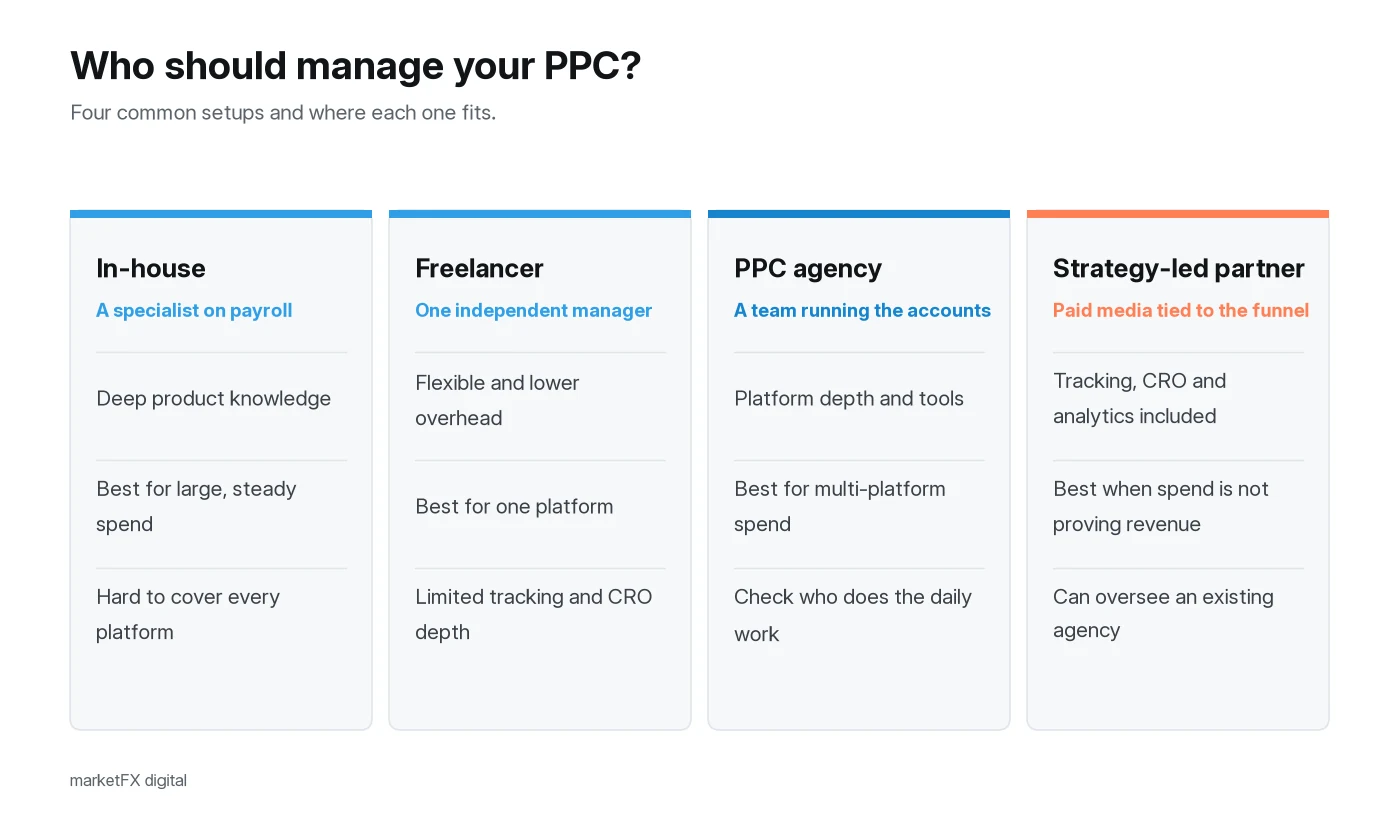
Four common ways to manage PPC and where each fits.
| Setup | What it is | Strength | Best fit | Watch out for |
|---|---|---|---|---|
| In-house | A specialist on payroll | Deep product knowledge | Large, steady spend | Hard to cover every platform |
| Freelancer | One independent manager | Flexible, lower overhead | One platform | Limited tracking and CRO depth |
| PPC agency | A team running the accounts | Platform depth and tools | Multi-platform spend | Who does the daily work |
| Strategy-led partner | Paid media tied to the funnel | Tracking, CRO, and analytics included | Spend that is not proving revenue | Can also oversee an existing agency |
There is no single right answer. Many growing companies keep a capable in-house marketer and add outside help for tracking, strategy, and the platforms they cannot cover. Another common setup is to keep the current agency and add independent oversight, which is often the fastest way to find out whether spend is working without changing who runs the accounts.
Multi-location and franchise brands have extra needs: location-level campaigns and budgets, local landing pages, call tracking by location, and reporting that rolls up to the brand while still showing each market. If that is your situation, ask providers how they handle it, and see our approach to multi-location and franchise marketing.
How Do You Know If a PPC Agency Is Doing a Good Job?
A good PPC agency reports on business results first and platform metrics second. You should see cost per qualified lead or sale, revenue or pipeline from paid media, and blended efficiency such as MER, reconciled with your CRM. Clicks, impressions, and platform ROAS are supporting detail.
Signs the work is solid:
- You own the ad accounts, the tracking, and the data, and you have admin access.
- Conversion counts in the platforms are close to your CRM, and someone can explain the gap.
- Search term reports and negative keyword lists are reviewed on a schedule you can see.
- Budget changes are explained in terms of revenue, not only platform metrics.
- New creative and landing page tests run continuously, with results recorded.
- Branded and non-branded search are reported separately.
Warning signs:
- Reports only show clicks, CTR, and platform ROAS.
- Results are celebrated while lead quality or sales are flat.
- Nobody can say which conversions the bidding is optimizing toward.
- The provider resists sharing account access or wants to own the account.
If you are unsure, an outside PPC and paid media audit is a low-risk first step. It shows where tracking, structure, and spend stand before you decide whether to change providers.
What Should You Ask Before Hiring a PPC Management Service?
Ask questions that reveal how a provider thinks, not just which platforms they use:
- How will you check our conversion tracking before changing campaigns, and what will you fix first?
- Which conversion will the bidding optimize toward, and how will you feed back lead quality or closed revenue?
- How do you split brand and non-brand results, and how do you stop Performance Max from taking credit for brand demand?
- How often do you review search terms and negative keywords?
- Who creates new ads for Meta and YouTube, and how often?
- Do you work on landing pages, or only inside the ad accounts?
- How will you decide budget between Google, Meta, and other channels?
- How will we know which results are incremental?
- Who owns the accounts and data if we part ways?
- Who will actually manage our account day to day?
Clear, specific answers to these matter more than a list of platform badges.
How marketFX Approaches Paid Media
At marketFX, paid media is part of a connected growth system rather than a channel run on its own. Our paid media management covers Google, Meta, LinkedIn, and YouTube across search, social, video, and programmatic. We start with measurement: conversion tracking, server-side events, and CRM parity before scaling spend, then allocate budget by revenue contribution.
For Google specifically, our Google Ads agency work covers Search, Performance Max, YouTube and Demand Gen, Shopping, and Display. If you already have an agency, we can run a paid media audit or provide strategic oversight alongside them. And because paid results depend on what happens after the click, we connect ads with conversion rate optimization, marketing attribution, and analytics, which is the idea behind our performance marketing agency model.
If you want to know whether your ad spend is working, book a strategy call. We will look at your tracking, your accounts, and how paid media connects to the leads and revenue your team actually sees.
Related services
FAQs
Frequently Asked Questions
- What do PPC management services include?
- PPC management services cover conversion tracking, account and campaign structure, keyword and audience targeting, negative keywords, bids and budgets, ad creative, landing page work, testing, and reporting. A complete service starts by checking that tracking counts the right results, then manages Google, Meta, and other platforms against revenue and pipeline rather than clicks.
- How much do PPC management services cost?
- Cost has two parts: ad spend paid to the platforms and a management fee paid to the provider, usually a percentage of spend, a flat monthly fee, or a hybrid with a minimum. The fee depends on platforms, campaigns, tracking work, creative, landing pages, and reporting depth. Click costs vary by industry, so set the ad budget from your own numbers.
- How long does PPC management take to show results?
- Ads can bring traffic within days, but useful results take longer. The first weeks usually go to fixing tracking and structure. Automated bid strategies also go through a learning period after they are created or changed. Judge performance over a few months using qualified leads, sales, and revenue, not the first week of platform data.
- What is the difference between Google Ads and Meta ads management?
- Google Ads management mostly captures demand from people already searching, using keywords, search terms, negative keywords, and bids. Meta ads management mostly creates demand among people who are not searching yet, using creative, offers, and audience signals. Most businesses need both, measured together so each platform does not take credit for the same sale.
- Is Performance Max worth using?
- Performance Max can work well when conversion tracking is accurate and the campaign optimizes toward valuable conversions. It needs guardrails: brand exclusions, campaign-level negative keywords, search terms and channel performance reporting, and checks on which pages final URL expansion sends traffic to. Without those, it can take credit for brand demand you would get anyway.
- Should I hire a PPC agency or manage ads in-house?
- An in-house specialist suits large, steady spend on a few platforms. A freelancer suits one platform. A PPC agency suits multi-platform spend. A strategy-led partner suits companies whose spend is not yet proving revenue, because it connects ads with tracking, landing pages, and analytics. Many companies combine an in-house marketer with outside help.
- How do you know if a PPC agency is doing a good job?
- A good PPC agency reports cost per qualified lead or sale, revenue or pipeline from paid media, and blended efficiency, reconciled with your CRM. You own the accounts and data, search terms and negative keywords are reviewed on a schedule, and budget changes are explained in revenue terms. Reports built only on clicks and platform ROAS are a warning sign.