
How to Choose an Integrated Marketing Agency: 8 Questions to Ask
How to choose an integrated marketing agency: use the marketFX One Team Scorecard™ and ask these 8 questions about ownership, measurement and reporting.
Quick Answer
To choose an integrated marketing agency, test whether one team owns the total marketing outcome, shares one measurement stack across paid, SEO, content and CRM, and can show how channels brief each other weekly. Ask who owns the accounts if you leave, how channel conflict gets resolved, what reporting actually decides, and whether pricing rewards total ROI rather than siloed spend.
Most brands that say they want an integrated marketing agency already have several vendors. Paid sits with one shop. SEO sits with another. Content, CRM and analytics are somewhere else. Each report looks fine in isolation. Revenue still stalls because nobody owns the handoffs.
This guide is the buyer evaluation checklist. It sits next to our model comparison on integrated vs fragmented marketing and our deeper look at fragmented marketing agencies and ROI. Those pages explain the structure problem. This one gives you eight questions, the marketFX One Team Scorecard™, and a way to score finalists without ranking competitor agencies.
What Is an Integrated Marketing Agency?
An integrated marketing agency plans and runs strategy, paid media, SEO and AI visibility, content, CRM and analytics as one program with shared goals, shared data and one owner of outcomes. It is not a holding company of specialists who only meet at QBRs. Integration shows up in weekly briefs, one measurement stack and reporting that decides where the next dollar goes.
Buyers often confuse "full service" with "integrated." Full service means a long menu. Integrated means the channels actually reinforce each other. For how marketFX packages that work as a strategy engagement, see digital marketing strategy. For the paid media side of the same system, see paid media services.
What Is the marketFX One Team Scorecard™?
The marketFX One Team Scorecard™ is an eight-criteria checklist that tests whether an agency behaves like one accountable team. Score each criterion Pass, Partial or Gap after the same pitch meeting with every finalist. Add the Passes. An agency that cannot clear most of the board is selling coordination theater, not integration.
Attribution: marketFX One Team Scorecard™ is an original marketFX framework for buyer evaluation. It is not a third-party ranking and it does not rate named competitors.
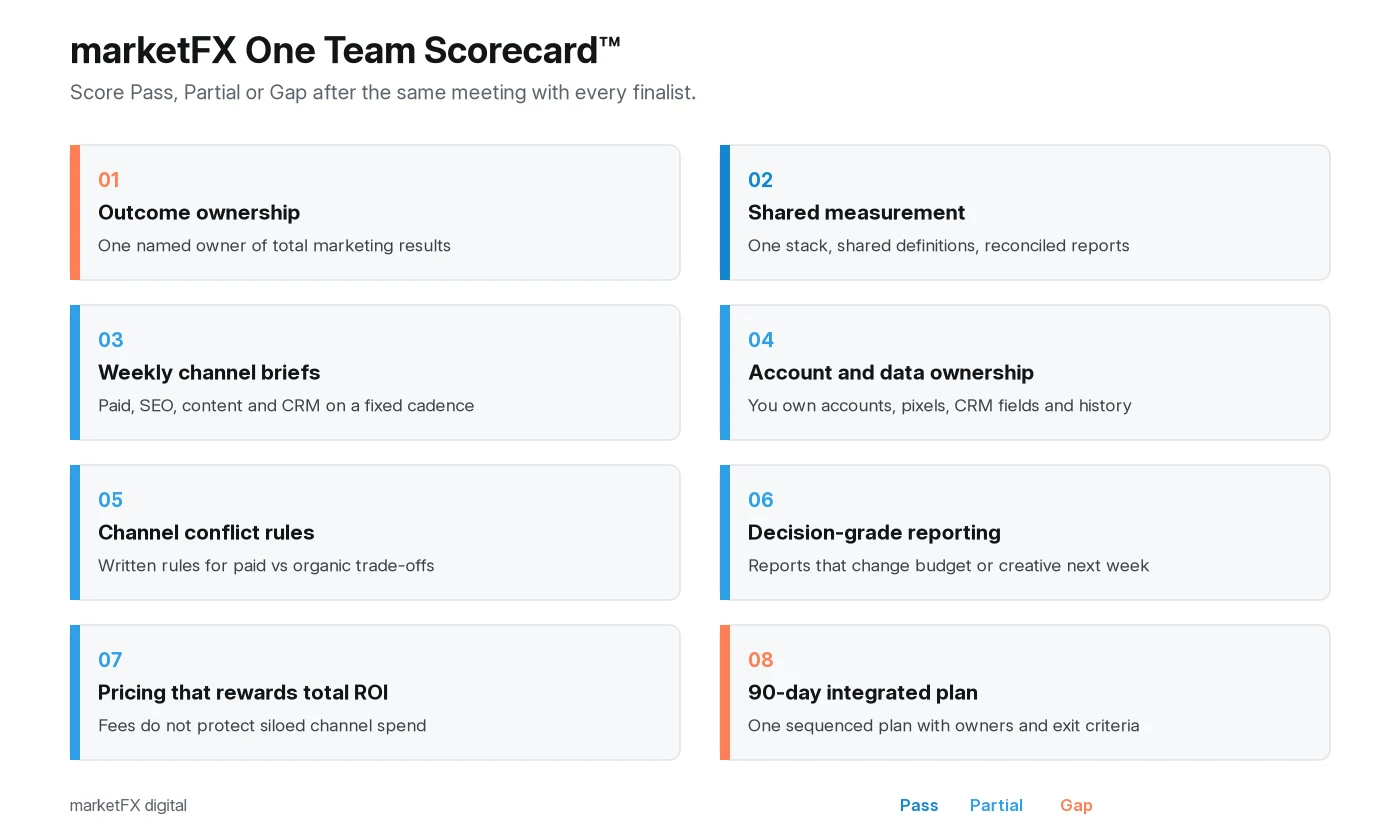
marketFX One Team Scorecard™. Score Pass, Partial or Gap for each criterion after the same meeting with every finalist.
| Criterion | What Pass looks like | What Gap looks like |
|---|---|---|
| 1. Outcome ownership | One named owner of total marketing results | Each channel lead only owns their channel KPI |
| 2. Shared measurement | One stack, shared definitions, reconciled reports | Separate vendor dashboards that never match |
| 3. Weekly channel briefs | Paid, SEO, content and CRM brief each other on a fixed cadence | Channels only sync at monthly or quarterly reviews |
| 4. Account and data ownership | You own accounts, pixels, CRM fields and history | Work lives inside the agency's accounts |
| 5. Channel conflict rules | Written rules for paid vs organic, brand vs performance | "We will figure it out" with no process |
| 6. Decision-grade reporting | Reports change budget or creative next week | Reports summarize vanity metrics by channel |
| 7. Pricing that rewards total ROI | Fees do not push channels to protect their own spend | Fee share rises when one channel spends more |
| 8. 90-day integrated plan | Sequenced plan across channels with owners and exit criteria | Separate 90-day plans stapled together |
Fill the scorecard in the room. Do not wait for a polished follow-up deck. The answers that matter are the ones the team can give live.
Which Buyer Keywords Point at This Decision?
Buyers searching for an integrated marketing agency often mix structural terms (integrated, full funnel, fragmented) with cost and strategy queries. The volumes below are cached Semrush US figures from Oct 2026. Keyword difficulty for the primary was not scored in that cache.
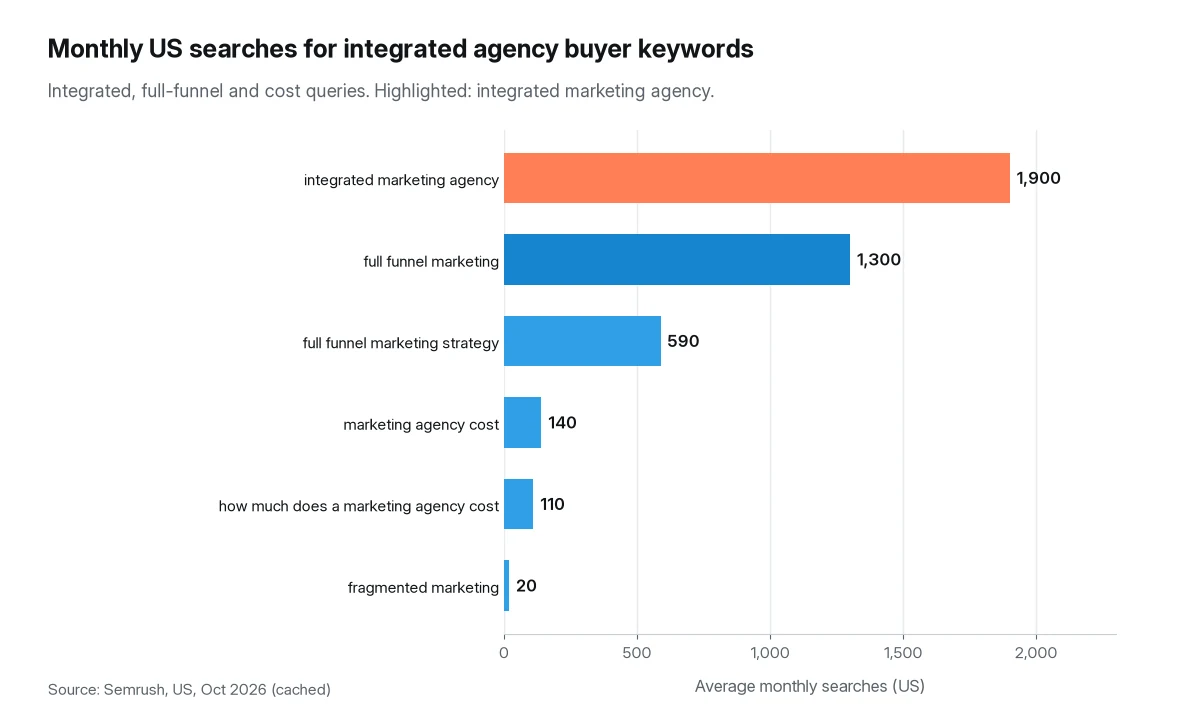
Monthly US searches for integrated and full-funnel buyer keywords. Source: Semrush, US, Oct 2026 (cached).
| Search term | US monthly searches | What buyers usually mean |
|---|---|---|
| integrated marketing agency | 1,900 | Hiring a partner that runs channels as one program |
| full funnel marketing | 1,300 | Brand plus performance working together |
| full funnel marketing strategy | 590 | How to structure the program |
| marketing agency cost | 140 | Budget bands and fee models |
| how much does a marketing agency cost | 110 | Same cost intent, longer query |
| fragmented marketing | 20 | Diagnosing multi-vendor waste |
The head term is commercial. This post owns the how-to-choose / questions-to-ask angle. The structural comparison lives on integrated vs fragmented marketing. The ROI math of fragmentation lives on fragmented marketing agencies and ROI.
What Questions Should You Ask an Integrated Marketing Agency?
Ask every finalist the same eight questions. Score them on the One Team Scorecard while they answer. The goal is a side-by-side comparison you can defend to finance and the executive team, not a popularity contest.
1. Who owns the total marketing outcome?
Listen for one named person who is accountable for pipeline, revenue contribution or another business outcome you care about. A strong answer names the owner, the meeting where trade-offs get made, and what happens when paid is up and SEO is flat. A weak answer lists channel leads and says "we collaborate."
If nobody owns the total, each channel will protect its own scorecard. That is fragmentation with better branding.
2. Do you run one shared measurement stack across channels?
Ask which tools, which conversion definitions and which attribution rules every channel uses. Ask how often reports are reconciled when Google Ads, Meta, LinkedIn, Search Console and CRM disagree. Funnel's 2026 Marketing Intelligence reporting has repeatedly highlighted that a large majority of marketers still lack a clear signal on what is working when data is fragmented across platforms (Funnel reporting guide summarizing the 2026 Marketing Intelligence Report).
A Pass means shared definitions and a written reconciliation process. A Gap means each vendor ships its own dashboard and you are the integrator.
3. How do paid, SEO, content and CRM brief each other every week?
Integration is a cadence, not a slide. Ask for the weekly ritual: who attends, what gets shared (search queries, creative winners, lead quality, sales objections) and what changes as a result. For how SEO and AI visibility sit inside that loop, see SEO and AI visibility consulting.
If the only sync is a monthly deck, channels are optimizing past each other.
4. Who owns the ad accounts, analytics, CRM fields and creative if we leave?
You should own the accounts. The agency should work inside them with clear access roles. Ask what happens to pixels, conversion APIs, UTM standards, call tracking, landing pages and historical data at offboarding. If the answer is vague, assume switching costs are being built in.
5. How do you resolve channel conflict?
Paid search bidding on brand terms that organic already wins. Retargeting that burns audience quality. Content that chases topics paid already saturates. Ask for a written conflict rule and a recent example of a trade-off they forced. Agencies that cannot describe a hard call are not integrating. They are avoiding conflict.
6. What does monthly reporting actually decide?
Ask to see a redacted report and point to the last three decisions it drove. Budget moves, creative kills, landing page tests and CRM handoff fixes count. Channel CTR tables that never change next week's plan do not. This is the reporting test behind the One Team Scorecard's decision-grade criterion.
7. How is pricing structured so channels are not competing for fee share?
Ask whether any part of the fee rises automatically when one channel's media spend rises, and whether SEO, content and CRM are funded as first-class work or as leftovers. Pricing honesty matters here: many buyers ask for a single number too early. Fee models (retainer, percent of spend, project, hybrid) are comparable only after scope, channels and ownership are clear. See also our guide on marketing agency cost for model definitions without invented price tables.
8. Can you show a 90-day integrated plan with owners and exit criteria?
Ask for a plan that sequences measurement fixes, creative and landing tests, SEO or AI visibility work, and CRM handoffs in one timeline. Separate 90-day plans stapled into one PDF are a Gap. One plan with shared milestones and clear exit criteria is a Pass.
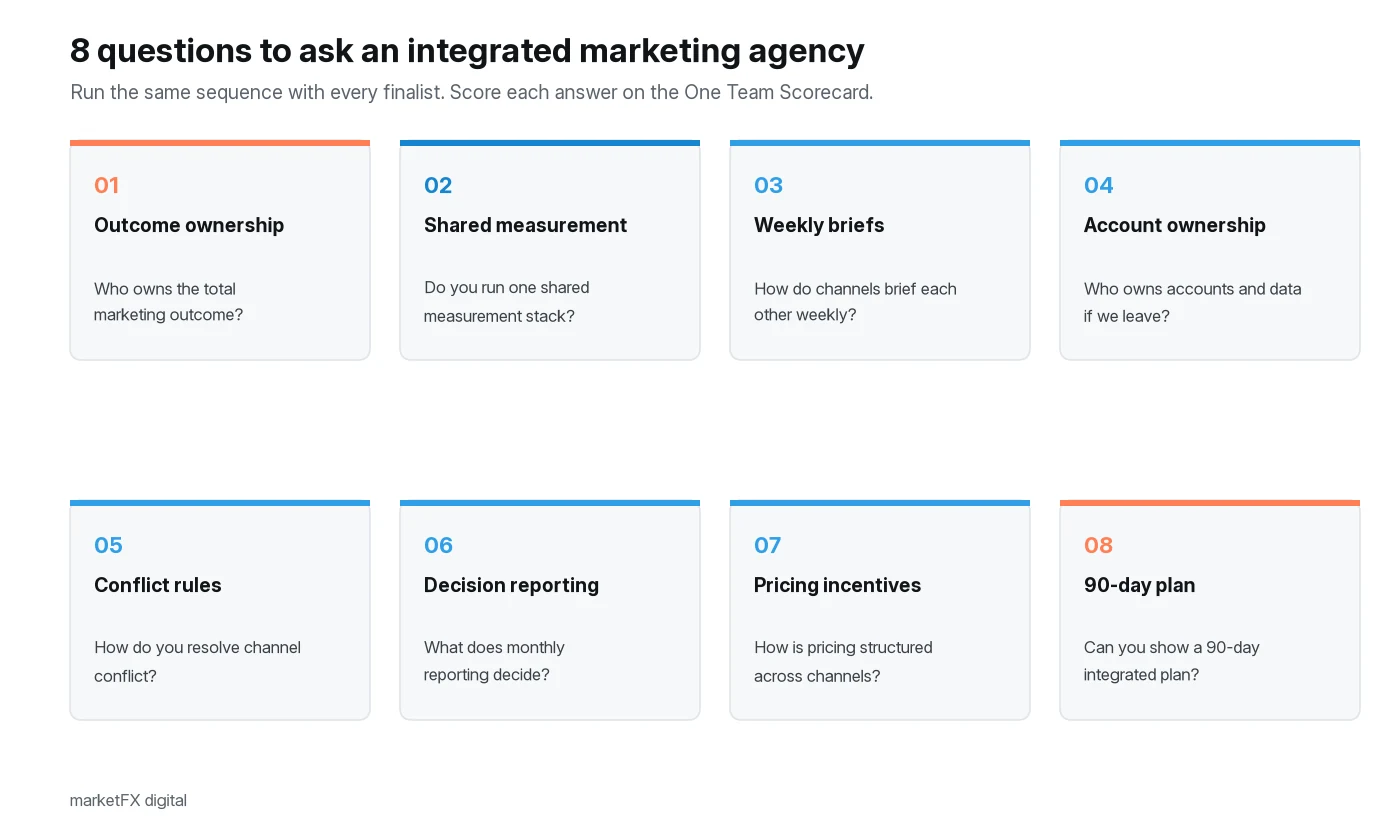
Eight questions, one scorecard. Run the same sequence with every finalist.
| # | Question | Scorecard criterion | Pass signal |
|---|---|---|---|
| 1 | Who owns the total marketing outcome? | Outcome ownership | One named owner of business results |
| 2 | Do you run one shared measurement stack? | Shared measurement | Shared definitions and reconciliation |
| 3 | How do channels brief each other weekly? | Weekly channel briefs | Fixed cadence with actionable handoffs |
| 4 | Who owns accounts and data if we leave? | Account and data ownership | You own accounts and history |
| 5 | How do you resolve channel conflict? | Channel conflict rules | Written rules plus a real example |
| 6 | What does monthly reporting decide? | Decision-grade reporting | Report drove budget or creative changes |
| 7 | How is pricing structured across channels? | Pricing that rewards total ROI | Fees do not protect siloed spend |
| 8 | Can you show a 90-day integrated plan? | 90-day integrated plan | One sequenced plan with exit criteria |
How Should You Compare Finalists Side by Side?
Build a simple comparison table before the first pitch. Rows are the eight scorecard criteria. Columns are finalists. Cells are Pass, Partial or Gap. Do not average soft impressions. Count Passes, note the Gaps that would create switching pain, and force a written remediation plan for any Partial you are willing to live with.
| Scorecard criterion | Finalist A | Finalist B | Finalist C | Notes |
|---|---|---|---|---|
| 1. Outcome ownership | ||||
| 2. Shared measurement | ||||
| 3. Weekly channel briefs | ||||
| 4. Account and data ownership | ||||
| 5. Channel conflict rules | ||||
| 6. Decision-grade reporting | ||||
| 7. Pricing that rewards total ROI | ||||
| 8. 90-day integrated plan | ||||
| Pass count |
Never turn this into a public "best agencies" list. Rank fit against your scorecard. Do not rank brands for the internet.
How Should Pricing Conversations Stay Honest?
Ask for fee structure, what is included, what is out of scope, and how change orders work. Do not ask "what do you charge?" before you know which channels, which markets and which measurement rebuilds are in scope. Percent-of-spend fees can reward media volume. Pure retainers can hide under-staffing. Hybrids can work when the incentives are written down.
marketFX does not publish invented price tables on this page. If you need a second opinion on structure before you sign, book a strategy call. We will tell you which Gaps on your current vendor map are costing you the most, even if you do not hire us.
For a related decision on whether to keep work in-house, see marketing agencies vs in-house team.
When Is an Integrated Agency the Wrong Fit?
Integration is not always the answer. A single-channel specialist can be right when you already have a strong in-house strategy lead, clean measurement and a clear owner of trade-offs. An integrated agency is the better fit when handoffs are failing, reports disagree, channel conflict is unresolved, or nobody owns total ROI.
If your problem is mostly paid media execution inside an otherwise healthy system, start with a focused paid media review rather than a full re-platform of every vendor.
How marketFX Approaches Integrated Marketing
We run strategy, paid media, SEO and AI visibility, CRM and analytics as one program with shared measurement and one owner of outcomes. Across client work we report 94% client retention, more than 20 years driving growth, and more than $20 million in revenue tracked. We use the same One Team Scorecard logic on ourselves that we recommend you use on any finalist.
If you want a second opinion on your current vendor map, book a strategy call. Bring the scorecard. We will walk your Gaps in plain language.
FAQs
Frequently Asked Questions
- What is an integrated marketing agency?
- An integrated marketing agency runs multiple marketing disciplines as one program with shared goals, shared data and one owner of business outcomes. The difference from a multi-vendor setup is ownership of the handoffs, not the length of the service menu.
- How is an integrated agency different from a fragmented vendor model?
- In a fragmented model, each vendor optimizes its own channel KPI and reporting. In an integrated model, channels share briefs, measurement and trade-off rules, and one team is accountable for total marketing results. See integrated vs fragmented marketing for the structural comparison.
- What questions should I ask before hiring an integrated marketing agency?
- Ask who owns total outcomes, whether measurement is shared, how channels brief each other weekly, who owns accounts and data, how channel conflict is resolved, what reporting decides, how pricing incentives work, and whether they can show one 90-day integrated plan. Those eight map to the marketFX One Team Scorecard™.
- How much does an integrated marketing agency cost?
- Cost depends on scope, channels, markets and whether measurement needs a rebuild. Compare fee models only after scope is clear. This page does not invent price ranges. Ask finalists for written scope, inclusions and change-order rules, then compare on the same scorecard.
- Can I keep some specialists and still run an integrated model?
- Yes, if one owner controls trade-offs, measurement definitions and the weekly brief. Specialists can sit inside an integrated operating model. They cannot replace the owner of total outcomes.
- How long does it take to see results from switching to an integrated agency?
- Measurement and waste fixes often show up first. Creative, SEO and CRM changes take longer. Ask for 30, 60 and 90-day exit criteria in the integrated plan so you are measuring progress against agreed checkpoints, not vibes.
- Should I hire an integrated agency or build an in-house team?
- It depends on whether you can staff strategy, channel depth, measurement and management bandwidth. Many brands run a hybrid: in-house ownership of brand and CRM with an integrated partner on paid, SEO and analytics. See marketing agencies vs in-house team.