
Marketing Agency RFP: Template, Timeline and Scoring Guide
A marketing agency RFP template with the 10 sections to include, a realistic timeline, how many agencies to invite and a weighted scorecard for responses.
Quick Answer
A marketing agency RFP (request for proposal) is a written brief that asks a shortlist of agencies to explain how they would reach your goals, who would do the work and what it would cost, all in the same format. A good RFP states your goals, scope, budget range, timeline and the scoring weights you will use.
Most companies only hire a marketing agency every few years, so the process gets rebuilt from scratch each time. Someone finds an old template, adds a list of questions, sends it to whoever came up in a search, and three weeks later the team is comparing five proposals that answer different questions at different prices. A good request for proposal fixes that before it starts.
RFPs are not going away. In the Agency Management Institute's 2024 Agency Edge study of 400 marketing decision makers at organizations with under $500 million in revenue, one in two had issued an RFP or RFI to find an agency, and 91% said it had been at least somewhat effective. Yet only 18% said they assess agencies with an established scorecard (Agency Management Institute, Getting Hired in 2024). The brief gets written. The scoring is usually left to gut feel.
This guide gives you both: a copyable marketing agency RFP template with the ten sections that matter, a realistic timeline, and the marketFX Brief, Compare, Choose Method™ for turning responses into a decision you can defend. If you are earlier in the process, start with our 12 questions to ask a digital marketing agency.
What Is a Marketing Agency RFP?
A marketing agency RFP is a document you send to a shortlist of agencies that describes your business, your goals and the work you need, and asks each agency to respond with an approach, a team and a price in a set format. Its job is to make proposals comparable, so you judge agencies on the same brief instead of on who tells the best story.
An RFP is one of three related documents. Many searches combine them, so it helps to know which one you need.
| Document | What it asks for | When to use it | Typical length |
|---|---|---|---|
| RFI (request for information) | Capabilities, team size, experience, clients, basic fees | You have a long list and need to cut it to three to five agencies | A few pages and 10 to 15 questions |
| RFP (request for proposal) | A proposed approach, named team, plan for the first 90 days, pricing and measurement | You have a shortlist and a defined scope or goal | 8 to 15 pages plus attachments |
| RFQ (request for quotation) | A price for a fixed, clearly specified deliverable | The work is already defined, such as a set number of ads or a site build to spec | A specification and a price table |
When Should You Use an RFP to Hire a Marketing Agency?
Use an RFP when the engagement is large enough that a wrong choice would cost you months, when several people need to agree on the decision, or when your company's purchasing rules require competitive bids. Skip the formal RFP when the scope is small, when you already know the agency you want, or when the real problem is still unclear.
Signs an RFP is worth the effort:
- The work covers several channels or teams, such as paid media, SEO, content and reporting, and you need one plan across them.
- Procurement, finance or leadership will review the decision and want a documented process.
- You are replacing an incumbent agency and need a fair comparison that includes them.
- You plan to keep the relationship for years, so the cost of a bad fit is high.
Signs a lighter process is better:
- The project is a one-off with a fixed deliverable. An RFQ or a short brief is enough.
- You do not yet know what is wrong with your marketing. An audit or a diagnostic project will tell you what to ask for.
- You run a small business and are choosing between two or three agencies you already know. A one-page brief and a call with each will usually get you further.
What Should a Marketing Agency RFP Include?
A marketing agency RFP should include ten sections: company background, business goals and KPIs, scope and exclusions, your current setup, budget range, timeline, questions for agencies, proposal format and pricing table, evaluation criteria, and terms and contacts. The table below shows what each one is for and what to ask agencies to send back.
| # | Section | What you write | What agencies send back |
|---|---|---|---|
| 1 | Company background | What you sell, to whom, where, and how you make money | Evidence they understood it, in their own words |
| 2 | Business goals and KPIs | Revenue, leads, bookings or margin targets, with current baselines | How their plan connects to those numbers |
| 3 | Scope and exclusions | Channels, markets and tasks in scope, and what is not | Confirmation of scope, plus anything they think is missing |
| 4 | Current setup | Your internal team, other agencies and partners, tools and data | How they would work alongside your people and partners |
| 5 | Budget range | Agency fees and media spend as separate ranges | A plan that fits the range, with options above and below it |
| 6 | Timeline | Key dates from questions to start date | A realistic onboarding plan for the first 90 days |
| 7 | Questions for agencies | 8 to 12 questions that matter for your decision | Direct answers, in order, within a word limit |
| 8 | Proposal format and pricing table | Page limits, file format and a pricing table to complete | Proposals and prices in the same structure |
| 9 | Evaluation criteria | The criteria and weights you will score against | Responses aimed at what you actually value |
| 10 | Terms and contacts | Confidentiality, ownership, deadlines and one contact | Questions sent to one person by one date |
1. Company background
Write one page, not ten. Cover what you sell, who buys it, where you operate, how customers find you today and what makes a good customer worth to you. Agencies cannot propose a sensible plan without knowing your margins and sales cycle, even roughly.
2. Business goals and KPIs
State goals as business outcomes with a baseline and a target: qualified leads per month, booked appointments, online revenue, cost per acquisition, or customer lifetime value. "Increase brand awareness" is not a goal an agency can be held to. "Grow qualified leads from 120 to 180 a month at or below today's cost per lead" is.
3. Scope and exclusions
List the channels and tasks in scope, such as paid search, paid social, SEO, AI search visibility, email, content, website changes or reporting. Then list what is out of scope. Exclusions prevent the most common problem in agency proposals: two agencies quoting different amounts of work and looking like a cheap option and an expensive one.
4. Your current setup
Describe who does what today. Name the internal roles, the other agencies and freelancers you work with and plan to keep, and the main tools you use for analytics, ads, CRM and your website. Most businesses already have people and partners in place, and the new agency has to fit around them. Asking how an agency would work with your existing team and partners tells you more about the working relationship than any credentials page.
5. Budget range
Share a range. Agencies cannot design a sensible plan for an unknown budget, and a blind ask produces proposals you cannot compare. Separate agency fees from media spend, because a proposal that blends them makes it hard to see what you are paying for. Our guide to how much a marketing agency costs in 2026 explains the cost layers that sit behind a quote.
6. Timeline
Give dates for questions, answers, proposals, finalist meetings, the decision and the start date. Leave enough time for good answers. A deadline of a week or two pushes agencies toward reused material.
7. Questions for agencies
Ask 8 to 12 questions, each tied to something you will score. Good RFP questions ask for evidence and specifics: who will work on the account and what share of their time, how the agency would approach your first 90 days, how it measures results against your goals, and what it would change or stop doing. Set a word limit, such as 250 to 400 words per answer, so responses stay focused.
8. Proposal format and pricing table
Tell agencies exactly how to respond: page limit, file format, section order and the pricing table they must complete. A shared pricing table is the single most useful part of an RFP, because it lets you compare like with like. The template below includes one.
9. Evaluation criteria and weights
Publish the criteria and the weights. Agencies will focus on what you say matters, and your own team will score more consistently if the weights were agreed before anyone read a proposal.
10. Terms and contacts
Cover confidentiality, who owns any work produced during the process, the submission deadline and one named contact for all questions. If you will share answers to one agency's questions with all agencies, say so.
Copyable Marketing Agency RFP Template
Copy the outline below into a document and fill in each part. Delete anything that does not apply. Most strong RFPs end up between 8 and 15 pages before attachments.
| Section | Prompts to complete |
|---|---|
| Cover page | Company name, project name, issue date, response deadline, contact name and email |
| 1. About us | What we sell; who our customers are; where we operate; how customers find and buy from us today; what a good customer is worth |
| 2. What we want to achieve | Two to four business goals with today's baseline and a 12 month target; how we measure them today |
| 3. Scope of work | In scope: channels, markets, deliverables. Out of scope: what stays in house or with other partners |
| 4. How we work today | Internal team and roles; other agencies and freelancers we are keeping; tools for analytics, ads, CRM, website and reporting; who has admin access to each account |
| 5. Budget | Agency fee range per month or per year; media budget range; any one-off budget for setup, tracking or website work |
| 6. Timeline | Questions due; answers shared; proposals due; finalist meetings; decision; start date |
| 7. Questions | 8 to 12 numbered questions, each with a word limit |
| 8. Proposal format | Page limit; section order; named team with roles and time on the account; plan for the first 90 days; reporting sample; completed pricing table |
| 9. How we will decide | Criteria, weights and scoring scale; who is on the selection team; whether finalists will present |
| 10. Terms | Confidentiality; ownership of submitted work; no unpaid speculative creative unless stated; how questions are handled |
Attach anything that saves agencies from guessing: a recent performance summary, a list of current campaigns and channels, brand guidelines, and any reporting your leadership already uses.
The marketFX Brief, Compare, Choose Method™
The marketFX Brief, Compare, Choose Method™ is the three-stage process we recommend for running an agency RFP. Brief is writing a document that agencies can actually answer. Compare is scoring every response against the same criteria before anyone talks about price. Choose is testing the finalists in conversation and agreeing terms before you sign.
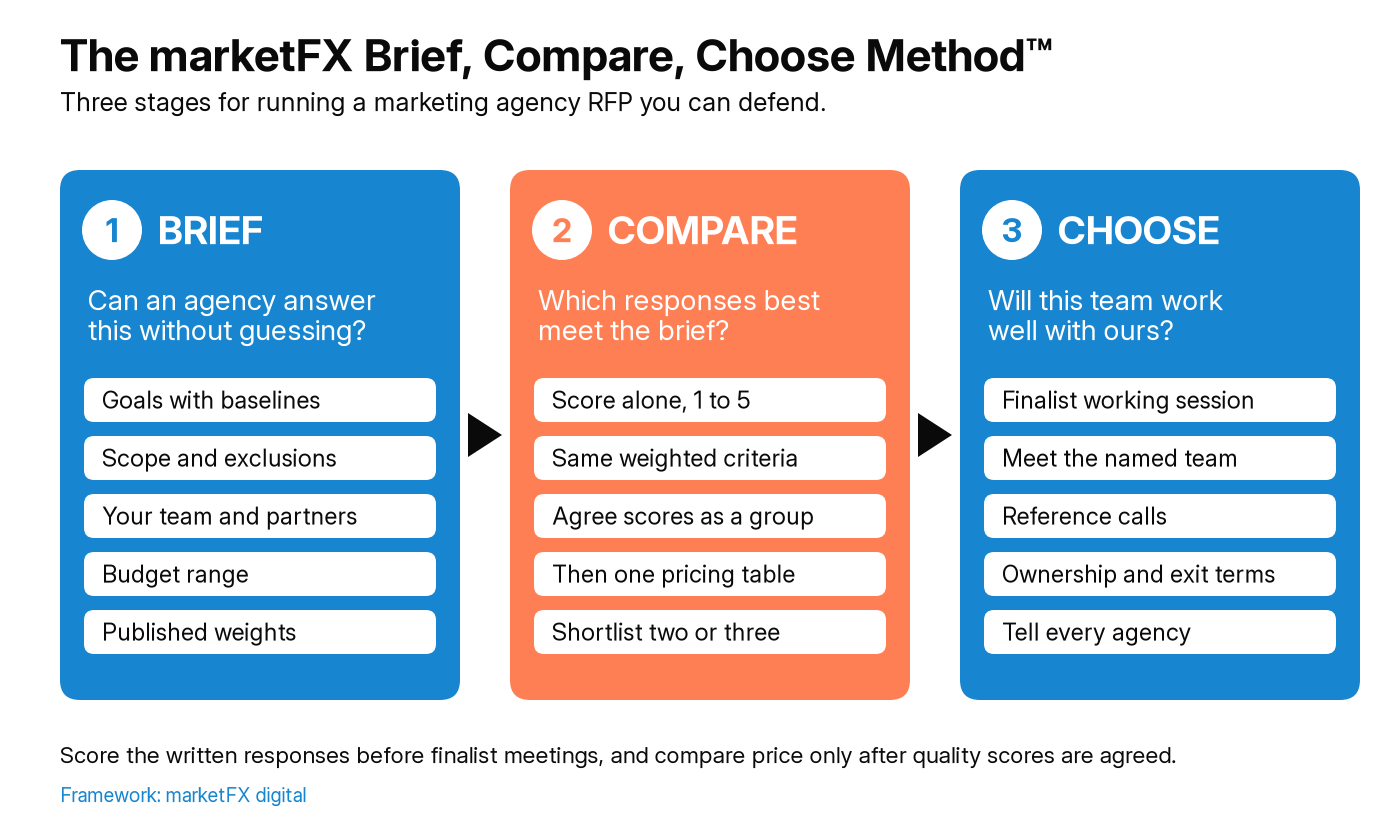
| Stage | Question it answers | Main output | Common mistake it prevents |
|---|---|---|---|
| Brief | Can an agency answer this without guessing? | A 10-section RFP with goals, budget range and weights | Proposals that answer different questions |
| Compare | Which responses best meet the brief? | A weighted scorecard and a single pricing table | Choosing on presentation style or lowest headline price |
| Choose | Will this team work well with ours? | Finalist sessions, references and an agreed contract | A good proposal followed by a poor working relationship |
How Long Does a Marketing Agency RFP Process Take?
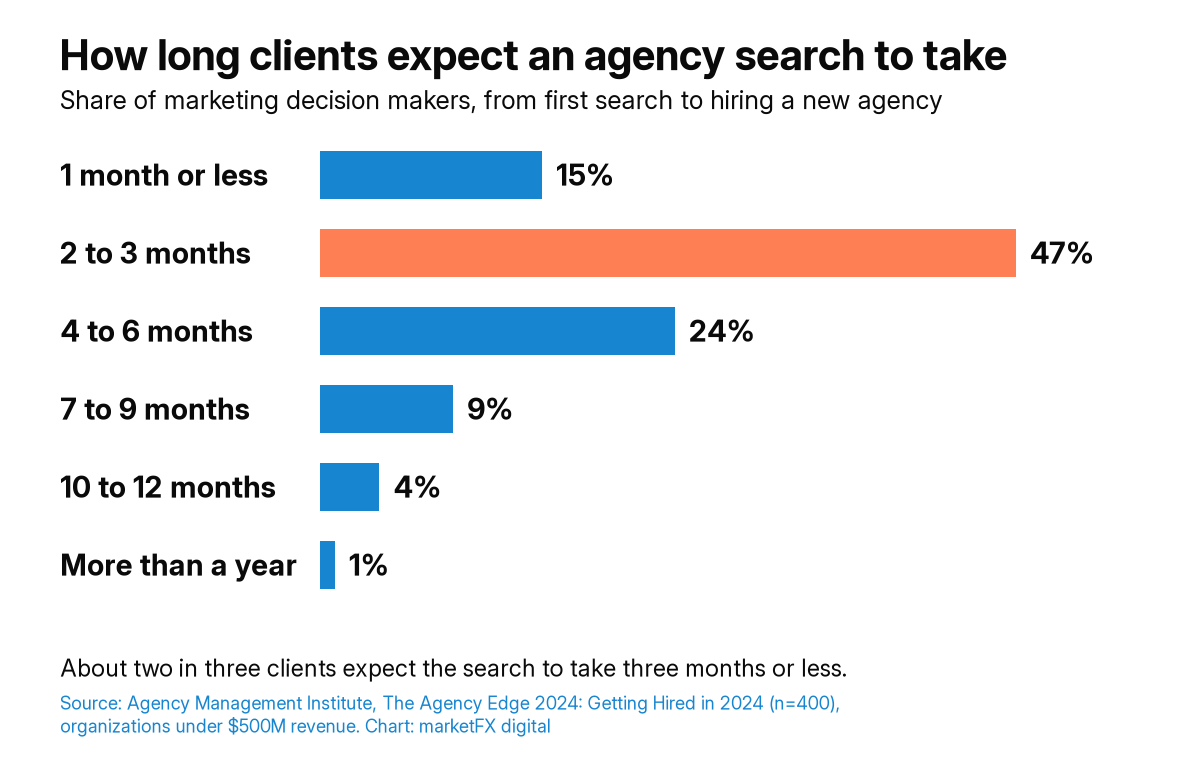
Most marketing agency searches take two to three months from first brief to decision. In the Agency Edge study, 47% of clients expected a search for a new agency to take two to three months, 15% expected one month or less, and 24% expected four to six months (Agency Management Institute, Getting Hired in 2024).
A realistic plan for a mid-sized search looks like this. Shorter is possible when the scope is small. Longer is common when several stakeholders or a procurement team are involved.
| Week | Step | Owner |
|---|---|---|
| 1 to 2 | Agree goals, scope, budget range and weights internally; write the RFP | You |
| 2 | Send an RFI or make calls to cut a long list to three to five agencies | You |
| 3 | Issue the RFP | You |
| 4 | Agencies send questions; you share answers with all of them | Both |
| 6 | Proposals due | Agencies |
| 7 | Score proposals independently, then agree scores as a group | You |
| 8 | Finalist working sessions with two or three agencies | Both |
| 9 | Reference calls and contract terms | You |
| 10 | Decision, notify every agency, plan onboarding | You |
How Many Agencies Should Receive Your RFP?
Send your RFP to three to five agencies. Fewer than three gives you little to compare. More than five creates more reading than most teams can score carefully, and it lowers the effort strong agencies are willing to put in, because their odds of winning drop.
Pitches are expensive for both sides. Digiday reported that the Association of National Advertisers estimated in 2023 that running a pitch costs clients more than $400,000 on average and costs each participating agency more than $200,000, figures that reflect large advertiser reviews (Digiday, October 24, 2025). Your process will cost far less, but the principle holds: every extra agency adds hours of reading, meetings and scoring for your team.
Use an RFI or a short call to build the shortlist. Look for agencies that have worked on problems like yours, that can name the people who would do the work, and that ask good questions before they pitch.
How Should You Score Marketing Agency RFP Responses?
Score every response against the same weighted criteria, with each reviewer scoring alone before the group compares notes. Use a 1 to 5 scale, multiply by the weight, and only look at price once the quality scores are in. This stops the cheapest or most polished proposal from setting the anchor.
| Criterion | Weight | What a 5 looks like |
|---|---|---|
| Understanding of the business and goals | 20% | Plays back your goals accurately, asks sharp questions and spots gaps in the brief |
| Strategy and first 90 days | 20% | A clear plan with priorities, and a view on what to stop doing as well as start |
| Team and fit with your people and partners | 15% | Named people, time on the account, and a clear way of working with your team and other agencies |
| Relevant experience and proof | 15% | Similar problems solved, with starting points and outcomes you can check with references |
| Measurement and reporting | 15% | Reporting tied to your business goals, with a sample report |
| Commercial clarity | 15% | Completed pricing table, clear inclusions and exclusions, sensible terms |
When you compare price, use the pricing table, not the headline number. A low retainer that excludes setup, tracking, reporting or creative is not cheaper if you have to pay for those separately later.
| Line item | Agency fee | Billing model | Included or extra |
|---|---|---|---|
| One-off setup, audit and tracking | $ | Fixed or hourly | |
| Monthly strategy and account management | $ | Retainer | |
| Paid media management, by channel | $ | Flat, % of spend or hybrid | |
| SEO, content and AI search visibility | $ | Retainer or project | |
| Creative production | $ | Per asset or included | |
| Reporting and analytics | $ | Included or separate | |
| Tools and software passed through | $ | At cost or marked up |
What Are the Most Common Marketing Agency RFP Mistakes?
The most common RFP mistakes are hiding the budget, asking for too much free work, sending the RFP to too many agencies and choosing on presentation rather than on the brief. Each one makes responses harder to compare or pushes the best agencies away.
- No budget range. Agencies guess, and you get proposals at very different scales.
- Goals without baselines. Without today's numbers, nobody can propose a realistic target.
- Asking for unpaid speculative creative. It rewards agencies with spare capacity, not the best fit. If you want to see thinking, ask for a short working session on a real problem instead.
- Too many questions. Fifty questions get fifty short, generic answers. Ten good ones get real thinking.
- Leaving out your existing team and partners. The new agency has to work with them, so the RFP should say who they are.
- Scoring after the pitch meeting. Score the written responses first, then use finalist meetings to test the top scores.
- Silence after the decision. Tell every agency the outcome and offer brief feedback. Your next search will be easier for it.
Both sides feel these problems. In research reported by Digiday, 68% of brand marketers and 84% of agency executives surveyed by Creativebrief said the pitch process was not fit for purpose (Digiday, October 24, 2025).
Should You Write an RFP or Start With an Audit?
If you are not sure what is wrong with your current marketing, start with an audit before you write an RFP. An RFP asks agencies to propose a solution. If the problem is unclear, every agency will diagnose it differently, and you will be comparing guesses.
An outside review of your accounts, tracking and results gives you the baselines, priorities and scope that a good RFP needs. Our marketing audit services page explains what that review covers.
How marketFX Can Help Before You Write Your RFP
marketFX is a North American omnichannel marketing company that helps businesses bring their internal teams, agency partners and channels together so time and budget go where they matter most. If you are about to run an agency search, we can give you an outside view first with a free audit: a one-page written summary of what we find, plus a 30-minute walkthrough. It is yours to keep, whether you include us in your RFP or not.
Related services
FAQs
Frequently Asked Questions
- What is an RFP in marketing?
- An RFP, or request for proposal, is a document a company sends to several marketing agencies asking each to propose an approach, a team and a price for the same brief. It is used to compare agencies fairly before hiring one.
- How do I write an RFP for a marketing agency?
- Start with your goals and baselines, then describe your business, scope and exclusions, current team and partners, budget range and timeline. Add 8 to 12 questions, a required proposal format with a pricing table, and the weighted criteria you will use to score responses.
- How many agencies should I send a marketing RFP to?
- Three to five agencies is enough for a meaningful comparison. Use an RFI or short calls to cut a longer list down first. More than five usually means rushed scoring and less effort from the strongest agencies.
- Should I include my budget in a marketing agency RFP?
- Yes. Share a range, with agency fees and media spend shown separately. Without a range, agencies have to guess, and the proposals you receive will be built for very different budgets and will be hard to compare.
- How long should a marketing agency RFP process take?
- Plan for about two to three months from writing the brief to choosing an agency. In the Agency Management Institute's 2024 study, 47% of clients expected an agency search to take two to three months. Smaller searches can move faster.
- What is the difference between an RFI and an RFP?
- An RFI asks for general information about an agency's capabilities and experience and is used to build a shortlist. An RFP asks the shortlisted agencies for a specific proposal, team and price for your project.
- Do small businesses need an RFP to hire a marketing agency?
- Usually not a formal one. A one-page brief with your goals, budget range and timeline, sent to two or three agencies, followed by a call with each, gives most small businesses what they need. Use the same scorecard to compare them.