
12 Questions to Ask a Digital Marketing Agency Before You Hire
12 questions to ask a digital marketing agency before you hire, covering strategy, proof, people and control, plus red flags and a scorecard for finalists.
Quick Answer
Before you hire a digital marketing agency, ask questions that test four things: strategy, proof, people and control. Ask how they will learn your business and tie work to revenue, what a business like yours got and how fast, who will actually do the work, and who owns your accounts, data and exit terms. Compare every finalist on the same answers.
Hiring a digital marketing agency is one of the bigger spending decisions a marketing leader makes, and most of the information you get during the search comes from the agency's own pitch. Good questions fix that. They move the conversation from what an agency says it does to how it would actually work on your business, who would do the work, and what happens if it does not go to plan.
The pressure to get this right has gone up. In Gartner's 2026 CMO Spend Survey, marketing budgets averaged 7.8% of company revenue, barely up from 7.7% in 2025, and 56% of CMOs said their marketing organization lacks the budget required to deliver their 2026 strategy (Gartner, May 11, 2026). When budgets are flat, every agency dollar has to earn its place.
Below are the 12 questions we would ask if we were on your side of the table, grouped by the marketFX Agency Hiring Scorecard™. If you already know you want one team running every channel, our guide to choosing an integrated marketing agency goes deeper on that decision.
What Should You Ask a Digital Marketing Agency Before Hiring?
Ask questions that test four things: whether the agency understands your business (strategy), whether it can show relevant results (proof), who will really do the work (people), and whether you keep ownership and a clean exit (control). Ask every finalist the same 12 questions, in writing where you can, so you compare answers rather than presentations.
| # | Question | Lens | What it tests |
|---|---|---|---|
| 1 | What do you need to know about our business before you recommend anything? | Strategy | Discovery and diagnosis |
| 2 | Which channels would you prioritize for us, and which would you cut? | Strategy | Channel judgment |
| 3 | How will you define success, and how will you tie it to revenue? | Strategy | Measurement |
| 4 | Can you show work for a business like ours, with the starting point and timeline? | Proof | Relevant results |
| 5 | Can we speak with a current client? | Proof | References |
| 6 | What will the first 90 days produce? | Proof | Planning and pace |
| 7 | Who will actually work on our account, and how much of their time do we get? | People | Team and capacity |
| 8 | How will you run brand and local marketing across our locations? | People | Fit for multi-location brands |
| 9 | How do you use AI, and where do people review the work? | People | AI governance and quality |
| 10 | Who owns the ad accounts, analytics, data and creative? | Control | Ownership and access |
| 11 | How is pricing structured, and what is not included? | Control | Cost clarity |
| 12 | What are the contract terms, and how does an exit work? | Control | Accountability and transition |
What Is the marketFX Agency Hiring Scorecard™?
The marketFX Agency Hiring Scorecard™ is a simple way to score agency answers across four lenses: Strategy, Proof, People and Control. Each lens holds three of the 12 questions. An agency that scores well on only one or two lenses is a risk, however good the pitch looks, because the weak lens is usually where the relationship breaks later.
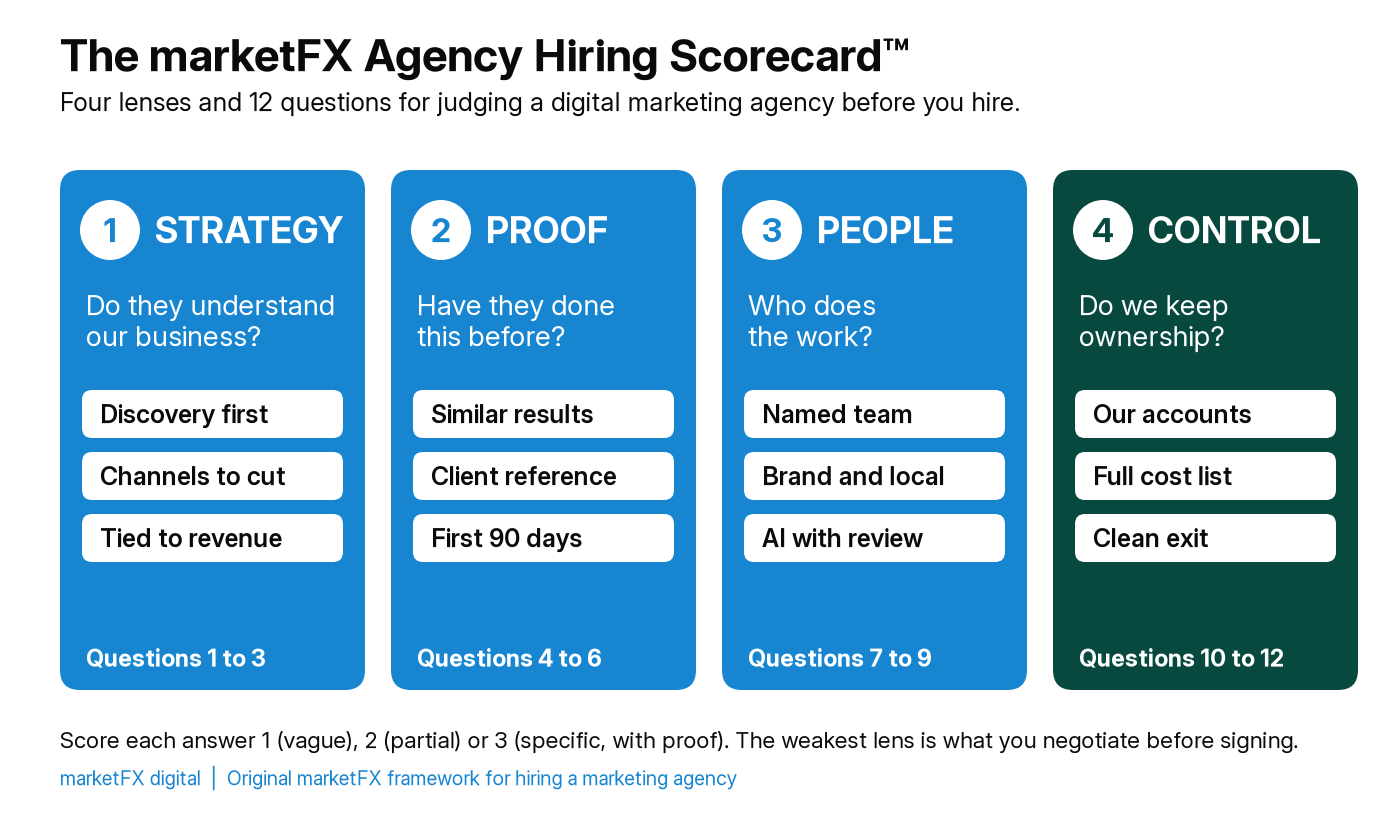
| Lens | Questions | The core test | Where it breaks if you skip it |
|---|---|---|---|
| Strategy | 1 to 3 | Do they understand our business and measure what matters? | Busy campaigns that never connect to revenue |
| Proof | 4 to 6 | Have they done this before, and can they show it? | Learning on your budget |
| People | 7 to 9 | Who does the work, and how is quality controlled? | The senior team pitches, a junior team delivers |
| Control | 10 to 12 | Do we keep ownership, cost clarity and a clean exit? | Lost accounts, data and history when you leave |
Score each answer from 1 (vague or evasive) to 3 (specific, with evidence). The totals matter less than the pattern. A 3 on Proof with a 1 on Control tells you exactly what to negotiate before you sign.
Strategy: Does the Agency Understand Your Business?
Strategy questions show whether an agency diagnoses before it prescribes. A strong agency asks you more than you ask it in the first meeting, and its recommendations change once it learns how you make money.
1. What do you need to know about our business before you recommend anything?
A good agency needs your goals, margins, sales cycle, customer types, locations, current results and constraints before it recommends a plan. Listen for questions about revenue, lead quality and what a customer is worth, not just budget and target keywords. Google gives the same advice for hiring an SEO: a good partner should ask what makes your business unique, who your competitors are and how your customers find you, and if it is not interested in your business, find someone who is (Google Search Central, Do you need an SEO?).
A weak answer jumps straight to a channel or a package before the agency has seen any of your data.
2. Which channels would you prioritize for us, and which would you cut?
The best answer names priorities and trade-offs. Every agency can list channels it offers. Fewer will tell you which ones to stop funding, or that a channel they sell is the wrong fit for you right now. Ask what they would do with your current budget if it could not grow, and what they would add first if it could. If the answer lines up neatly with the agency's most profitable service, probe harder.
For a deeper look at how paid and organic search fit together, see our comparison of SEO vs PPC.
3. How will you define success, and how will you tie it to revenue?
Success should be defined in writing before work starts, in business terms such as qualified leads, cost per acquisition, booked appointments, pipeline or revenue. Ask which numbers they will report, how they will connect ad platforms and analytics to your CRM or sales data, and what they will do when platform numbers and your own numbers disagree.
Be wary of reports that stop at impressions, clicks and rankings. They are useful signals, but they are not outcomes. Our guide to why your Google Analytics dashboard may be misleading you explains the most common tracking gaps to ask about.
Proof: Can the Agency Show It Has Done This Before?
Proof questions separate experience from confidence. Every agency is confident in a pitch. What you want is evidence from businesses with problems like yours, presented with enough context to judge it.
4. Can you show work for a business like ours, with the starting point and timeline?
Ask for examples from businesses with a similar model, size or buying cycle, and ask for three things with every result: where the client started, how long it took and what the agency actually changed. A percentage lift with no starting point or time frame tells you very little. Google's SEO hiring guidance also suggests asking what kind of results to expect, in what timeframe, and how the partner measures success.
Treat any guaranteed outcome as a warning sign. Google is direct about this for search: if someone guarantees their changes will put you in first place in search results, find someone else.
5. Can we speak with a current client?
A confident agency can connect you with a client, ideally one at a similar stage to yours, within a few days. Ask that client how the agency handles bad months, how quickly the team responds and whether the people from the pitch still work on the account. Google recommends the same step: check business references and ask past clients whether the work was useful, easy to manage and produced positive results.
6. What will the first 90 days produce?
Ask for a written outline of the first 90 days, with owners and deliverables. A strong answer usually includes an audit of your accounts and tracking, quick fixes to wasted spend or broken measurement, a prioritized plan and the first set of tests or campaigns. A vague answer such as "we will ramp up and optimize" means the plan does not exist yet.
| Window | What you should see | Question to ask |
|---|---|---|
| Days 1 to 30 | Account and tracking access, an audit, fixes to broken tracking or obvious waste | What did the audit find, and what did you fix first? |
| Days 31 to 60 | A written plan with priorities, budgets and targets, first campaigns or tests live | What are you testing, and how will we know it worked? |
| Days 61 to 90 | Early results against the agreed measures, next-quarter priorities | What will you change next quarter, and why? |
People: Who Will Actually Do the Work?
People questions protect you from the most common agency letdown: the senior team that wins the business is not the team that does the work. They also cover how quality holds up when work is spread across many locations or produced with AI.
7. Who will actually work on our account, and how much of their time do we get?
Ask for the names and roles of the people who will run your account day to day, how many other accounts each of them manages, and who you call when something goes wrong. Ask whether any work is subcontracted or offshored, and who reviews it. "Our team" is not an answer. A named strategist, a named channel lead and a clear escalation path are.
8. How will you run brand and local marketing across our locations?
For multi-location and franchise brands, this question often decides the shortlist. Ask how the agency balances national brand campaigns with local campaigns, how it manages location pages and Google Business Profiles at scale, how local budgets are set and how results are reported by location and rolled up for the brand. Ask what they would do with an underperforming market.
An agency that treats 200 locations as one national account will miss the local search and local budget decisions where most of the revenue is won. Our guide to local SEO for multi-location brands covers what good looks like.
9. How do you use AI, and where do people review the work?
Most agencies now use AI somewhere in their work, so the useful question is how. Ask which tasks use AI, which tools touch your data, how your data is protected and where a person reviews the output before it goes live. Gartner's 2025 CMO Spend Survey found 22% of CMOs said generative AI had already let them reduce their reliance on external agencies for creativity and strategy building (Gartner, May 12, 2025). An agency should be able to explain what it adds beyond what your own team can now do with the same tools.
Ask about AI search too. Buyers increasingly get answers from Google AI Overviews and assistants like ChatGPT before they click a link. Ask how the agency would measure and improve your visibility there. Our guide to improving visibility in Google AI Overviews explains the basics.
Control: Do You Keep Ownership and a Clean Exit?
Control questions decide what happens if the relationship ends. They are easy to skip when everyone is excited about a new partnership, and expensive to fix later.
10. Who owns the ad accounts, analytics, data and creative?
You should own your ad accounts, analytics properties, tag manager containers, CRM data, websites, domains and the creative you paid for, with the agency added as a user. Ask this directly, and get the answer in the contract. Google's SEO guidance makes a related point for audits: give a prospective partner read access to Search Console at first, not write access.
If an agency runs your ads inside its own account, you may lose the account history, audiences and learning when you leave. Make sure every account is in your name from day one.
11. How is pricing structured, and what is not included?
Ask how the fee is calculated (retainer, project, percentage of spend or a hybrid), what it includes, and what costs extra: ad spend, tools, creative production, landing pages, reporting dashboards or setup fees. Ask how the fee changes if your budget or scope changes, and get the quote in writing.
There is no single right price. It depends on channels, markets, locations and how much work you keep in house. Our guide to how much a marketing agency costs in 2026 breaks down the layers behind a quote, so you can compare proposals like for like.
12. What are the contract terms, and how does an exit work?
Ask for the minimum term, the notice period, what happens to work in progress, and how accounts, files and documentation are handed over when you leave. A good agency is comfortable putting its exit process in writing before you start. Ask what would make them recommend ending the engagement themselves, and how they handle a quarter that misses target.
What Are the Red Flags When Interviewing a Marketing Agency?
The biggest red flags are guarantees, vagueness and ownership grabs. If an agency promises specific rankings or results, cannot name who will work on your account, avoids putting accounts in your name or will not explain its exit terms, keep looking.
| Topic | A good answer sounds like | A red flag sounds like |
|---|---|---|
| Results | Realistic ranges, the starting point and the time frame, with the risks explained | Guaranteed rankings, guaranteed leads or a "special relationship" with Google |
| Team | Named people, their roles and how many accounts each runs | "Our team," or the pitch team disappears after signing |
| Measurement | Business outcomes such as qualified leads, pipeline and revenue | Impressions, clicks and rankings only |
| Ownership | Accounts, data and creative in your name, agency added as a user | Ads run in the agency's own account, or data held back |
| Pricing | A written scope listing what is included and what costs extra | A low headline fee with tools, setup and reporting added later |
| Process | A clear explanation of what they will change and why | Secrecy about methods, or "proprietary" with no detail |
| Exit | A defined notice period and handover process in the contract | Long lock-in with no exit terms |
Google's guidance names several of these directly: be wary of anyone who claims to guarantee rankings, alleges a special relationship with Google, advertises a "priority submit" to Google, or is secretive about what they intend to do. It also notes that you are ultimately responsible for the actions of any company you hire.
What Questions Should a Good Agency Ask You?
A good agency interviews you as hard as you interview it. If an agency asks almost nothing about your business, it is probably selling a standard package. Expect questions like these:
- What are your revenue and growth targets for the next 12 months?
- What is a customer or a qualified lead worth to you?
- Which channels and locations perform best today, and how do you know?
- How do leads move from marketing to sales, and who follows up?
- What has worked before, what has not, and why did past agency relationships end?
- What will your team keep in house, and what do you need from us?
- Who signs off on creative, budgets and reporting?
How Should You Compare Agency Finalists?
Compare finalists side by side on the same questions, the same brief and the same scoring. Send every agency the same written brief, ask the 12 questions in the same order, score each answer from 1 to 3 on the Agency Hiring Scorecard™, and only then compare price. Comparing price first rewards the agency that scoped the least work.
| Lens | Agency A | Agency B | Agency C | Notes to capture |
|---|---|---|---|---|
| Strategy (questions 1 to 3) | _ / 9 | _ / 9 | _ / 9 | Did they ask about margins, lead value and sales follow up? |
| Proof (questions 4 to 6) | _ / 9 | _ / 9 | _ / 9 | Relevant examples with starting points, a reference call, a 90 day plan |
| People (questions 7 to 9) | _ / 9 | _ / 9 | _ / 9 | Named team, location approach, AI review process |
| Control (questions 10 to 12) | _ / 9 | _ / 9 | _ / 9 | Ownership in writing, full cost list, exit terms |
| Total | _ / 36 | _ / 36 | _ / 36 | Weakest lens is what you negotiate before signing |
If two finalists score close, ask each for a short paid or free audit of one channel. How an agency presents what it finds in your real accounts tells you more than any case study.
Why Are Marketing Leaders Asking Harder Questions in 2026?
Marketing leaders are asking harder questions because budgets are flat and agency spend is under the most scrutiny. Gartner's surveys show paid media growing as a share of marketing budgets while the share going to agencies has fallen, and in 2025, 39% of CMOs said they planned to cut back on agency budgets, starting with unproductive agency relationships and overlapping rosters.
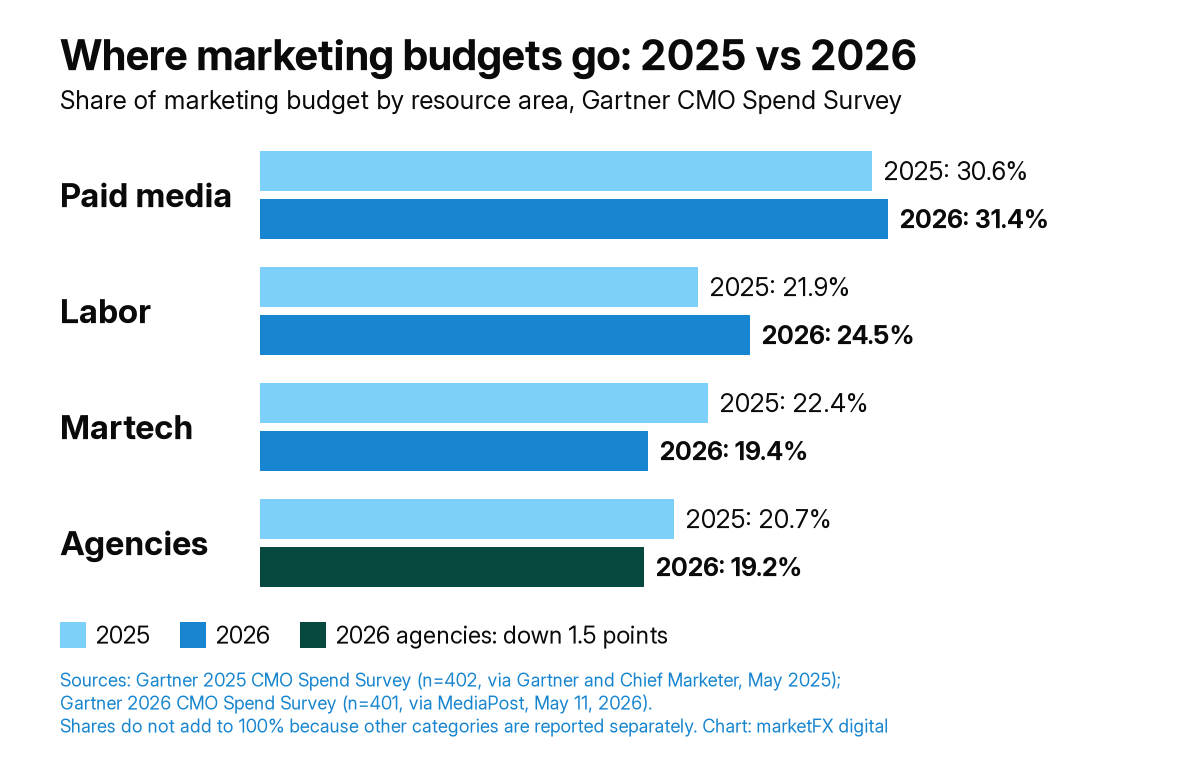
| Resource area | 2025 | 2026 | Change |
|---|---|---|---|
| Paid media | 30.6% | 31.4% | +0.8 points |
| Labor | 21.9% | 24.5% | +2.6 points |
| Martech | 22.4% | 19.4% | -3.0 points |
| Agencies | 20.7% | 19.2% | -1.5 points |
The practical takeaway: fewer, better agency relationships. That makes the hiring decision more important, and it rewards agencies that can show how their work connects to revenue rather than activity.
Questions to Ask Specialist Agencies
The 12 questions work for any digital marketing agency. If you are hiring for one channel or one type of business, add a few specialist questions:
- SEO and AI search agencies. Do you follow Google Search Essentials? How will you measure visibility in AI Overviews and AI assistants? What will you change on our site, and will you share every change? See our SEO and AI visibility consulting page for how we approach it.
- Paid media agencies. Will the accounts be in our name? How do you decide budget between platforms? How do you test creative, and how do you measure incrementality? Our paid media services page covers our approach.
- Franchise and multi-location agencies. How do you split brand fund and local budgets? How do you report by location? Our guide on choosing a franchise marketing agency lists 10 questions for that decision.
- Analytics and measurement agencies. How will you reconcile platform data with our CRM? Do you use attribution, incrementality tests or marketing mix modeling, and when? See our guide on choosing a marketing analytics agency.
How marketFX Answers These Questions
We would rather be asked all 12 questions than none. At marketFX, every engagement starts with an audit of your accounts, tracking and results, so our recommendations come from your data rather than a standard package. We report on business outcomes such as qualified leads, pipeline and revenue alongside channel metrics, and we expect to be scored on the same Strategy, Proof, People and Control questions as anyone else on your shortlist. Search, paid media, content, CRM and analytics sit in one team, so the plan and the measurement are shared. Across our client work we report 94% client retention, more than 20 years driving growth and more than $20 million in revenue tracked.
If you want a second opinion before you choose an agency, our marketing audit services review search, paid media and tracking in one pass, and you can see the full list of what we do on our services page.
Related services
FAQs
Frequently Asked Questions
- What questions should I ask a digital marketing agency before hiring?
- Ask how they will learn your business, which channels they would prioritize or cut, how they will tie results to revenue, what they achieved for similar businesses and how fast, who will do the work, how they use AI, who owns your accounts and data, what the price includes and how an exit works.
- What should I look for in a digital marketing agency?
- Look for an agency that asks detailed questions about your business, shows relevant results with starting points and timelines, names the people who will work on your account, reports on business outcomes rather than activity, keeps accounts and data in your name and puts pricing and exit terms in writing.
- What are the red flags when hiring a marketing agency?
- Common red flags are guaranteed rankings or results, claims of a special relationship with Google, vague answers about who does the work, ads run inside the agency's own accounts, reporting that stops at clicks and impressions, hidden costs added after signing and long contracts with no clear exit terms.
- How many marketing agencies should I interview?
- Most companies get a useful comparison from three to five agencies. Fewer makes it hard to compare answers, and many more makes it hard to evaluate each one properly. Send every finalist the same brief, ask the same questions and score the answers the same way before you compare price.
- Should I own my ad accounts if I hire an agency?
- Yes. Your ad accounts, analytics properties, tag manager, CRM data, website and domain should be in your company's name, with the agency added as a user. If the agency owns the accounts, you can lose your account history, audiences and data when the relationship ends.
- How long should a marketing agency contract be?
- It depends on the work. Ongoing services often run on a minimum term with a notice period, while audits and projects have a fixed scope. Whatever the term, get the notice period, the handover process and what happens to work in progress written into the contract before you start.
- What questions will a good marketing agency ask me?
- A good agency will ask about your revenue goals, what a customer or qualified lead is worth, which channels and locations perform best, how leads reach your sales team, what worked or failed before, what your team keeps in house and who approves creative, budgets and reporting.