
SEO vs PPC: Which Should Your Business Fund First?
SEO vs PPC compared on cost, speed, click-through rates and ROI, with 2025 AI Overview data and a plan for when to rent search traffic and when to build it.
Quick Answer
SEO is usually the better choice when you can wait months for results and want leads that do not cost you per click. PPC is usually better when you need leads now, want to test offers fast, or compete on searches where ads and AI answers push organic results down. Most growing brands run both, with PPC buying demand today and SEO building it.
SEO vs PPC is usually framed as free traffic against paid traffic, and that framing leads to bad budget decisions. Organic clicks are not free. They cost time, content, technical work and patience. Paid clicks are not simply expensive. They buy speed, control and data you cannot get any other way. The real difference is that PPC rents visibility for as long as you pay, while SEO builds visibility that keeps working after the work is done.
The economics of both are shifting. Cost per click rose for 87% of industries in WordStream by LocaliQ's 2025 Google Ads benchmarks, taking the all-industry average to $5.26 (WordStream, Google Ads Benchmarks 2025). At the same time, AI Overviews are pulling clicks away from both organic and paid results on many informational searches. Choosing between the two now means looking at cost, speed, click behavior and how each channel feeds the other.
This guide compares SEO and PPC on each of those, shows when each should come first, and lays out the marketFX Rent, Build, Defend Plan™, the way we decide what to buy and what to build. If you already know you want help with one side, start with our SEO and AI visibility consulting or paid media services pages.
What Is the Difference Between SEO and PPC?
SEO (search engine optimization) earns unpaid placements in search results by making your pages relevant, useful and easy for search engines to understand. PPC (pay per click) buys ad placements, usually above or beside those results, and you pay each time someone clicks. Both target the same searcher. They differ in how you pay, how fast they work and what you keep when you stop.
| Factor | SEO | PPC |
|---|---|---|
| How you pay | Time, content, technical work and links, no cost per click | A bid for each click, plus management and landing pages |
| Speed | Months to build, faster for fixes on pages that already rank | Traffic can start the day a campaign goes live |
| What happens when you stop | Rankings fade slowly and often hold for a while | Traffic stops when the budget stops |
| Control | Low, Google decides what ranks | High, you choose keywords, ads, locations, budgets and pages |
| Where it shows | Organic results, local map results and sources cited in AI answers | Ad slots on Google Search, Shopping, Maps, YouTube and partner sites |
| Data | Search Console queries and clicks, slower to read | Search terms, conversions and costs in near real time |
| Best at | Compounding visibility for the questions buyers ask again and again | Buying demand now, testing offers and covering gaps in rankings |
One rule surprises many buyers: paying for ads does not lift your organic rankings. Google says that "advertising with Google won't have any effect on your site's presence in our search results" and that it "never accepts money to include or rank sites" in organic search (Google Search Central). The two channels help each other in other ways, which we cover below, but one cannot buy the other.
Which Is Better, SEO or PPC?
Neither is better in general. PPC is better when you need results this quarter, when the searches you want are dominated by ads, or when you are still learning which offers and keywords convert. SEO is better when you can invest ahead of results, when buyers research before they buy, and when the same questions are searched every month for years.
The more useful question is which one should lead right now. A new location, a new service or a cash-sensitive quarter usually points to PPC first. A brand with steady demand, decent margins and a website that already earns some organic traffic usually gets more from putting the next dollar into SEO. Most brands that grow past a single channel end up running both, with each one doing the job it is best at.
How Much Do SEO and PPC Cost?
PPC costs a price per click that you pay every time, while SEO costs the work needed to earn rankings, with no charge per click once you have them. That makes PPC easier to forecast in the short term and SEO cheaper per click over the long term, if the work succeeds.
On the paid side, the 2025 WordStream benchmarks put the average Google search cost per click at $5.26, the average conversion rate at 7.52% and the average cost per lead at $70.11 across US campaigns (WordStream, Google Ads Benchmarks 2025). The same report found that the overall average cost per click rose 12.88% year over year. Industry matters a great deal: our guide to PPC management services shows how click costs range from about $2 in restaurants to more than $8 in legal services.
On the organic side, there is no auction, but there is still a bill. It is paid in technical fixes, content, internal linking, authority building and the people who do that work, whether in-house or through an agency. The cost does not scale with clicks, which is why SEO tends to look expensive in the first months and cheap per lead later on.
To compare the two fairly:
- Use the same unit. Compare cost per qualified lead or cost per customer, not cost per click against a monthly SEO fee.
- Use the same time window. PPC costs land in the month you spend them. SEO costs pay back over many months, so compare over a year or more.
- Count what you keep. When a PPC campaign stops, the traffic stops. When SEO work stops, the pages, content and rankings usually remain for a while.
How Long Do SEO and PPC Take to Work?
PPC can produce traffic and leads within days of launch, while SEO usually takes months to move rankings for competitive searches. The gap is the main reason so many brands start with paid search.
PPC still needs a short learning period. Automated bidding needs conversion data before it settles, and the first weeks usually go to cutting irrelevant search terms and fixing landing pages. But the demand already exists, so results show quickly.
SEO speed depends on where you start. Fixing technical problems, improving titles or expanding a page that already ranks on page two can show results within weeks. Ranking a new page for a competitive term takes longer, because you are earning trust that competitors built over years. Be cautious with anyone who promises a fixed timeline or guaranteed rankings for SEO. Google's own guidance on hiring an SEO is blunt: "No one can guarantee a #1 ranking on Google" (Google Search Central).
Is SEO Still Worth It With AI Overviews?
Yes, but the payoff has changed. AI Overviews reduce clicks on many informational searches, for paid ads as well as organic results, so SEO now has to earn citations inside AI answers as well as rankings. Brands cited in AI Overviews earned noticeably more clicks than brands that were not.
Seer Interactive tracked 3,119 informational search terms across 42 client organizations from June 2024 to September 2025. In the third quarter of 2025, organic click-through rate was 1.45% on searches with no AI Overview, 0.70% when an AI Overview appeared and cited the brand, and 0.52% when it appeared without citing the brand. Paid click-through rate followed the same pattern at a higher level: 13.88%, 7.89% and 4.14%.
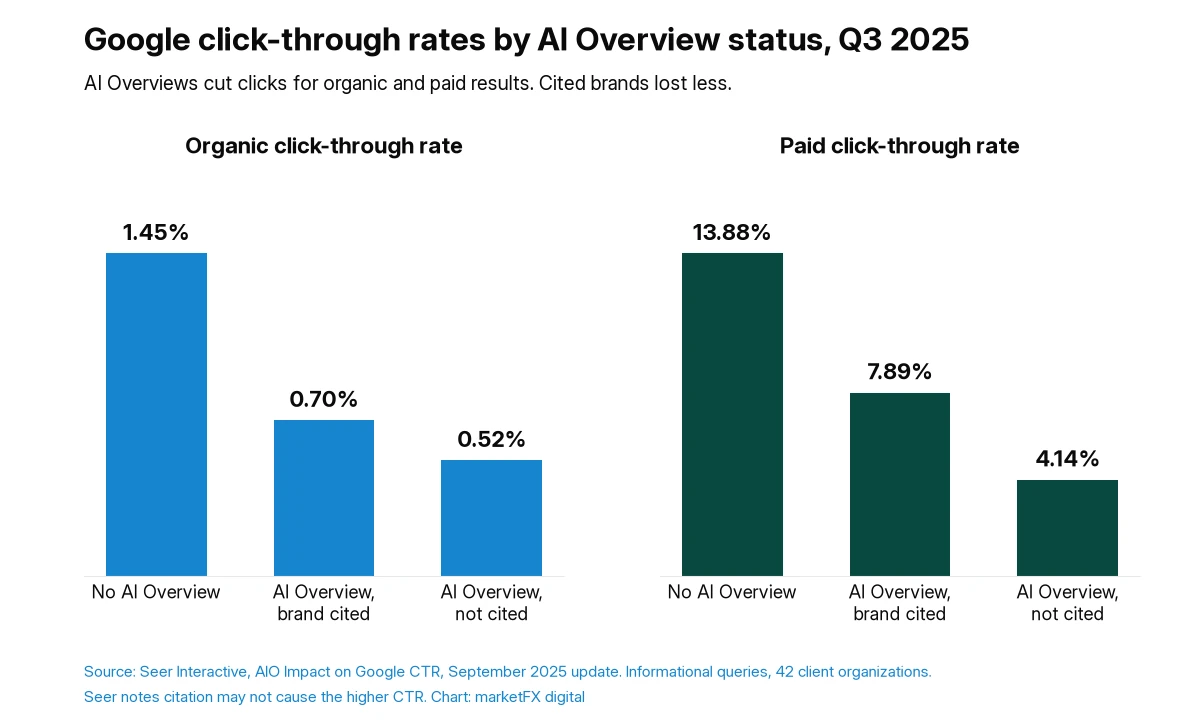
| Search result | Organic CTR | Paid CTR |
|---|---|---|
| No AI Overview | 1.45% | 13.88% |
| AI Overview, brand cited | 0.70% | 7.89% |
| AI Overview, brand not cited | 0.52% | 4.14% |
Source: Seer Interactive, AIO Impact on Google CTR: September 2025 Update. Informational and educational queries across 42 client organizations. Seer notes that citation may not cause the higher CTR, since stronger brands may simply be cited more often.
Over the full period, the decline hit both channels:
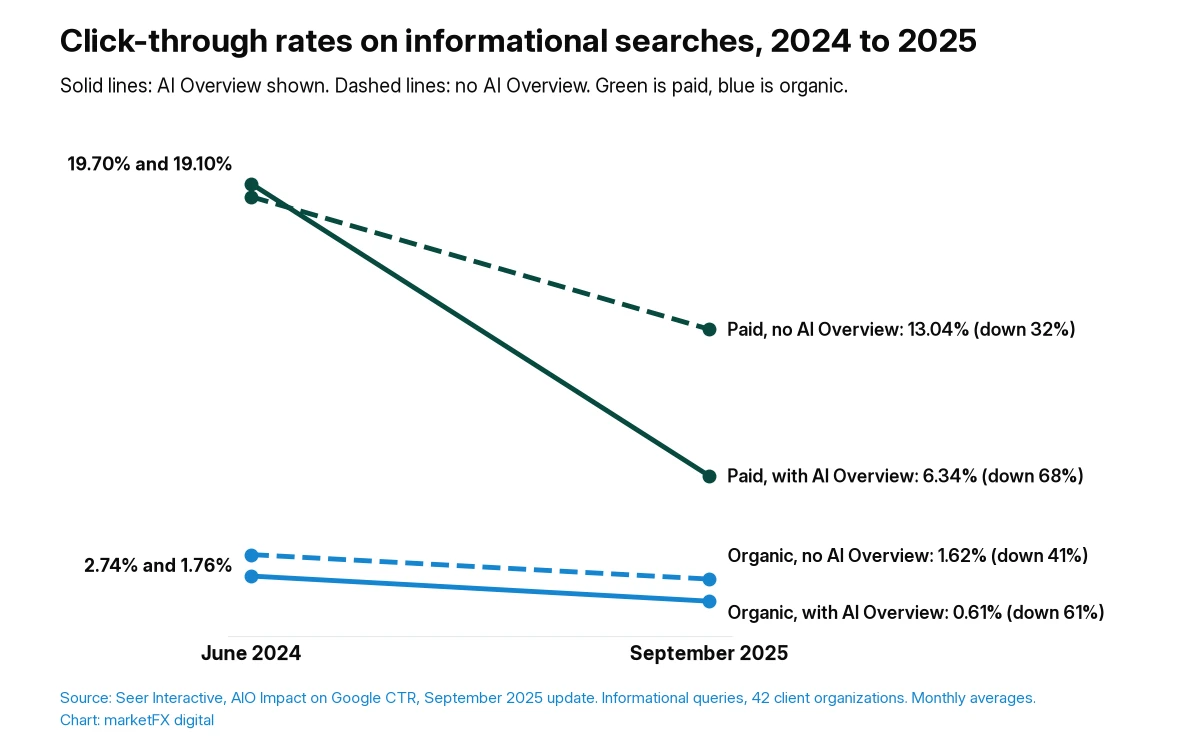
| Click type | June 2024 | September 2025 | Change |
|---|---|---|---|
| Paid, with AI Overview | 19.70% | 6.34% | Down 68% |
| Paid, no AI Overview | 19.10% | 13.04% | Down 32% |
| Organic, no AI Overview | 2.74% | 1.62% | Down 41% |
| Organic, with AI Overview | 1.76% | 0.61% | Down 61% |
Source: Seer Interactive, September 2025 update, monthly averages across the query set.
Two lessons follow. First, AI Overviews are not only an SEO problem. Paid ads on informational searches lost clicks too, which is one reason PPC budgets work best on commercial searches where buyers are ready to act. Second, being the source an AI answer cites is now part of the value of SEO. That work, often called generative engine optimization, is covered in our GEO vs SEO guide.
Keep the scope in mind. Seer studied informational queries, the type most likely to show AI Overviews. Searches for a service, a product or a business near you behave differently, and that is where most leads come from.
SEO vs PPC ROI: Which Pays Back Better?
PPC usually pays back faster and SEO usually pays back more over time, but only your own numbers can say which earns more. The return on PPC is easy to measure and roughly linear: more spend buys more clicks, up to the limit of demand. The return on SEO is harder to measure and compounds: a page that ranks keeps earning without a new bill for each visit.
To estimate return honestly:
- Track both to revenue. Send leads from both channels into your CRM with their source, so you can compare cost per customer rather than cost per form fill. Our marketing attribution work covers that setup.
- Value SEO over a longer window. Judge SEO on a year or more, and count the traffic a page keeps earning after the work is done.
- Look at the margin, not the average. Ask where the next dollar earns more. A PPC account close to the limit of its demand gets more expensive with each extra dollar. An SEO program with obvious technical gaps can get cheaper wins.
- Watch for overlap. If you rank first organically and also run ads on the same term, some ad clicks would have come for free. Test pausing ads on terms where you rank strongly and see whether total clicks hold.
When Should You Choose PPC First?
Choose PPC first when you need leads soon, when you are entering a new market, or when you do not yet know which keywords and offers convert. Paid search answers those questions in weeks.
PPC is also the stronger first move when:
- You are launching something new. A new location, service or product has no organic history. Ads put it in front of searchers on day one.
- The searches you want are crowded with ads. On some commercial searches, the top of the page is mostly ads, Shopping results and maps. Ranking first organically may still leave you below the fold.
- You sell something seasonal or time-bound. Ads can start and stop with demand. Rankings cannot.
- You need data to plan SEO. Search term reports show which queries turn into leads, so you can build organic content around proven demand instead of guesses.
For multi-location brands, PPC also gives precise control by area, which helps when some markets are new and others are established. See our Google Ads agency page for how we structure that.
When Should You Choose SEO First?
Choose SEO first when you have steady search demand, a buying process that involves research, and enough runway to invest ahead of results. SEO pays best for questions people search every month for years.
SEO is also the stronger first move when:
- Click costs are high relative to customer value. If each paid lead costs more than you can afford, earning the same searches organically is often the only way to compete.
- Buyers research before they buy. Comparisons, guides and answers to common questions are what organic search and AI answers reward, and they shape the shortlist before a buyer ever clicks an ad.
- Your site has technical problems. Fixing crawl, speed and indexing issues can unlock rankings you have already earned and would also improve landing pages for ads.
- You want to be named in AI answers. AI engines lean on content that is clear, well structured and already trusted. Paid ads do not get you cited.
SEO vs PPC for Small Business
For a small business with a limited budget, the usual answer is to start with the cheapest reliable source of leads and build from there. For most local service businesses, that means a well-run Google Business Profile and basic local SEO, plus a tightly focused PPC campaign on the few searches that mean someone is ready to buy.
Small budgets are where PPC waste hurts most. Keep campaigns narrow: a short list of high-intent keywords, a firm location radius, negative keywords for jobs, free and do-it-yourself searches, and a landing page that matches the ad. On the SEO side, the highest return is usually the basics done well: accurate business details, a page for each core service, reviews and answers to the questions customers ask on the phone.
The marketFX Rent, Build, Defend Plan™
The marketFX Rent, Build, Defend Plan™ is the three-part plan we use to decide which searches to pay for, which to earn and where to keep both running. It treats PPC and SEO as one search budget rather than two competing line items.
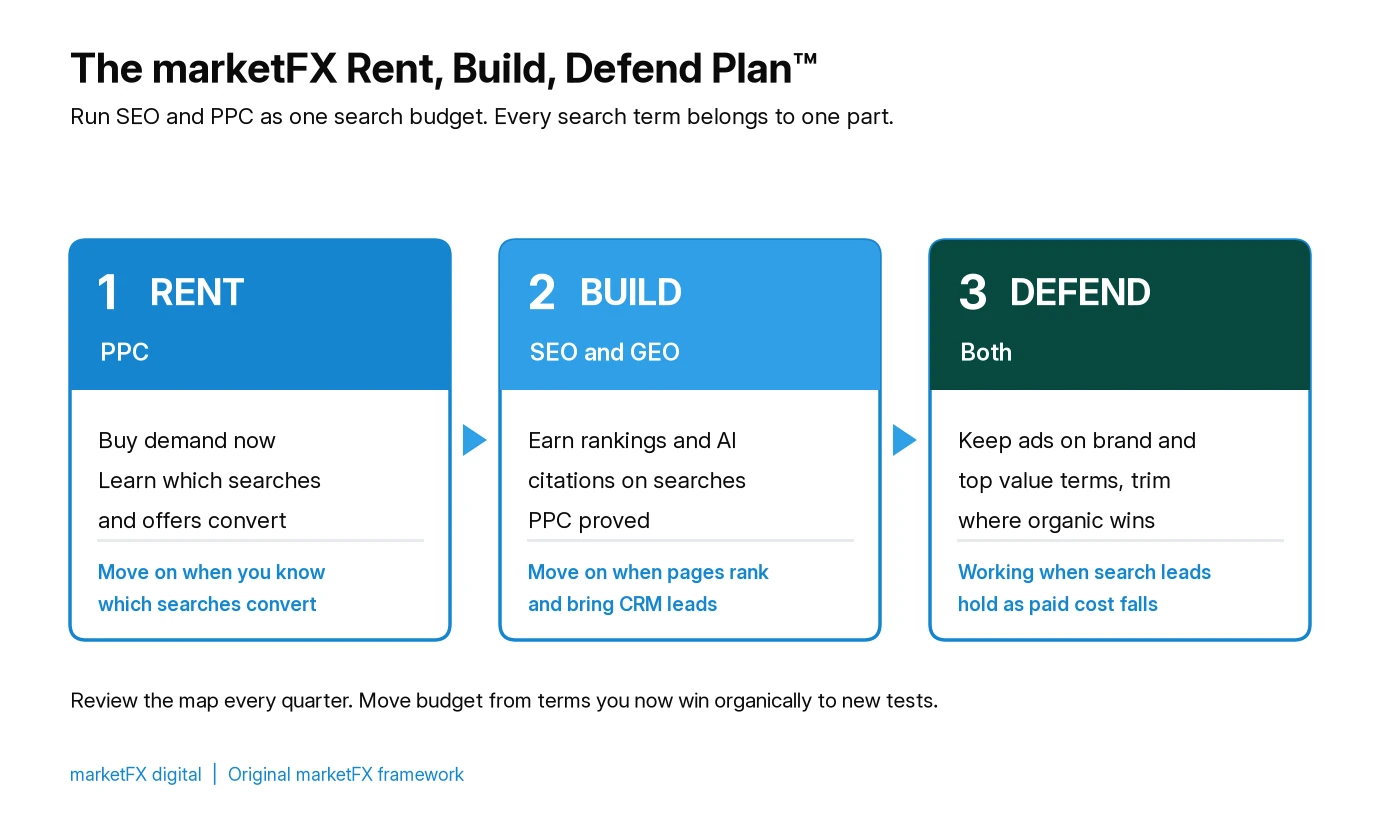
| Part | Main channel | What it does | Signal to move on |
|---|---|---|---|
| 1. Rent | PPC | Buys demand now and shows which searches, offers and pages turn into leads | You know which searches produce qualified leads at a cost you can carry |
| 2. Build | SEO and GEO | Earns rankings and AI citations on the searches PPC proved, starting with the most expensive clicks | Organic pages rank on page one and bring leads you can see in the CRM |
| 3. Defend | Both | Keeps paid coverage on your brand and highest value terms, and trims ads where organic already wins the click | Total search leads hold or grow while paid spend per lead falls |
How to use it:
- Every search term belongs to one part. New or untested searches sit in Rent. Proven, expensive searches move to Build. Searches you already win organically, plus your brand name, sit in Defend.
- Review the map every quarter. As SEO pages start to rank, move budget from those terms to new tests. As click costs rise, push more terms into Build.
- Defend is not automatic. Bidding on your own brand is often cheap and protects against competitors, but test whether it adds clicks you would not have won organically.
Attribution: the marketFX Rent, Build, Defend Plan™ is an original marketFX framework for search budget planning. It is not a vendor ranking.
How Should You Split Budget Between SEO and PPC?
Split budget by what each channel can do for you this year: fund PPC to cover the demand you need now, fund SEO to cover the demand you want to stop paying for, and move money between them as organic rankings arrive.
There is no correct ratio for every business, and fixed splits quoted online are starting points at best. A practical way to set yours:
- Start from the lead target. Work out how many qualified leads you need each month and how many organic search delivers today.
- Fill the gap with PPC first. Paid search is the fastest way to close a short-term gap. Set a target cost per qualified lead before launch.
- Fund SEO against your most expensive clicks. The searches that cost the most per lead are the best candidates to earn organically.
- Rebalance quarterly. When organic pages start delivering, shift paid budget to new tests rather than cutting it by reflex.
How Do SEO and PPC Work Together?
SEO and PPC work best as one program because they share the same searcher, the same keywords and often the same landing pages. Each one makes the other cheaper or more effective.
- PPC data guides SEO. Search term reports show which queries convert, so organic content goes after proven demand.
- Better pages help both. Google's Quality Score diagnostic looks at expected click-through rate, ad relevance and landing page experience (Google Ads Help). Clear, useful pages built for SEO are also better landing pages for ads.
- Coverage across the page. For high-value searches, owning both an ad and an organic listing gives the searcher two chances to choose you, and protects against a competitor taking the top slot.
- One view of results. When both channels report into the same CRM, you can see the full cost per customer from search, not two partial stories.
That is why we run search as one program across SEO, AI search visibility and paid media, instead of separate teams competing for credit.
How marketFX Runs SEO and PPC Together
We plan SEO and PPC as one search budget, with one set of conversion definitions and one map of which searches to rent, build and defend. Every engagement starts with a review of your paid accounts, your organic visibility, your AI search presence and your tracking, then a written plan that says which searches each channel owns and how budget will move as results come in. Across managed paid media portfolios, marketFX reported an average 4.1x ROAS in 2025, and across our client work we report 94% client retention and more than $20 million in revenue tracked.
If you want an outside view before changing anything, our paid media audit and strategy and marketing audit services look at both sides of search.
Related services
FAQs
Frequently Asked Questions
- Is SEO or PPC better for small businesses?
- Most small businesses do best with local SEO basics plus a narrow PPC campaign. Local SEO, including a complete Google Business Profile and a page for each core service, builds steady leads without a cost per click. A tightly targeted PPC campaign on a few high-intent searches fills the gap while organic visibility grows. Avoid broad campaigns that spend a small budget on curious clicks.
- Does PPC help SEO rankings?
- No. Paying for Google Ads does not improve organic rankings. Google states that advertising with Google has no effect on a site's presence in its search results. PPC can still help SEO indirectly, because search term data shows which queries convert and which pages are worth building out for organic search.
- Which is cheaper, SEO or PPC?
- PPC is cheaper to start and SEO is usually cheaper per lead over time. PPC charges for every click, with a 2025 average of $5.26 per click on Google search according to WordStream. SEO has no cost per click, but it needs ongoing investment in content, technical work and authority before it pays back. Compare both on cost per qualified lead over at least a year.
- How long does SEO take compared with PPC?
- PPC can bring traffic within days of launch. SEO usually takes months to move rankings for competitive searches, although technical fixes and improvements to pages that already rank can show results within weeks. Treat any provider that guarantees rankings or a fixed timeline with caution.
- Should I stop PPC once SEO starts working?
- Usually not all at once. Move budget away from searches where you now rank strongly and test whether total clicks hold. Keep paid coverage on your brand and on high-value searches where ads, maps and AI answers push organic results down. Use the freed budget to test new searches.
- Do AI Overviews affect SEO and PPC?
- Yes, both. Seer Interactive found that on informational searches with AI Overviews, organic click-through rate fell 61% and paid click-through rate fell 68% between June 2024 and September 2025. Brands cited in AI Overviews earned more clicks than brands that were not. Commercial and local searches are affected differently, so check your own Search Console and Google Ads data.
- What is the difference between SEO, PPC and SEM?
- SEO earns unpaid placements in search results. PPC is a payment model where you pay per click on an ad. SEM, or search engine marketing, is commonly used for paid search advertising, although some people use it to cover both paid and organic search. In practice, SEM and PPC on Google usually mean the same thing: Google Ads search campaigns.