
Organic SEO Services: What to Expect and How to Compare Providers
What organic SEO services include, how AI answers change the work, organic vs paid search, what drives cost, and the questions to ask before you hire.
Quick Answer
Organic SEO services improve how often your site appears in unpaid search results and, now, in AI answers built from those results. A complete program covers technical SEO, keyword and intent research, on-page work, content, internal linking, authority building, local search and reporting. Choose a provider that explains every change, ties work to leads and revenue, and never promises rankings.
Organic search is the one channel you cannot buy your way into. Google states that it "never accepts money to include or rank sites in our search results, and it costs nothing to appear in our organic search results" (Google Search Central). You pay for the expertise and the work, not for the placement.
That work is getting harder to judge. Ahrefs found that 96.55% of the roughly 14 billion pages it studied get no traffic from Google at all (Ahrefs), and as the Pew numbers show, ranking no longer guarantees the click. This guide covers what organic SEO services should include today and how to choose a provider.
What Are Organic SEO Services?
Organic SEO services are the strategy and hands-on work that help a website earn unpaid visibility in search engines. The provider improves how search engines crawl, understand and trust your pages, so they show up for the questions your buyers ask. The goal is qualified traffic and leads without paying per click.
Google's own list of what SEO providers typically offer is a good baseline: content and structure reviews, technical advice, content development, keyword research, training, market expertise and optimizing for generative AI (Google Search Central).
"Organic" separates this work from paid search. A paid ad stops when the budget stops, while an organic ranking or an AI citation can keep working for months with upkeep.
What Do Organic SEO Services Include?
A complete organic SEO program includes eight workstreams. Smaller engagements may cover only a few, which is fine if the proposal says so. Use this list to check what a proposal leaves out.
- Technical SEO. Crawling, indexing, site speed, redirects, canonical tags, rendering and AI crawler access. Nothing ranks if search engines cannot read the page. Our guide to technical SEO services covers what an audit should deliver.
- Keyword and intent research. Mapping the searches your buyers actually make to the pages that should answer them, grouped by intent so each page has one job.
- On-page optimization. Titles, headings, meta descriptions, answer blocks, schema markup and copy that match what the searcher wants.
- Content. New pages and refreshes of old ones that answer real buyer questions with evidence. See SEO content services for what good content work looks like.
- Internal linking. Connecting related pages so authority flows to the pages that make money. Internal linking is one of the cheapest ways to lift an existing page.
- Authority building. Earning backlinks, brand mentions and reviews from sources people and AI engines already trust.
- Local SEO. Google Business Profiles, location pages and consistent business details for brands with physical locations. Read more on local SEO for multi-location brands.
- Measurement and reporting. Rankings, organic traffic, leads and revenue from organic search, plus how often AI answers cite or mention your brand.
What Is the marketFX Rank, Cite, Convert Model?
The marketFX Rank, Cite, Convert Model is a way to judge organic SEO work by the three jobs it now has to do. A page has to rank in Google, get cited when an AI engine answers the question, and convert the visitor who does click. Most proposals are strong on the first job and thin on the other two.
Rankings alone no longer tell you whether organic search is paying off. A page can hold position three and still lose clicks to an AI Overview above it, and a page that ranks and gets cited still has to turn a visit into a lead.
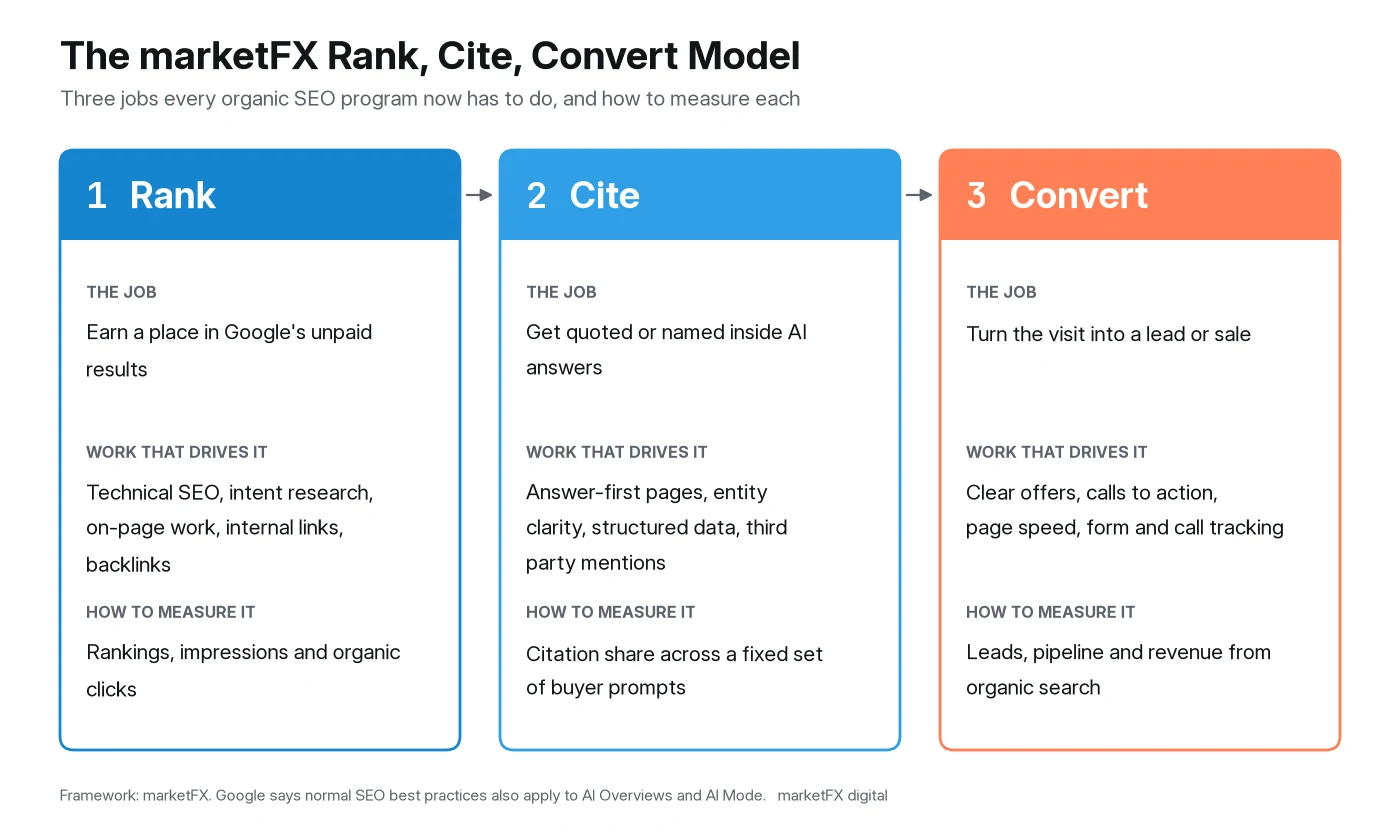
The marketFX Rank, Cite, Convert Model for judging organic SEO services.
| Job | What it means | Work that drives it | How to measure it |
|---|---|---|---|
| 1. Rank | Earn a place in Google's unpaid results | Technical SEO, intent research, on-page work, internal links, backlinks | Rankings, impressions and organic clicks in Search Console |
| 2. Cite | Get quoted or named inside AI answers | Answer-first pages, entity clarity, structured data, third party mentions | Citation share across a fixed set of buyer prompts |
| 3. Convert | Turn the visit into a lead or sale | Clear offers, calls to action, page speed, form and call tracking | Leads, pipeline and revenue from organic search |
Ask every provider which of the three jobs their plan covers and how each shows up in the monthly report. If the answer to "cite" or "convert" is vague, you are buying a ranking program.
How Has AI Search Changed Organic SEO Services?
AI search has not replaced organic SEO, but it has changed what a good result looks like. AI answers draw on pages that already rank and are easy to read, so the SEO foundation matters more, while clicks from each ranking are less certain. Services now need to cover being cited, not just being listed.
The click data is the clearest sign. In Pew Research Center's study of real browsing data, users clicked a search result on 8% of visits to a results page with an AI summary, compared with 15% without one. They clicked a link inside the summary itself on just 1% of those visits, and they ended their browsing session on 26% of pages with a summary versus 16% without (Pew Research Center).
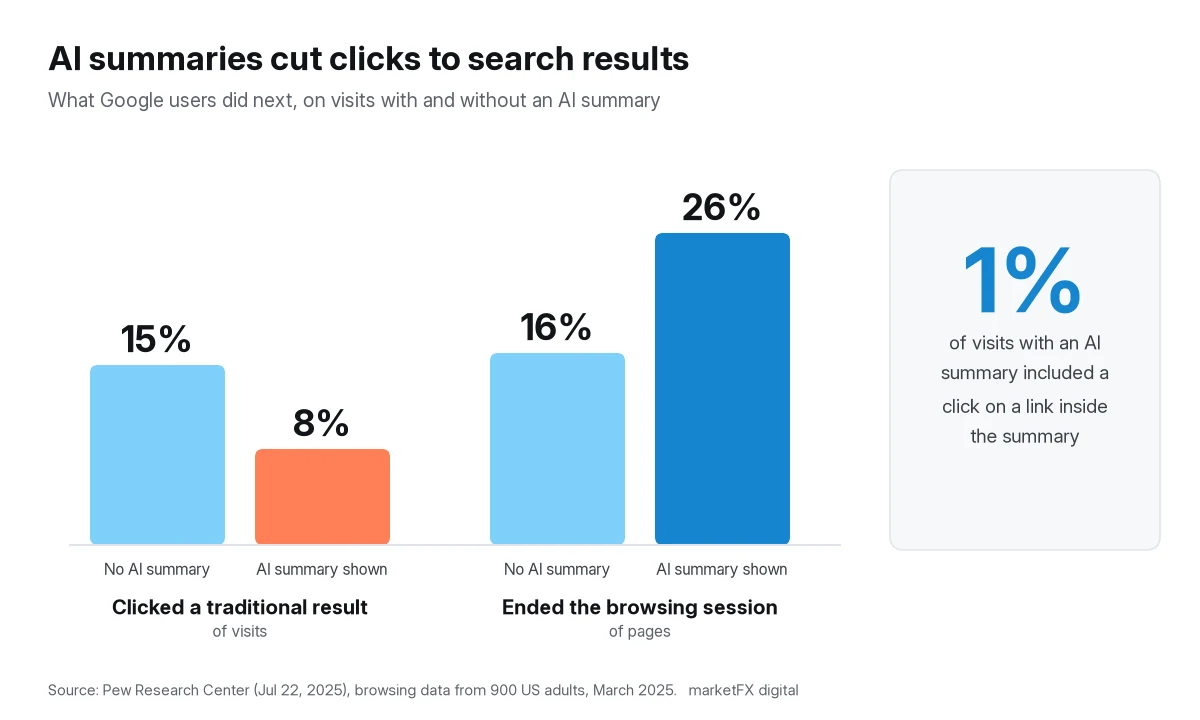
What Google users did next, with and without an AI summary. Source: Pew Research Center, July 2025.
| What the user did next | No AI summary | AI summary shown | Source |
|---|---|---|---|
| Clicked a traditional search result | 15% of visits | 8% of visits | Pew, 2025 |
| Ended the browsing session | 16% of pages | 26% of pages | Pew, 2025 |
| Clicked a link inside the AI summary | Not applicable | 1% of visits | Pew, 2025 |
Pew also found that only 8% of one or two word searches produced a summary, versus 53% of searches of ten words or more and 60% of searches starting with question words such as who, what or why (Pew Research Center). Long informational questions are the most exposed.
What this means for the service you buy:
- The foundation is the same. Google says the best practices for SEO remain relevant for AI Overviews and AI Mode, and that there are "no additional requirements" or special optimizations needed to appear in them (Google Search Central). Be skeptical of any provider selling a secret AI trick.
- Pages need quotable answers. Clear definitions, direct answers under question style headings and tables make it easier for any engine to lift your content accurately. Our guides to AEO services and GEO vs SEO go deeper.
- Reporting needs a new line. Track citation share and brand mentions for a fixed set of buyer prompts, alongside rankings and clicks. An AI search audit is the usual way to set that baseline.
Which Type of Organic SEO Service Do You Need?
Many buyers need a specialized version of organic SEO, and the right one depends on your site and business model. US search demand shows buyers often look for a specific type of SEO service rather than the general category.
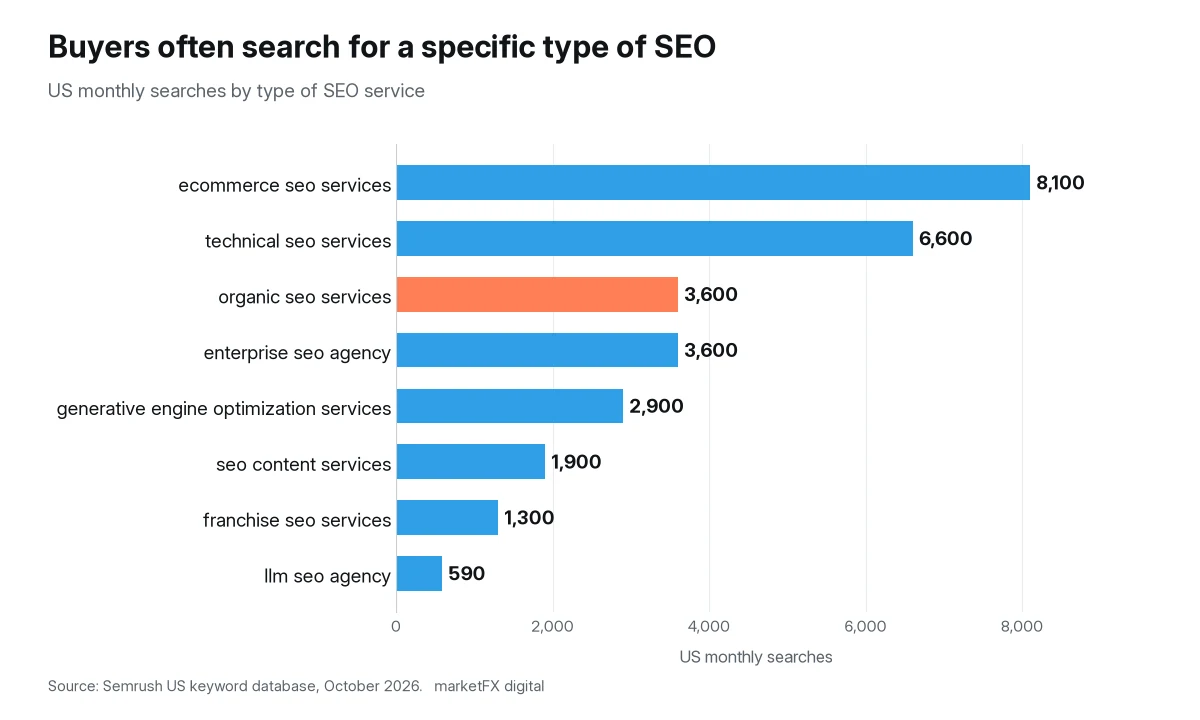
US monthly searches by type of SEO service. Source: Semrush US database, October 2026.
| Search term | US monthly searches | Best fit | Our guide |
|---|---|---|---|
| ecommerce seo services | 8,100 | Online stores with large catalogs | Ecommerce SEO services |
| technical seo services | 6,600 | Sites with crawl, speed or rendering problems | Technical SEO services |
| organic seo services | 3,600 | Brands that need the full program | This guide |
| enterprise seo agency | 3,600 | Large sites with many teams and approvals | Enterprise SEO agency |
| generative engine optimization services | 2,900 | Brands focused on AI answers | GEO agency |
| seo content services | 1,900 | Sites with sound foundations but thin content | SEO content services |
| franchise seo services | 1,300 | Franchise and multi-location systems | Franchise SEO |
| llm seo agency | 590 | Teams evaluating AI search specialists | LLM SEO agency |
If your problems span technical health, content and local signals, buy the full program. If one area is clearly the bottleneck, a focused engagement costs less. A marketing audit can tell you which situation you are in.
Organic SEO vs local SEO
Local SEO is a part of organic SEO, not a separate discipline. It focuses on map results, Google Business Profiles, reviews and location pages for searches with local intent, such as "near me" searches. If you sell from physical locations or serve defined areas, your organic SEO provider should cover local SEO or work closely with whoever does.
Organic SEO vs Paid Search: Which Should You Fund First?
Fund paid search first when you need leads this quarter, and organic SEO first when you are building a cost base that should keep paying off for years. Most growing brands need both. Paid search buys immediate, controllable visibility. Organic SEO builds visibility you do not pay for per click, but it takes longer and comes with no guarantees.
| Factor | Organic SEO | Paid search |
|---|---|---|
| What you pay for | Expertise and work, not placement | Each click, plus management |
| Speed | Builds over weeks and months | Can start the day campaigns launch |
| When spend stops | Rankings can hold for a while, then fade without upkeep | Visibility stops |
| Control | Indirect, search engines decide | Direct control of keywords, budget and copy |
| Best for | Durable demand capture and authority | Fast tests, launches and high intent terms |
Buying ads does not help your organic rankings. Google says plainly that "advertising with Google won't have any effect on your site's presence in our search results" (Google Search Central). The two channels help each other in other ways, such as sharing keyword and conversion data, which is why we plan paid media and organic search together.
How Do You Choose an Organic SEO Company?
Choose an organic SEO company by testing how it works, not how it pitches. Ask for examples of past work, a plain explanation of every change it would make, and a measurement plan tied to leads. Walk away from anyone who guarantees rankings or will not explain their methods.
Google publishes its own interview questions for hiring an SEO, and they are a good starting point (Google Search Central):
- Can you show me examples of your previous work and share some success stories?
- Do you follow the Google Search Essentials?
- What kind of results do you expect to see, and in what timeframe? How do you measure your success?
- What's your experience in my industry, and in my country or city?
- How can I expect to communicate with you? Will you share all the changes you make to my site, with the reasoning behind them?
We would add four questions that reflect how organic search works now:
- Which of the three jobs, rank, cite and convert, does your plan cover? Ask to see each one in a sample report.
- How will you track whether AI answers cite us? Listen for a fixed prompt set and a baseline, not a vague promise of "AI optimization."
- Who owns the work when we part ways? Your Search Console, analytics, content and any tools should sit in your accounts, with the provider given access.
- How do you connect organic leads to revenue? Without CRM data, a provider can only report traffic. Our marketing attribution work exists because this link is so often missing.
If a provider offers an audit first, Google advises granting only read access to Search Console at that stage (Google Search Central).
Green flags and red flags in an organic SEO proposal
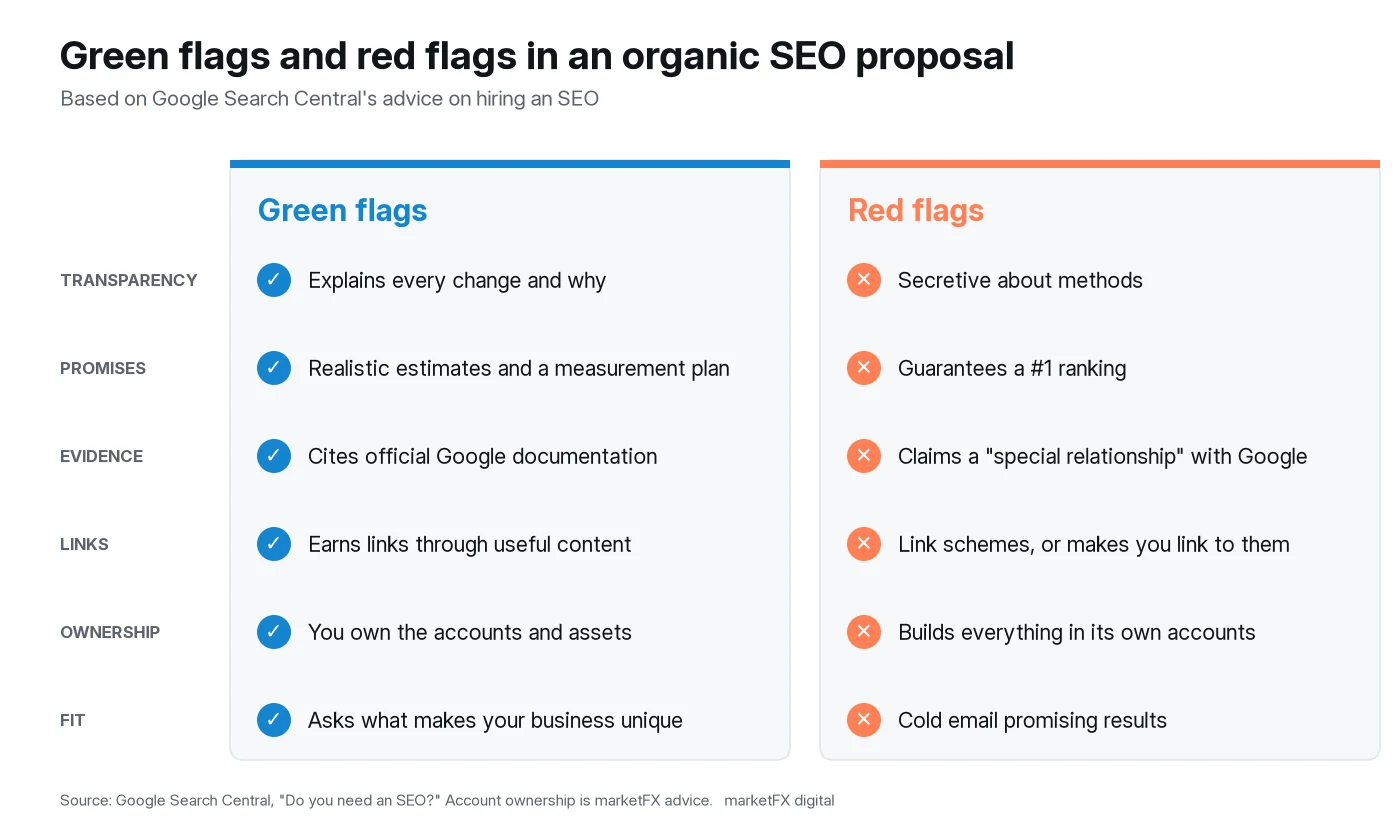
Green and red flags in an organic SEO proposal, based on Google Search Central's advice on hiring an SEO.
| Area | Green flag | Red flag |
|---|---|---|
| Transparency | Explains every change and the reasoning behind it | Secretive or will not explain what it intends to do |
| Promises | Realistic estimates of improvement and effort, with a measurement plan | Guarantees a number one ranking on Google |
| Evidence | Cites official Google documentation for its recommendations | Claims a "special relationship" with Google or a "priority submit" |
| Links | Earns links and mentions through useful content and outreach | Link popularity schemes, or requires you to link to the provider |
| Ownership | Your accounts, with the provider given access | Everything built inside the provider's own accounts |
| Fit | Asks what makes your business unique and how customers find you | Cold email out of the blue promising results |
The red flags come from Google's guidance, except account ownership, which is our own advice. Google is blunt: "No one can guarantee a #1 ranking on Google," and you are responsible for the actions of any company you hire (Google Search Central).
What about "best organic SEO agency" lists?
Lists of the best organic SEO agencies can help you build a long list, but many are published by agencies that include themselves. Run every name, including us, through the questions and flags above.
How Much Do Organic SEO Services Cost?
Organic SEO cost depends on site size, how much is broken, how competitive your searches are and how many of the eight workstreams the provider handles. Content and authority building usually drive most of the cost, because they are the most labor heavy. Ask every provider to price the same scope so the numbers are comparable.
Common pricing structures include:
- Monthly retainer. Ongoing work across several workstreams. Check what is included each month.
- Project or audit fee. A fixed fee for an audit, migration or fix list, useful when your team implements.
- Hourly or advisory. Consulting time for in-house teams who do the work themselves.
- Performance based. Fees tied to rankings or traffic. Read the terms, since rankings for terms nobody searches are easy to hit.
Two proposals with the same monthly fee can contain very different work, so compare deliverables line by line against the eight workstreams above. For agency fees more broadly, see our breakdown of marketing agency cost.
How Long Do Organic SEO Services Take to Work?
Expect early signals within weeks and meaningful results over months. Google says some changes take effect in a few hours while others could take several months, and suggests waiting a few weeks to assess whether a change helped (Google Search Central). Competitive terms and new sites take longer.
In our own SEO and AI visibility engagements, technical and schema fixes usually start showing up in AI engines within two to six weeks as the major bots crawl again, content and topical authority work compounds over 60 to 120 days, and meaningful organic ranking lift typically arrives by months four to six, as described on our SEO and AI visibility consulting page. These are typical patterns, not promises.
Agree on leading indicators for the first 90 days, such as pages fixed and indexed, Search Console impressions and an AI citation baseline, so nobody judges the program on month one revenue.
How marketFX Approaches Organic SEO
We run organic SEO and AI visibility as one program, connected to paid media, CRM and analytics, because rankings that never become revenue are not much use to anyone. Every engagement starts with an audit of technical health, content, internal linking, structured data and location signals, plus a baseline of where your brand appears in Google and in AI answers for a defined set of buyer questions.
From there we agree a 90 day action plan with named owners and weekly milestones, and work alongside your developers and content team to ship it. Reporting covers organic traffic, rankings, leads from organic search and citation share in AI answers, measured against the baseline. Structured data helps machines read a site but guarantees nothing, so we judge the work by outcomes.
Across all our work we report 94% client retention, more than 20 years driving growth and more than $20 million in revenue tracked for clients. Read what clients say on our testimonials page, see our SEO and AI visibility consulting service, or explore our AI SEO agency work if your foundations are already strong.
If you are comparing organic SEO providers now, put us through the same questions.
Related services
FAQs
Frequently Asked Questions
- What are organic SEO services?
- Organic SEO services are the strategy and hands-on work that help a website earn unpaid visibility in search engines and AI answers. A full program covers technical SEO, keyword and intent research, on-page optimization, content, internal linking, authority building, local SEO and reporting. You pay for the expertise and the work, because Google does not sell organic placement.
- What is the difference between organic SEO and paid search?
- Organic SEO earns unpaid rankings through better pages, content and authority, so results build over months and can keep working when spend pauses. Paid search buys ad placement per click, starts quickly and stops when the budget stops. Google says advertising with it has no effect on your organic rankings, so the two channels need separate plans that share data.
- Is local SEO part of organic SEO?
- Yes. Local SEO is the part of organic SEO that targets map results and searches with local intent, using Google Business Profiles, reviews, location pages and consistent business details. Brands with physical locations or defined service areas should make sure their organic SEO provider covers local work or coordinates closely with the team that does.
- Do organic SEO services still matter with AI Overviews?
- Yes. Google says normal SEO best practices still apply to AI Overviews and AI Mode, with no special requirements. AI answers draw on pages that are crawlable, clear and trusted, which is what organic SEO builds. What changes is measurement, because clicks per ranking can fall, so track citations in AI answers alongside rankings and leads.
- How long do organic SEO services take to show results?
- Google says some changes take effect within hours while others take several months, and suggests waiting a few weeks before judging a change. In our engagements, technical fixes often show early signals within weeks, while content and authority work compounds over several months. Agree on leading indicators for the first 90 days so the program is judged fairly.
- How much do organic SEO services cost?
- Cost depends on site size, how much needs fixing, how competitive your searches are and how many workstreams the provider handles. Common structures are a monthly retainer, a fixed project or audit fee, hourly advisory time and performance based fees. Ask every provider to price the same scope, then compare deliverables line by line rather than monthly totals.
- What questions should I ask an organic SEO company?
- Start with Google's own list: ask for examples of past work, whether they follow Google Search Essentials, what results they expect and when, their industry experience, and whether they will share every change. Then ask how they track AI citations, how they connect organic leads to revenue, and whether you will own every account and asset.