
Enterprise SEO Agency: How to Choose One in the AI Search Era
Hiring an enterprise SEO agency? What the work covers at scale, how AI Overviews change it, agency vs in-house, a 90 day plan, and questions to ask.
An enterprise SEO agency is not a regular SEO agency with a bigger invoice. The work changes when a site has tens of thousands of pages, several brands or regions, hundreds of locations, and a development queue shared with every other team in the business. The hard part stops being "what should this page say" and becomes "which fix reaches the most pages, who owns it, and how do we get it shipped."
AI search adds a second layer. Google AI Overviews, ChatGPT, Perplexity, and Gemini now answer many of the questions your buyers used to click through to answer. An enterprise SEO agency in 2026 has to protect organic revenue on both surfaces at once.
This guide covers what enterprise SEO actually involves, how AI search changes it at scale, when an agency makes sense versus an in-house team, what the first 90 days should produce, and the questions that separate a real enterprise partner from a mid-market shop with an enterprise sales deck.
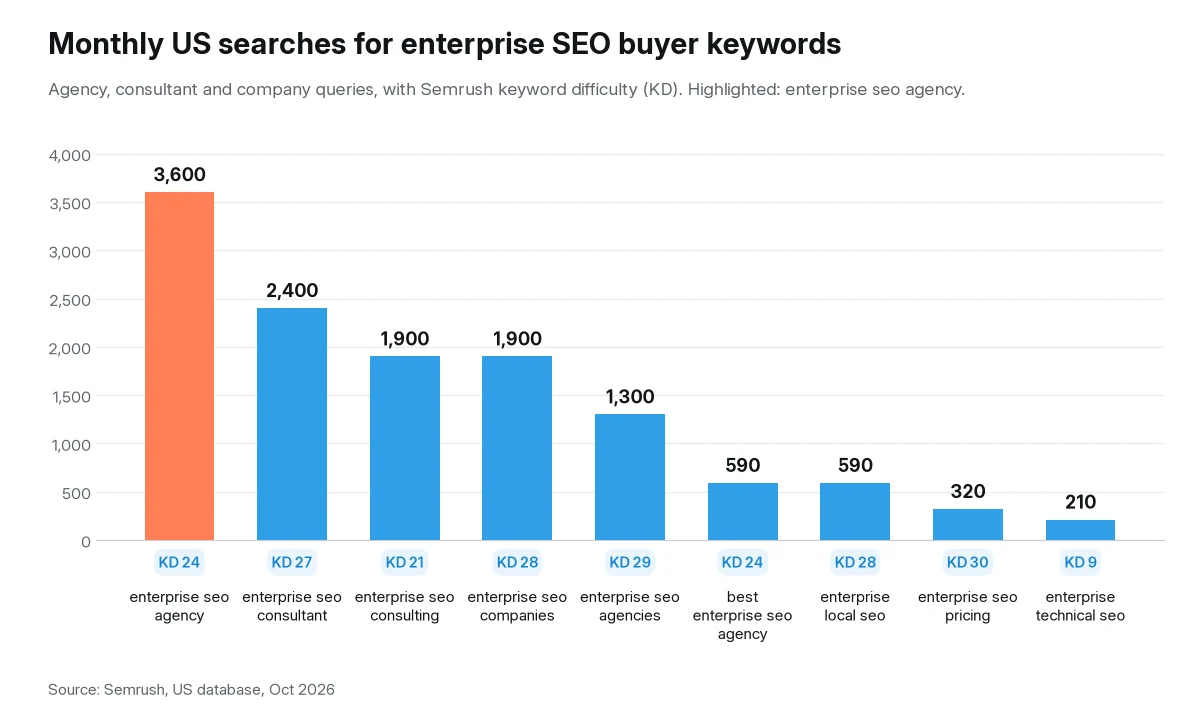
Buyers search for enterprise SEO help in several ways: agency, consultant, consulting, and company. Source: Semrush, US database, Oct 2026.
What an Enterprise SEO Agency Does Differently
There is no official line where SEO becomes enterprise SEO. In practice, the label fits when the site and the organization behind it create problems a single SEO specialist cannot solve alone. The usual signs:
- Scale. Pages are generated by templates, so one template bug can affect thousands of URLs. Crawl budget, canonical rules, and faceted navigation become real issues.
- Many stakeholders. Product, brand, legal, IT, regional marketing, and franchisees all touch the site. SEO recommendations compete with everyone else's roadmap.
- Multiple brands, regions, or locations. Each one needs consistent signals, from location pages to Google Business Profiles to brand naming.
- Shared engineering resources. The agency rarely ships code directly. It writes tickets that your developers have to understand, estimate, and prioritize.
- Revenue accountability. Leadership wants organic performance tied to leads, bookings, and pipeline, not a monthly ranking report.
A good enterprise SEO agency is built for those conditions. That means strong technical SEO, but also project management, clear documentation, and the patience to work inside someone else's release cycle.
Enterprise SEO Is a Leverage Problem
The single most useful habit in enterprise SEO is sorting every recommendation by how many pages it reaches. A fix to a product or location template can change thousands of pages in one release. A rewritten blog post changes one.
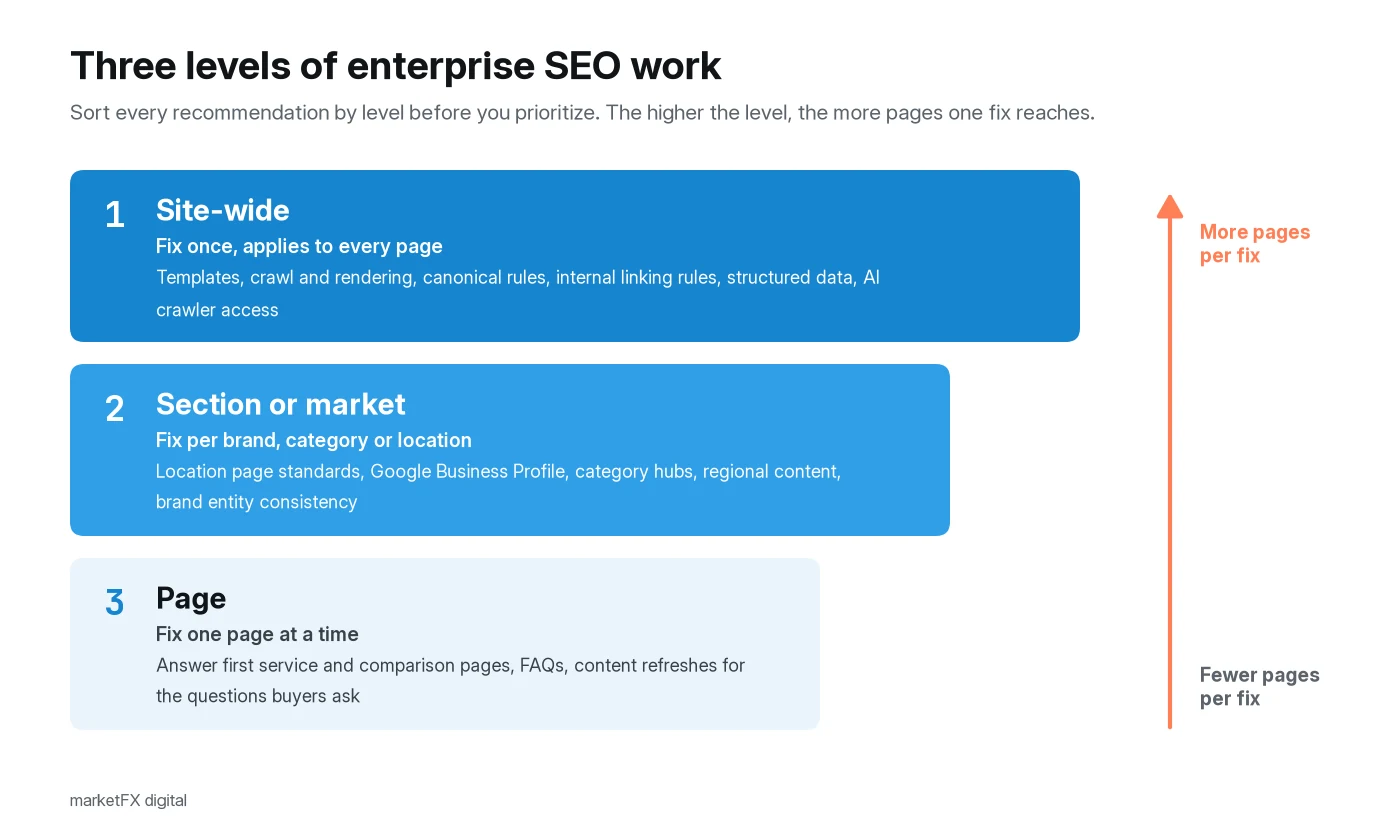
Sort every recommendation by level before you prioritize. Site-wide fixes earn the most per developer hour.
- Site-wide. Templates, crawl and rendering, canonical rules, internal linking rules, schema markup, and access for AI crawlers. These are fixed once and apply everywhere.
- Section or market. Location page standards, Google Business Profile hygiene, category hubs, regional content, and consistent brand entities across business units. Our local SEO playbook for multi-location brands covers this level in depth.
- Page. Answer first service and comparison pages, FAQs, and refreshes for the questions buyers ask.
Starting at level 3 because it is easier to show activity is an easy way to spend an enterprise SEO budget without moving much. Ask any agency you are considering to show you how they tag and sequence their recommendations.
How AI Search Changes Enterprise SEO
Large brands rank for a very large number of keywords, so changes on the results page hit them at scale. In our 18-brand study of US multi-location retailers, the brands together ranked for 9,579,636 keywords in Google's US top 100, and 31.4% of those keywords returned an AI Overview. The largest single footprint, Tractor Supply, ranked for 2,648,680 keywords, with 744,994 of them under an AI Overview.
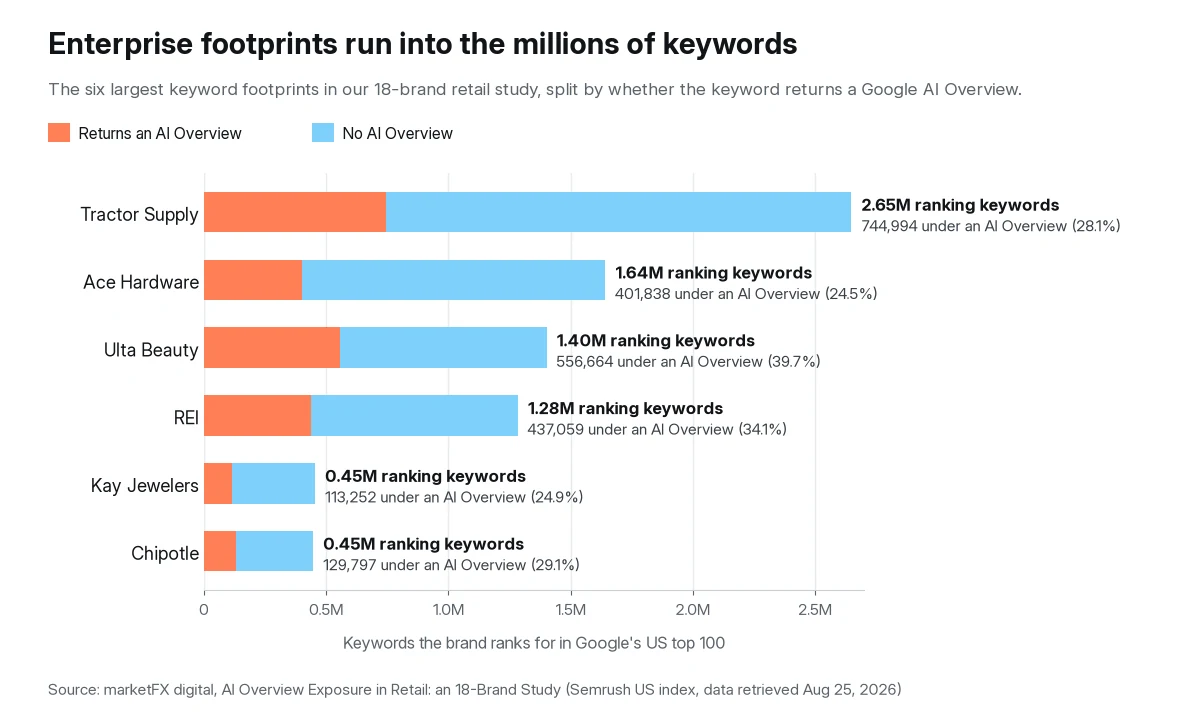
At enterprise scale, even a modest AI Overview share covers hundreds of thousands of keywords. Source: marketFX digital, AI Overview Exposure in Retail: an 18-Brand Study (Semrush US index, data retrieved Aug 25, 2026).
Two findings from that study matter for anyone hiring an enterprise SEO agency:
- Exposure varies widely between similar brands. The share of keywords under an AI Overview ranged from 21.5% to 59.0% across the 18 brands. You cannot assume your exposure from your category.
- Authority does not predict exposure. The correlation between Semrush Authority Score and AI Overview exposure was +0.04, effectively zero. A strong domain does not protect you from AI answers sitting above your rankings.
Exposure matters because AI answers change click behavior. Pew Research Center analyzed the browsing of 900 US adults in March 2025 and found that users clicked a traditional search result on 8% of visits to pages with an AI summary, compared with 15% of visits to pages without one (Pew Research Center, July 2025).
What that means in practice: an enterprise SEO agency should measure your AI Overview exposure by section, track whether your brand is cited inside those answers, and report share of model next to organic traffic. If an agency's reporting stops at rankings, it is reporting on half the results page. For a deeper look at the AI side, see our guides to choosing an LLM SEO agency and running an AI search audit.
Agency, In-House, or Hybrid
Most enterprise teams end up with some mix. The right split depends on what you already have, not on a rule.
| Model | Works best when | Watch out for |
|---|---|---|
| In-house team | You have steady volume, strong engineering access, and SEO leaders who can set priorities across business units. | Narrow skill coverage. One team rarely has deep technical SEO, content, local, analytics, and AI search expertise all at once. |
| Enterprise SEO agency | You need senior expertise fast, a fresh audit, or capacity for a migration, replatform, or AI search program. | Agencies that treat your site like a mid-market account, or hand recommendations over without owning the outcome. |
| Hybrid | An in-house SEO lead owns priorities and stakeholders, and the agency brings depth and execution capacity. | Blurry ownership. Every fix needs one named owner on one side or the other. |
We compare these models in more detail in marketing agencies vs an in-house team. For budget context, see how much a marketing agency costs in 2026.
What the First 90 Days Should Produce
A credible enterprise SEO agency should be able to tell you, before you sign, what you will have in hand after 90 days. The exact timing will vary with your site and your release cycle, but the outputs should look something like this.
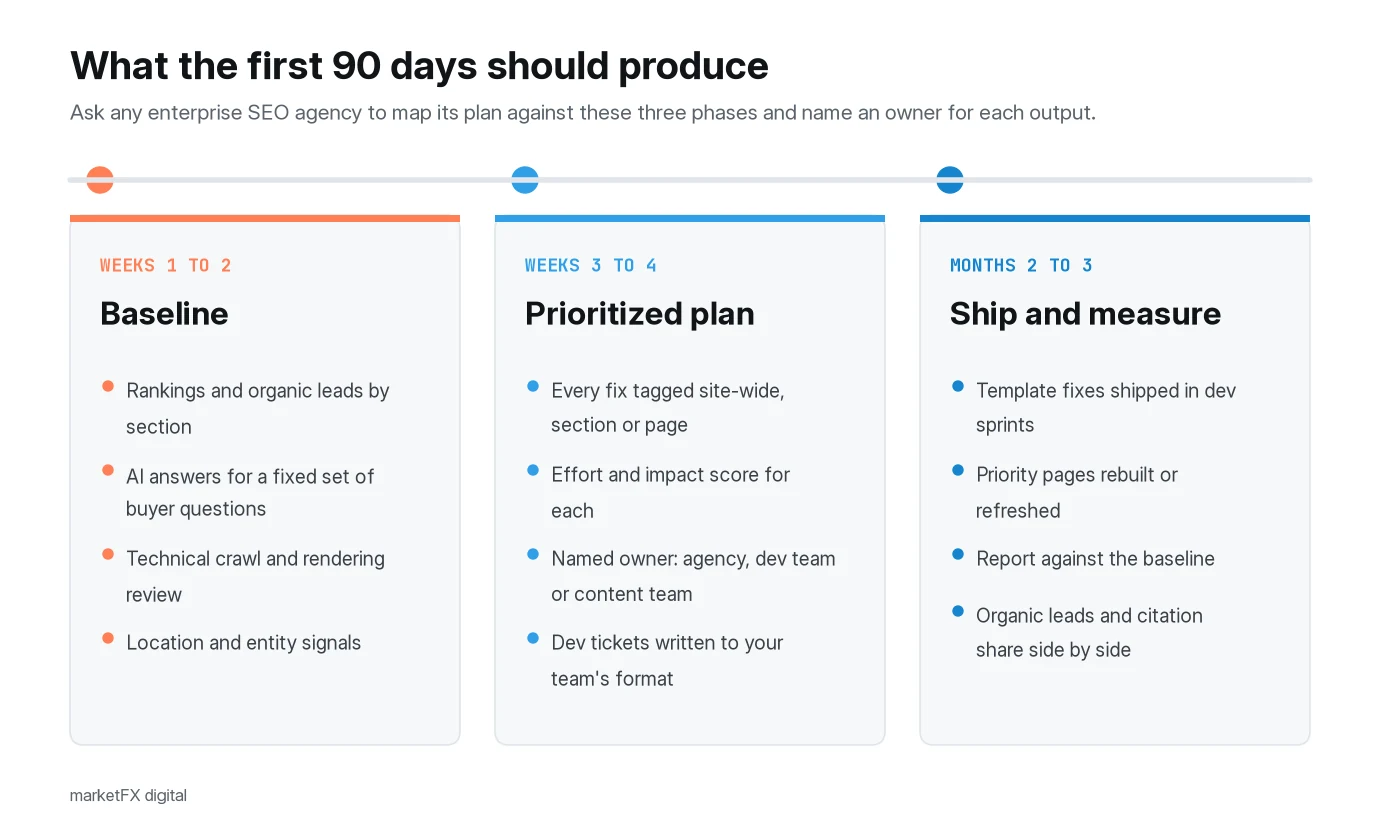
Ask any enterprise SEO agency to map its plan against these three phases and name an owner for each output.
- Baseline (weeks 1 to 2). Rankings and organic leads by site section, AI answers for a fixed set of buyer questions, a technical crawl and rendering review, and location and entity signals.
- Prioritized plan (weeks 3 to 4). Every recommendation tagged by level, scored for effort and impact, assigned to a named owner, and written as tickets your developers can estimate.
- Ship and measure (months 2 to 3). Template fixes go out in normal dev sprints, priority pages get rebuilt or refreshed, and reporting compares organic leads and AI citation share against the baseline.
If an agency cannot describe its first 90 days in this level of detail, it will not run them in this level of detail either.
Questions to Ask Before You Sign
- How do you prioritize across thousands of pages? Listen for leverage, templates, and sequencing. Be wary of a long list of page-level tasks.
- Who will actually do the work? Ask to meet the people on your account, not just the people in the pitch.
- How do you work with our developers? Ask for a sample ticket. Good agencies write tickets your team can estimate without a follow-up meeting.
- How do you handle multiple brands, regions, or locations? Ask how they keep location pages and Google Business Profiles consistent at scale.
- What do you measure for AI search? You want AI Overview exposure, citation share in AI answers, and AI referral traffic, reported next to organic leads.
- How do you connect SEO to revenue? Ask what reporting and analytics looks like in month three, and which numbers leadership will see.
- What will you not promise? No one can guarantee rankings or placement inside AI answers. An agency that does is telling you something about how it sells.
How marketFX Runs Enterprise SEO
Our enterprise SEO and AI visibility consulting starts with an audit that goes beyond rank tracking: technical SEO, structured data, crawlability for both search and AI crawlers, content, entity clarity, topical authority, internal linking, location and FAQ structure, and readiness for AI answers. The output is a 90 day action plan with named owners.
We work alongside your developers and content team rather than around them, and we report on organic traffic, rankings, leads, and citation share against the baseline. For multi-location and franchise brands, that work connects with our multi-location and franchise marketing and franchise SEO programs. For the AI side, see our AI SEO agency and GEO agency services.
If you are comparing enterprise SEO agencies now, book a strategy call. We will show you how your site and your brand show up in Google and in AI answers today, and what we would fix first.
FAQs
Frequently Asked Questions
- What is an enterprise SEO agency?
- An enterprise SEO agency specializes in search for large organizations: sites with thousands of pages, multiple brands, regions, or locations, and many internal stakeholders. The work focuses on site-wide technical fixes, governance, and scalable content, and in 2026 it also covers visibility in AI answers such as Google AI Overviews and ChatGPT.
- How is enterprise SEO different from regular SEO?
- The fundamentals are the same, but the scale changes the work. Pages are built from templates, fixes depend on shared developer time, and every recommendation has to be prioritized by how many pages it reaches and who owns it.
- Should we hire an enterprise SEO agency or build an in-house team?
- It depends on what you already have. In-house teams work well with steady volume and strong engineering access. Agencies add senior depth and capacity quickly. Many enterprise teams run a hybrid, with an in-house lead who owns priorities and an agency that brings expertise and execution.
- What should an enterprise SEO agency deliver in the first 90 days?
- A baseline of rankings, organic leads, and AI answer visibility, a prioritized plan with every fix tagged by level and assigned to a named owner, and the first round of template and priority page fixes measured against that baseline.
- Does an enterprise SEO agency need to handle AI search?
- Yes. Google AI Overviews and AI assistants now sit above or replace many traditional results, and in our study of 18 US multi-location retail brands, 31.4% of their ranking keywords returned an AI Overview. Reporting should cover AI Overview exposure and citation share, not only rankings.
Get a Second Opinion on Your Enterprise SEO Plan
Book a strategy call. We will look at how your site, your locations, and your brand show up in Google and in AI answers today, and what an enterprise SEO program should fix first.