
AI Search Audit: What It Covers and How to Run One
What does an AI search audit actually check? The five layers to review, how to run one step by step, what the deliverable should include, and red flags.
An AI search audit tells you how AI engines answer your buyers' questions today, whether your brand is part of those answers, and what is stopping it. That matters more each quarter. When Google shows an AI summary, Pew Research Center found users click a traditional result in 8% of visits, compared with 15% when no summary appears (Pew Research Center, July 2025, based on March 2025 browsing data from 900 US adults). Buyers are searching for help with this: according to Semrush, US searches for "ai search audit" average about 480 a month, with another 260 each for "ai visibility audit" and "geo audit" (Semrush US database, October 2026). This guide covers what an AI search audit should check, how to run one, what the deliverable should look like, and when to bring in outside help.
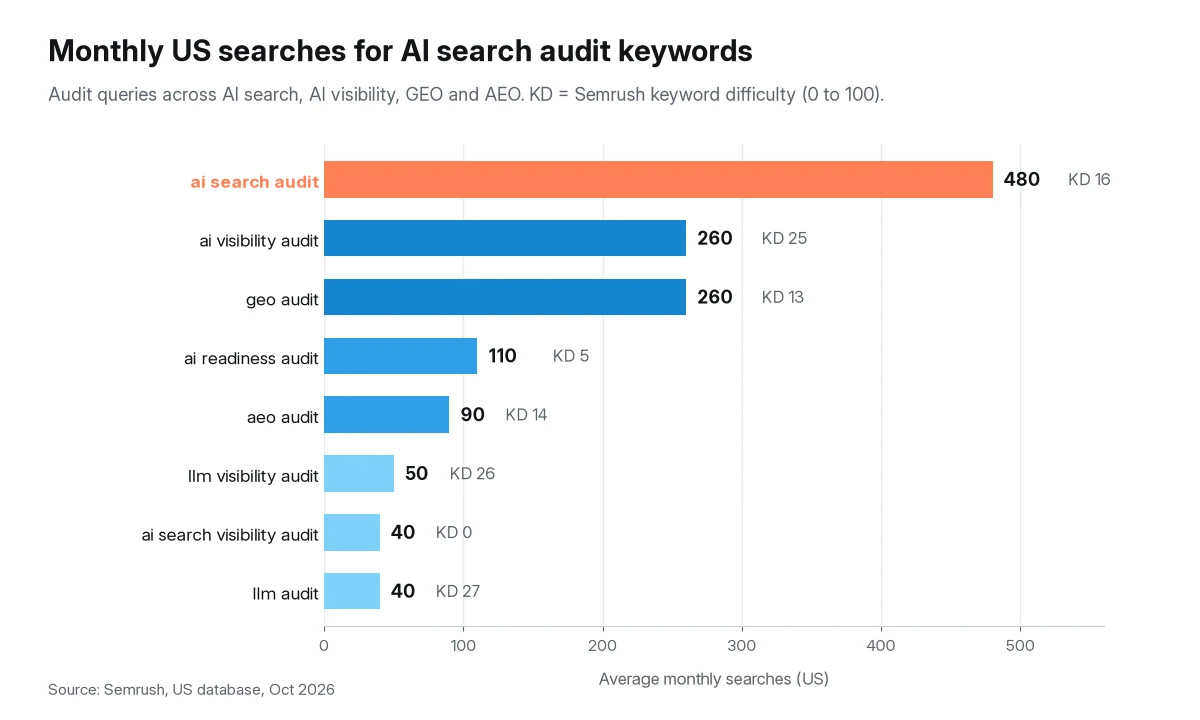
Monthly US searches for AI search audit keywords. Source: Semrush, US database, Oct 2026.
What Is an AI Search Audit?
An AI search audit is a structured review of how your brand appears in AI generated answers from ChatGPT, Perplexity, Gemini, Claude, and Google AI Overviews, and of the signals that decide whether it appears at all. It combines prompt testing (what the engines say) with a site and reputation review (why they say it).
You will see the same work sold as an AI visibility audit, a GEO audit, an AEO audit, or an LLM visibility audit. The names differ. Judge the offer on what it checks and what you get at the end.
An AI search audit is not the same as an AI readiness audit. A readiness audit looks at how your own team uses AI tools. An AI search audit looks outward, at how AI engines describe your brand to buyers. If the readiness question is the one you need answered, start with the AI Enablement Ladder™.
Why a Traditional SEO Audit Is Not Enough
A standard SEO audit checks rankings, technical health, and links. Those still matter, because several AI engines draw on pages that already rank well. But rankings alone do not tell you whether you are cited.
Our own research shows why. Across 18 US multi-location retail brands and 9,579,636 ranking keywords, 31.4% of the keywords those brands rank for now sit under a Google AI Overview, and domain authority showed no meaningful relationship with that exposure (r = +0.04) (AI Overview Exposure in Retail: an 18-Brand Study, marketFX digital, data retrieved August 25, 2026). Strong SEO gets you ranked. It does not, on its own, tell you what the answer above your ranking says.
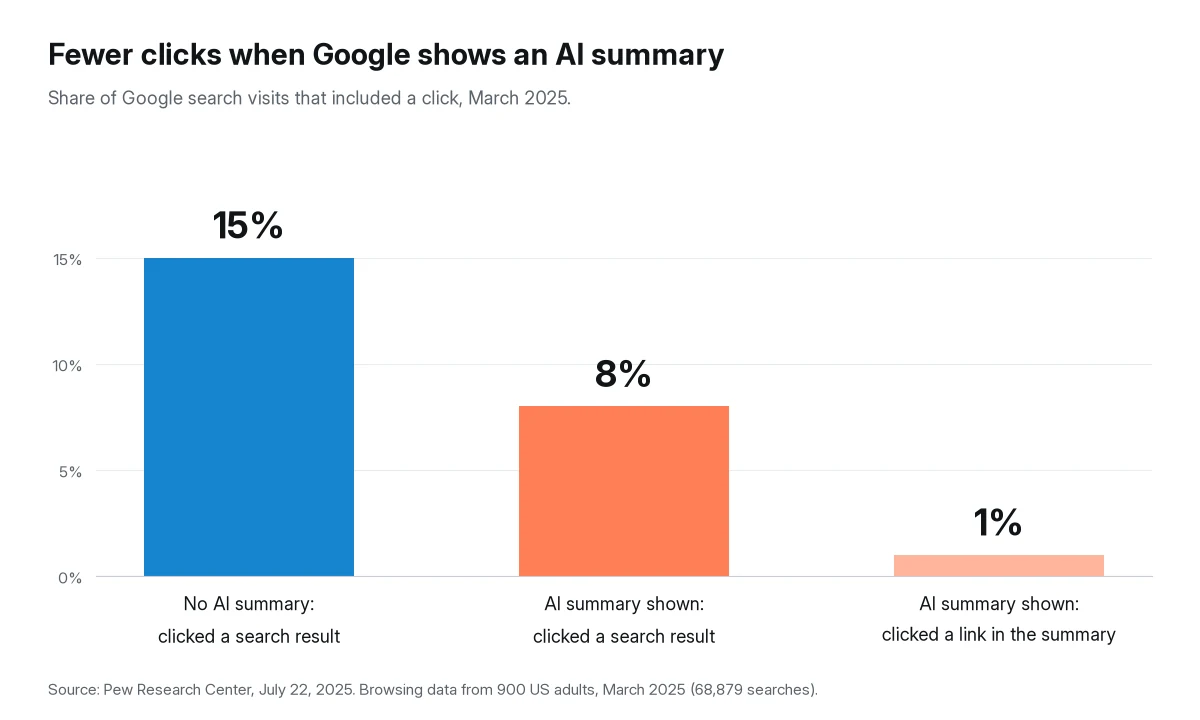
Share of Google search visits that included a click, with and without an AI summary. Source: Pew Research Center, July 2025.
The Five Layers of an AI Search Audit
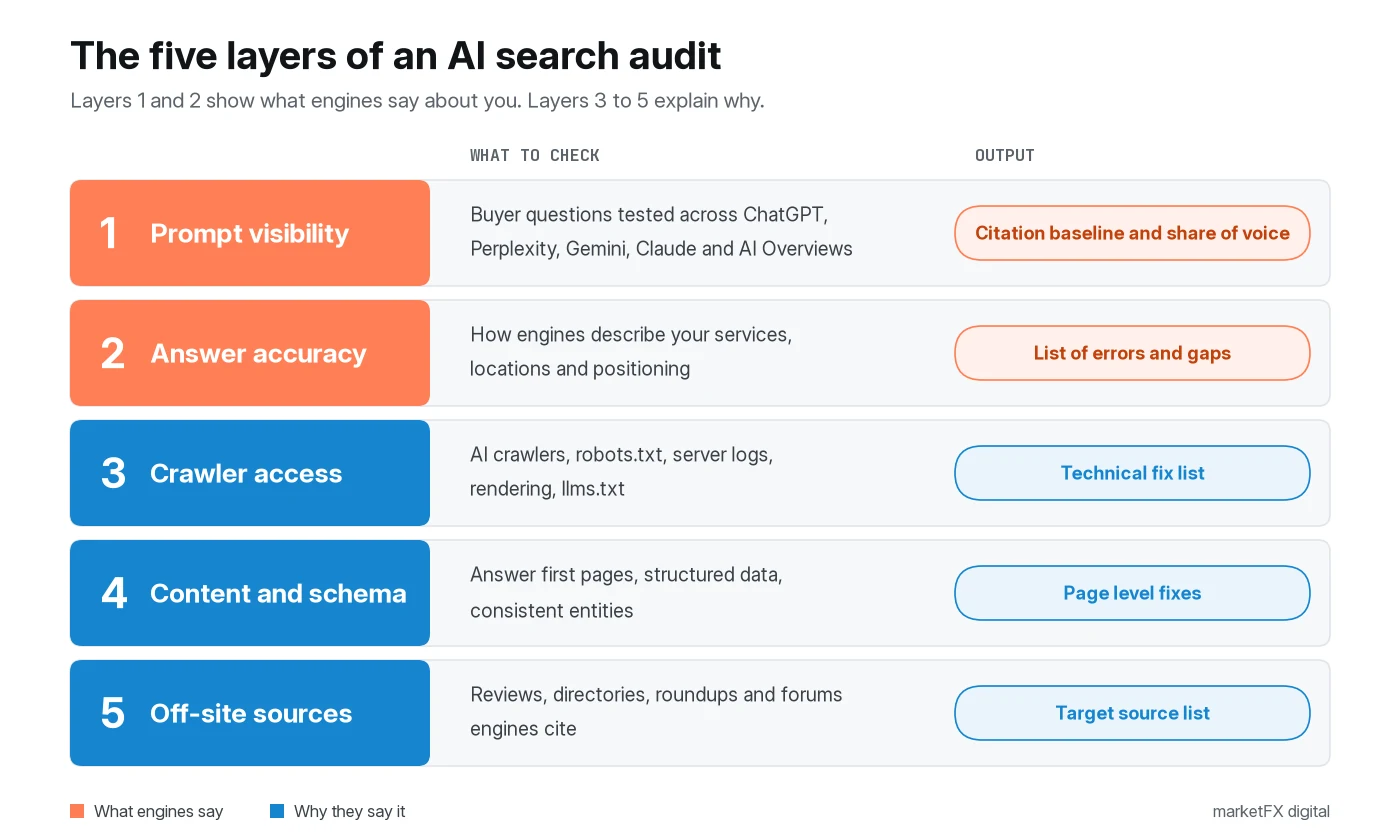
A complete audit covers five layers. The first two describe what engines say about you. The last three explain why.
-
Prompt visibility. Build a fixed set of the questions your buyers actually ask, from "what is" questions through comparison and "best provider for" questions. Run each one across the engines that matter to you and record who gets cited or named: you, a competitor, or neither. Answers change between runs, so test each prompt more than once. This becomes your baseline and your share of model against the brands you compete with.
-
Answer accuracy and sentiment. Being named is not enough if the answer is wrong. Check how engines describe your services, locations, pricing model, and positioning, and flag anything outdated, incomplete, or confused with another company.
-
Crawler access and rendering. AI crawlers such as GPTBot, ClaudeBot, and PerplexityBot need to reach your pages, and your key content should render without depending on JavaScript. Review robots.txt rules, server logs for AI crawler visits, sitemaps, and whether you publish an llms.txt file.
-
Content structure and entity signals. Engines quote passages, not whole pages. Check whether your service and comparison pages lead with a direct answer, use clear headings and tables, and carry accurate schema markup for your organization, services, locations, and FAQs. Make sure your brand, people, and services are described consistently everywhere, which is the core of entity SEO.
-
Off-site sources. Answer engines read reviews, directories, industry roundups, forums, and publications, not just your site. Look at which sources the engines cite for your category's questions, and whether you are present and described accurately in them.
How to Run an AI Search Audit, Step by Step
-
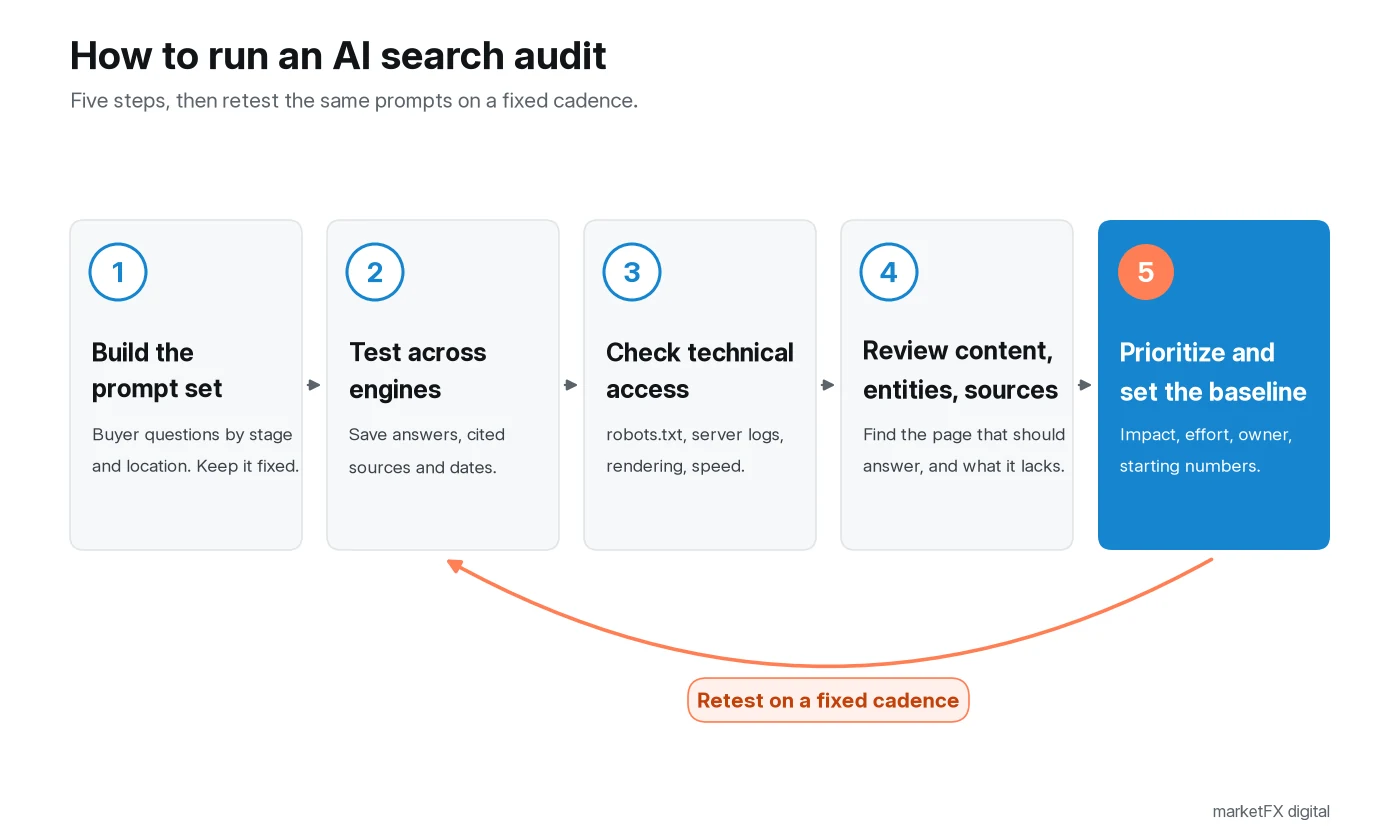
Build the prompt set. List the questions buyers ask at each stage: problem, category, comparison, and provider selection. Include location versions if you operate in several markets. Keep the set fixed so later tests are comparable.
-
Test across engines. Run every prompt in each engine you care about and save the full answer, the cited sources, and the date. Screenshots or exports matter, because you will need them to prove change later.
-
Check technical access. Review robots.txt, server logs, rendering, and site speed for the pages your prompts should surface. Fixes here are usually quick and sitewide.
-
Review content, entities, and sources. For each prompt where you are missing or misdescribed, identify the page that should answer it, what it lacks, and which outside sources the engines prefer instead.
-
Prioritize and set the baseline. Score each fix on impact and effort, assign an owner, and record the starting numbers you will measure against. Then retest the same prompts on a fixed cadence.
If you want to compare the tools that automate parts of steps 1 and 2, see our guide to generative engine optimization tools.
What the Audit Deliverable Should Include
A useful audit ends in decisions, not a dashboard. Whether you run it yourself or hire it out, expect:
- A citation baseline by engine and by prompt, with competitors alongside.
- An accuracy log of every place an engine describes you incorrectly, with the likely source.
- A technical fix list for crawler access, rendering, and structured data, scored on effort and impact.
- Page level recommendations for the service, location, and comparison pages that should be answering your buyers.
- A target source list of third party sites to earn a place in.
- A measurement plan that ties AI visibility to AI referral traffic, leads, and revenue in the same reporting as the rest of your marketing.
Should You Run It Yourself or Hire Help?
A small team can run a first pass in house. A fixed prompt set, a spreadsheet, and a few hours of testing will show whether you have a visibility problem.
Outside help is worth it when the audit has to cover many services or locations, when the fixes span technical SEO, content, and digital PR, or when leadership needs a baseline they can trust. That is how we run it at marketFX: our SEO and AI visibility consulting starts with an AI visibility audit across ChatGPT, Perplexity, Gemini, Claude, and Google AI Overviews alongside a full SEO audit, and returns a prioritized 90 day plan. If AI visibility is one question among several, our marketing audit reviews it alongside paid media, analytics, CRM, and conversion. Multi-location and franchise brands should also review location level signals, which we cover in our multi-location and franchise marketing work.
Questions to Ask an AI Search Audit Provider
- Which engines do you test, and how many times per prompt? One run per prompt is a snapshot, not a baseline.
- Who writes the prompt set? It should come from your buyers' real questions, agreed with you, not a generic template.
- Do we get the raw answers? You should be able to check every finding yourself.
- How do you connect findings to revenue? Citation counts are a starting point, not the goal.
- What happens after the audit? Ask whether they implement, hand off to your team, or both.
Red Flags
- A single score with no evidence. A visibility score you cannot trace back to specific prompts and answers is hard to act on.
- Guaranteed citations. No one controls what an AI model says. A credible provider improves the signals engines rely on and measures the result.
- Tool output passed off as an audit. A tracking dashboard shows the gap. The audit should explain why it exists and how to close it.
- No baseline. If the starting point is not recorded, no one can show what changed.
If the audit shows you need ongoing work rather than a one time review, our guide to AEO services covers what that work should include, and our GEO agency page explains how we run it.
If you want to see how AI engines answer your own buyers' questions today, book a strategy call.
Related services
FAQs
Frequently Asked Questions
- What is an AI search audit?
- An AI search audit is a structured review of how your brand appears in AI generated answers from engines such as ChatGPT, Perplexity, Gemini, Claude, and Google AI Overviews, plus the technical, content, and off-site signals that decide whether you appear.
- How is an AI search audit different from an SEO audit?
- An SEO audit focuses on rankings, technical health, and links. An AI search audit adds prompt testing across AI engines, checks whether answers describe you accurately, and reviews the third party sources those engines cite. The two work best together.
- What is the difference between an AI search audit and an AI visibility audit or GEO audit?
- In practice they describe the same work. Providers use different names, so compare what each audit checks and what you receive at the end.
- How often should you run an AI search audit?
- Run a full audit once to set a baseline, then retest the same prompt set on a fixed cadence. AI answers change as engines update, so a one time snapshot goes stale.
- Can an AI search audit guarantee my brand will be cited?
- No. An audit shows where you stand and what to fix. No one controls what an AI model says, so any provider that guarantees citations is overpromising.
See How AI Engines Answer Your Buyers Today
Book a strategy call. We will walk through where your brand shows up in ChatGPT, Perplexity, Gemini, Claude, and Google AI Overviews, and which audit findings to fix first.