
LLM SEO Agency: How to Evaluate One Before You Sign
Hiring an LLM SEO agency? What the work covers, where an agency can and cannot influence AI answers, a six point scorecard, pitch questions, and red flags.
An LLM SEO agency works to get your brand found, described accurately, and cited when buyers ask ChatGPT, Perplexity, Gemini, Claude, or Google AI Overviews for a recommendation. Plenty of companies are now shopping for one. According to Semrush, US searches for "llm seo agency" average about 590 a month, "llm seo services" about 480, and "llm optimization agency" about 320 (Semrush US database, October 2026). The harder part is telling a real LLM SEO practice from a traditional SEO retainer with a new label. This guide covers what the work should include, where an agency can and cannot influence AI answers, and a scorecard you can use in your next pitch meeting.
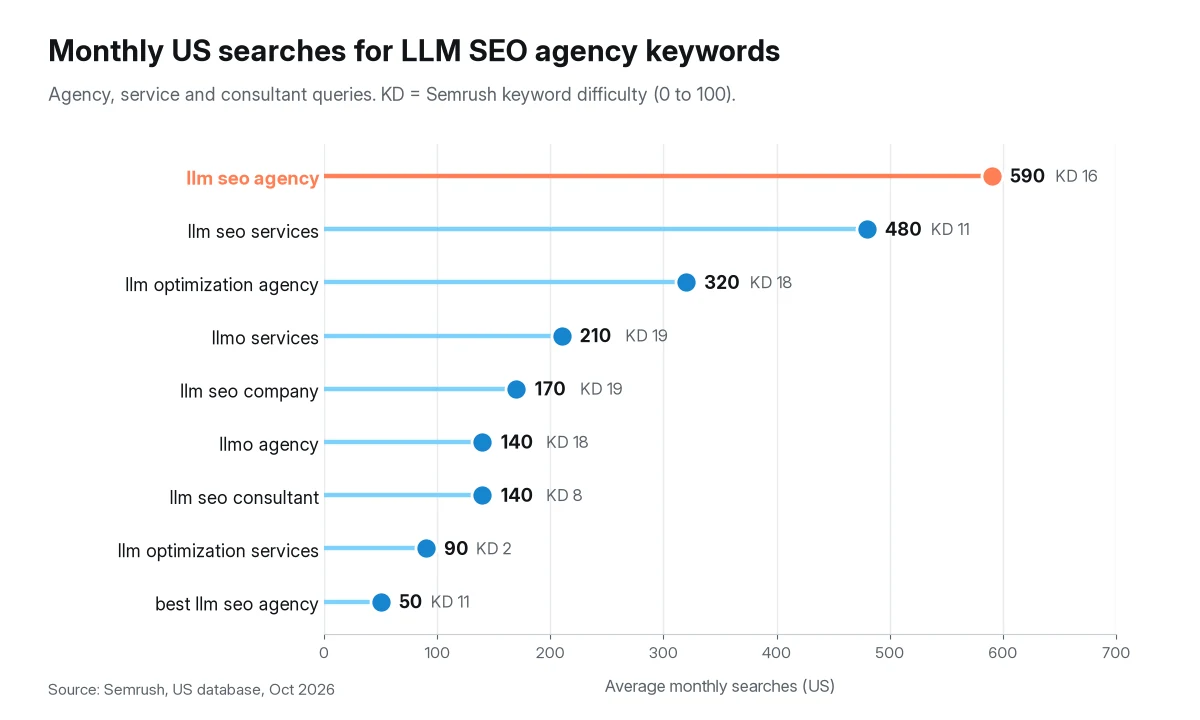
Monthly US searches for LLM SEO agency and service keywords. Source: Semrush, US database, Oct 2026.
What Does an LLM SEO Agency Do?
LLM SEO is the work of earning visibility inside answers generated by large language models. You will also see it called LLM optimization (LLMO), generative engine optimization (GEO), answer engine optimization (AEO), or AI SEO. The labels describe the same goal, so judge an agency on what it does, not which acronym it uses. If you want the longer explanation of how this differs from classic search, start with GEO vs SEO.
A credible LLM SEO agency covers five things:
- Measurement first. A fixed set of the questions your buyers ask, tested across the engines that matter to you, with a record of who gets cited.
- Technical access. Making sure AI crawlers can reach and read your pages without depending on JavaScript.
- Content built to be quoted. Pages that answer the question directly, then support the answer with specifics engines can lift.
- Entity and source signals. Consistent descriptions of your brand across your site, schema markup, and the third party sites engines already trust.
- Reporting tied to revenue. Citation share and AI referral traffic reported next to leads and pipeline, not in a separate dashboard nobody reads.
Where an LLM SEO Agency Can and Cannot Influence AI Answers
Before you compare agencies, it helps to know how an AI answer gets built, because that tells you which promises are realistic.
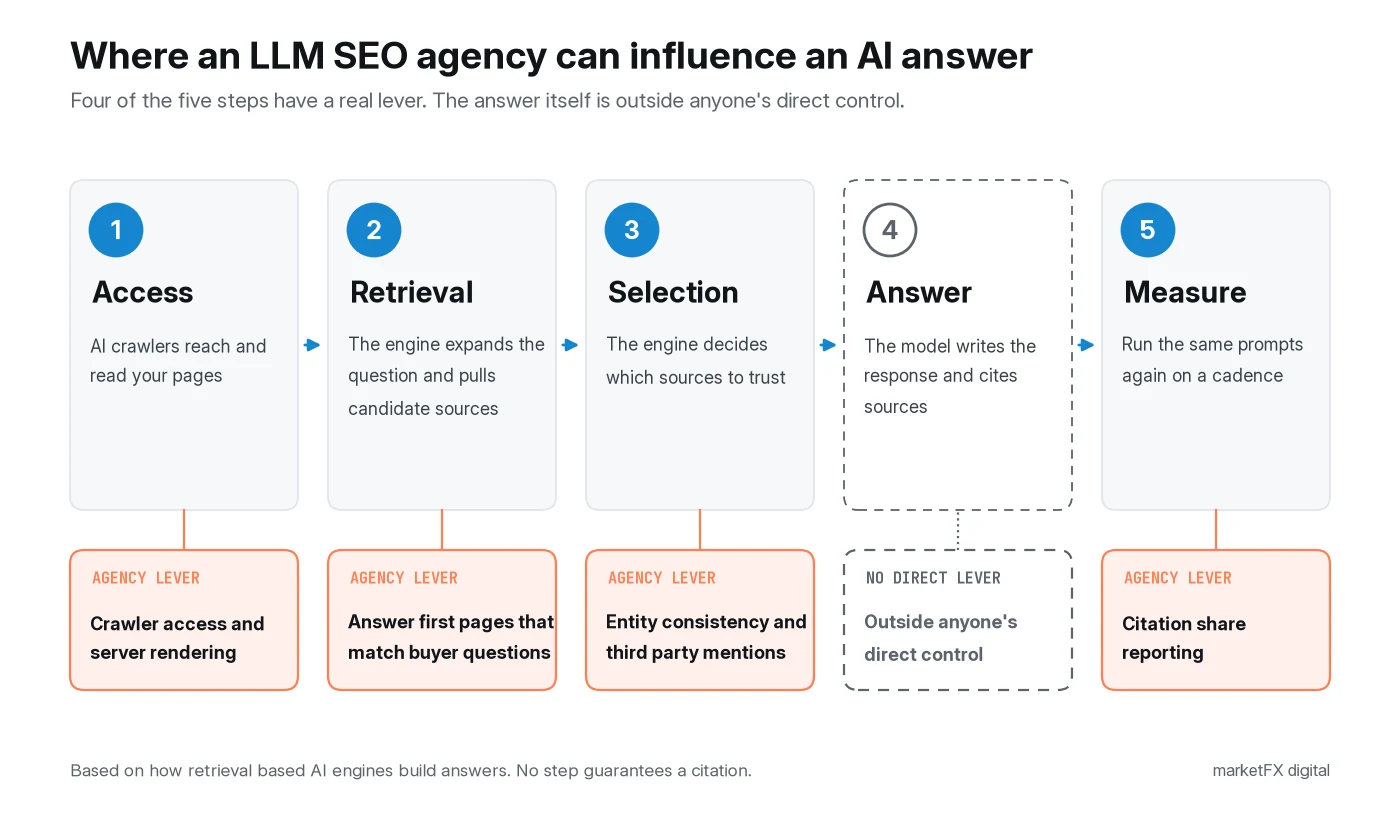
- Access. If an engine's crawler cannot reach or render a page, that page cannot be used. This step is fully within an agency's control.
- Retrieval. Many engines expand a single question into several related searches, a process called query fan-out, and pull candidate passages from the results. This is retrieval-augmented generation at work. An agency influences this step by making sure you have a clear, specific page for each question your buyers ask.
- Selection. The engine decides which sources to trust. Your own site is only part of the picture. Pew Research Center found that Wikipedia, YouTube, and Reddit together made up 15% of the sources linked in Google's AI summaries (Pew Research Center, July 2025, based on 68,879 Google searches by 900 US adults in March 2025). An agency influences this step through consistent entity signals and earned mentions on the sites engines already cite.
- Answer. The model writes the response. No agency controls this step, which is why nobody can honestly guarantee a citation.
- Measure. Run the same prompts again on a fixed cadence and track your share of model against competitors.
One more point from the same Pew analysis matters for how you measure success. Of the Google searches that produced an AI summary, 88% of those summaries cited three or more sources, and only 1% cited a single source. You are rarely trying to be the only answer. You are trying to be one of the sources the answer is built from, described accurately.
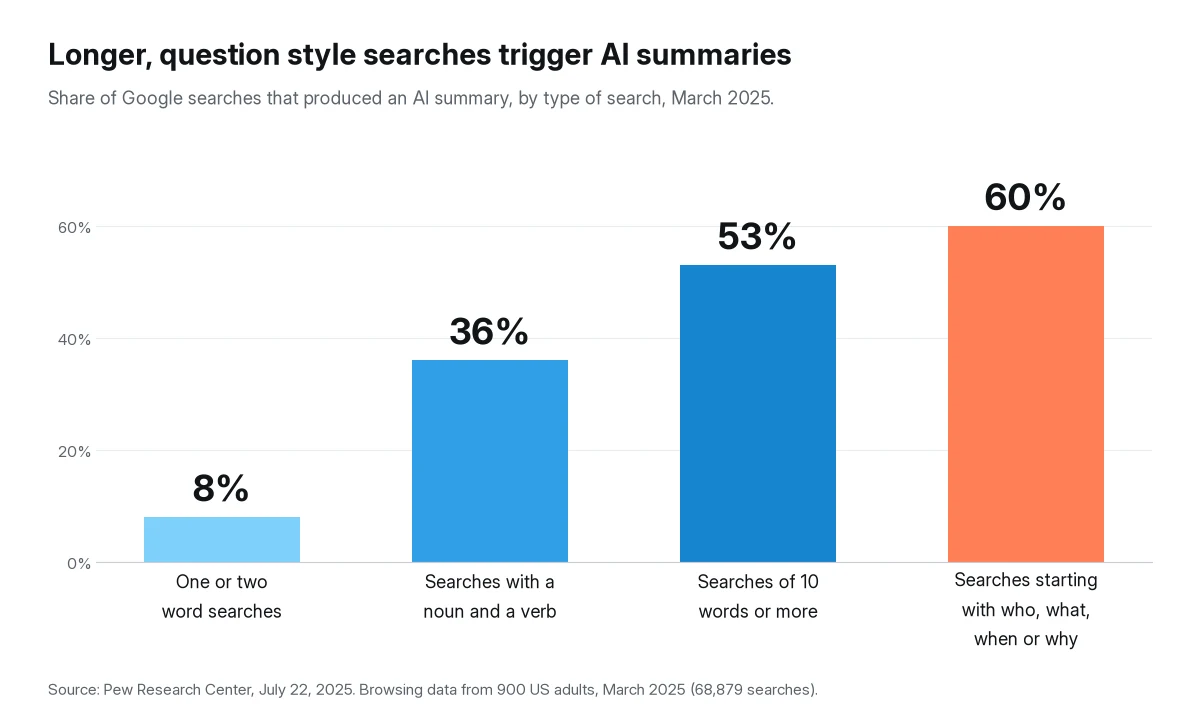
Longer, question style searches trigger AI summaries far more often. Source: Pew Research Center, July 2025.
That pattern is why LLM SEO is built around full buyer questions rather than two word keywords. Pew found that 8% of one or two word Google searches produced an AI summary, compared with 53% of searches with 10 words or more and 60% of searches that began with a question word such as "who," "what," "when," or "why."
LLM SEO Agency vs Traditional SEO Agency
The two overlap more than most pitches admit. Several AI engines draw on pages that already rank well, so strong SEO fundamentals still help. Our own research found that 31.4% of the 9,579,636 keywords ranked by 18 US multi-location retail brands now sit under a Google AI Overview (AI Overview Exposure in Retail: an 18-Brand Study, marketFX digital, data retrieved August 25, 2026). Ranking well is still the entry ticket. What changes is what the agency measures and optimizes for.
| Traditional SEO agency | LLM SEO agency | |
|---|---|---|
| Goal | Rank pages in search results | Get cited and described accurately in AI answers |
| Unit of work | The page and the keyword | The passage, the entity, and the buyer question |
| Research input | Keyword lists | Real buyer prompts, tested across engines |
| Off-site focus | Backlinks | Mentions on the sources AI engines cite |
| Core KPI | Rankings, clicks, organic traffic | Citation share, answer accuracy, AI referral traffic |
If an agency's proposal reads exactly like an SEO retainer from three years ago, with keyword rankings as the only KPI, it is not an LLM SEO engagement.
A Six Point Scorecard for Evaluating an LLM SEO Agency
Score each agency you are considering from 0 to 2 on each point. Anything below 8 out of 12 deserves hard follow up questions.
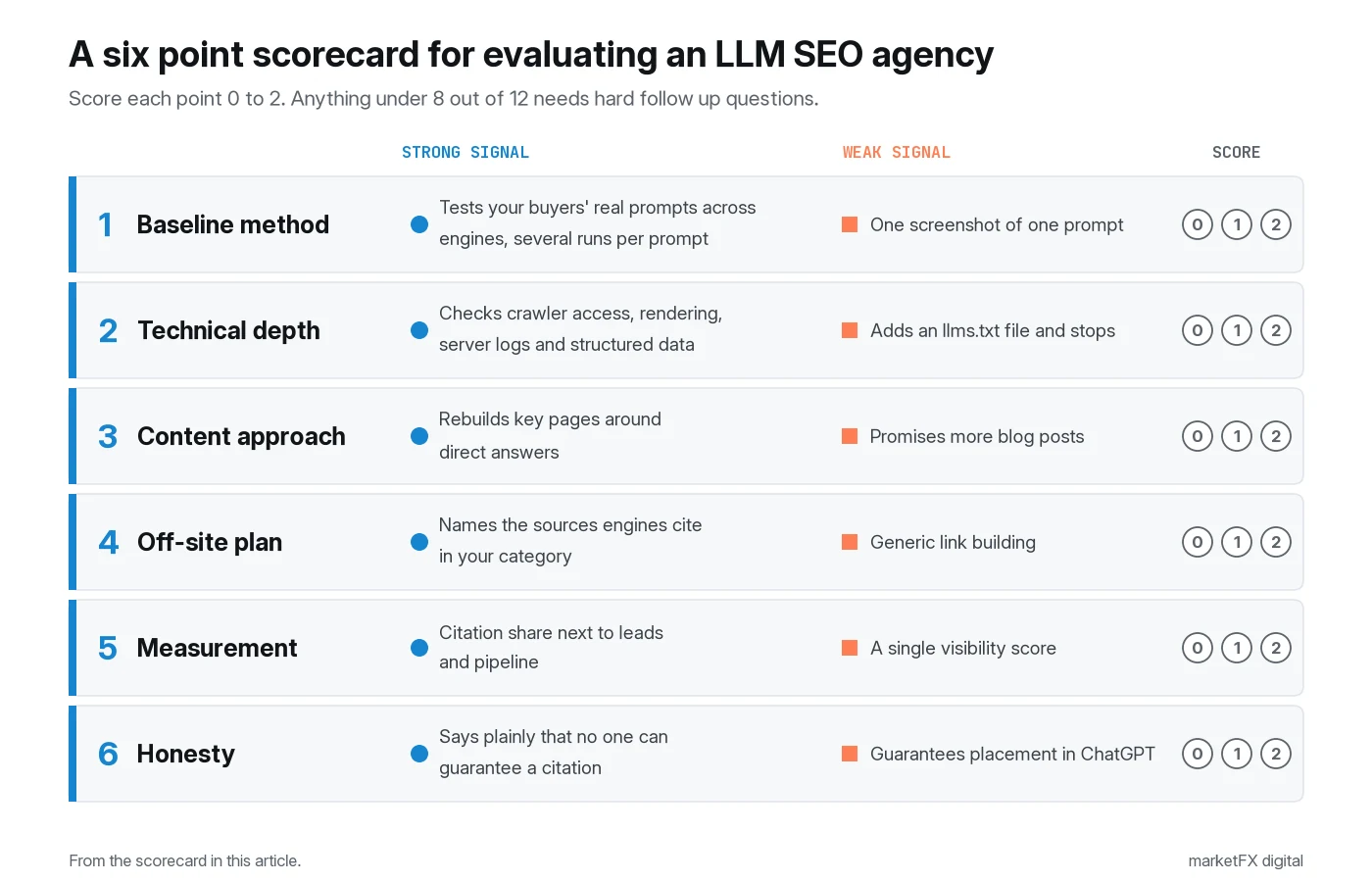
- Baseline method. Do they start by testing a fixed set of your buyers' real questions across engines, more than once per prompt? Answers change between runs, so a single screenshot is an anecdote, not a baseline. Our guide to running an AI search audit shows what a proper baseline involves.
- Technical depth. Do they check crawler access, rendering, server logs, and structured data? An llms.txt file is a reasonable addition, but it is not a strategy on its own.
- Content approach. Do they plan to restructure your service, location, and comparison pages so they answer buyer questions directly, or just promise more blog posts?
- Off-site plan. Can they tell you which third party sources AI engines cite for questions in your category, and how they will earn you a place there?
- Measurement. Do they report citation share and answer accuracy next to leads and pipeline? If AI visibility lives in a separate report from the rest of your marketing, nobody will act on it.
- Honesty about limits. Do they say plainly that no one controls what an AI model says? That answer is a good sign.
Questions to Ask in the Pitch
- Which engines do you test, and how many runs per prompt? You want a clear, repeatable answer.
- Who writes the prompt set? It should come from your sales conversations and customer questions, agreed with you.
- Which tools do you use, and what do you check by hand? Tracking tools are useful, but each measures something slightly different. Our guide to generative engine optimization tools explains the categories.
- Can we see the raw answers behind every finding? You should be able to verify the baseline yourself.
- How will you connect this to revenue? Ask to see how AI referral traffic and AI assisted leads show up in reporting.
- What do you implement, and what do you hand to our team? Clarify who changes the site, who writes content, and who does outreach.
Red Flags
- Guaranteed citations or rankings in ChatGPT. No one can promise this. Credible agencies commit to the work and measure the result.
- A proprietary score you cannot trace. If a visibility score cannot be tied back to specific prompts and answers, it is hard to act on.
- No baseline. Without a recorded starting point, nobody can show what changed.
- Only on-site work. If the plan ignores the third party sources engines rely on, it covers only part of the problem.
- Volume content as the main deliverable. Publishing more pages does not help if none of them answer the questions buyers actually ask.
How We Run LLM SEO at marketFX
We treat LLM SEO, GEO, and AEO as one practice inside our GEO agency and AI SEO agency work, run alongside SEO rather than as a separate silo. Engagements start with a GEO Audit: a fixed fee, two week diagnostic that tests the prompts your buyers ask AI engines, reviews your schema, llms.txt, and authority signals, and ends with a prioritized action plan split into this week, the next 30 days, and the next 90 days. From there we report citation share monthly and adjust based on what the data shows.
If your team wants to keep execution in house, our SEO and AI visibility consulting gives you the priorities and technical guidance without a full retainer. If you are still comparing deliverables across providers, our guide to AEO services lists what a complete engagement should include. And if AI search is one part of a broader question about how your marketing team uses AI, the AI Enablement Ladder™ shows where your organization sits today, from Stage 1 Experimentation to Stage 4 Optimisation.
If you want to see how AI engines answer your own buyers before you choose an agency, book a strategy call.
Related services
FAQs
Frequently Asked Questions
- What does an LLM SEO agency do?
- An LLM SEO agency works to get your brand found, described accurately, and cited in answers from AI engines such as ChatGPT, Perplexity, Gemini, Claude, and Google AI Overviews. The work covers prompt testing, crawler access, answer first content, entity and third party source signals, and reporting tied to revenue.
- Is LLM SEO the same as GEO or AEO?
- In practice, yes. LLM SEO, LLM optimization, generative engine optimization, answer engine optimization, and AI SEO all describe the work of earning visibility inside AI answers. Compare agencies on deliverables, not acronyms.
- Do I still need a traditional SEO agency if I hire an LLM SEO agency?
- You still need strong SEO, because several AI engines draw on pages that already rank well. The best setup runs SEO and LLM SEO as one program with one set of priorities, whether that is one agency or two that work closely together.
- How do you measure LLM SEO results?
- Start with a baseline: a fixed set of buyer questions tested across engines. Then track citation share, answer accuracy, and AI referral traffic over time, reported alongside leads and pipeline.
- Can an LLM SEO agency guarantee my brand will appear in ChatGPT?
- No. No one controls what an AI model says. A credible agency improves the signals engines rely on and measures the result, but it will not guarantee placement.
Pressure Test Your LLM SEO Shortlist
Book a strategy call. We will show you how ChatGPT, Perplexity, Gemini, and Google AI Overviews answer your buyers' questions today, and what an LLM SEO engagement should fix first.