
SEO Content Services: What They Should Include for Google and AI Search
What SEO content services should include in 2026, how AI-written content performs in Google and AI answers, provider types, cost drivers, and what to ask.
Quick Answer
SEO content services plan, write, optimize, and maintain content that ranks in Google and gets cited in AI answers. A complete service covers keyword and topic research, briefs, subject expert input, writing and editing, on-page SEO and internal links, publishing support, and regular refreshes. In 2026 the real difference between providers is not the writing. It is the strategy, expertise, and proof behind each page.
Content is easier to produce than it has ever been. Anyone can generate a 2,000 word article in a minute, and many companies do. That has not made content marketing easier. It has made average content worthless, because there is now an endless supply of it.
This guide is for marketing leaders deciding whether to buy SEO content services and what to buy. It covers what a complete service includes, how AI-written content actually performs in Google and AI answers, how SEO content differs from general content creation, which kind of provider fits which situation, what drives cost, and the questions to ask before you sign anything.
What Are SEO Content Services?
SEO content services are outsourced help with planning, producing, optimizing, and updating the content that brings in search traffic: blog posts, guides, service and location pages, comparison pages, and FAQs. The goal is not more pages. It is pages that rank for searches your buyers make, answer their questions well enough to be cited, and move them toward a conversation with your team.
That makes SEO content different from writing alone. A writer can produce a clean article on any topic. An SEO content service should also decide which topics deserve a page, which page owns each search so your own pages do not compete with each other, what each page needs to say to beat what already ranks, and how it connects to the rest of the site.
Two shifts have changed the job since 2023:
- AI search. Google's AI Overviews and AI Mode, ChatGPT, Perplexity, and other assistants now answer many questions directly and cite a handful of sources. Google says its AI features may use a "query fan-out" technique, running multiple related searches across subtopics to build a response (Google Search Central). Content now has to be the clearest answer to a question, not just a page that mentions the keyword.
- Unlimited supply. Generative AI made first drafts close to free. When everyone can publish at scale, what stands out is what AI cannot make up: first-hand experience, original data, clear opinions, and proof.
What Should SEO Content Services Include?
A complete SEO content service should cover six stages: demand research, briefs, expert input, drafting and editing, publishing and connecting, and measuring and refreshing. We call this the marketFX Answer-Ready Content Loop. Providers that skip stages usually skip the first and the last, which are the two that decide whether content pays off.
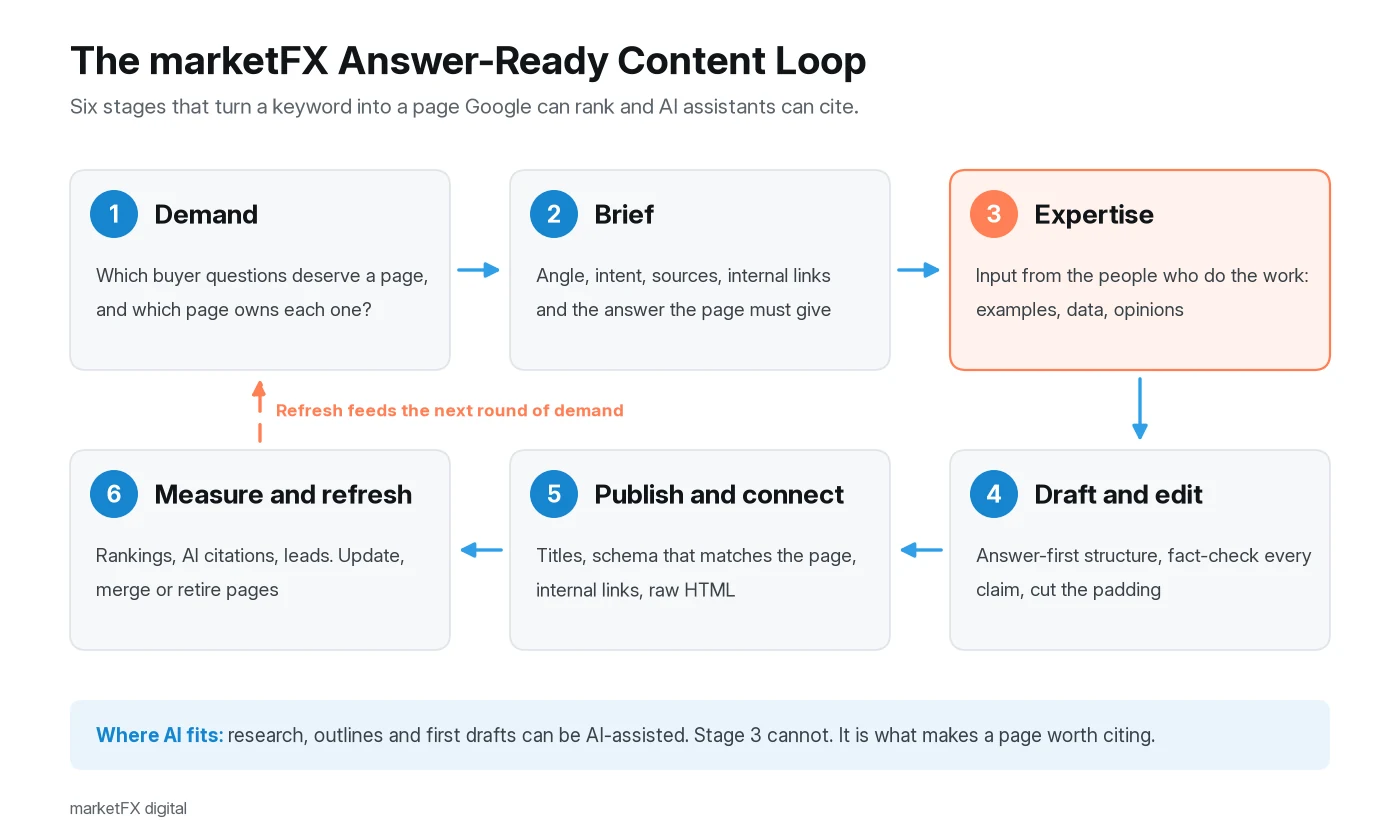
The marketFX Answer-Ready Content Loop. Stage 3 is the one AI cannot do for you.
| Stage | Question it answers | What it produces |
|---|---|---|
| 1. Demand | Which buyer questions deserve a page, and which page owns each one? | A prioritized topic map tied to services, with one target page per search intent |
| 2. Brief | What must this page say to be the best answer? | Angle, intent, outline, sources, internal links, and the direct answer the page must give |
| 3. Expertise | What do we know that others do not? | Input from the people who do the work: examples, data, process detail, opinions |
| 4. Draft and edit | Is it clear, accurate, and answer-first? | A fact-checked draft with question-style headings, short answers first, and no padding |
| 5. Publish and connect | Can search engines and AI crawlers read and place it? | Titles, meta descriptions, schema that matches the page, internal links, content in the raw HTML |
| 6. Measure and refresh | Is it working, and what should change? | Reporting on rankings, AI citations, and leads, plus updates, merges, and retirements |
1. Demand. Good SEO content starts with buyer intent, not volume. The highest volume keyword in your space may attract students and job seekers. A smaller search like "seo content services" signals someone ready to hire. Research should also map each topic to one page, so you build topical authority instead of five thin posts competing for the same search.
2. Brief. The brief is where most quality is won or lost. It should state the search intent, what currently ranks and what it misses, the angle, the sources to cite, the internal links to include, and the short answer the page must give near the top.
3. Expertise. This is the stage generic content skips. Google's guidance on helpful content and E-E-A-T rewards first-hand experience, and AI assistants need a reason to cite you instead of the ten other pages saying the same thing. A short interview with the person who actually does the work can supply more useful material than hours of desk research.
4. Draft and edit. Structure matters as much as prose. Question-style headings, a direct answer under each one, tables for comparisons, and named sources make a page easy for readers to scan and easy for AI systems to quote. Editing should include a fact-check of every number and claim.
5. Publish and connect. Titles, meta descriptions, schema markup that matches what is on the page, and internal links to and from related pages. The main content should be in the HTML the server sends, because most AI crawlers do not run JavaScript, as we covered in our guide to technical SEO services.
6. Measure and refresh. Content decays. Competitors publish, facts change, and AI answers shift. A service should review performance, update pages that are slipping, merge pages that overlap, and retire pages that will never earn traffic.
Does AI-Written Content Rank in Google and AI Search?
Some does, but far less than the volume being published would suggest. Graphite's studies found that about half of new English articles are now primarily AI-generated, yet only 14% of articles ranking in Google and 18% of articles cited by ChatGPT and Perplexity were AI-generated. Google itself does not ban AI content. It ranks content on quality.
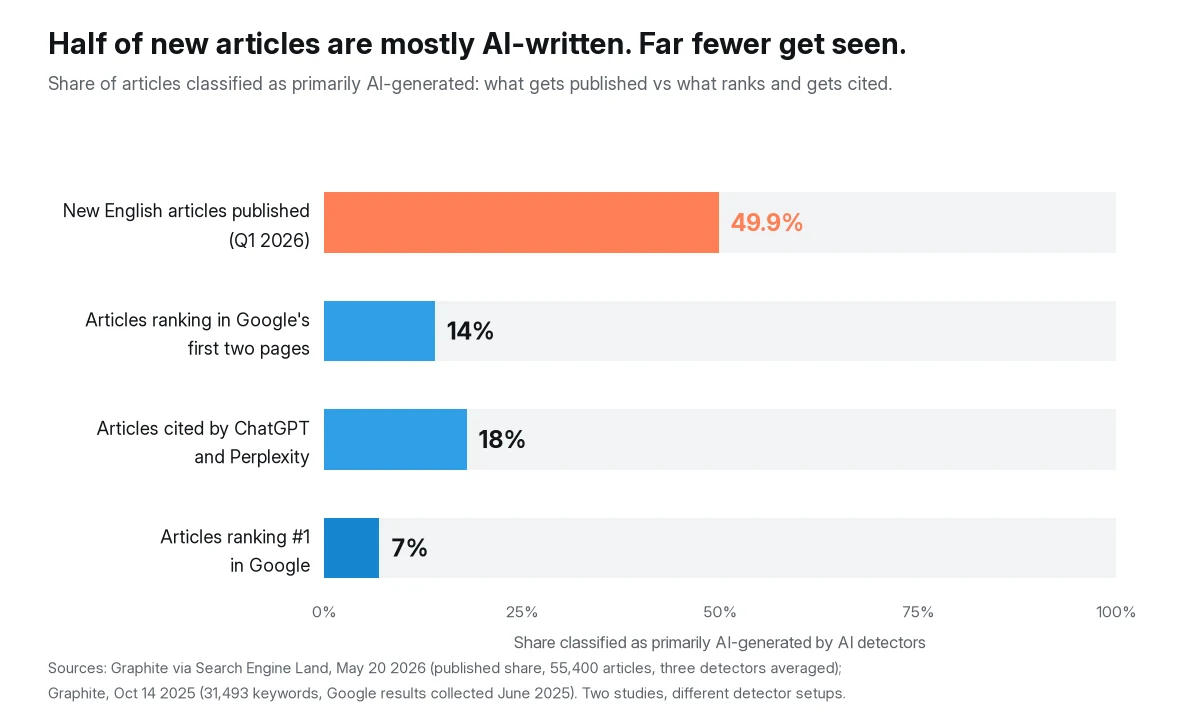
Half of new articles are mostly AI-written. Far fewer of them rank or get cited.
| Group of articles | AI-generated share | Study |
|---|---|---|
| New English articles published, Q1 2026 | 49.9% | Graphite, reported May 2026 (55,400 articles, three detectors averaged) |
| Articles ranking in Google's first two pages | 14% | Graphite, October 2025 (31,493 keywords, results collected June 2025) |
| Articles cited by ChatGPT and Perplexity | 18% | Graphite, October 2025 |
| Articles ranking number one in Google | 7% | Graphite, October 2025 |
The published share comes from a May 2026 Graphite analysis of 55,400 English articles from Common Crawl, classified by three AI detectors. It found 35.9% of articles were primarily AI-generated within 12 months of ChatGPT's launch, about 48% by late 2024, and 49.9% in Q1 2026 (Search Engine Land, May 20, 2026). The ranking and citation figures come from an earlier Graphite study that used a different detector, so treat the comparison as directional rather than exact.
Three things are worth knowing before you draw conclusions:
- Google judges quality, not method. Google's guidance says "appropriate use of AI or automation is not against our guidelines" (Google Search Central, February 2023). What it does treat as spam is scaled content abuse: "many pages are generated for the primary purpose of manipulating search rankings and not helping users," which it says applies "no matter how it's created" (Google spam policies).
- Most ranking content is a mix. An Ahrefs analysis of pages cited in AI Overviews found 3.6% were pure AI, 8.6% were pure human, and 87.8% were a mix of the two (Ahrefs, July 14, 2025). Graphite also notes it did not test AI drafts with heavy human editing.
- Most content gets no search traffic at all. Ahrefs estimated that 96.55% of the roughly 14 billion pages in its index get zero traffic from Google (Ahrefs, December 2023). Publishing more is not a strategy on its own.
The practical answer: use AI where it saves time, such as research, outlines, and first drafts, and put people where it counts, which is the angle, the expertise, the proof, and the final edit. Our AI Enablement Ladder™ explains how we think about where AI belongs in a marketing workflow.
How Are SEO Content Services Different From Content Creation Services?
Content creation services produce content: articles, social posts, videos, graphics, and email. SEO content services produce content designed to be found, with research, structure, optimization, and refreshes built in. Many companies need both, but buying content creation and expecting search results is a common reason content budgets disappoint.
Buyers search for both. In Semrush's US data, "content creation services" gets more searches than "seo content services," and specialist searches like "saas content marketing agency" are close behind.
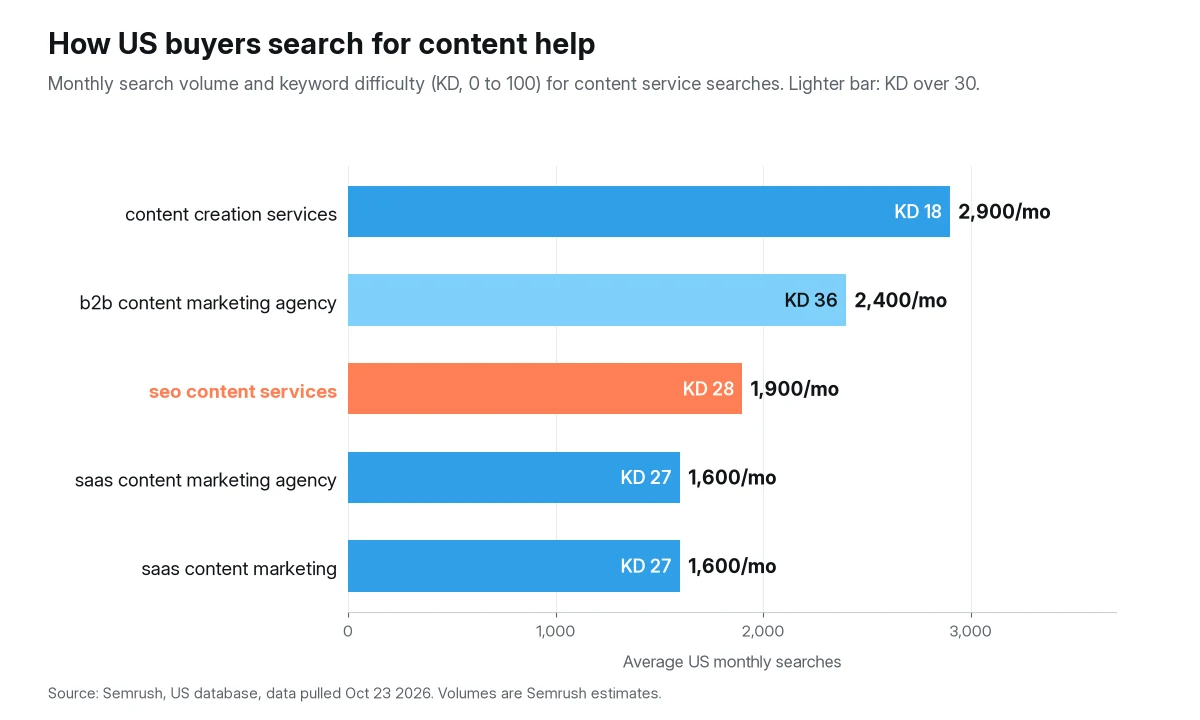
How US buyers search for content help. Source: Semrush, US database, October 2026.
| Search term | US monthly searches | Keyword difficulty (0 to 100) |
|---|---|---|
| content creation services | 2,900 | 18 |
| b2b content marketing agency | 2,400 | 36 |
| seo content services | 1,900 | 28 |
| saas content marketing agency | 1,600 | 27 |
| saas content marketing | 1,600 | 27 |
Here is how the two compare in practice:
| Content creation services | SEO content services | |
|---|---|---|
| Starting point | A brief or calendar you supply | Keyword, intent, and competitor research |
| Main output | Finished assets across channels | Pages built to rank and be cited |
| Structure | Written for the channel | Question-style headings, direct answers, tables, schema |
| Connection to the site | Often none | Internal links, one page per search intent |
| After publishing | Usually done | Measured, refreshed, merged, or retired |
| Measured by | Output and engagement | Rankings, AI citations, organic leads |
What about SEO content writing services? SEO content writing services usually cover stage 4 of the loop: drafting and editing to a brief, sometimes with basic on-page optimization. They can be a good fit when your team already handles research, briefs, and expert input. They are a poor fit when nobody owns those stages, because a well-written article on the wrong topic still earns nothing.
Who Should Provide Your SEO Content: a Platform, Freelancer, or Agency?
Choose by which stages of the loop you can already cover in-house. Writing platforms and freelancers mostly supply writing. SEO content agencies usually add research and optimization. A strategy-led partner should own the whole loop, including the plan, the expert input, and reporting tied to pipeline.
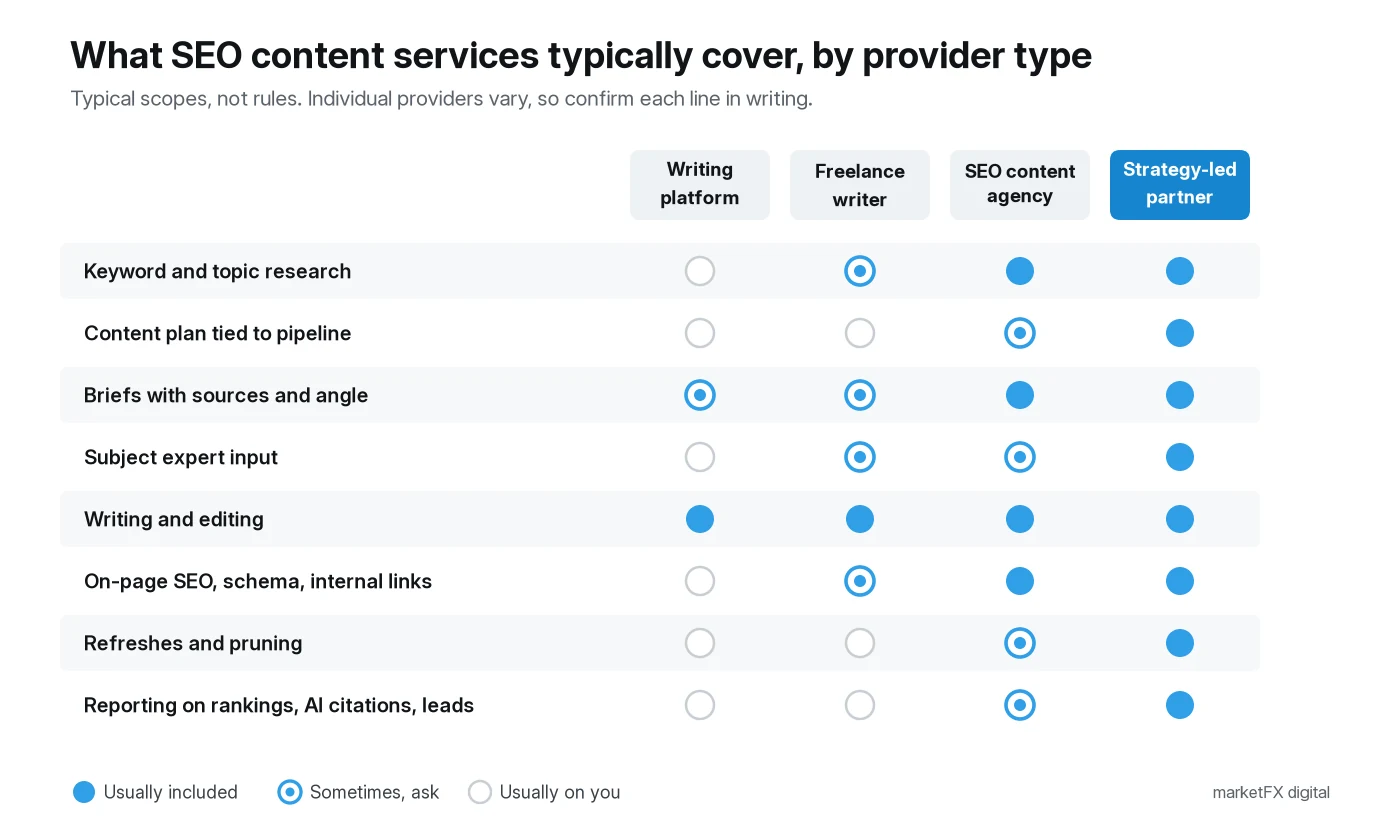
What SEO content services typically cover, by provider type. Scopes vary, so confirm each line in writing.
| Task | Writing platform | Freelance writer | SEO content agency | Strategy-led partner |
|---|---|---|---|---|
| Keyword and topic research | Usually on you | Sometimes | Usually included | Usually included |
| Content plan tied to pipeline | Usually on you | Usually on you | Sometimes | Usually included |
| Briefs with sources and angle | Sometimes | Sometimes | Usually included | Usually included |
| Subject expert input | Usually on you | Sometimes | Sometimes | Usually included |
| Writing and editing | Usually included | Usually included | Usually included | Usually included |
| On-page SEO, schema, internal links | Usually on you | Sometimes | Usually included | Usually included |
| Refreshes and pruning | Usually on you | Usually on you | Sometimes | Usually included |
| Reporting on rankings, AI citations, leads | Usually on you | Usually on you | Sometimes | Usually included |
A few patterns hold for most companies:
- You have a content lead and a clear plan. Freelancers or a writing platform can add capacity. Invest in strong briefs and an editor.
- You need volume and optimization but own the strategy. An SEO content agency can run research, briefs, writing, and on-page work against your plan.
- Nobody owns the plan, or content has not produced pipeline. Start with strategy. A strategy-led partner sets the direction and can work alongside writers, agencies, or your internal team.
Mixed setups are common and often work well. What fails is a setup where everyone writes and nobody decides what is worth writing.
How Does SEO Content Work for B2B, SaaS, and Multi-Location Brands?
The loop stays the same, but the emphasis shifts. B2B and SaaS content has to support long buying cycles and several decision makers. Multi-location content has to scale across many locations without creating dozens of near-duplicate pages.
B2B content. Buyers often research long before they talk to sales, and more of that research now happens in AI assistants. That is why people searching for a "b2b content marketing agency" should look for one that builds content around the questions buyers ask at each stage: problem pages, comparison and alternative pages, pricing explainers, and proof such as process detail and examples. Expert input from sales and delivery teams matters most here, because B2B buyers can spot generic advice immediately.
SaaS content. SaaS content marketing works best when content is close to the product: use cases, integrations, comparisons, and how-to guides that show the product solving a real problem. A good "saas content marketing agency" should be able to explain how each piece connects to trials, demos, or sign-ups, not only to traffic. Many SaaS buyers also use AI assistants to build shortlists, so clear, quotable answers about what your product does and who it is for matter more each year.
Multi-location and franchise brands. The challenge is scale without duplication. Location pages need real local detail, not the city name swapped into the same template. We cover the location side in our guide to local SEO for multi-location brands and on our multi-location and franchise marketing page.
How Do You Measure SEO Content Services?
Measure SEO content on outcomes in three layers: visibility (rankings and AI citations), engagement (clicks and conversions from organic search), and business results (leads and pipeline from content). Output, such as the number of articles published, is a cost, not a result.
| Layer | What to track | Where it comes from |
|---|---|---|
| Visibility | Rankings for target searches, impressions, AI answer citations for priority questions | Search Console, rank tracking, a repeatable AI prompt panel |
| Engagement | Organic clicks, time on page, scroll depth, internal link clicks | Search Console, GA4 |
| Business results | Form fills, calls, demo requests, and pipeline attributed to content | GA4 conversions, CRM |
Two cautions. First, AI answers often satisfy a question without a click, so impressions and AI citations belong in the report alongside traffic. Second, give content time. New pages on a site with limited authority can take months to settle, so judge a program on trends across a quarter or more, not on week one.
If you have never measured how often AI assistants mention or cite your brand, an AI search audit is a good place to start. For ongoing reporting, our marketing analytics and reporting work connects content to leads and revenue.
How Much Do SEO Content Services Cost?
SEO content services are priced per article, per word, or as a monthly retainer, and cost depends mostly on how many stages of the loop are included. Writing alone costs the least. Research, expert interviews, optimization, refreshes, and reporting add cost and add most of the value.
The main cost drivers are:
- Scope. Writing only, or the full loop from research to refreshes.
- Depth and expertise. A specialist B2B or regulated topic needs more research, expert time, and review than a general topic.
- Volume and cadence. A few strong pages a month and a large publishing program are very different budgets.
- Original assets. Custom charts, original data, and diagrams take time and are often what earns citations.
- Refresh work. Updating and consolidating existing content is often the fastest win, and it needs budget too.
When you compare proposals, line them up stage by stage against the loop above before you compare fees. A low per-article price that excludes research, briefs, and refreshes often costs more over a year, because the pages never earn traffic.
What Should You Ask Before Hiring an SEO Content Service?
Ask how they choose topics, who supplies the expertise, how they use AI, who edits and fact-checks, what happens after publishing, and how they report results. Ask every provider the same questions so the answers are comparable.
- How do you decide what to write? Look for keyword and intent research tied to your services, not a list of popular topics.
- Who provides subject expertise? The best answer includes interviews or input from your team, plus the provider's own experience.
- How do you use AI? Expect a clear answer. AI-assisted research and drafting can be fine. Unedited AI output at scale is a risk.
- Who fact-checks? Every statistic should have a named source you can click.
- How do you optimize for AI answers? Look for answer-first structure, question-style headings, tables, entity clarity, and schema that matches the page.
- What happens after a page goes live? Ask about refreshes, merges, and internal linking updates.
- How will you report? Expect rankings, AI citations, and leads, not only word counts and articles delivered.
Red flags include guaranteed rankings, promises of a fixed number of AI citations, pricing based only on word count, and content calendars built before anyone has looked at your existing pages.
How marketFX Approaches SEO Content
At marketFX, content starts with strategy. Our content strategy services cover the plan, messaging frameworks, audience and narrative work, and executive oversight, and we are execution agnostic: we can work with your internal team, your writers, or specialist production partners, so you are not locked into one way of producing content.
Every program follows the Answer-Ready Content Loop. We map buyer questions to pages, write briefs with sources and internal links, get expert input from your team, and structure pages to rank in Google and be cited in AI answers. Content also connects to our SEO and AI visibility consulting, so technical health, internal linking, and AI citation tracking are part of the same plan. If AI answers are the main goal, see our GEO agency practice and our guide to AEO services.
If you want to know which content is worth writing, and which existing pages are worth fixing first, book a strategy call. We will look at what you have, what your buyers search and ask, and where content can do the most for pipeline.
Related services
FAQs
Frequently Asked Questions
- What are SEO content services?
- SEO content services plan, write, optimize, and update content that ranks in Google and gets cited in AI answers. A complete service includes keyword and topic research, briefs, subject expert input, writing and editing, on-page SEO and internal links, publishing support, and regular refreshes, with reporting on rankings, AI citations, and leads.
- What is the difference between SEO content and regular content?
- Regular content is written for a channel or audience. SEO content is also built to be found: it targets a researched search intent, answers the question early, uses clear headings and tables, links to related pages, and is measured and refreshed after it goes live. Many brands need both, but they are different jobs.
- Does AI-generated content rank in Google?
- It can, but less often than its volume suggests. Graphite found about half of new English articles are primarily AI-generated, yet only 14% of articles ranking in Google were AI-generated in its study. Google says appropriate use of AI is not against its guidelines, but mass-produced content that does not help users is treated as spam.
- Should I hire an SEO content agency or a freelance writer?
- Hire freelancers when you already own the strategy, briefs, and editing and need more writing capacity. Hire an SEO content agency when you need research, briefs, writing, and optimization handled together. Choose a strategy-led partner when nobody owns the content plan or content has not produced pipeline yet.
- How does SEO content help with AI search?
- AI assistants and Google's AI features cite pages that answer a question clearly and credibly. Content with a direct answer near the top, question-style headings, tables, named sources, first-hand expertise, and matching schema is easier to quote. The same content still needs to rank, because AI features draw on pages search engines can find.
- How do you measure the results of SEO content services?
- Track visibility (rankings, impressions, and AI citations for priority questions), engagement (organic clicks and conversions), and business results (leads and pipeline from content). Judge trends over a quarter or more, because new pages take time to settle and many AI answers do not produce a click.
- How much do SEO content services cost?
- Cost depends on scope, topic depth, volume, original assets such as charts and data, and whether refreshes and reporting are included. Writing only is the cheapest option and the least likely to pay off on its own. Compare proposals stage by stage, from research to refreshes, before comparing fees.