
Ecommerce SEO Services: What to Buy in the AI Search Era
What ecommerce SEO services should include in 2026: the six layers, how AI Overviews change product search, what to fix first, and how to compare proposals.
Ecommerce SEO services are the work that gets an online store's category and product pages found, chosen, and bought from in search. For most of the last decade that meant crawl fixes, category copy, product schema, and links. That work still matters. What has changed is where shoppers get their answers before they click.
Google AI Overviews now sit on top of a growing share of product searches, and assistants like ChatGPT and Perplexity are being asked which product or brand to buy. A Visibility Labs analysis of 20,900,323 product-intent keywords, reported by Search Engine Land in March 2026, found that 14.0% returned an AI Overview, up from 2.1% in November 2025.
This guide covers what ecommerce SEO services should include in 2026, how AI search changes the work, how to tell which service you need first, and how to compare the proposals you get.
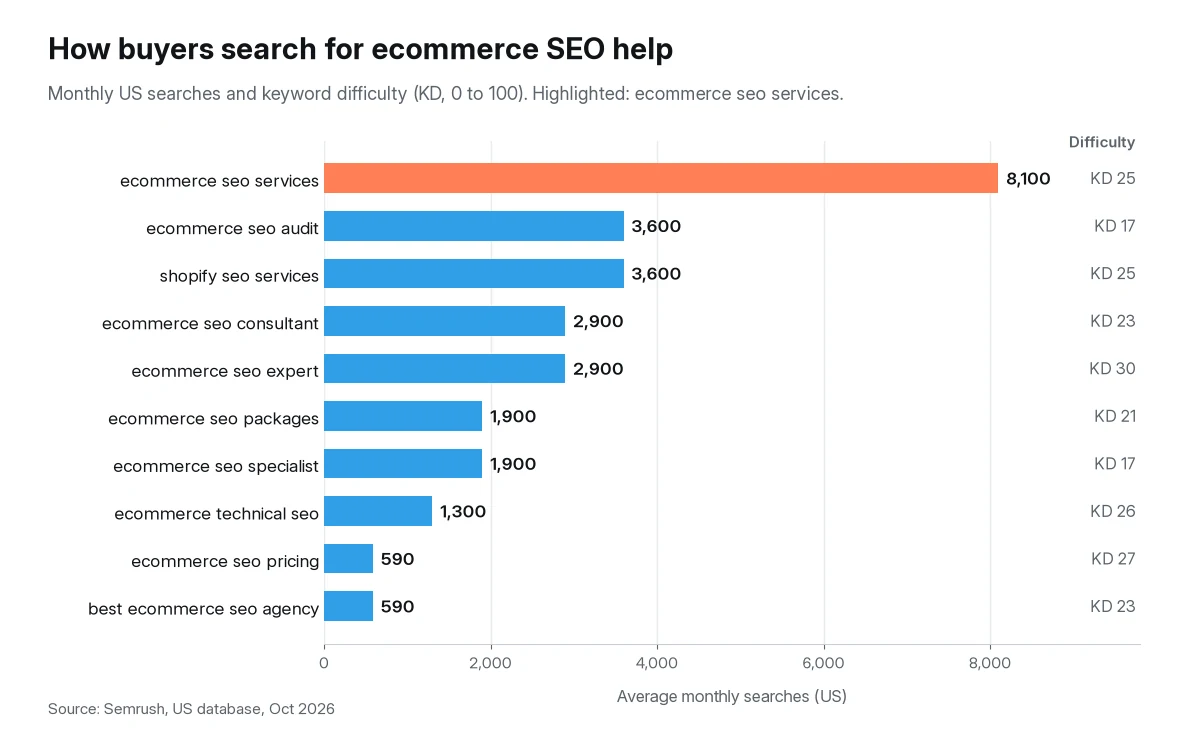
Buyers look for ecommerce SEO help as services, audits, consultants, and packages. Source: Semrush, US database, Oct 2026.
What Ecommerce SEO Services Should Include
A store is not a brochure site with more pages. Most of its pages are generated by templates, its inventory changes daily, and its filters can create far more URLs than it has products. Good ecommerce SEO services are built around that reality. We think about the work in six layers.
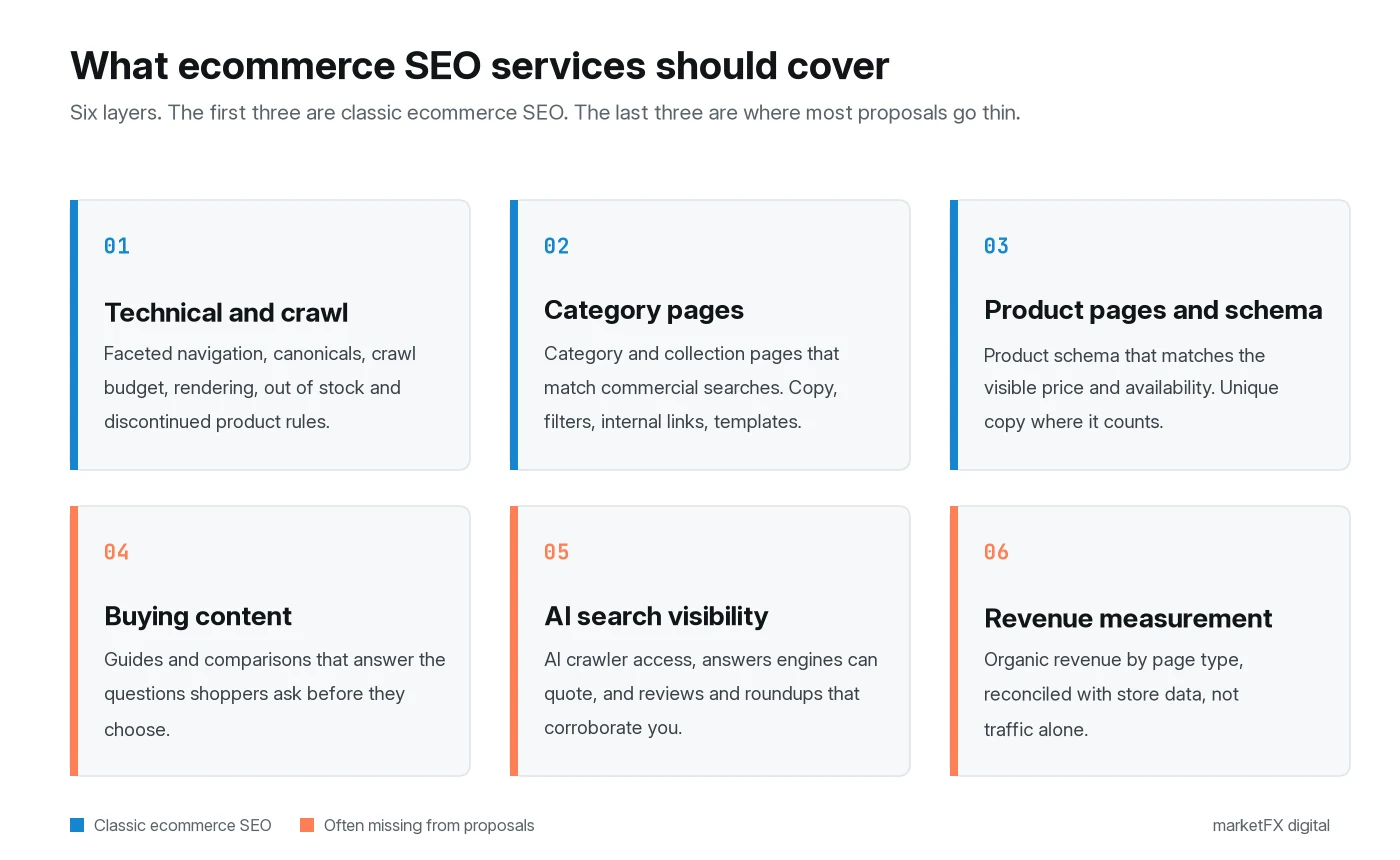
The first three layers are classic ecommerce SEO. The last three are where most proposals go thin.
- Technical and crawl. Faceted navigation rules, canonical URLs, crawl budget, JavaScript rendering, and clear rules for out of stock, seasonal, and discontinued products. On a large catalog, one template fix can change thousands of URLs at once.
- Category and collection pages. These are the pages that match commercial searches like "women's trail running shoes." They need useful copy, sensible filters, strong internal links, and templates that do not produce near duplicates.
- Product pages and structured data. Schema markup for products should match what the page actually shows, including price and availability. Unique copy matters most on the products that carry the most revenue.
- Buying content. Guides, comparisons, and sizing or fit pages that answer the questions shoppers ask before they choose. This is the content AI answers draw on, and it is usually the first thing a lean SEO retainer drops.
- AI search visibility. Making sure AI crawlers can reach the store, writing answers an engine can quote, and earning the reviews, roundups, and third party mentions that corroborate what your pages claim. We cover the discipline in depth on our generative engine optimization page.
- Revenue measurement. Organic revenue by page type, reconciled with store data, rather than traffic and rankings alone. If a provider cannot tell you which category pages produced orders last month, you are paying for activity, not outcomes.
How AI Search Changes Ecommerce SEO
For a long time, ecommerce was the part of search least touched by AI answers. Product searches returned shopping units and organic listings, and the summary boxes went mostly to informational queries. That is changing.
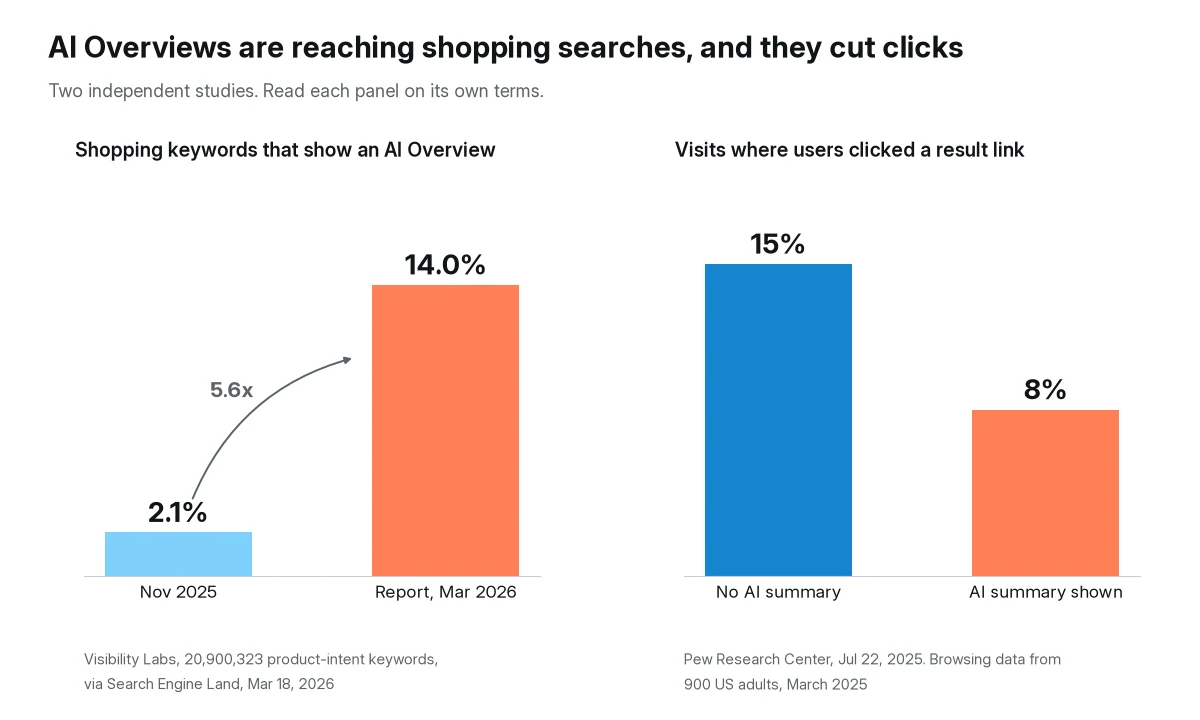
AI Overviews are spreading into product searches, and when they appear, fewer people click through. Sources: Visibility Labs via Search Engine Land, Mar 18, 2026; Pew Research Center, Jul 22, 2025.
Two numbers frame the shift. The Visibility Labs analysis above found AI Overviews on 14.0% of shopping keywords, a 5.6 times increase in four months. Separately, Pew Research Center tracked the browsing of 900 US adults in March 2025 and found users clicked a traditional result link on 8% of visits when an AI summary appeared, against 15% when it did not.
A store's own exposure is usually higher than the shopping query average, because a store ranks for much more than product terms. In our AI Overview exposure study of 18 US retail brands, 31.4% of the 9,579,636 keywords those brands ranked for returned an AI Overview, with individual brands ranging from 21.5% to 59.0%. Brands whose footprint leans toward research and comparison language carried more exposure than brands whose footprint leans toward product and branded navigation.
Three practical consequences for ecommerce SEO services:
- Buying content moves up the priority list. The questions shoppers ask before they buy are exactly the queries most likely to be summarized. If your guides and comparisons are not the clearest source, the summary will be built from someone else's.
- Corroboration matters more than it used to. An engine assembling an answer looks for claims it can confirm elsewhere. Reviews, editorial roundups, and consistent product data across retailers and marketplaces all count.
- Rank tracking alone undercounts the problem. A page can hold position three and lose clicks to an overview above it. Measurement has to include whether you are cited in AI answers, which is what share of model describes.
None of this replaces the classic work. An engine cannot cite a product page it cannot crawl, and a category page with no useful content gives a summary nothing to quote.
Which Ecommerce SEO Service Do You Need First?
Most stores do not need all six layers at full intensity on day one. The right starting point depends on the symptom you can already see. Packages that start every client with the same blog content plan skip this step.
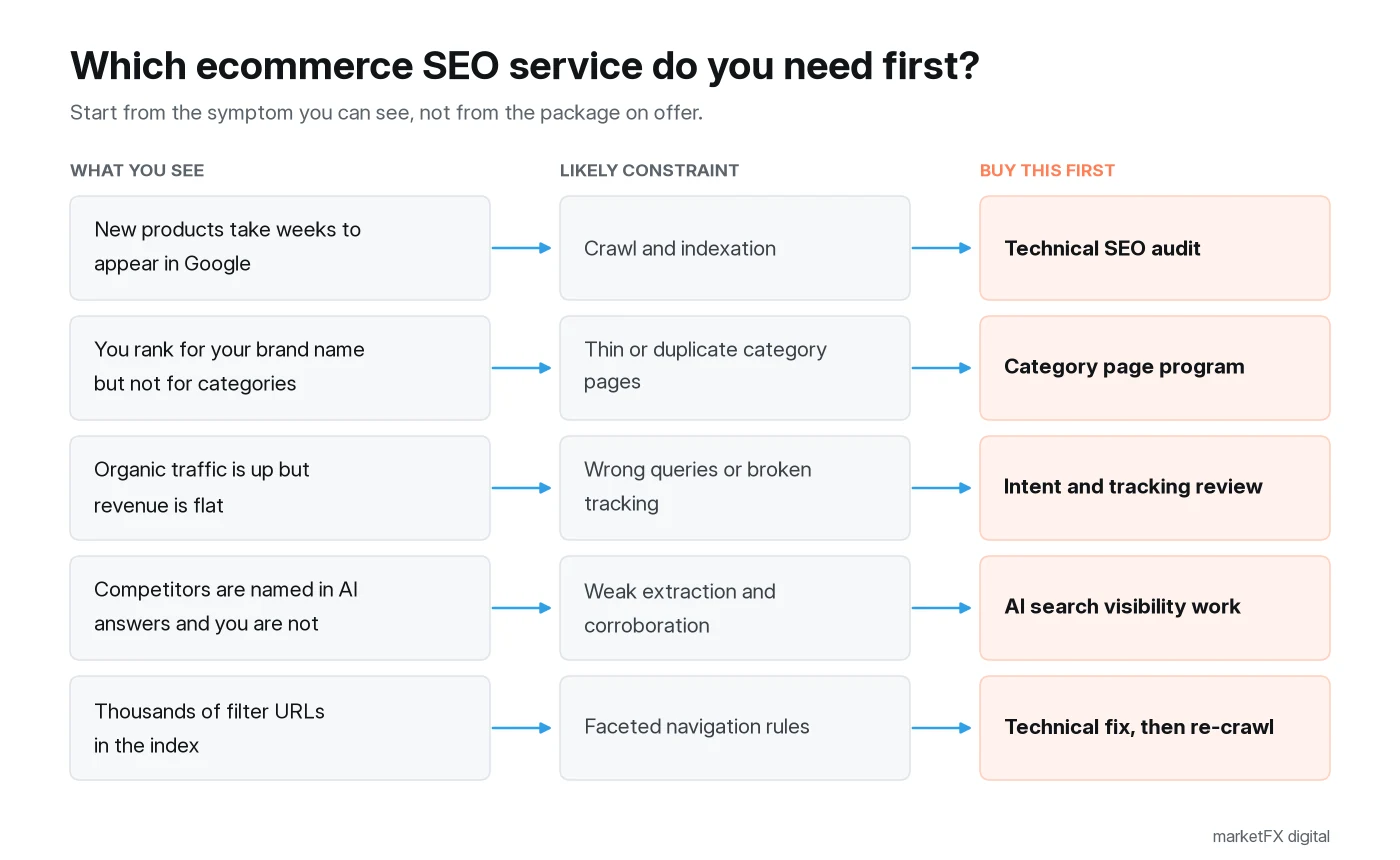
Start from the symptom you can see, not from the package on offer.
If you cannot tell which symptom applies, that is the case for an audit before a retainer. A useful ecommerce SEO audit gives you a ranked fix list tied to page types and revenue, not a raw export from a crawler.
How to Compare Ecommerce SEO Proposals
Ecommerce SEO packages vary widely in what they include, which makes price comparisons misleading. Before you compare fees, compare scope. Ask each provider:
- How will you handle faceted navigation on our platform? A specific answer about which filter combinations get indexed, and why, is a good sign. A generic answer is not.
- Which page templates will you change first, and how many URLs does each reach? Template fixes usually beat one page at a time edits on a large catalog.
- What does your product schema plan look like, and how will you keep it in sync with price and stock? Structured data that disagrees with the page is a liability.
- How will you measure AI search visibility? Look for a fixed set of buyer questions tested across engines over time, not a single screenshot.
- How will you report organic revenue? Ask to see a sample report that ties category and product pages to orders, reconciled with store data.
- Who does the work? Find out whether the people on the sales call will be on your account.
Red flags worth walking away from:
- Guaranteed rankings, or guaranteed placement in AI answers. No one controls either.
- Link packages sold by volume.
- A content plan of generic blog posts with no category or product page work.
- Reporting built on traffic and keyword counts with no revenue view.
On cost, the honest answer is that scope drives price: catalog size, number of templates, platform constraints, how much content needs writing, and whether international stores are involved. We break down how agency fees are structured in how much a marketing agency costs.
How marketFX Runs Ecommerce SEO
At marketFX, ecommerce SEO is one part of a connected ecommerce marketing program alongside paid media, conversion work, lifecycle email and SMS, and analytics. We treat organic search and AI search as one problem, because the same category pages, product data, and buying content feed both.
Engagements usually start with an audit of tracking, paid media, and the highest traffic product and category pages. That shows whether the main constraint is measurement, acquisition, conversion, or organic and AI visibility, so effort goes where it will move revenue first. From there the work runs through our SEO and AI visibility consulting practice, with reporting built on marketing analytics and reporting that reconciles platform numbers with store and finance data.
If you are comparing ecommerce SEO services now, we are happy to give you a second opinion on the proposals in front of you.
Related services
FAQs
Frequently Asked Questions
- What do ecommerce SEO services include?
- Ecommerce SEO services cover the technical health of the store, category and collection pages, product pages and structured data, buying content, AI search visibility, and revenue measurement. The first three are the classic core. The last three are increasingly where results are won or lost as AI answers spread into product searches.
- How is ecommerce SEO different from regular SEO?
- Stores generate most pages from templates, change inventory constantly, and can create huge numbers of filter URLs. That makes crawl control, canonical rules, template fixes, and product data accuracy far more important than on a typical brochure site.
- Do I need separate AI search optimization for my store?
- Not as a separate vendor, but it should be part of the scope. AI search visibility depends on crawler access, content an engine can quote, and third party corroboration such as reviews and roundups. A good ecommerce SEO provider should cover those and measure whether you are cited in AI answers.
- How are ecommerce SEO packages priced?
- Pricing depends on scope: catalog size, number of templates, platform constraints, content volume, and whether international stores are involved. Compare what each package actually includes before comparing fees.
- Where should an ecommerce SEO engagement start?
- Usually with an audit of tracking, technical health, and the highest traffic product and category pages. That identifies the constraint actually limiting organic revenue, so budget goes there first.
Find Out What Your Store Should Fix First
Book a strategy call. We will look at how your category and product pages show up in Google and in AI answers today, and which ecommerce SEO work would move revenue first.