
How to Choose a Franchise Marketing Agency: 10 Questions to Ask
How to choose a franchise marketing agency: map your brand fund, co-op, local and development budgets, then ask these 10 questions about reporting and leads.
Quick Answer
To choose a franchise marketing agency, check whether it can manage four separate budgets (brand fund, co-op funds, local franchisee spend and franchise development), report each one the way your disclosure document describes it, and trace a single lead from click to franchisee to report. Ask who owns the ad accounts and listings, how territories are handled, and what each location sees monthly.
Franchising keeps growing. The International Franchise Association and FRANdata project about 845,000 US franchise establishments in 2026, up 1.5% from 832,521 in 2025, with economic output of $921.4 billion (IFA 2026 Franchising Economic Outlook). Every one of those units needs to be found in its own neighborhood, and more of that finding now happens inside AI answers.
A franchise brand is a national marketer and hundreds of local businesses at once, and its marketing money comes from different pockets with different rules. This guide maps those budgets, then gives you ten questions that separate agencies built for franchise systems from agencies that only list franchise as an industry.
What Does a Franchise Marketing Agency Do?
A franchise marketing agency plans and runs marketing for a franchise system at two levels at once: the national brand and every local unit. That usually covers brand advertising, local SEO and Google Business Profiles for each location, paid search and social by territory, franchisee toolkits, lead routing and reporting that rolls up from location to region to system.
The hard part is coordination. A franchisor wants consistent brand standards and clean data. Franchisees want leads in their territory and proof that their fund contributions are working. A good franchise partner serves both without one side feeling shortchanged. Our franchise and multi-location marketing services are built around running national strategy, local SEO, paid media, CRM and analytics as one program for exactly this reason.
What Is the marketFX Four Budget Map?
The marketFX Four Budget Map is a way to sort franchise marketing money into four pots, each with its own payer, decision maker, job and report. Most agency problems in franchise systems start when two of these pots get mixed together in one campaign or one report.
The four pots line up with the advertising programs a franchisor has to describe in Item 11 of its Franchise Disclosure Document under the FTC Franchise Rule, 16 CFR 436.5(k). That rule asks franchisors to disclose, among other things, any local or regional advertising cooperatives, any other advertising fund, who administers it, how the money was spent in the last fiscal year (including percentages for production, media placement and administrative expenses), and what share went principally to soliciting new franchise sales.
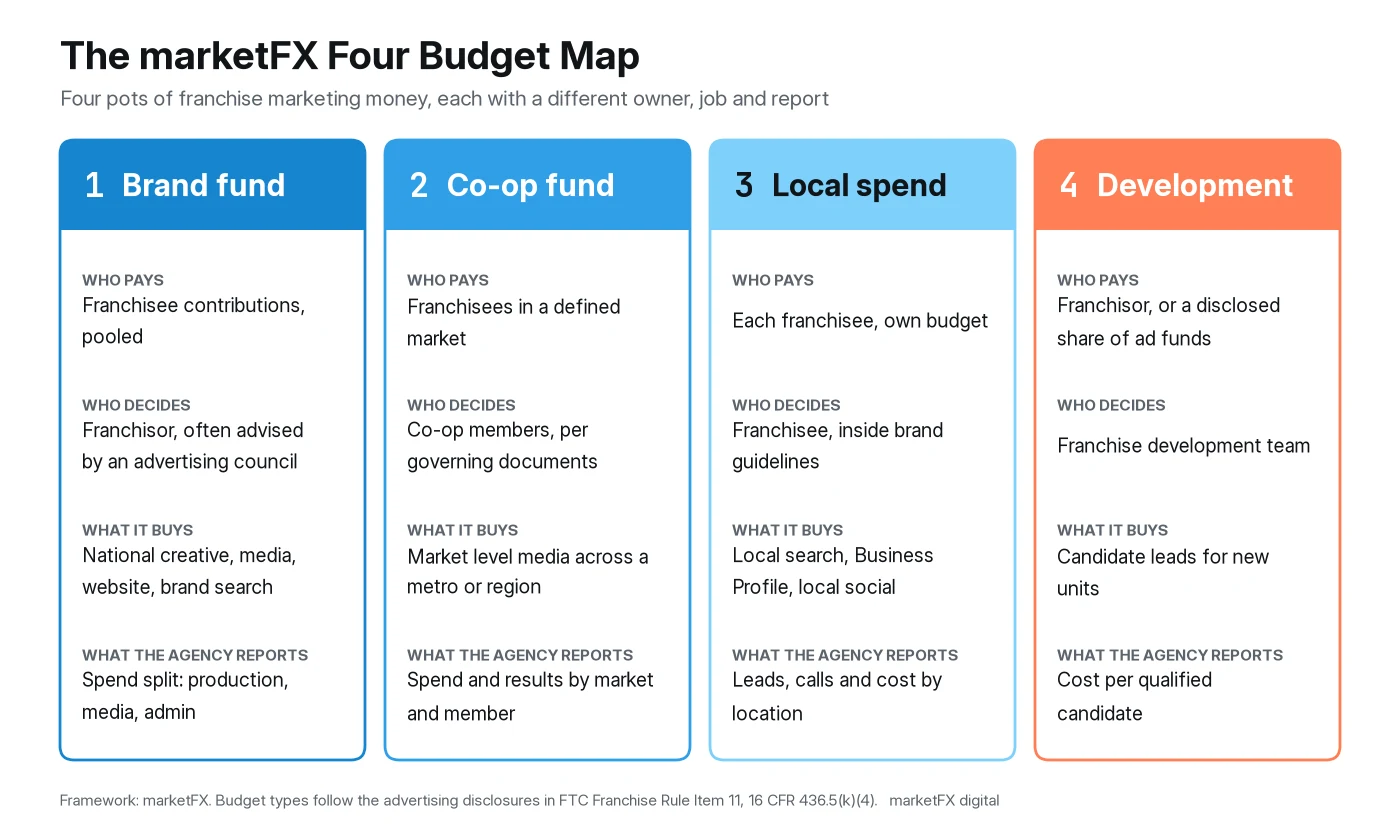
The marketFX Four Budget Map. Budget types follow the advertising disclosures in FTC Franchise Rule Item 11.
| Budget | Who pays | Who decides | What it buys | What the agency reports |
|---|---|---|---|---|
| 1. Brand fund | Franchisee contributions, pooled | Franchisor, often advised by an advertising council | National creative, media, website, brand search | Spend split across production, media and administration |
| 2. Co-op fund | Franchisees in a defined market | Co-op members, per its governing documents | Market level media across a metro or region | Spend and results by market and by member |
| 3. Local spend | Each franchisee, from their own budget | Franchisee, inside brand guidelines | Local search, Business Profile, local social | Leads, calls and cost by location |
| 4. Development | Franchisor, or a disclosed share of ad funds | Franchise development team | Candidate leads for new units | Cost per qualified candidate |
Fill in the map before you talk to any agency: which pots you want help with, roughly how much sits in each, and who signs off. In pitch meetings, notice whether the agency speaks this language or treats your system like one big ad account.
This is a marketing framework, not legal advice. Your franchise agreement and FDD set the actual rules for your system, so confirm anything fund related with your franchise counsel.
What Questions Should You Ask a Franchise Marketing Agency?
Ask questions that make the agency show how it handles franchise structure, not just how it runs ads. Ask every finalist the same ten so you can compare answers side by side.
1. Which of our four budgets will you manage, and how will you keep them separate?
Listen for a clear answer on each pot. A strong agency will ask how your brand fund, co-ops, local spend and development budget are set up before it proposes anything. A weak answer sounds like "we will optimize the total budget," which is a problem when franchisees paid into one pot and expect results from it.
2. Can your fund reporting match how our FDD describes the fund?
If your FDD reports brand fund spending by production, media placement and administration, the agency's reporting should make that split easy. Ask to see a sample fund report with names removed. Your franchisees can read your Item 11 disclosure, so reporting that lines up with it builds trust at the annual meeting.
3. Who owns the ad accounts, Business Profiles, analytics, call tracking and domains?
The franchisor should own the core accounts and grant the agency access. Ask what happens to data, tracking numbers, Business Profile ownership and landing pages if you part ways. If the agency builds everything inside its own accounts, switching later can mean losing years of history and reviews tied to listings you do not control.
4. How do you structure campaigns by territory?
Franchise paid media lives or dies on territory logic. Ask how the agency maps campaigns to protected territories, what it does where two territories overlap, and how it stops one unit's budget from buying clicks in another unit's ZIP codes. For how we run paid search and social, see our paid media services.
5. Can you walk one real lead from click to franchisee to report?
This is the most revealing question on the list. Ask the agency to show, in a live account, how a lead moves through five steps: click or call, capture, territory routing, franchisee follow up and reporting.
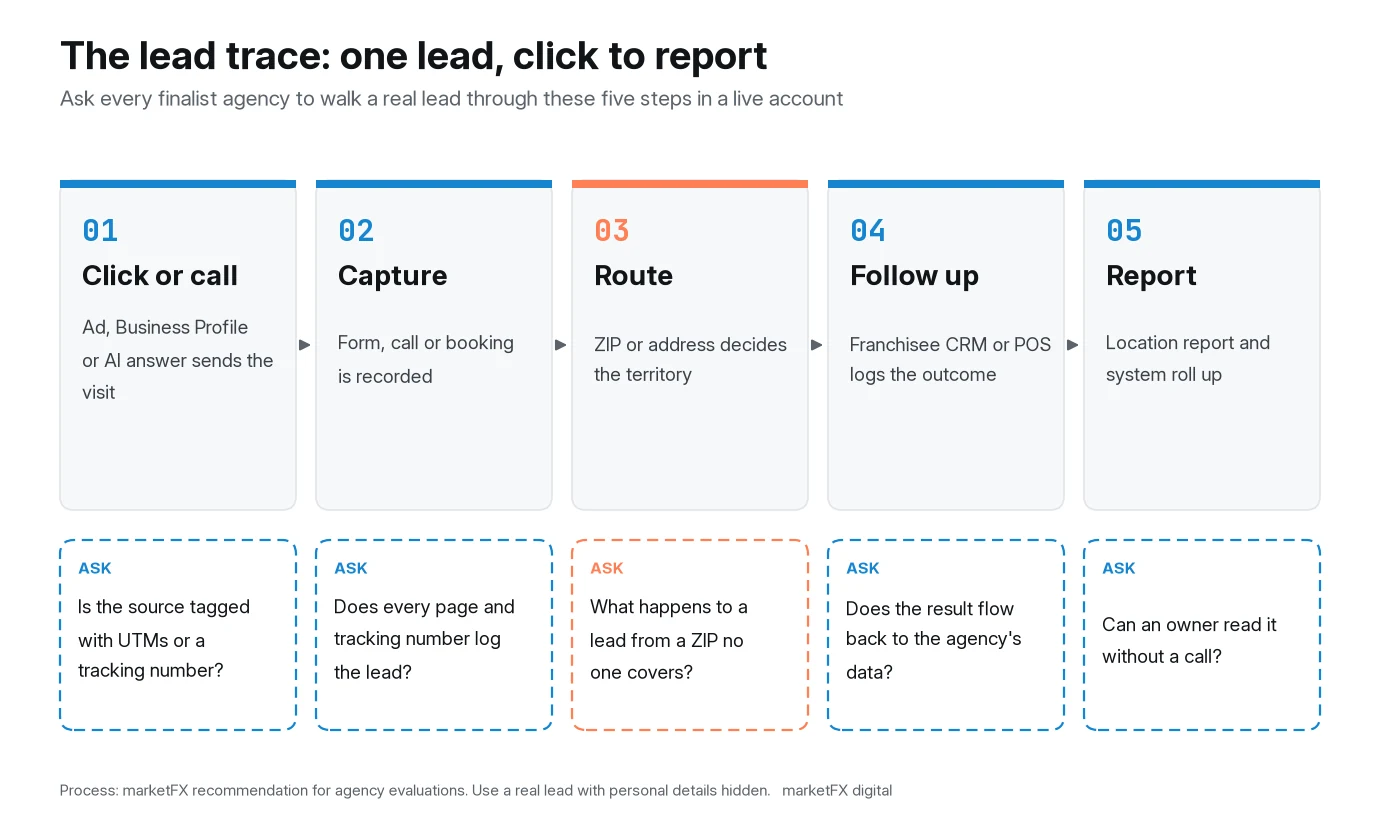
The lead trace. Ask each finalist to walk a real lead through these steps with personal details hidden.
| Step | What happens | Ask the agency |
|---|---|---|
| 1. Click or call | An ad, Business Profile or AI answer sends the visit | Is the source tagged with UTMs or a tracking number? |
| 2. Capture | A form, call or booking is recorded | Does every page and tracking number log the lead? |
| 3. Route | The ZIP code or address decides the territory | What happens to a lead from a ZIP no one covers? |
| 4. Follow up | The franchisee's CRM or POS logs the outcome | Does the result flow back into the agency's reporting? |
| 5. Report | Location reports roll up to the system view | Can an owner read the report without a call? |
Step 4 is where most systems lose the thread. If outcomes never come back from the franchisee's CRM or point of sale, the agency can only report clicks and form fills, and your marketing attribution stops at the website. Ask how they connect CRM data and which attribution model they would use.
6. What will each franchisee see in a monthly report?
Ask for a sample location report. A useful one fits on a page and answers three questions for an owner: how many leads came in, where they came from, and what they cost. Franchisees who cannot read their report will assume the fund is being wasted, even when it is not.
7. How do you handle local SEO and Business Profiles across hundreds of locations?
Local search is where most franchise customers start. Ask how the agency builds and maintains location pages, keeps names, addresses and phone numbers consistent, manages reviews and keeps Business Profiles accurate as units open, close or change hours. Our franchise SEO services cover location pages, Business Profiles, citations, reviews and franchisee playbooks, and our guide to local SEO for multi-location brands explains the method in more detail.
8. How will you track whether our locations show up in AI answers?
With 45% of consumers now asking AI tools for local recommendations, per BrightLocal, this question belongs in every 2026 pitch. ChatGPT (31%) and Google AI Mode (23%) were the most used AI tools for local recommendations in the last year. Ask the agency how it measures AI citations and share of model for your locations, not just for the brand name.
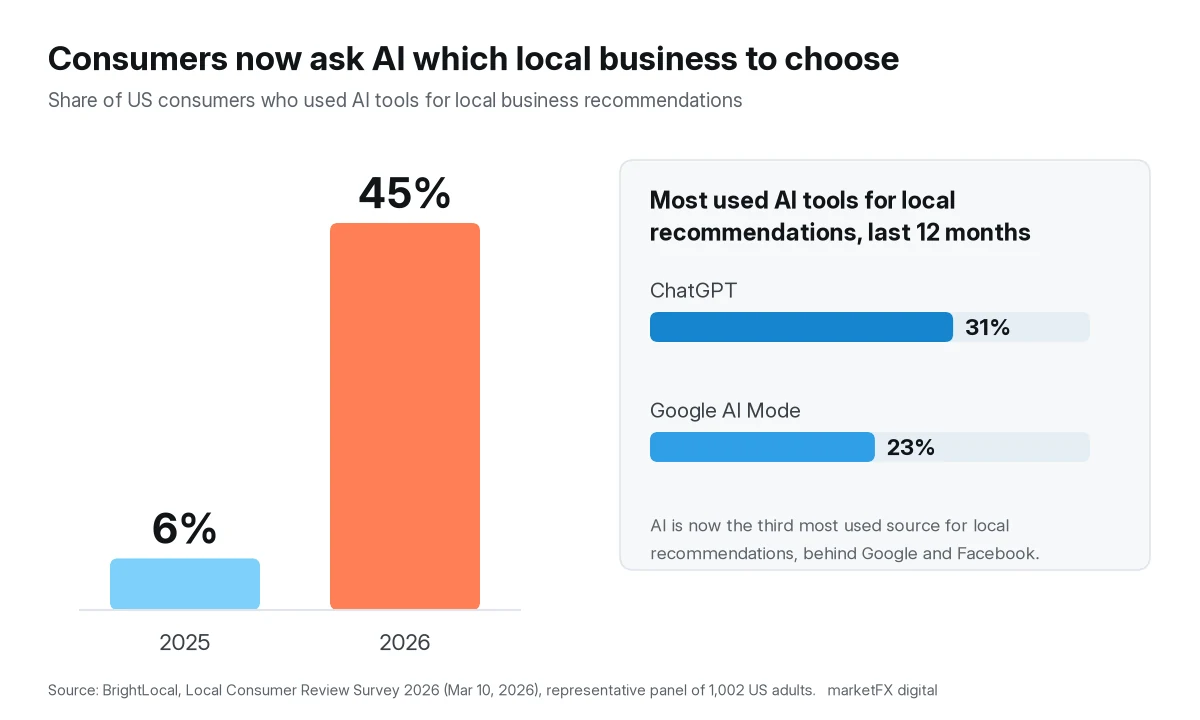
US consumers using AI for local business recommendations. Source: BrightLocal Local Consumer Review Survey 2026.
| Measure | Share of consumers | Source |
|---|---|---|
| Used AI tools for local business recommendations, 2025 | 6% | BrightLocal, 2026 |
| Used AI tools for local business recommendations, 2026 | 45% | BrightLocal, 2026 |
| Used ChatGPT for local recommendations, last 12 months | 31% | BrightLocal, 2026 |
| Used Google AI Mode for local recommendations, last 12 months | 23% | BrightLocal, 2026 |
BrightLocal also found that 88% of consumers who use AI fact check the reviews it cites, so reviews and listings still carry the weight. Our GEO services and our AI Overview exposure study cover how AI engines pick which local businesses to name.
9. How do you win franchisee buy-in?
Many systems have an advertising council, and the FTC rule asks franchisors to disclose whether it advises or has the power to decide. Ask how the agency presents plans and results to the council, how it trains franchisees on local tools, and how it handles the owner who wants to run their own ads.
10. What exactly is included in your price, and how does it scale with locations?
Ask for pricing broken out by budget pot and by location count. Find out what is included per location (listings, pages, reports), what is extra (creative, new unit launches), and how the fee changes as you add units. Two proposals with the same monthly number can include very different work.
How Is a Franchise Marketing Agency Different From a Generalist Agency?
A franchise marketing agency is set up to serve two clients at once, the franchisor and the franchisees, while a generalist agency usually serves one marketing team with one budget. The difference shows up in budgets, data, local search and reporting.
| Area | Franchise marketing agency | Generalist agency |
|---|---|---|
| Budgets | Separates brand fund, co-op, local and development spend | Usually one combined budget |
| Campaign structure | Built around territories and location pages | Built around products or audiences |
| Local search | Business Profiles, citations and reviews for every unit | Often a single site and profile |
| Reporting | Location, region and system views | One account level dashboard |
| Stakeholders | Franchisor, advertising council and owners | One marketing team |
A generalist can suit an emerging system with a few units. Once you have dozens of locations and separate funds, franchise skills matter more. Hiring a separate agency for each channel creates the gaps we describe in our post on fragmented marketing agencies.
What Are the Red Flags When Hiring a Franchise Marketing Agency?
The clearest red flags are vague fund reporting, agency owned accounts and no plan for franchisee communication. Watch for these in proposals and pitch meetings:
- One blended budget. The proposal never mentions your brand fund, co-ops or local spend separately.
- Accounts in the agency's name. Ad accounts, tracking numbers or Business Profiles would belong to the agency.
- Clicks as the finish line. Reporting stops at traffic and form fills with no plan to bring back franchisee outcomes.
- No territory logic. There is no answer for overlapping territories or unassigned ZIP codes.
- Results you cannot check. Case studies with big numbers but no way to verify the system, the timeframe or the starting point.
- No AI visibility plan. The agency cannot explain how it tracks your locations in AI answers.
How Should You Compare Franchise Marketing Agency Proposals?
Score each proposal on the same criteria so the decision is not just about who gave the best presentation.
| Criterion | What a 5 looks like | Related question |
|---|---|---|
| Budget separation | Clear plan and report for each of the four pots | 1 and 2 |
| Ownership | All accounts, listings and data owned by the franchisor | 3 |
| Territory structure | Campaigns mapped to territories with overlap rules | 4 |
| Lead trace | Live walkthrough from click to franchisee outcome | 5 |
| Franchisee reporting | One page location report an owner can read alone | 6 |
| Local search at scale | Process for pages, profiles, citations and reviews | 7 |
| AI visibility | Location level tracking in AI answers | 8 |
| Franchisee buy-in | Council plan, training and owner support | 9 |
| Pricing clarity | Fees broken out by pot and by location count | 10 |
If you want a neutral starting point before the pitches, a marketing audit gives you a baseline that every agency has to respond to.
How Much Does a Franchise Marketing Agency Cost?
Franchise marketing agency cost depends on how many locations you have, which of the four budgets the agency manages, and how much local work is included per unit. Common structures include a monthly management fee for the brand program, a per location fee for local SEO and reporting, and a percentage of media spend for paid campaigns.
Ask each agency to price the same scope: the same locations, pots and reporting. Then compare what is included, especially location pages, Business Profile management, review response and new unit launches. Also check how fees are paid. If any agency fees come out of the brand fund, that spending should show up in your fund reporting.
How Long Does It Take to See Results?
Expect an onboarding and audit phase first, then local results that build over months. For our own franchise programs, the audit and roadmap phase runs four to six weeks for systems of 20 to 200 locations, and the full model is usually in place within one to two quarters.
Paid search can drive leads within weeks once tracking is set up, while local SEO and AI visibility build over months. Agree on leading indicators for the first 90 days, such as tracked calls, profile actions and lead routing accuracy, so the council is not judging the program on month one sales.
What About Franchise Development Marketing?
Franchise development marketing sells franchises to new owners, while franchise marketing sells products and services to customers. They need different audiences, messages and metrics, so treat development as its own budget even if the same agency handles both.
The FTC rule asks franchisors to disclose the percentage of advertising fund money used principally to solicit new franchise sales. If your system uses any fund money for development, the agency's reports need to keep that spend clearly separate. Measure development on cost per qualified candidate and signed agreements, not on customer leads.
How marketFX Approaches Franchise Marketing
We run franchise and multi-location marketing as one connected program: national strategy, local SEO, paid media, CRM and analytics. Our franchise work starts with a location level audit, then a national and local channel roadmap, a 90 day action plan and a standardized franchisee dashboard that uses the same conversion definitions as corporate.
We built the Four Budget Map because blended budgets and unclear reporting cause more friction between franchisors and franchisees than any single channel does. Our home page numbers are 94% client retention, more than 20 years driving growth and more than $20 million in revenue tracked for clients. You can read what clients say on our testimonials page or learn more about us.
If you are comparing agencies now, use the ten questions above on us too.
Related services
FAQs
Frequently Asked Questions
- What is a franchise marketing agency?
- A franchise marketing agency plans and runs marketing for a franchise system at both the national brand level and the local unit level. Work usually includes brand advertising, local SEO and Google Business Profiles for each location, territory based paid media, franchisee toolkits, lead routing and reporting that rolls up from each location to the whole system.
- How much does a franchise marketing agency cost?
- Cost depends on location count, which budgets the agency manages and how much local work is included per unit. Common structures are a monthly management fee for the brand program, a per location fee for local SEO and reporting, and a percentage of media spend. Ask every agency to price the same scope so you can compare fairly.
- How long does it take a franchise marketing agency to show results?
- Paid search can produce tracked leads within weeks once tracking is in place, while local SEO and AI visibility build over months. At marketFX, the audit and roadmap typically run four to six weeks for networks of 20 to 200 locations, with the full operating model usually live within one to two quarters.
- What questions should I ask a franchise marketing agency?
- Ask which budgets it will manage and how it keeps them separate, whether fund reporting matches your FDD, who owns the accounts and listings, how campaigns map to territories, and how one lead travels from click to franchisee to report. Also ask about franchisee reports, local SEO at scale, AI visibility, council buy-in and pricing.
- What is the difference between franchise marketing and franchise development marketing?
- Franchise marketing sells products and services to customers for the brand and its locations. Franchise development marketing sells franchises to prospective owners. They need different audiences, messages and metrics, so keep development as a separate budget and measure it on qualified candidates and signed agreements rather than customer leads, even when one agency handles both.
- Can franchisees hire their own marketing agency?
- That depends on your franchise agreement and brand standards. Many systems allow local marketing within approved guidelines, and the FTC Franchise Rule asks franchisors to disclose when franchisees may use their own advertising materials. A system agency can help by offering approved templates and a local program, so owners are not forced to go it alone.
- What is a franchise brand fund?
- A brand fund, also called a national advertising fund or marketing fund, pools contributions from franchisees to pay for system wide advertising. Under the FTC Franchise Rule, franchisors disclose who administers it, whether it is audited and how it was spent in the last fiscal year. Your agency's reporting should make that spending easy to explain.