
How to Choose a Marketing Mix Modeling Agency: 7 Questions to Ask
How to choose a marketing mix modeling agency: a readiness check, 7 questions on data, validation, refresh, ranges and ownership, plus cost drivers.
Quick Answer
To choose a marketing mix modeling agency, check readiness first, then test the provider. You need about two to three years of weekly spend and sales data and a budget decision the model must inform. Then ask seven questions: data needs, validation, experiment calibration, refresh cadence, uncertainty ranges, model ownership and conflicts of interest. Pick the provider whose answers you can verify.
Marketing mix modeling (MMM) is back on the agenda for a simple reason. Cookies, consent rules and walled gardens have made click-level attribution less complete every year, and leadership still wants to know how to split next year's budget. In IAB's 2025 Outlook Study, 56% of US ad buyers said they would put more focus on MMM in 2025 (IAB, 2025 Outlook Study, January 2025). Open-source models such as Google's Meridian, which Google made available to everyone in January 2025 (Google, Meridian is now available to everyone), and Meta's Robyn (Robyn on GitHub) have also lowered the software barrier.
Lower software cost has not made MMM easy. The math is the smaller part of the work. The harder parts are getting clean weekly data out of every platform, proving the model against something it did not see, refreshing it often enough to matter and turning its output into budget moves someone actually makes. That is what this guide helps you test. It starts with a readiness check, the marketFX Data, Decision, Proof Gates™, then walks through seven questions to ask any marketing mix modeling agency, a comparison of the ways to buy MMM, what drives cost and the red flags to watch for.
If you are still sorting out tracking and reporting, start with our guide on how to choose a marketing analytics agency. MMM sits on top of that foundation, not in place of it.
What Does a Marketing Mix Modeling Agency Do?
A marketing mix modeling agency builds and maintains a statistical model that estimates how much each marketing channel contributes to sales, using aggregate spend and outcome data over time. The output is a contribution and return estimate for each channel, response curves that show where spend hits diminishing returns, and budget scenarios that show what would likely happen if you moved money between channels.
Because MMM works on aggregate weekly data rather than individual user journeys, it does not depend on cookies or click paths. That is its main strength. It can include channels that attribution struggles to see, such as TV, radio, out-of-home, podcasts and offline promotions, alongside search, social and programmatic. It also accounts for things that are not marketing at all, such as seasonality, pricing, promotions and the economy.
A good provider does more than fit the model. The work usually includes:
- Data collection and cleanup. Pulling spend, impressions and outcomes from each platform, aggregating campaigns into channels and fixing gaps.
- Model design. Choosing channels, control variables, adstock (how long an ad's effect lasts) and saturation (where more spend stops helping).
- Validation and calibration. Checking the model against holdout periods and against incrementality experiments.
- Scenario planning. Turning results into a recommended budget split, with ranges.
- Refresh and governance. Updating the model on a set cadence and documenting every change.
MMM answers a different question from attribution and from incrementality testing. Attribution assigns credit among the interactions you can observe. An incrementality test measures causal lift for one channel or campaign with a control group. MMM estimates the contribution of every channel at once over a long period. Our marketing attribution page explains how those methods fit together, and why most teams need more than one.
Are You Ready for MMM? The marketFX Data, Decision, Proof Gates™
The marketFX Data, Decision, Proof Gates™ is a three-part readiness check we use before anyone spends money on a marketing mix model. Each gate is a yes or no question. If you cannot pass all three, the best first purchase is usually tracking, reconciliation or a single experiment, not a model.
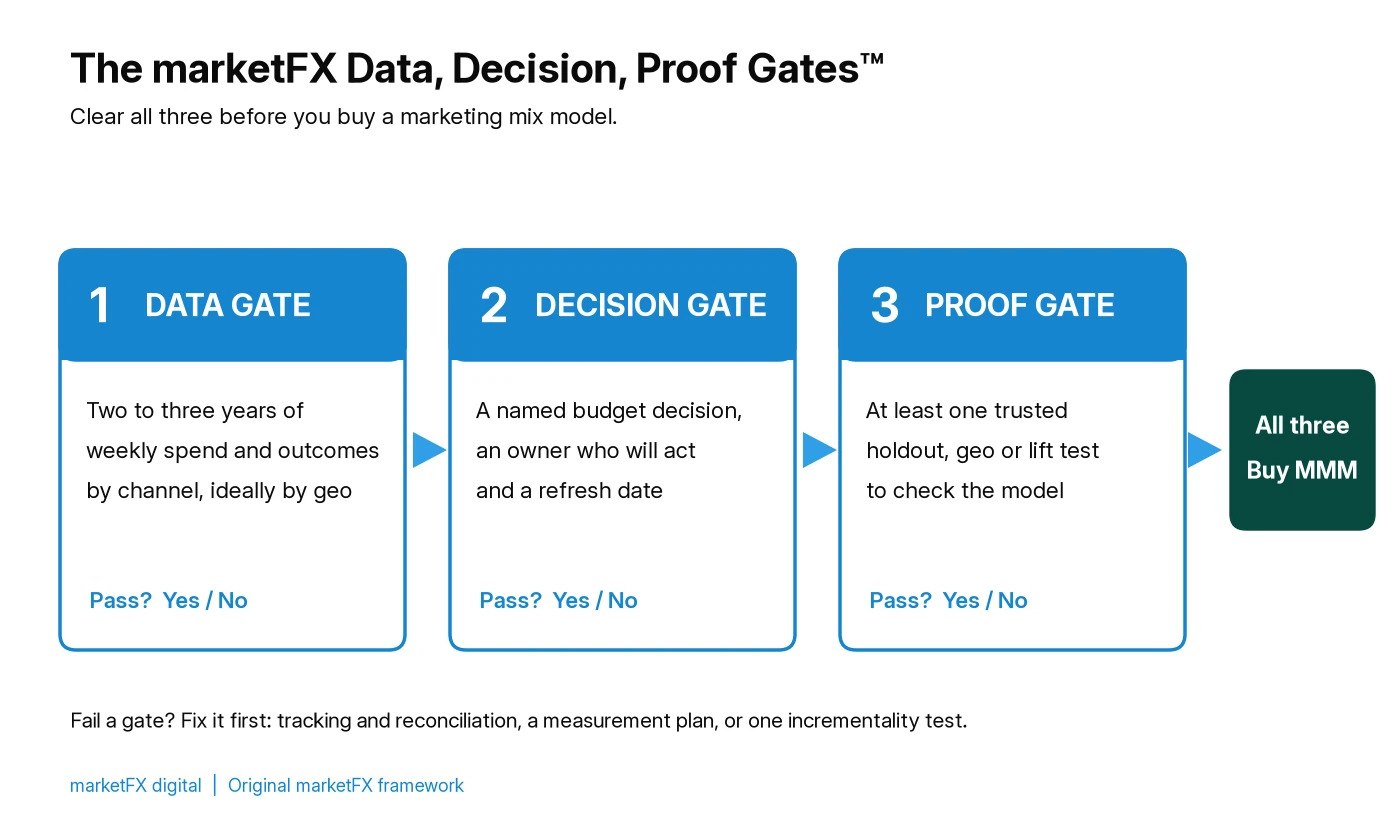
The marketFX Data, Decision, Proof Gates™. Clear all three before you buy a model.
| Gate | Question to answer | Pass looks like | If you fail it, buy this first |
|---|---|---|---|
| 1. Data | Do we have enough consistent history? | Two to three years of weekly spend and outcomes by channel, ideally by region or market | Tracking cleanup, CRM and revenue reconciliation, a channel naming standard |
| 2. Decision | What budget decision will the model change? | A named decision, an owner who will act on it and a date for the next refresh | A measurement plan that ties reports to budget meetings |
| 3. Proof | What will we check the model against? | At least one trusted holdout, geo or platform lift test, run or planned | One well-designed incrementality test on your largest or least certain channel |
Gate 1: Data. Google's Meridian documentation recommends at least two years of weekly data for a geo-level model and three years for a national model, and three years if you only have monthly data (Google for Developers, Meridian: Collect and organize your data). The same documentation is clear that this is rough guidance, and that the real test is how wide the model's uncertainty ranges come out (Meridian: Amount of data needed). History also has to be consistent. If channel names, conversion definitions or revenue sources changed halfway through, the model will read those changes as marketing effects.
Gate 2: Decision. A model nobody acts on is an expensive report. Before you buy, write down the decision it has to inform, such as next year's channel split or whether to keep a channel at its current level, plus the person who owns that decision and when the model will refresh before it.
Gate 3: Proof. Every MMM rests on assumptions. An experiment gives you something outside the model to compare against. One trusted test is enough to start. If you have never run one, plan it in parallel with the model build rather than after.
7 Questions to Ask a Marketing Mix Modeling Agency
These seven questions separate providers who can defend their work from providers who sell a dashboard. Ask every shortlisted agency the same questions, in writing, and compare the answers side by side.
1. What data do you need from us, and what happens if we do not have it?
A strong answer is specific. The provider should list the inputs it needs: weekly spend and an exposure metric such as impressions for each paid channel, the outcome you care about such as revenue or orders, and control variables such as pricing, promotions and seasonality. It should state how much history it needs and at what level, national or by market. It should also explain what it does when data is missing. Meridian's documentation, for example, says missing media weeks should be filled with zero while missing sales or control data should be estimated with standard methods, because filling them with zero distorts the baseline (Meridian: Collect and organize your data).
Watch for providers who say any amount of data is fine, or who never ask about changes in your tracking or business during the period.
2. How do you validate the model against something it did not fit?
A model that fits your history well is not automatically right about cause and effect. Ask what the provider checks beyond fit statistics. A minimum answer is a holdout period: build the model on older weeks, then see how well it predicts recent weeks it never saw. A stronger answer adds a comparison against an experiment result. Ask to see a past validation report with client names removed.
3. How will incrementality experiments calibrate the model?
Experiments and MMM work best together. A geo test or platform lift study gives a causal read on one channel over a few weeks. The model can use that result as a starting assumption, often called a prior, for that channel's return. Google designed Meridian to take this kind of experiment input. Ask the provider which channels it would test first, how it would design the test, and whether it will compare the model's estimate with the test before or after using the test to calibrate. Both are useful, but they are different checks, and a good provider will explain which one it is doing.
4. How often will the model refresh, and how long does a refresh take?
A model refreshed once a year can inform an annual plan but not an in-year shift. In IAB's State of Data 2026 survey, 42% of marketing mix model users said they run their models only twice a year or once a year today. The same users expect that share to fall to 26% within one to two years, with monthly or faster runs rising from 26% to 42% (IAB and BWG Strategy, State of Data 2026, February 2026).
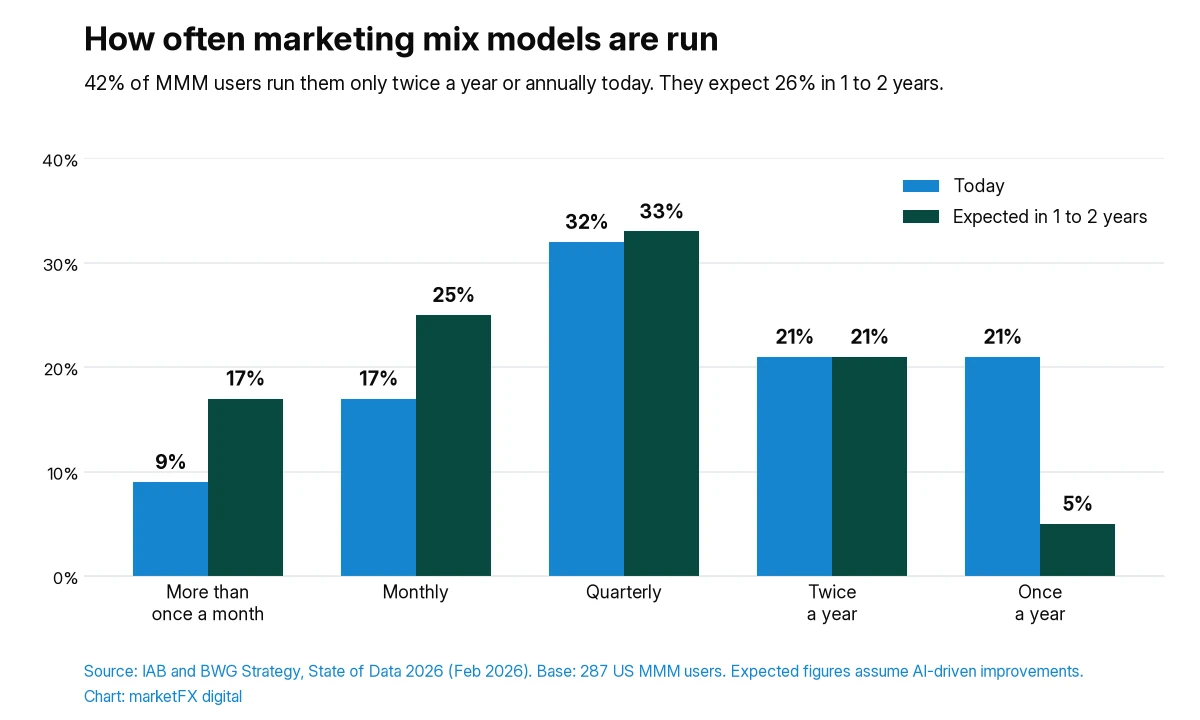
Source: IAB and BWG Strategy, State of Data 2026 (February 2026). Base: 287 US marketing mix model users. Expected figures assume AI-driven improvements, as asked in the survey.
| Cadence | Today | Expected in 1 to 2 years |
|---|---|---|
| More than once a month | 9% | 17% |
| Monthly | 17% | 25% |
| Quarterly | 32% | 33% |
| Twice a year | 21% | 21% |
| Once a year | 21% | 5% |
Ask for the refresh cadence in the contract, the time from data cutoff to updated results, and what triggers an off-cycle refresh, such as a new channel, a new market or a big pricing change. If a refresh takes six to eight weeks end to end, the model will mostly describe the past.
5. Will you report ranges or single numbers?
Every MMM estimate comes with uncertainty. A provider who reports that a channel returns exactly 3.2 dollars per dollar, with no range, is hiding something or does not know. Ask for credible or confidence intervals on every channel return, and ask how the provider will present a channel whose range crosses break even. That channel is not proven good or bad, and the right move is often a test, not a cut. Meridian's documentation makes the same point from the other side: the best way to know whether you have enough data is to fit the model and look at how wide the intervals are (Meridian: Amount of data needed).
6. Who owns the model, the code and the cleaned data when we part ways?
This question tells you whether you are buying measurement or renting it. Some providers run everything inside their own software and keep the model when the contract ends. Others build in your cloud environment, often on open-source code, and hand over the pipeline, the model files and documentation. Neither is automatically wrong, but you should know which one you are signing. At a minimum, you should keep the cleaned dataset, the channel definitions and every past result.
7. Do you buy media, and how do you handle the conflict?
If the same company that runs your paid media also builds the model that grades it, ask how it keeps those apart. Look for a separate measurement team, documented model choices made before results are seen, and a commitment to report channels that look weak, including the ones it manages. This is not a reason to rule out an agency that does both. Integrated teams can act on results faster. It is a reason to ask for the safeguards in writing.
How Do the Ways to Buy MMM Compare?
You can buy marketing mix modeling in four broad ways. They often use similar statistics and still produce very different results a year later, because they differ on who maintains the model and how fast it turns into decisions.
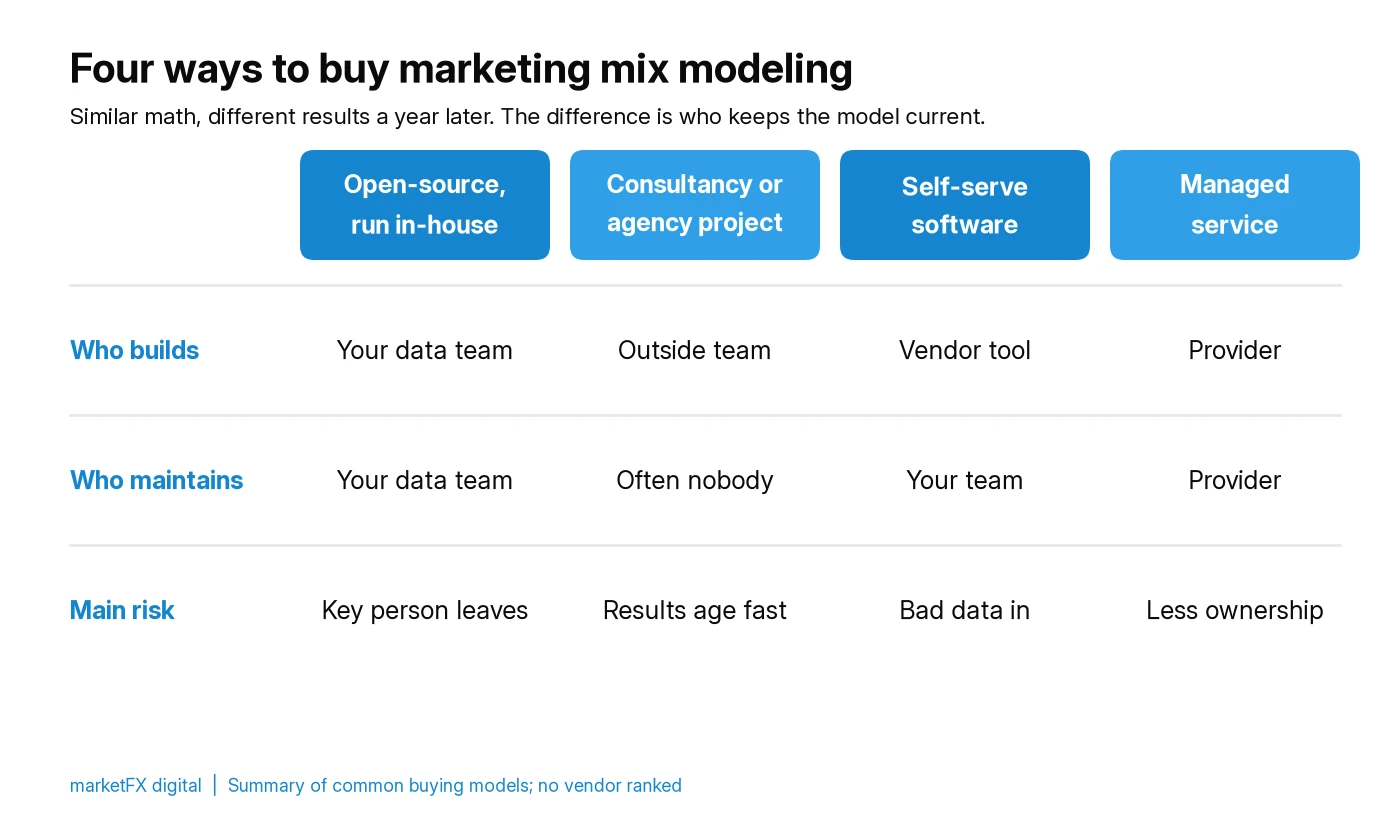
Four ways to buy MMM. The right one depends on your team, not on the math.
| Option | Who builds and maintains it | Best fit | Main risk |
|---|---|---|---|
| Open-source model run in-house | Your own data scientists, using tools such as Meridian or Robyn | Teams with analysts who can own pipelines, retraining and explanation | The model stalls when the one person who understands it leaves |
| Consultancy or agency project | An outside team builds the model and delivers findings | A one-time budget question or a first model to learn from | Results age quickly if refreshes are not in scope |
| Self-serve software | The vendor provides the tool; your team prepares data and reads results | Teams with clean data and someone to run it weekly | Garbage in, confident charts out |
| Managed service | The provider connects data, maintains the model and reviews outputs with you | Teams that want ongoing answers without hiring a data science group | Less transparency and ownership unless the contract requires it |
Many companies start with a project to prove value, then move to a managed or in-house setup once the model is informing real decisions. Whichever route you pick, the seven questions above apply.
How Much Does Marketing Mix Modeling Cost?
Marketing mix modeling cost depends on how many channels and markets you model, how messy your data is, how often the model refreshes and whether experiments are included. Data preparation is usually the largest hidden cost. A company with clean weekly data from every platform pays far less than one where spend sits in spreadsheets, invoices and three different naming conventions.
The main cost drivers to compare across proposals are:
- Scope. Number of channels, markets, brands and outcomes modeled.
- Data work. Connectors, cleanup and reconciliation, especially for offline and agency-held spend.
- Refresh cadence. A yearly project costs less than a monthly managed model, and also does less.
- Experiments. Whether design and readout of calibration tests are included or billed separately.
- Ownership. Whether you receive the code, data and documentation at the end.
Ask each provider to price the same scope so you are comparing like with like. Treat a quote that skips data preparation as incomplete rather than cheap.
Why Is MMM a Good Fit for Multi-Location and Franchise Brands?
Brands with many locations have an advantage most single-site companies do not: natural geographic variation. Spend, promotions and results already differ by market, and each market can become a row in the model. Meridian's documentation recommends geo-level data as the best practice, because its hierarchical model shares information across regions and produces tighter estimates than a national model with the same number of weeks (Meridian: Collect and organize your data).
The same structure makes experiments easier. A multi-location brand can hold spend back in a few matched markets and compare sales against similar markets that kept running, without touching the rest of the system. That gives the Proof gate a clean test.
There are traps. Local co-op budgets, franchisee-run campaigns and national media often sit in different systems, so the Data gate is harder than it looks. Before a provider models your markets, make sure every source of spend in each market is captured, including what franchisees spend on their own. Our multi-location and franchise marketing page covers how we keep national, regional and local budgets in one view.
What Are the Red Flags When Hiring an MMM Provider?
Walk away, or at least slow down, if you hear any of these:
- "We do not need much history." Without enough consistent data the model will lean on its assumptions, not your results.
- Single-number returns with no ranges. Precision without uncertainty is false precision.
- No plan to validate against an experiment. Fit statistics alone cannot show cause and effect.
- A black box you cannot inspect. If the provider cannot explain why the model credits a channel, you cannot defend it to finance.
- Results that always favor the provider's own media. Ask how the model treated channels the provider does not run.
- No refresh in scope. A one-off model is a snapshot. Budgets change monthly.
How marketFX Approaches Marketing Mix Modeling
We treat MMM as one layer of a measurement system, not a product to sell on its own. Most of our measurement work starts lower down: auditing tracking, reconciling platform numbers with CRM and revenue records, documenting attribution choices and scoping controlled experiments where the data and design allow. That is the work that gets a company through the Data and Proof gates, and it is covered on our marketing attribution and marketing analytics consulting pages.
When a company passes all three gates, we help scope the model, put the seven questions above to the options, and connect the model's output to the budget decisions it was bought to inform. When a company does not pass, we say so, and recommend the smaller step that gets it there. For many teams the right first move is a paid media audit or fixing the dashboard problems described in why your Google Analytics dashboard is lying to you.
If you want a second opinion on whether your data is ready for MMM, or on a proposal you already have, book a strategy call. We will walk through the three gates with you and tell you what we would do first.
Related services
FAQs
Frequently Asked Questions
- What is a marketing mix modeling agency?
- A marketing mix modeling agency builds and maintains a statistical model that estimates how much each marketing channel contributes to sales, using weekly spend and outcome data over two to three years. It also turns the results into budget scenarios. Good providers include data preparation, validation against experiments, regular refreshes and clear ownership terms, not just a one-time report.
- How much data do you need for marketing mix modeling?
- As a rule of thumb, about two years of weekly data by region or market, or three years of weekly data at the national level. Google's Meridian documentation gives that guidance and notes it is rough, because the real test is how wide the model's uncertainty ranges come out. Consistent definitions across the whole period matter as much as length.
- What is the difference between MMM and attribution?
- Attribution assigns credit for conversions among the interactions you can observe, such as clicks and site visits, and is useful for day to day optimization. Marketing mix modeling uses aggregate weekly spend and sales across every channel, including offline media, to estimate each channel's contribution. MMM does not need user-level tracking, but it needs longer history and works best for budget allocation.
- Can a small or mid-sized company use marketing mix modeling?
- Yes, if it has enough consistent history, spends across several channels and has a budget decision the model will change. Companies with one or two channels, short history or unreliable data usually get more value from fixing tracking and running a single incrementality test first. Open-source tools have lowered software costs, but data preparation still takes real effort.
- How often should a marketing mix model be refreshed?
- Often enough to inform the decisions you actually make. Quarterly is a common baseline, and monthly is better when budgets shift during the year. In IAB's State of Data 2026 survey, 42% of MMM users run their models only twice a year or annually today, and most expect to move faster within one to two years.
- Should marketing mix models be calibrated with experiments?
- Yes, where you can. A geo holdout or platform lift test gives a causal read on one channel that does not depend on the model's assumptions. The model can use that result as a starting point for that channel, or you can compare the model's estimate against it as a check. Either way, it makes the output easier to trust and defend.
- Who should own the marketing mix model?
- You should, at least the cleaned data, channel definitions, documentation and past results. Some providers keep the model inside their own software, while others build in your environment and hand over the code. Decide which you want before you sign, and write the handover terms into the contract so you do not lose years of work if you switch providers.