
Email Marketing
Email Marketing Agency for Multi-Location, B2B and Growth Brands
An email marketing agency plans, builds and runs the emails that turn subscribers, leads and past customers into revenue: the automated flows that fire on behavior, the campaigns you send to your list and the segmentation, deliverability and reporting underneath them. marketFX runs email marketing for multi-location, franchise, B2B and growth brands inside one integrated team, connected to your CRM, your paid media and your website, and measured on revenue rather than opens.
Book a Strategy Call See how it starts
Why email still earns its place in the budget
Email is the channel you own. There is no auction and no algorithm deciding whether your message is shown, and it reaches people who already asked to hear from you. In Litmus's 2025 State of Email research, 35% of marketing leaders said they get $10 to $36 back for every $1 spent on email, 30% get $36 to $50 and 5% get more than $50, while 21% do not measure email ROI at all (Litmus, The ROI of Email Marketing). Visitors from email also convert well once they reach a page: in Unbounce's 2024 benchmark, email traffic converted at 19.3% on average, ahead of paid social at 12% and paid search at 10.9% (Unbounce, Conversion Benchmark Report 2024).
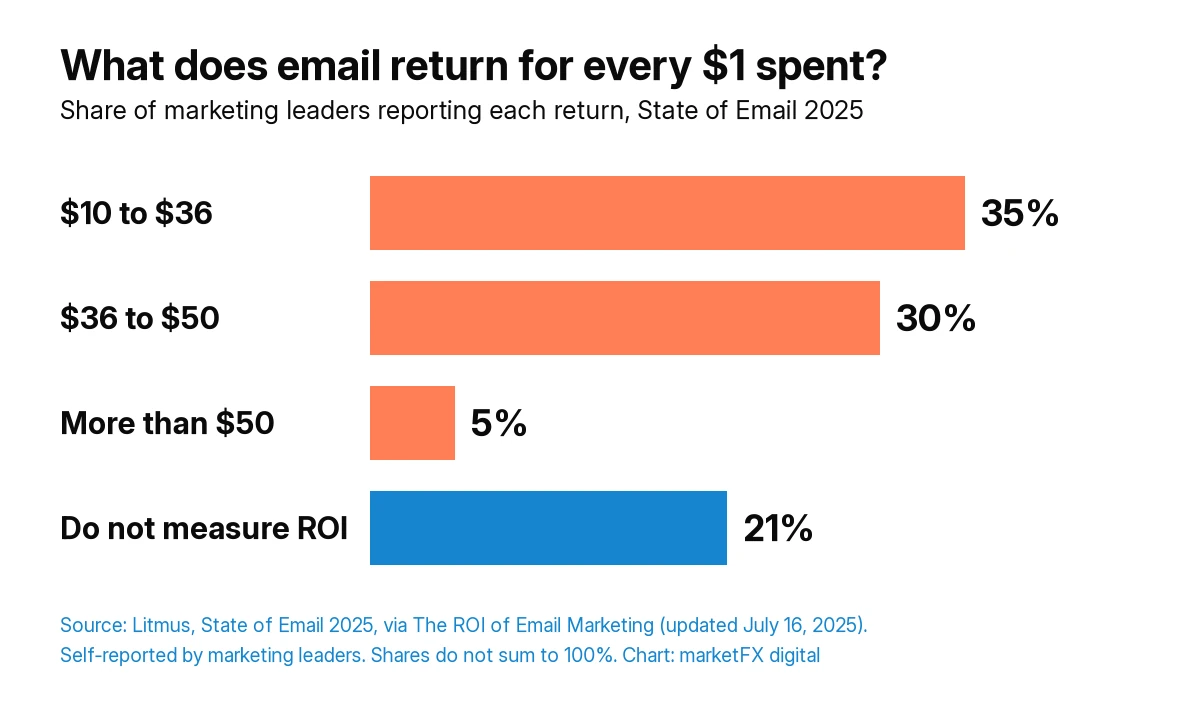
| Reported return for every $1 | Share of marketing leaders |
|---|---|
| $10 to $36 | 35% |
| $36 to $50 | 30% |
| More than $50 | 5% |
| Do not measure email ROI | 21% |
Source: Litmus, State of Email 2025, as published in The ROI of Email Marketing, updated July 16, 2025. Self-reported by marketing leaders; your return depends on your list, offer and measurement.
The gap is execution. Most email programs underperform in one of four ways:
- Mail that does not reach the inbox. Missing authentication, old lists and rising spam complaints quietly push messages into spam folders.
- One message for everyone. The whole list gets the same newsletter, so it is relevant to almost nobody.
- Flows built once and forgotten. Welcome, follow up and win-back automations set up at launch and never touched again.
- Reports that stop at opens. Open rates go up or down while nobody checks what email added to leads, bookings or sales.
The marketFX Inbox Revenue Loop™
The marketFX Inbox Revenue Loop™ is the five-step method we use to run email marketing so that messages reach the inbox, reach the right people, fire at the right moment and prove what they earned. The loop repeats every quarter, and each turn uses what the last one proved.
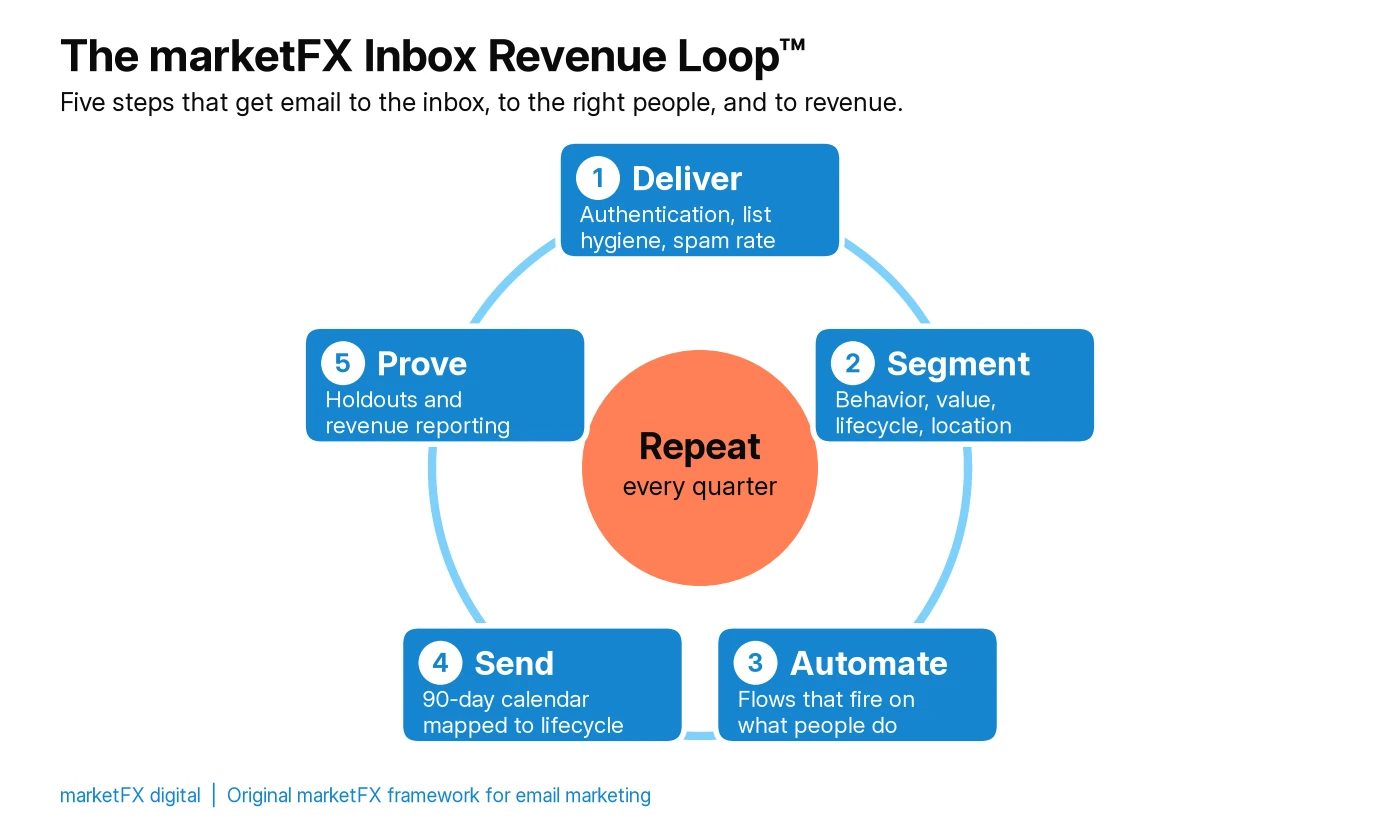
| Step | What goes wrong without it | What we put in place |
|---|---|---|
| 1. Deliver | Messages land in spam and nobody notices | A check of authentication, list hygiene, consent records and spam complaint rates, with a plan to fix gaps |
| 2. Segment | Everyone gets the same email | Audiences built on behavior, value, lifecycle stage and location, set up in your platform |
| 3. Automate | Leads and customers hear nothing at the moments that matter | Welcome, lead nurture, abandonment, post-purchase and win-back flows, built, tested and live |
| 4. Send | Last-minute blasts with no plan | A 90-day calendar of campaigns and automated sends mapped to the customer lifecycle |
| 5. Prove | Reporting on opens and clicks only | Holdouts or comparison groups for key flows and reporting on leads, revenue and repeat rate |
Attribution: the marketFX Inbox Revenue Loop™ is an original marketFX framework for email marketing. It is not a vendor ranking.
Email marketing services we deliver
Every engagement is scoped to your list, your platform and your goals. The core work covers:
- Email strategy and audit. What your program sends today, what is working, where revenue is leaking and what to build first.
- Segmentation. Audiences by behavior, value, lifecycle stage and location, so each message reaches the people it is for.
- Automated flows. Welcome and onboarding, lead nurture, cart and browse abandonment, post-purchase, review requests and win-back sequences.
- Campaign calendar. A 90-day plan of broadcast and automated sends tied to launches, seasons and the customer lifecycle.
- SMS alongside email. Permission-based SMS added at the moments where speed matters, coordinated with email so customers are not hit twice.
- Loyalty and retention programs. Programs built to change behavior and lift repeat rate.
- Testing and reporting. Subject line, content and timing tests, plus holdouts that show what email actually added.
We work in the platforms you already use, including Klaviyo, Mailchimp, HubSpot and Salesforce. If the CRM itself needs rebuilding, our CRM and marketing automation work covers data, routing and lifecycle architecture.
Deliverability: getting to the inbox first
Every other email metric depends on delivery. Since February 1, 2024, Gmail has required anyone sending to personal Gmail accounts to authenticate their mail, and it set stricter rules for senders of 5,000 or more messages a day (Google, Email sender guidelines).
| Requirement | All senders | Senders of 5,000+ messages a day |
|---|---|---|
| Email authentication | SPF or DKIM | SPF, DKIM and DMARC |
| Spam rate in Postmaster Tools | Below 0.3% | Below 0.3%, with Google recommending below 0.1% |
| Unsubscribe | Easy way to opt out recommended | One-click unsubscribe and a visible unsubscribe link in marketing messages |
| From address alignment | Do not impersonate Gmail From headers | From domain aligned with the SPF or DKIM domain to pass DMARC |
Source: Google, Email sender guidelines. Google also notes it does not track open rates and that low open rates are not necessarily a sign of deliverability problems.
We review authentication, sending domains, list sources, consent records and complaint rates at the start of every engagement, and work with whoever manages your domain to close the gaps before we send more.
Email marketing for franchise and multi-location brands
Franchise and multi-location brands need email at two levels: brand campaigns that stay consistent everywhere, and local messages that feel like the location down the street. We build both from one system. The brand owns templates, the core calendar and the main flows. Locations get local segments, local offers and events, and reporting by location rolled up for the brand, so it is clear where email is driving visits and bookings and where a location needs help. This is part of our wider multi-location and franchise marketing work.
Email marketing for B2B and lead generation
For B2B and service businesses with longer sales cycles, email does most of its work between the first inquiry and the sales conversation. We build nurture sequences that stay in front of a lead until they are ready, route engaged leads to sales quickly and stop marketing emails once a deal is in progress. Leads that wait lose interest, so fast, automated follow up after a form submit is usually the first flow we fix. Our CRO audit checklist explains how we check that follow up as part of a conversion review.
Signal vs Noise™ in email reporting
We judge email by what it changes in the business, not by how busy the inbox looks.
| Decision-grade | Vanity |
|---|---|
| Revenue, leads and bookings from email, tracked into the CRM | Open rate on its own |
| Incremental lift from flows, measured against a holdout | Total sends |
| Repeat purchase rate and customer lifetime value by segment | List size |
| Spam complaint rate and inbox placement | Click rate without outcomes |
| Speed from inquiry to first follow up | Newsletter frequency |
Reporting connects to the rest of your measurement through our marketing attribution work, so email is judged on the same outcomes as every other channel.
Every email engagement starts with an audit
Before we change anything, we review your program along the Inbox Revenue Loop™: how your mail is authenticated and where it lands, how the list was built and how consent is recorded, which segments exist, which flows run and what they earn, what campaigns you send and how often, and how results are tracked to revenue. The output is a written plan that says what to fix first, which flows to build or rebuild, how the calendar should run and how success will be measured.
If you want a wider review first, our marketing audit services cover email alongside search, paid media and tracking.
How marketFX runs email marketing
Email is not a separate silo for us. It sits inside the same team that runs paid media, SEO, content, CRM and analytics, so paid campaigns grow the list, the website captures sign-ups and leads, email turns them into customers and repeat buyers, and reporting ties it all to revenue. Across our client work we report 94% client retention, more than 20 years driving growth and more than $20 million in revenue tracked.
Find out what email could earn for your brand
30 minutes. We will look at your list, your platform, your flows and your reporting, and tell you what we would fix first, even if you do not hire us.
FAQs
Email Marketing Agency FAQ
- What does an email marketing agency do?
- An email marketing agency plans, builds and manages a brand's email program. The work usually covers strategy, segmentation, automated flows, campaign calendars, testing, deliverability and reporting. A good agency ties email to leads, bookings and revenue in your CRM rather than reporting opens and clicks alone.
- How much does an email marketing agency cost?
- Cost depends on your list size, platform, number of flows to build, how many campaigns you send and whether SMS and loyalty work are included. We scope the work after an audit and share pricing in writing after a brief scoping call, so you pay for what your program needs rather than a fixed package.
- Which email platforms do you work with?
- We work in the platforms you already use, including Klaviyo, Mailchimp, HubSpot and Salesforce. If your current platform is holding the program back, the audit will say so and explain the tradeoffs, but we do not require you to switch.
- What email automations should every business have?
- Most businesses should start with a welcome or onboarding flow, fast follow up for new leads or inquiries, abandonment reminders where people start but do not finish, a post-purchase or post-service flow with review requests, and a win-back flow for customers who have gone quiet.
- How do you improve email deliverability?
- We check that sending domains are authenticated with SPF, DKIM and DMARC, that the list was built with consent, that inactive and bounced contacts are handled, and that spam complaint rates stay low. Gmail requires bulk senders to keep complaints below 0.3% and recommends below 0.1%.
- Do you run email for franchise and multi-location brands?
- Yes. We build brand templates, a core calendar and shared flows, then add local segments, offers and events for each location. Results are reported by location and rolled up for the brand, so you can see where email drives visits and bookings.
- How do you measure email marketing results?
- We track leads, bookings and revenue from email into your CRM, measure the lift from key flows against holdout groups, and watch repeat rate, lifetime value and complaint rates. Opens and clicks are reported too, but they sit next to business results rather than replacing them.
Read next
- CRM and Marketing AutomationThe CRM and lifecycle system that email runs on.Read more
- CRO Audit Checklist: 10 Checks to Find Where Your Site Loses LeadsHow to check that email traffic lands on pages that convert.Read more
- Franchise Multi Location Marketing AgencyHow brand and local marketing work across every location.Read more