
Brand vs Performance Marketing: How to Balance the Budget
Brand vs performance marketing compared on goals, channels, payback and measurement, with Binet and Field budget benchmarks and a dial for setting your split.
Quick Answer
Brand marketing builds the memory and preference that make people choose you later. Performance marketing turns people who are ready now into leads and sales you can count. Neither is better alone. Research for LinkedIn's B2B Institute puts the most efficient split near 60% brand in consumer markets and 46% in B2B, and integrated plans beat performance-only plans on return.
Brand vs performance marketing is usually argued as a choice between feelings and numbers. Brand marketing gets cast as the expensive, unmeasurable work of being remembered. Performance marketing gets cast as the efficient work that pays for itself in clicks, leads and sales. That framing pushes budgets toward whatever shows up in this month's dashboard, and over time it starves the thing that makes those dashboards work.
The evidence points the other way. Analytic Partners found that 10% to 50% of media impact is realized in the long term, well beyond the window most campaign reporting captures, and that an integrated brand and performance strategy delivers up to 90% higher ROI than a performance-only strategy (Think with Google, Brand is a performance multiplier, November 2026). Cutting brand to fund performance can look efficient for a quarter and cost far more over the next two years.
This guide explains the difference, shows how much of a budget each side usually earns, how to measure both, and lays out the marketFX Grow and Harvest Dial™, the way we decide where a brand's budget should start. If you already want a team to run both sides, see our performance marketing agency and digital marketing strategy pages.
What Is the Difference Between Brand and Performance Marketing?
Brand marketing builds awareness, memory and preference with people who are not buying yet, so they think of you first when they are. Performance marketing reaches people who are ready to act and asks for a click, a call, a form or a sale, and it is judged on the cost of each one. One creates future demand. The other harvests demand that already exists.
| Factor | Brand marketing | Performance marketing |
|---|---|---|
| Main job | Build memory and preference before people are in market | Turn people who are in market now into leads and sales |
| Audience | Broad, including people who will buy months or years from now | Narrow, people showing intent today |
| Typical channels | Video, connected TV, social, sponsorship, out of home, PR and content | Paid search, shopping, retargeting, lead ads, affiliate and email offers |
| Message | Who you are, why you are different, how you make people feel | An offer, a reason to act now and an easy next step |
| When it pays back | Over months and years, and it lifts other channels along the way | Within days or weeks, then fades quickly |
| How it is measured | Branded search, share of search, direct traffic, lift studies and marketing mix modeling | Clicks, conversions, cost per lead, cost per acquisition and ROAS |
| Main risk | Spending without a way to see what it changed | Paying more each year to reach the same shrinking pool of ready buyers |
The line between the two is blurrier in practice than the table suggests. A YouTube ad can build memory and drive a sale in the same week. A paid search ad on your own brand name only works because brand work made someone type it. That is why the better question is not which one to pick but how much of each to buy, and how to know whether the mix is right.
Which Is Better, Brand or Performance Marketing?
Neither is better on its own. Performance marketing is better at capturing demand that exists today, and brand marketing is better at creating the demand performance marketing will capture next year. A plan with only one of them gets weaker over time, either because nobody is converting the interest or because nobody is creating it.
Performance-only plans are the more common failure because they look efficient. Early on, they harvest the demand that past brand work, word of mouth and reputation already built. As that pool is used up, cost per lead creeps up, retargeting audiences shrink and the business has to bid harder for the same buyers. Brand-only plans fail the opposite way: people know the name, but there is no clear path to act when they are ready, so competitors with better offers and better search coverage collect the sale.
The useful question is which one your budget is short of right now. If branded searches, direct traffic and close rates are flat while paid costs climb, you are probably under-investing in brand. If people know you but leads are thin and the site does not convert, you are probably under-investing in performance.
Why Do Performance-Only Budgets Stall?
Performance-only budgets stall because they keep fishing in the same small pond. At any moment only a small share of potential buyers is in market. Performance marketing reaches that share efficiently, but it does little to grow it or to make those buyers prefer you before they start looking.
Three findings from recent measurement work explain why:
- A large part of the payoff arrives late. Analytic Partners found that 10% to 50% of media impact is realized in the long term, beyond the window most campaign reports cover. A 30-day attribution report will miss that part entirely.
- Advertising lifts other channels. Analytic Partners' ROI Genome found that 45% of advertising's impact comes from its ability to boost the ROI of other channels. Brand work makes search ads, email and sales calls convert better, but that credit rarely shows up next to the brand line item.
- Integration pays. The same ROI Genome research found that an integrated brand and performance strategy delivers up to 90% higher ROI than a performance-only strategy.
All three figures come from Analytic Partners and were published by Google, which sells both brand and performance media, so treat them as strong evidence for the direction rather than exact numbers for your business (Think with Google, Brand is a performance multiplier, November 2026).
There is also a measurement trap. Click-based attribution gives most of the credit to the last thing someone clicked, which is usually a branded search ad, a retargeting ad or an email. Brand work that created the interest gets little or none. Teams that budget from that report keep moving money toward the channels that close and away from the ones that open, until there is less to close. Our guide to why your Google Analytics dashboard is lying to you covers that problem in more detail.
How Should You Split Budget Between Brand and Performance?
Start from a benchmark, then adjust for your category, buying cycle and brand strength. The best-known benchmark comes from Les Binet and Peter Field's analysis of the IPA Databank of advertising effectiveness cases: in consumer markets, efficiency is typically maximized with around 60% of the communications budget on brand building and 40% on sales activation. In research for LinkedIn's B2B Institute, they found the B2B optimum closer to 46% brand and 54% activation.
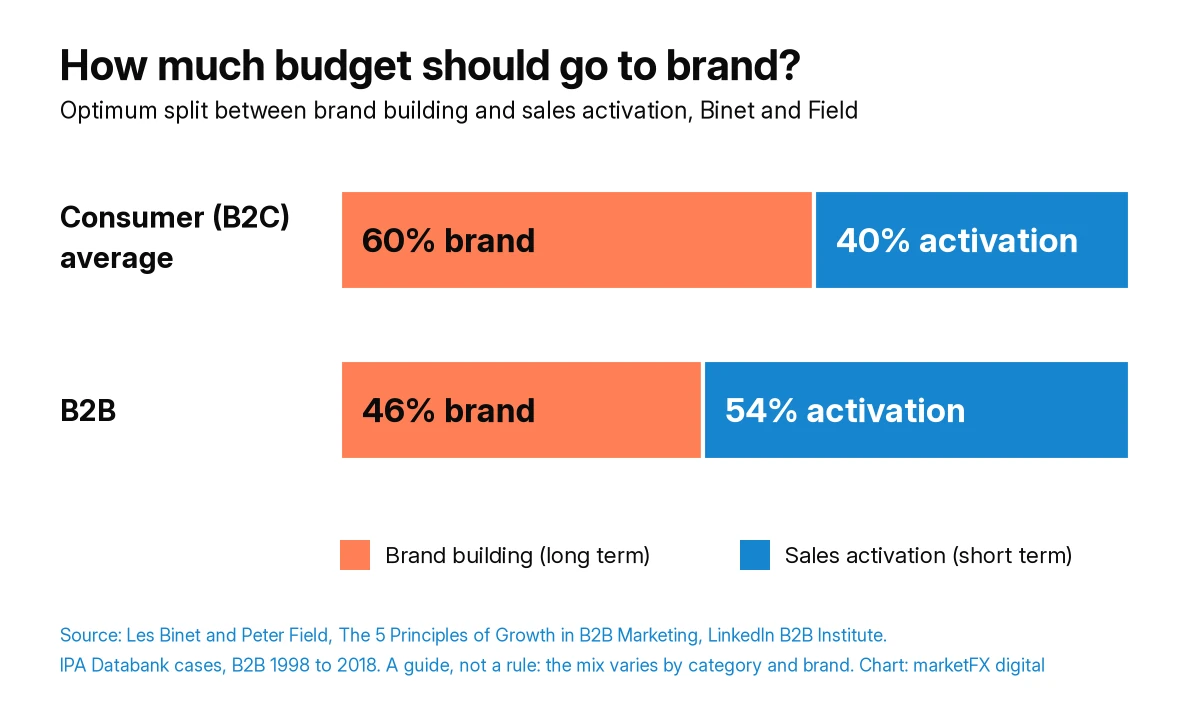
| Market | Brand building | Sales activation |
|---|---|---|
| Consumer (B2C) average | 60% | 40% |
| B2B | 46% | 54% |
Source: Les Binet and Peter Field, The 5 Principles of Growth in B2B Marketing, LinkedIn B2B Institute, based on IPA Databank B2B cases from 1998 to 2018. The authors describe the B2B figure as a rough estimate from a small sample and say the right mix varies by category, price point and brand size.
Treat these numbers as a starting point, not a rule. They come from campaigns entered for effectiveness awards, which skew toward brands that measure well and had results worth showing. They also describe communications budgets, so they do not map one to one onto a digital media plan where a single channel can do both jobs.
If brand spend was the first thing cut when budgets tightened, you may be far below the benchmark. A practical way to move toward a healthier split:
- Classify your current spend. Tag each campaign as brand (aimed at future buyers, judged on reach and memory) or performance (aimed at ready buyers, judged on cost per result). Be honest about retargeting and branded search: both are performance.
- Compare to the benchmark. If you are at 10% brand in a consumer category, you are not close to 60%, and you will not get there in one quarter.
- Move in steps. Shift 5 to 10 points of budget toward brand per quarter, in markets where you can compare results against markets that did not change.
- Protect the performance floor. Do not cut the paid search and conversion campaigns that capture existing demand. Fund brand growth from waste you find in performance, not from what already works.
The marketFX Grow and Harvest Dial™
The marketFX Grow and Harvest Dial™ is the five-question check we use to decide where a brand's budget should start on the range between growing future demand and harvesting demand that exists today. Each answer turns the dial toward Grow (brand) or Harvest (performance). The result sets the starting split and the first tests.
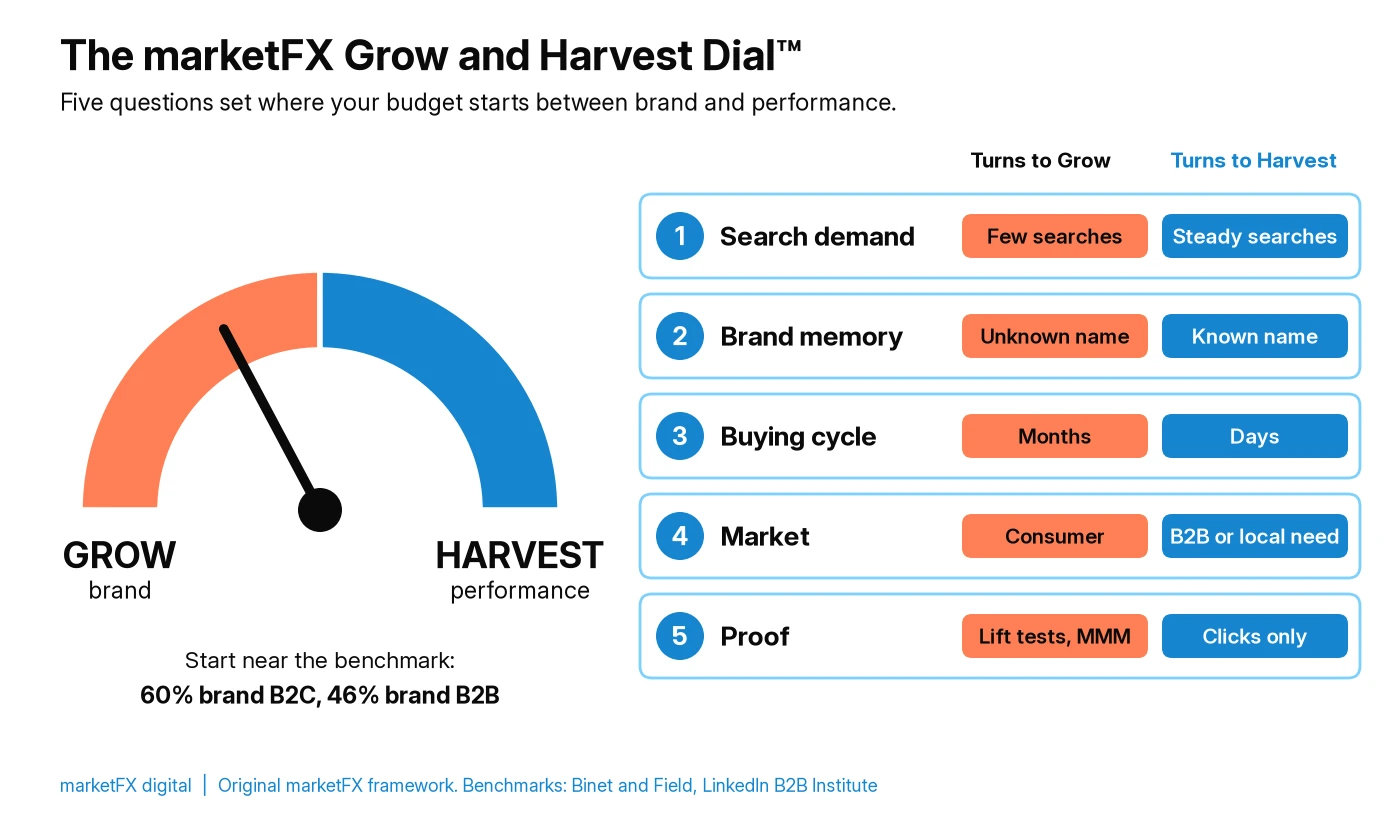
| Question | Turns toward Grow (brand) | Turns toward Harvest (performance) |
|---|---|---|
| 1. Search demand: do buyers already search for what you sell? | Few searches for the category or your name, so demand has to be created | Steady search volume for the category and your services |
| 2. Brand memory: do buyers in your markets know your name? | Low branded search and direct traffic, or a new market or location | Strong branded search and a known name where you sell |
| 3. Buying cycle: do people buy within days or over months? | Long, considered purchases with several people involved | Urgent or repeat purchases decided within days |
| 4. Market: is it consumer, local or B2B? | Consumer categories where emotion and memory drive choice | B2B with a short list of known buyers, or local services bought on need |
| 5. Proof: can you measure long-term effects? | Lift tests, market comparisons or marketing mix modeling are in place | Only click-based attribution, so start brand small and build proof first |
How to use it:
- Count the answers. Four or five Grow answers point to a split at or above the benchmark for your market. Four or five Harvest answers point to a split below it, with brand spend focused on the markets and audiences where it is easiest to prove.
- Fix proof before you scale brand. Question 5 is the gate. If you cannot see long-term effects yet, start with a contained brand test in a few markets and a clean comparison group, then grow the budget as the evidence comes in.
- Re-read the dial every six months. As brand memory grows, question 2 turns toward Harvest, and performance gets cheaper. As you enter new markets, it turns back toward Grow.
Attribution: the marketFX Grow and Harvest Dial™ is an original marketFX framework for brand and performance budget planning. It is not a vendor ranking.
How Do You Measure Brand Marketing?
Measure brand marketing by what it changes later and elsewhere: branded search, direct traffic, share of search, close rates and the efficiency of performance channels, checked with controlled tests or a marketing mix model. Reach and impressions show that the work ran, not that it worked.
A practical measurement stack:
- Branded search and share of search. Track searches for your name in Google Search Console and Google Trends, and compare them with competitors. Rising branded demand in markets where brand work ran is one of the clearest signals.
- Direct and returning traffic. More people typing your address or coming back without an ad is a sign of memory.
- Performance efficiency. Watch cost per lead, conversion rate and close rate in brand markets against comparison markets. Brand work should make performance cheaper.
- Lift and market tests. Run brand activity in some markets and hold it back in similar ones, then compare sales, leads and branded search.
- Marketing mix modeling. Models built on weekly data can estimate long-term and cross-channel effects that click tracking cannot see. Our guide to choosing a marketing mix modeling agency explains when it is worth it.
The goal is one view where brand and performance are judged against the same business outcome. That is what our marketing attribution work sets up: shared conversion definitions, CRM data and a test plan that values both sides fairly.
How Do You Measure Performance Marketing?
Measure performance marketing on cost per qualified lead, cost per acquisition, revenue and ROAS tracked through to the CRM, not on clicks or platform-reported conversions alone. Then check how much of that result was incremental.
Two checks keep performance reporting honest:
- Separate brand capture from new demand. Branded search and retargeting often show the best ROAS because they reach people who were already coming. Report them apart from prospecting so they do not hide weak campaigns.
- Test incrementality. Pause or hold back spend in a few markets or audiences and see whether total results fall. If they do not, that spend was capturing sales you would have made anyway.
Brand Building vs Performance Marketing in B2B
B2B needs a little more performance than consumer marketing, but brand still deserves close to half the budget. Binet and Field's B2B analysis put the optimum near 46% brand and 54% activation, close to an even split, because B2B buyers are fewer, easier to target and often in a defined buying process.
The bigger issue in B2B is time. Most of a company's future buyers are not in market this quarter, and the ones who are often have a short list before they ever fill in a form. Brand work, such as thought leadership, video and steady LinkedIn presence, gets you onto that list. Performance work, such as search, retargeting and lead generation, closes the deal when the buying window opens. Our LinkedIn ads agency page covers how we run both on a platform built around professional audiences.
Brand vs Performance for Multi-Location and Local Brands
Multi-location and franchise brands need brand work at two levels: the national or regional brand that makes people trust the name, and the local presence that makes each location the obvious choice nearby. Performance marketing then captures the "near me" and service searches in each market.
For these brands, local social pages, Google Business Profiles and reviews do brand work at street level. They are often the first thing a nearby customer sees. Our social media management agency and Google Business Profile management pages explain how we run that local layer, and our multi-location and franchise marketing work ties it to paid search and paid social in each territory.
Location data also makes brand easier to prove. A multi-location brand can run brand activity in some markets and not others, then compare leads, bookings and branded search across them, a cleaner test than most single-site businesses can run.
Brand vs Performance Marketing Examples
These examples are illustrative scenarios, not client results. They show how the dial changes the plan.
- A regional home services brand entering a new city. Nobody there knows the name, and the service is bought on need. Search ads capture urgent jobs from day one, while video, local social and a complete Business Profile build the name so the next job comes through branded search instead of a costly generic click.
- A B2B software company with a long sales cycle. Buyers research for months and involve several people. LinkedIn thought leadership and video build familiarity with target accounts, while search and retargeting capture accounts that start evaluating. Success is judged on pipeline from target accounts and branded search, not form fills alone.
- A consumer brand with strong search demand. People already search the category, and paid search converts well. The risk is complacency. Brand video and social keep the brand top of mind so it is the name people search, which keeps search costs down as competitors bid up the generic terms.
How Do Brand and Performance Marketing Work Together?
Brand and performance work best as one plan because brand makes people more likely to respond, and performance turns that readiness into revenue. Each makes the other cheaper.
- Brand lowers performance costs. A known name earns higher click-through and conversion rates on the same ads, and more people search for you directly.
- Performance data guides brand. Search terms, conversion data and CRM records show which audiences and messages turn into customers, which sharpens brand targeting and creative.
- Some channels do both jobs. Google and Analytic Partners describe YouTube and connected TV as dual-mandate channels that drive immediate sales while building brand associations, and their US meta-analysis found YouTube delivered 23% higher ROAS on average than brands' total media. Our YouTube ads agency page covers how we run video for both goals.
- One team, one scorecard. When brand and performance report against the same revenue outcome, budget conversations shift from competing for credit to putting the next dollar where it works hardest. Our guide to a full funnel marketing strategy shows how to assign roles by stage.
How marketFX Plans Brand and Performance Together
We plan brand and performance as one budget, measured against one set of business outcomes. Every engagement starts with a review of your current spend, your measurement and your demand: how much of the budget builds future buyers, how much captures today's, and what you can and cannot prove. Then we set a starting split with the Grow and Harvest Dial™, design the tests that will prove or correct it, and move budget as the evidence comes in. Across managed paid media portfolios, marketFX reported an average 4.1x ROAS in 2025, and across our client work we report 94% client retention, more than 20 years driving growth and more than $20 million in revenue tracked.
If you want an outside view first, our paid media services and marketing audit services look at both sides of the budget.
Related services
FAQs
Frequently Asked Questions
- What is the main difference between brand marketing and performance marketing?
- Brand marketing builds awareness, memory and preference with people who are not buying yet. Performance marketing reaches people who are ready to act and is judged on the cost of each click, lead or sale. Brand creates future demand, and performance captures demand that exists today.
- What is the 60/40 rule in marketing?
- The 60/40 rule comes from Les Binet and Peter Field's analysis of IPA effectiveness cases. In consumer markets, efficiency is typically maximized with about 60% of the communications budget on brand building and 40% on sales activation. It is a guide, and the right mix varies by category, price point and brand size.
- How much of a B2B budget should go to brand?
- Binet and Field's research for LinkedIn's B2B Institute put the B2B optimum near 46% brand and 54% activation. The authors call it a rough estimate from a small sample. If your brand share sits far below that, moving toward it in steps, with tests, is usually safer than a sudden shift.
- Is performance marketing better for small businesses?
- Small businesses usually start with more performance marketing because cash flow matters and paid search captures demand quickly. Brand still matters at small scale through a complete Google Business Profile, reviews, local social presence and consistent creative. As the business grows, shift more budget toward brand to lower the cost of each lead.
- How do you measure the ROI of brand marketing?
- Measure brand marketing through branded search, share of search, direct traffic and the efficiency of performance channels in markets where brand work runs. Confirm it with market tests that compare similar areas with and without brand activity, or with marketing mix modeling, which can estimate long-term and cross-channel effects.
- Can one campaign do both brand and performance?
- Yes. Some channels, such as YouTube and connected TV, can drive immediate sales while building brand memory. Plan each campaign with a primary job and measure it against that job, but report the secondary effects too, so brand-building campaigns that also convert are not cut by mistake.
- Is performance marketing the same as digital marketing?
- No. Digital marketing covers every online channel, including brand work such as video, social and content. Performance marketing is the part of marketing, online or offline, that is bought and judged on measurable actions such as clicks, leads and sales. Many digital channels can serve either purpose.