
Microsoft Ads vs Google Ads: Where Each Wins and When to Add Microsoft
Microsoft Ads vs Google Ads compared on reach, cost, targeting and measurement, plus a 5-check test for when to add Microsoft Ads to your search budget.
Quick Answer
Google Ads should usually be your first search channel because it carries most of the volume, owns mobile and local search, and connects to YouTube and Maps. Microsoft Ads is usually the second channel. It reaches a desktop-heavy audience across Bing and partner sites, often at a lower cost per click, and it adds LinkedIn profile targeting that Google does not offer. Add it when Google is tracked properly and limited by volume or cost, not as a replacement.
Most advertisers ask the Microsoft Ads vs Google Ads question the wrong way. They treat it as a choice between two platforms, when for most accounts it is a sequencing decision. Google Ads is where the search volume is. Microsoft Ads is a second search channel that can add qualified leads at a lower click price, but only if your tracking, budget and audience are ready for it.
The gap in reach is real. In October 2026, Bing held 9.78% of US search across all devices, against 85.45% for Google (Statcounter, US search engine market share, October 2026). On desktop the picture changes: Bing held 18.8% of US desktop search (Statcounter, US desktop search engine market share, October 2026). On mobile it held 2.26% (Statcounter, US mobile search engine market share, October 2026). Microsoft Ads also serves search ads on partner sites such as Yahoo, AOL, DuckDuckGo and Ecosia, so its ad reach is wider than Bing alone (Microsoft Advertising, What are search ads?).
This guide compares the two platforms on the things that decide budget: reach, cost, targeting, automation and measurement. Then it gives you a five-check test, the marketFX Second Engine Test™, to decide whether Microsoft Ads deserves a share of your search budget this quarter. If you are still deciding what good PPC management looks like in general, start with our guide to PPC management services.
How Much US Search Each Platform Reaches
Search share explains most of the difference between the two platforms, and it changes sharply by device.
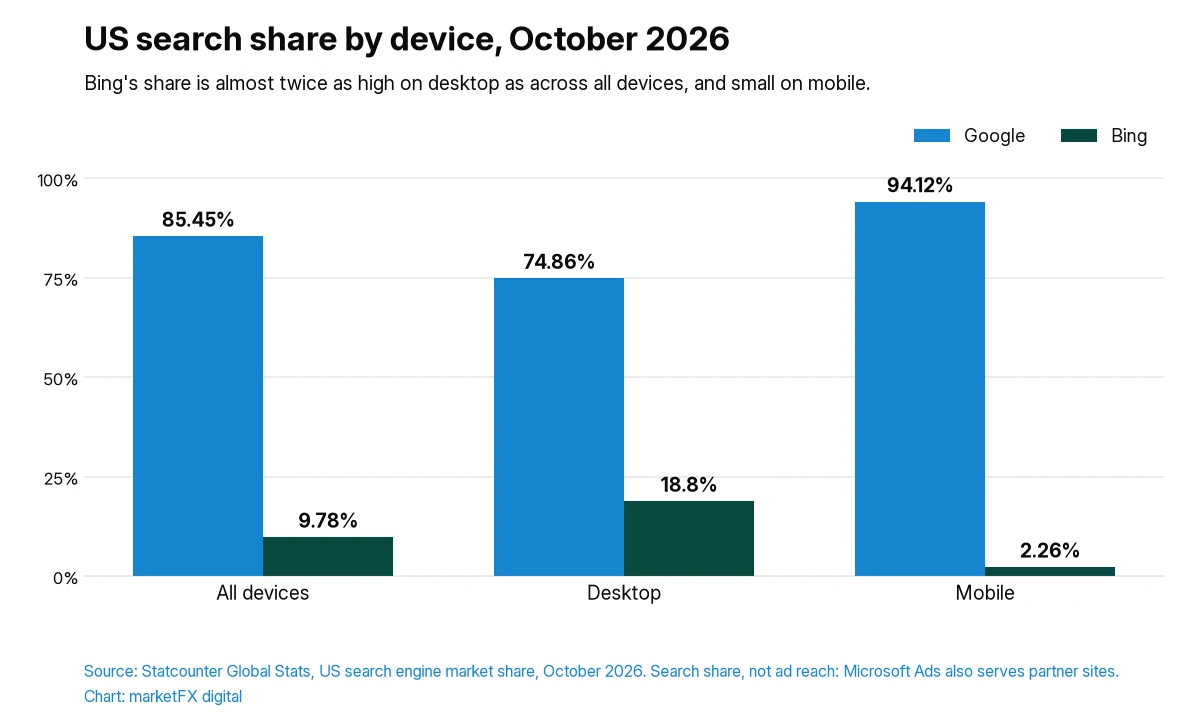
Source: Statcounter Global Stats, US search engine market share, October 2026. Search share is not the same as ad reach, because Microsoft Ads also serves partner sites.
Microsoft Ads vs Google Ads Compared
The two platforms run on the same basic model: keywords, auctions, ads, landing pages and conversion goals. The differences are in where the ads show, who sees them, what each auction costs and how much control you have.
| Factor | Google Ads | Microsoft Ads |
|---|---|---|
| Role in most plans | Primary search channel and most of the volume | Second search channel that adds reach at a lower click price |
| Where search ads show | Google Search and search partners | Bing, Yahoo, AOL, DuckDuckGo, Ecosia and other partners |
| Device mix | Strong on mobile and desktop | Skews heavily to desktop |
| Local and Maps | Google Maps and the local pack dominate "near me" searches | Bing Places and Maps, with far less local volume |
| Unique targeting | Broad audience signals, Customer Match, YouTube | LinkedIn profile targeting by company, industry and job function |
| Automation | Smart Bidding, Performance Max, AI Max for Search | Automated bidding and Performance Max, with ads also eligible in Copilot |
| Setup effort | Full build and ongoing management | Can start from an import of your Google campaigns, then needs its own tuning |
| Measurement | Google tag, enhanced conversions, native GA4 link, offline imports | UET tag, enhanced conversions, offline conversion imports |
Reach and audience
Google wins on raw volume, mobile and local intent. If you run a multi-location brand whose customers search "near me" on their phones, most of that demand sits on Google. Microsoft's share is concentrated on desktop, where people search at work, research larger purchases and fill out longer forms. That makes it more useful for B2B services, higher-consideration consumer purchases and any business whose buyers sit at a computer during the day.
Cost per click
Microsoft clicks are often cheaper because fewer advertisers bid in each auction. One agency's analysis of 73 of its own clients that ran search on both platforms found a spend-weighted average cost per click of $1.54 on Microsoft against $2.93 on Google over 12 months, and Microsoft took 17% of their search spend while delivering 29% of their search clicks (SmartSites, What 73 Advertisers Taught Us About Microsoft Ads, October 2026). The same study is clear about its limits: it is one agency's client sample, not an industry benchmark, and its lead cost estimates assume similar conversion rates rather than measuring them.
Treat cheaper clicks as a reason to test, not as a result. A click only matters if it turns into a qualified lead or a sale at a cost your business can carry.
Targeting
Microsoft Ads has one targeting option Google cannot match. It lets you target or adjust bids by LinkedIn profile data, including company, industry and job function, on Search, Dynamic Search, Shopping, Audience and Performance Max campaigns (Microsoft Advertising, LinkedIn profile targeting). For B2B advertisers, that means you can bid up when a search for your service comes from someone in your target industry or role. Google has stronger first-party audience tools, YouTube and a much larger remarketing pool.
Automation and AI placements
Both platforms push advertisers toward automated bidding and broad campaign types. Microsoft also serves eligible ads inside Copilot, and advertisers cannot opt out of that placement on its own, while Microsoft currently gives no Copilot-specific performance breakdown (Microsoft Advertising, About ads in Copilot). On both platforms, automation is only as good as the conversion data you feed it.
Setup and management
Microsoft Ads can import campaigns directly from Google Ads and keep them in sync on a schedule (Microsoft Advertising, Import campaigns from Google Ads). That saves build time, but a scheduled import can also overwrite bids, budgets and statuses you changed in Microsoft. The import is a starting point. Budgets, bids, negative keywords, ad distribution settings and conversion goals still need to be set for Microsoft's own auction.
Measurement
This is where most Microsoft tests fail. Microsoft Ads uses its own Universal Event Tracking (UET) tag and conversion goals, and it supports enhanced conversions with hashed customer data (Microsoft Advertising, Enhanced conversions). It does not plug into GA4 the way Google Ads does. If you launch Microsoft without its own conversion goals and offline imports, you will judge it on clicks and platform estimates, and the test will not tell you anything useful. If your conversion data is not reliable on either platform yet, start with our server-side tracking services.
The marketFX Second Engine Test™
The marketFX Second Engine Test™ is a five-check readiness test for adding Microsoft Ads to a Google Ads program. Each check is a yes or no question. Pass all five and Microsoft deserves a structured 90-day test. Fail one and fix that first, because a second search engine multiplies whatever is already broken in the first.
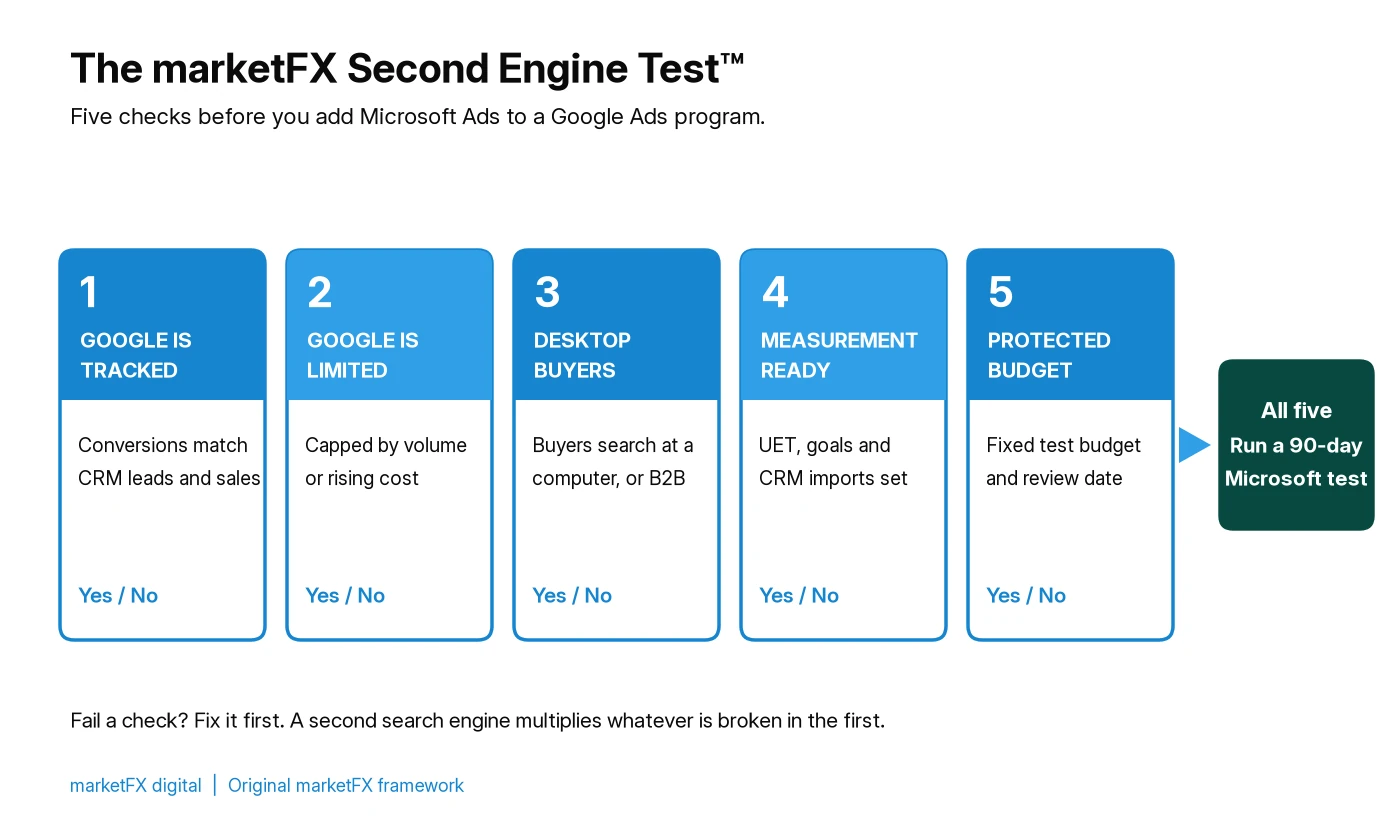
The marketFX Second Engine Test™. Pass all five checks before you split search budget.
| Check | Question to answer | Pass looks like | If you fail it, do this first |
|---|---|---|---|
| 1. Google is tracked | Do Google Ads conversions match real leads and sales? | Conversions reconcile with your CRM or order system within an agreed tolerance | Fix conversion tracking and CRM matching on Google |
| 2. Google is limited | Is Google capped by volume or rising cost? | Profitable campaigns that cannot scale without paying much more per lead | Improve structure, search terms and landing pages on Google |
| 3. Desktop buyers | Do your buyers search at a computer? | A meaningful share of Google conversions comes from desktop, or you sell B2B | Keep budget on Google mobile and local |
| 4. Measurement ready | Can Microsoft report real outcomes? | UET tag live, conversion goals set, offline or CRM imports planned | Set up UET, goals and imports before launch |
| 5. Protected budget | Can you fund a test without starving Google? | A fixed test budget and a review date agreed in advance | Wait until the budget exists |
Attribution: the marketFX Second Engine Test™ is an original marketFX framework for search budget decisions. It does not rank platforms or vendors.
7 Signs You Should Add Microsoft Ads Now
If you pass the Second Engine Test, these are the signs Microsoft is likely to add qualified volume rather than just cheaper clicks.
- Your best Google keywords are capped. Impression share is lost mainly to budget or rank on terms that already convert, and raising bids would push cost per lead past your target.
- Most of your conversions happen on desktop. Check the device report in Google Ads. If desktop drives a large share of leads or revenue, Microsoft's desktop audience is a natural extension.
- You sell to businesses. LinkedIn profile targeting lets you bid up on searchers by company, industry or job function, which Google search campaigns cannot do.
- Your Google CPCs are high. The more competitive your Google auction, the more room there is for a lower Microsoft price on the same intent.
- Your offer suits a considered purchase. Higher-value services and products with longer research cycles tend to fit an audience that searches at work and reads before buying.
- You can import a clean account. A well-structured Google account with clear naming, tight match types and a maintained negative list imports cleanly. A messy one imports its problems.
- You can measure to the CRM. If your team already sends offline conversions from the CRM to Google, extending that to Microsoft is a small step and makes the test trustworthy.
When Google Ads Alone Is the Right Call
Microsoft is not right for every account. Keep your search budget on Google for now if:
- Your demand is local and mobile. Multi-location and franchise brands that live on "near me" searches, calls from Maps and the local pack usually get more from tightening Google location targeting first. Our multi-location and franchise marketing work starts there.
- Your Google budget is not fully funded. If Google campaigns are limited by budget and profitable, more Google budget is usually the cheaper win.
- Your tracking is unreliable. Adding a second platform to a broken measurement setup doubles the confusion.
- Your addressable market is very small. Microsoft's lower volume may not give a test enough clicks to read in 90 days.
How to Run a 90-Day Microsoft Ads Test
A good test is boring by design. You decide in advance what success looks like, change as little as possible and judge it on outcomes.
- Pick the scope. Start with non-brand search campaigns that already convert profitably on Google, for a limited set of services and markets.
- Import, then fix. Use the Google import to save build time, then review budgets, bids, locations, ad schedules, negative keywords and ad distribution. Decide whether you want scheduled syncing or a one-time import.
- Set up measurement first. Install the UET tag on every page, create conversion goals that match your Google goals, turn on enhanced conversions and plan offline conversion imports from your CRM.
- Agree the budget and the rule. Set a fixed test budget and a target cost per qualified lead before launch. Agree what result means scale, hold or stop.
- Report on qualified outcomes. Compare Microsoft and Google on cost per qualified lead, pipeline or revenue, not on clicks or click-through rate. Check whether Microsoft added new leads or took credit for leads Google already drove.
- Decide on day 90. Scale what met the target, fix or cut what did not, and roll the learnings into your search plan.
Our paid media audit and strategy covers Google Ads and Microsoft Ads together, so you can see where search budget is leaking before you open a second channel. If Google is your main channel today, our Google Ads agency page explains how we manage search, Shopping and Performance Max with measurement in place before spend scales.
Red Flags in a Microsoft Ads Pitch
Be cautious if an agency or consultant:
- Leads with cheaper clicks and stops there. Click price is an input. Ask how they will prove cost per qualified lead.
- Imports your Google account and walks away. Microsoft needs its own bids, negatives and distribution settings.
- Has no plan for UET and offline conversions. Without them, the test cannot be judged.
- Wants to cut Google to fund Microsoft. Moving budget away from a profitable, capped Google campaign rarely makes sense. A test should use protected budget.
- Reports Microsoft on its own. Both platforms should be judged in one view, against the same definitions, so you can see what each one actually added. Our marketing attribution page explains how we approach that.
How marketFX Approaches Search Budget Decisions
We treat search as one budget with two auctions. Google and Microsoft are planned together, measured against the same conversion definitions and judged on qualified pipeline and revenue. Across managed paid media portfolios, marketFX reported an average 4.1x ROAS in 2025, and across our client work we report 94% client retention, more than 20 years driving growth and more than $20 million in revenue tracked. Those numbers come from measurement that is set up before spend scales, which is the same rule we apply to any new channel.
If you are weighing Microsoft Ads against more Google budget, the answer depends on your tracking, your buyers and your current Google limits. That is a short conversation with your data in front of us.
Related services
FAQs
Frequently Asked Questions
- Is Microsoft Ads cheaper than Google Ads?
- Often, yes, on cost per click, because fewer advertisers compete in each Microsoft auction. One agency's 12-month study of 73 clients found Microsoft search clicks cost about 47% less than Google. Cost per click is not cost per lead, though. Judge Microsoft on cost per qualified lead or revenue, measured with its own conversion tracking.
- Should I run Microsoft Ads and Google Ads at the same time?
- For many advertisers, yes, once Google is tracked properly and limited by volume or cost. Google carries most of the search volume, so it usually comes first. Microsoft then adds reach on Bing and partner sites, mostly on desktop. Run Microsoft as a structured test with protected budget rather than moving money away from profitable Google campaigns.
- Can I import my Google Ads campaigns into Microsoft Ads?
- Yes. Microsoft Ads can import campaigns directly from Google Ads and keep them in sync on a schedule. Treat the import as a starting point. Review budgets, bids, negative keywords, locations and ad distribution afterward, and check whether scheduled syncing might overwrite changes you make in Microsoft.
- Who uses Bing and Microsoft search?
- Microsoft's search audience skews toward desktop. In October 2026, Bing held 18.8% of US desktop search but 2.26% of US mobile search, according to Statcounter. That makes Microsoft more useful for B2B services and considered purchases researched at a computer, and less useful for mobile, local "near me" demand.
- Is Microsoft Ads good for B2B?
- It can be. Microsoft Ads lets you target or adjust bids by LinkedIn profile data, including company, industry and job function, on search and other campaign types. Paired with its desktop audience, that makes it a strong second search channel for many B2B advertisers, as long as leads are tracked through to the CRM.
- How long should a Microsoft Ads test run?
- About 90 days is a common test window, long enough to collect conversions and allow for lead-to-sale lag in most businesses. Set the budget, the target cost per qualified lead and the decision rule before launch, then decide on day 90 whether to scale, adjust or stop.
- Do Microsoft Ads show in Copilot?
- Yes. Microsoft serves eligible ads in Copilot, and advertisers cannot opt out of that placement on its own. Negative keywords still apply. Microsoft does not currently report Copilot performance separately, so measure the overall campaign on conversions rather than trying to isolate that placement.