
Financial Services
Financial Services Marketing Agency for Banks, Credit Unions, Lenders and Fintechs
A financial services marketing agency plans and runs the marketing that helps banks, credit unions, lenders, insurers, wealth and advisory firms and fintechs win new customers in a category where trust decides almost everything. marketFX runs search, AI search visibility, paid media, content, CRM and analytics for financial brands inside one integrated team, with your compliance review built into the workflow and results measured on applications, funded accounts and booked consultations rather than clicks.
Book a Strategy Call See how it starts
Why financial services marketing works differently
Financial decisions are high stakes, so search engines, ad platforms and customers all hold financial brands to a higher standard.
- Search engines ask for more proof. Google says its systems give even more weight to content with strong experience, expertise, authoritativeness and trust for topics that could significantly affect people's financial stability, which it calls "Your Money or Your Life" topics (Google Search Central, Creating helpful, reliable, people-first content).
- Ad platforms restrict targeting. Since January 2025, Meta has required US advertisers promoting financial products and services, such as credit, banking, insurance and investment services, to use its Financial products and services special ad category. That category removes options such as detailed demographic targeting, ZIP code targeting and lookalike audiences (Meta for Developers, Special Ad Categories).
- Every claim needs review. Rates, terms, testimonials and performance figures are regulated. Broker-dealer communications fall under FINRA Rule 2210, and investment adviser advertising falls under the SEC Marketing Rule. Lenders and deposit institutions have their own advertising rules.
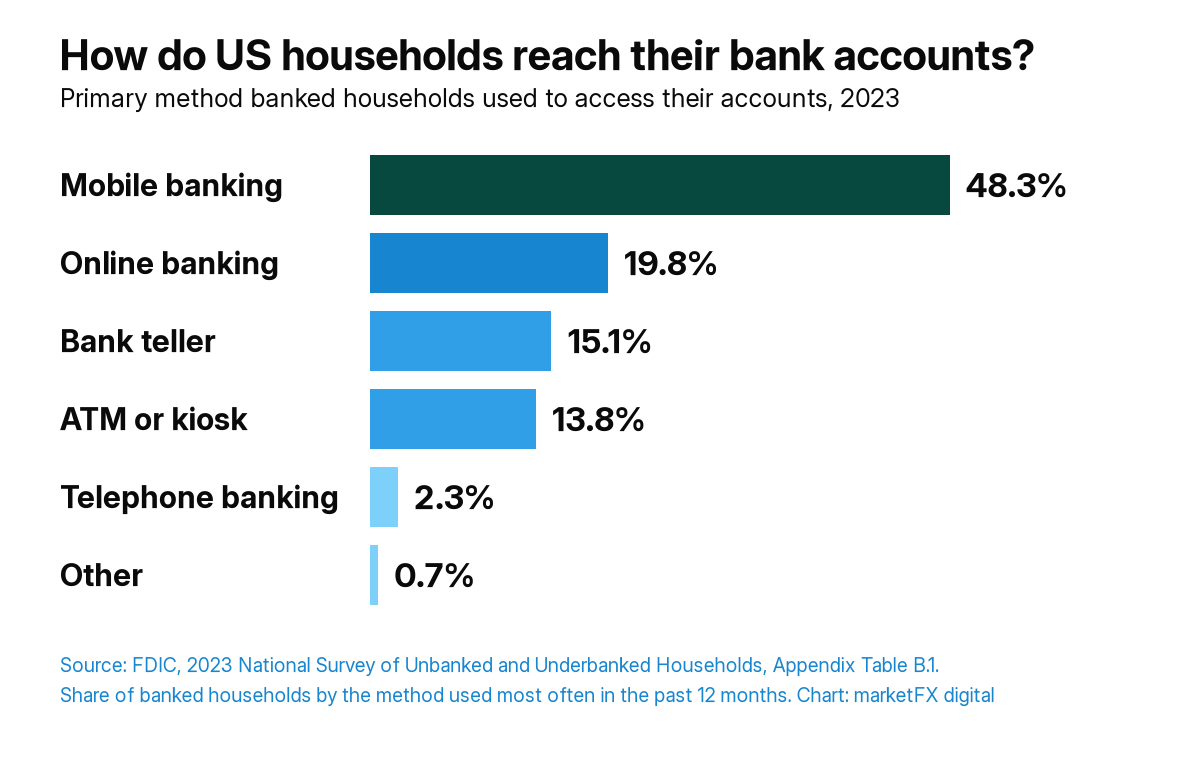
Customers have also moved. In the FDIC's 2023 national household survey, 48.3% of banked households said mobile banking was their main way of accessing their accounts, ahead of online banking at 19.8%, bank tellers at 15.1% and ATMs at 13.8% (FDIC, 2023 National Survey of Unbanked and Underbanked Households). Most of the relationship now happens on a screen, which means search, websites and digital campaigns carry more of the work a branch used to do.
| Primary access method | Share of banked households |
|---|---|
| Mobile banking | 48.3% |
| Online banking | 19.8% |
| Bank teller | 15.1% |
| ATM or kiosk | 13.8% |
| Telephone banking | 2.3% |
| Other | 0.7% |
Source: FDIC, 2023 National Survey of Unbanked and Underbanked Households, Appendix Table B.1. Share of banked households, by the method used most often in the past 12 months.
The marketFX Trust Ledger™
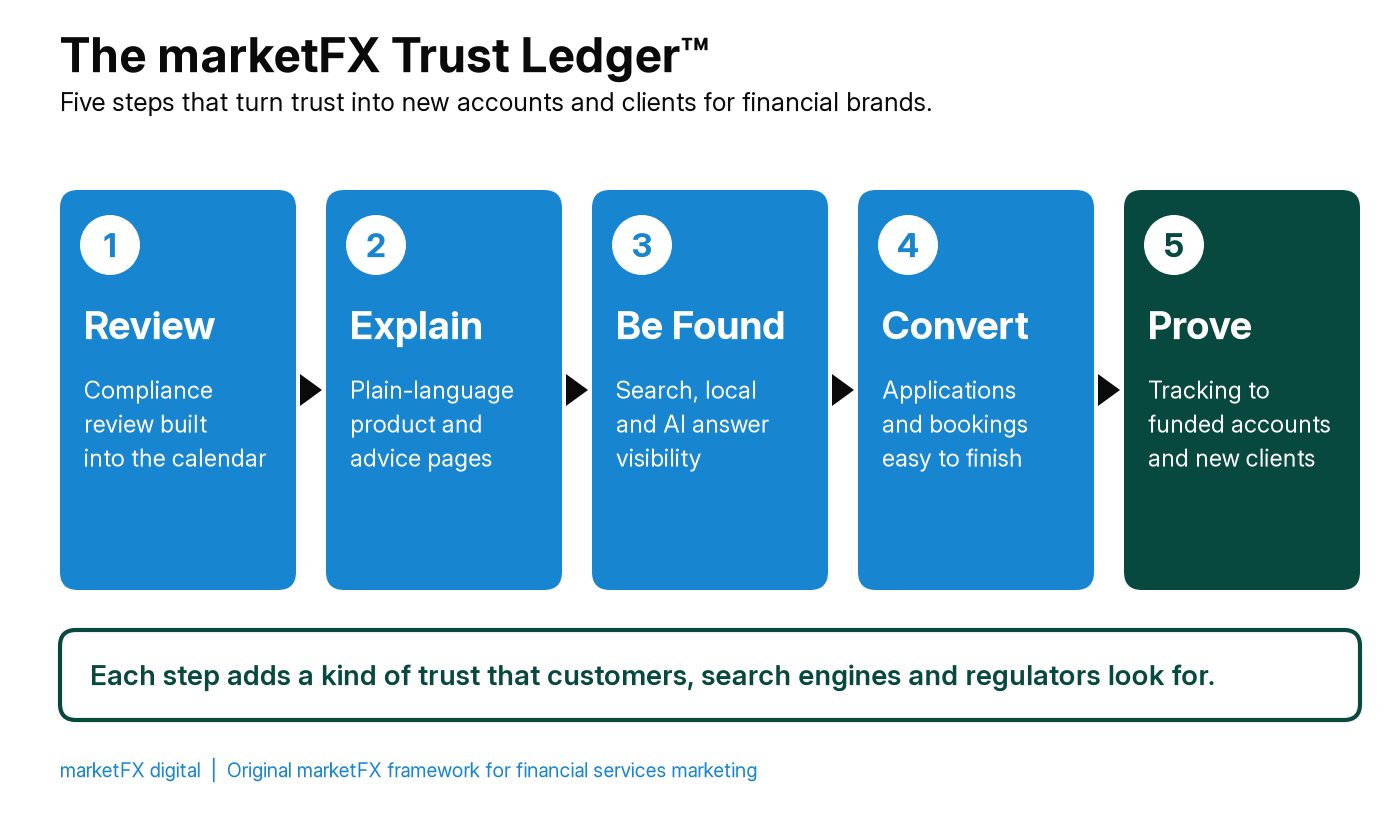
The marketFX Trust Ledger™ is the five-step method we use to run marketing for financial brands. Each step adds a kind of trust that customers, search engines and regulators look for, and the last step proves which work turned that trust into new accounts and clients.
| Step | What goes wrong without it | What we put in place |
|---|---|---|
| 1. Review | Campaigns stall in approval, or go out with claims nobody checked | A content and campaign calendar with your compliance review built in, and a record of what was approved |
| 2. Explain | Product pages full of jargon that neither customers nor AI answers can use | Clear pages for each product and service that answer the questions customers ask, with named, qualified reviewers where you have them |
| 3. Be Found | Competitors and comparison sites own the searches and AI answers for your products | SEO, local SEO for branches and advisors, and AI search visibility for your key products and markets |
| 4. Convert | Applications and booking forms that people start and never finish | Landing pages, applications and booking paths reviewed and tested for drop-off, with fast follow up |
| 5. Prove | Reports that stop at clicks and leads | Tracking from first visit to funded account, approved loan or booked consultation, reported by product and location |
Financial services marketing services we deliver
- SEO and AI search visibility. Product, rate and advice pages built to rank in Google and be cited in AI answers, plus technical SEO and structured data. See our SEO and AI visibility consulting and our guide to answer engine optimization.
- Local SEO for branches and advisors. Location pages, Google Business Profiles and reviews for every branch, office or advisor, managed at scale.
- Paid media. Google, Meta and LinkedIn campaigns built inside each platform's financial services rules, with landing pages that carry the right disclosures. See our paid media services, Google Ads agency and Meta ads agency pages.
- Content. Guides, calculators, comparison pages and explainers that answer real customer questions, written for review.
- CRM, email and lifecycle marketing. Onboarding, cross-sell and retention journeys that move new customers to their second and third product. See CRM and marketing automation and our email marketing agency page.
- Conversion and analytics. Application and booking flow reviews, testing and reporting tied to funded accounts and revenue. See conversion rate optimization and marketing attribution.
Compliance-aware marketing, without slowing everything down
We are not your compliance team or your legal counsel, and we do not replace them. What we do is plan for their review from the start. Copy, creative and landing pages go through the approval route you already use, with time for review built into the calendar, so campaigns launch on schedule instead of waiting in a queue. Rates, terms and disclosures come from you and are kept current, and nothing goes live with claims your team has not approved.
Working this way also makes the marketing stronger. Clear, accurate, well-sourced pages are exactly what search engines and AI answers look for on financial topics.
Marketing for branch-based banks, credit unions and advisory networks
For institutions with many branches or advisors, marketing has to work at two levels. The brand owns the core messages, products and campaigns. Each branch or advisor needs a local presence that is accurate, reviewed and easy to find. We build location pages and profiles for every branch or office, keep hours and details consistent, run local campaigns inside each platform's targeting rules and report results by location, rolled up for the brand. This is part of our wider multi-location and franchise marketing work.
Marketing for fintechs and digital-first financial brands
For fintechs and digital-first lenders, growth usually depends on two things: being found when people compare options, and getting new users through sign-up and onboarding. We focus on comparison and category searches, AI answers for "best" and "which is right for me" questions, paid acquisition measured against funded or active accounts rather than installs, and onboarding journeys that turn sign-ups into active customers.
Signal vs Noise™ in financial services reporting
We judge financial marketing by what it adds to the business, not by how busy the dashboards look.
| Decision-grade | Vanity |
|---|---|
| Funded accounts, approved loans and booked consultations by channel | Clicks and impressions on their own |
| Cost per funded account or new client | Cost per lead with no quality check |
| Application completion rate by step | Landing page visits |
| Products per customer and retention by cohort | Email open rates |
| Results by product, branch or advisor | One national total |
Every financial services engagement starts with an audit
Before we change anything, we review your marketing along the Trust Ledger™: how campaigns move through compliance review, how your product and advice pages explain what you offer, where you show up in search and AI answers, how applications and bookings perform step by step, and whether results are tracked through to funded accounts and new clients. The output is a written plan that says what to fix first, where to invest, how review will fit into the calendar and how success will be measured.
If you want a wider review first, our marketing audit services cover search, paid media and tracking in one pass.
How marketFX runs financial services marketing
marketFX has delivered integrated marketing programs for brands across retail, consumer goods, financial services and technology. Search, paid media, content, CRM and analytics sit in one team, so the page that ranks, the ad that runs and the follow up that converts are planned together and measured on the same outcomes. Across our client work we report 94% client retention, more than 20 years driving growth and more than $20 million in revenue tracked.
Find out where your financial brand is losing customers
30 minutes. We will look at your search visibility, your campaigns, your application or booking path and your reporting, and tell you what we would fix first, even if you do not hire us.
FAQs
Financial Services Marketing Agency FAQ
- What does a financial services marketing agency do?
- A financial services marketing agency plans and runs marketing for banks, credit unions, lenders, insurers, advisory firms and fintechs. The work usually covers strategy, SEO and AI search visibility, paid media, content, CRM and analytics, built to fit compliance review and measured on funded accounts, applications and new clients.
- How do you handle compliance in financial services marketing?
- Your compliance team or counsel approves what goes live, and we build their review into the plan from the start. Copy, creative and landing pages follow your approval route, rates and disclosures come from you, and we keep a record of what was approved so campaigns launch on time.
- Can financial brands advertise on Meta and Google?
- Yes, with rules. Since January 2025, Meta requires US advertisers promoting financial products and services to use its Financial products and services special ad category, which limits targeting options. Google Ads has its own financial products and services policy. Campaigns need to be planned around those rules from the start.
- Why is SEO harder for financial services websites?
- Financial topics are what Google calls "Your Money or Your Life" topics, and its systems give even more weight to content that shows strong experience, expertise, authoritativeness and trust. Financial pages need to be accurate, clearly sourced, kept current and, where possible, written or reviewed by qualified people.
- How do you measure financial services marketing results?
- We track from first visit to the outcome that matters for your business, such as a funded account, an approved loan or a booked consultation, and report by channel, product and location. Clicks and leads are reported too, but they sit next to business results rather than replacing them.
- Do you work with credit unions and community banks?
- We work with financial brands that need marketing across search, paid media, content and CRM, including institutions with many branches. For branch networks, we build local pages and profiles for every location and report results by branch, rolled up for the whole institution.
- How much does a financial services marketing agency cost?
- Cost depends on how many products, markets and channels are in scope, how much content needs review, and whether CRM and analytics work are included. We scope the work after an audit and share pricing in writing after a brief scoping call, so you pay for what your plan needs rather than a fixed package.
Read next
- Franchise Multi Location Marketing AgencyHow brand and local marketing work across every branch or office.Read more
- AEO Services: What They Include and How to Choose a ProviderHow financial brands earn citations in AI answers.Read more
- Marketing Attribution AgencyHow we tie marketing to funded accounts and new clients.Read more