
Enterprise SEO Audit: 7 Layers That Actually Ship
Enterprise SEO audit checklist in 7 layers. Use the marketFX STP Fix Units™ (System, Template, Page) to prioritize crawl, index, template and local fixes.
Quick Answer
An enterprise SEO audit is a structured review of a large site that finds which fixes will move organic revenue most, who owns each one, and how to ship them. It works from logs, Search Console, templates and samples rather than page-by-page checklists. Sort every finding with the marketFX STP Fix Units™ (System, Template, Page) so the highest-reach work comes first.
Enterprise SEO is a leverage problem before it is a content problem. One broken product template can hurt tens of thousands of URLs. One polished blog post changes one. Google itself frames crawl budget as a limit for large or fast-changing sites (1 million+ pages, or 10,000+ pages that update daily, or a large share of URLs marked Discovered and currently not indexed) and asks those sites to manage inventory, duplicates and host health deliberately (Google Crawling Infrastructure).
Buyers looking for an enterprise SEO audit usually need a framework they can run before or during an agency engagement, not another 200-item crawler dump. This guide walks seven audit layers in the order that ships, introduces the marketFX STP Fix Units™, covers enterprise technical SEO and enterprise local SEO checks, and explains how pricing conversations should work without invented fee tables. For how to hire the partner who will run this work, see our guide to choosing an enterprise SEO agency.
What Is an Enterprise SEO Audit?
An enterprise SEO audit is a time-boxed diagnosis of a large website that ends in a prioritized roadmap with owners, evidence and acceptance criteria. It is not a raw export from a crawler. The difference is scale and governance: the site is too big to check every URL by hand, many teams share the release queue, and leadership wants organic findings tied to revenue templates, not warning counts.
A useful audit answers three questions:
- Which System and Template fixes reach the most revenue URLs?
- Which findings are already owned, and which have no owner?
- What ships in 30, 60 and 90 days, and how will you re-measure?
If the deliverable is only a ranked list of tool severity labels, it is not an enterprise audit. It is a report that will sit in a shared drive.
What Are the marketFX STP Fix Units™?
The marketFX STP Fix Units™ sort every audit finding by how many URLs a single change reaches: System, Template or Page. Use the label before you prioritize. Without it, teams spend the budget on easy page rewrites and leave the high-leverage template bugs untouched.
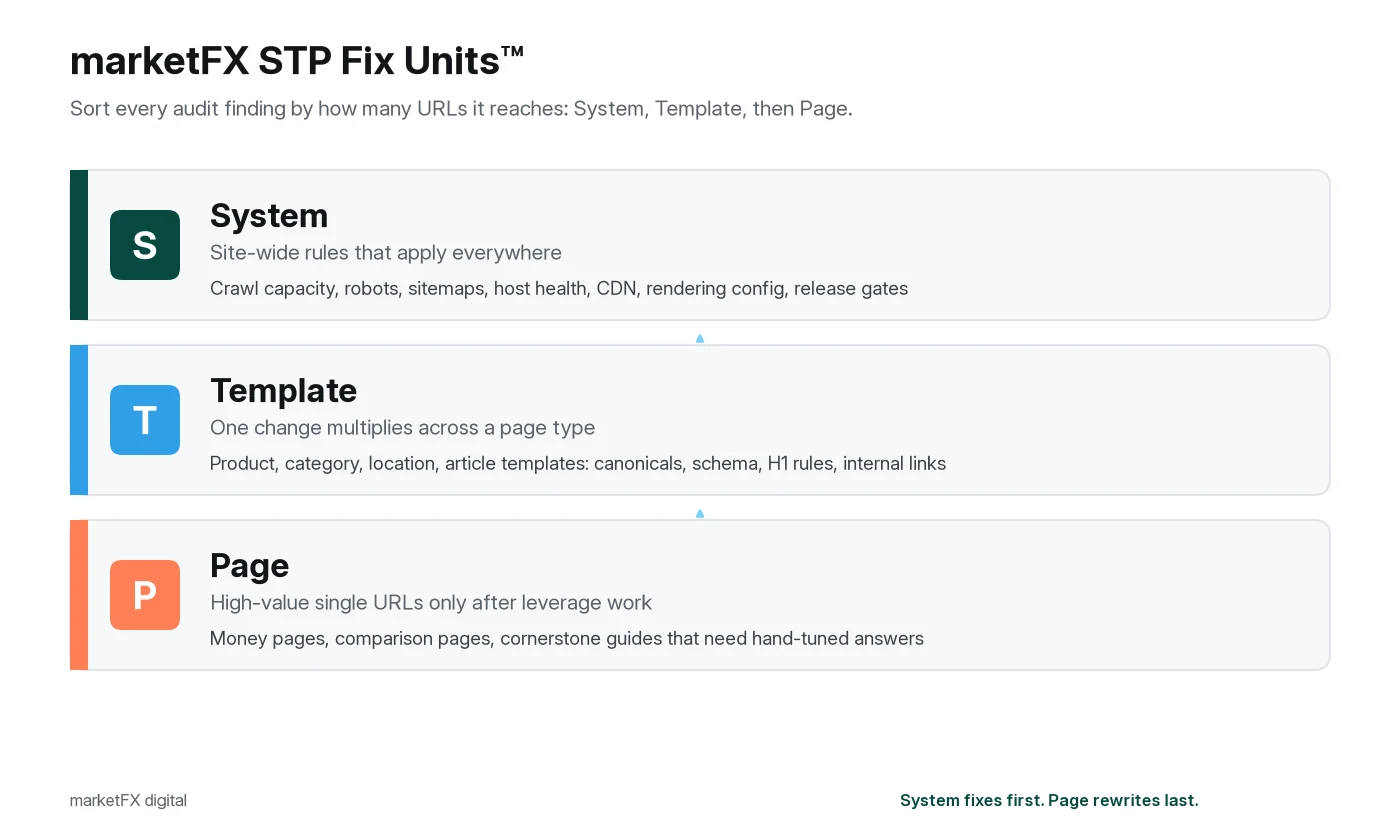
marketFX STP Fix Units™. System fixes first. Page rewrites last.
| Unit | What it covers | Typical reach | Example fix |
|---|---|---|---|
| System | Site-wide rules that apply everywhere | Whole host or property | Robots rules, sitemap hygiene, hostload, CDN caching, release SEO gates |
| Template | One change that multiplies across a page type | Hundreds to millions of URLs | Product canonical logic, location H1 pattern, category schema, internal link rule |
| Page | Hand-tuned work on a single high-value URL | One URL (or a short list) | Money-page rewrite, comparison guide, cornerstone FAQ block |
Tag every ticket STP before it enters the backlog. A Template fix that recovers crawl or indexation on a revenue page type almost always beats a Page rewrite on an already healthy URL. This is the same leverage idea behind our technical SEO services, applied as an audit sorting rule.
Which Enterprise SEO Keywords Are Buyers Searching?
Buyers use several labels for the same job: audit, agency, consultant, technical SEO, local SEO and pricing. The commercial cluster around enterprise SEO is large, and the audit query is one of the clearer buying intents inside it.
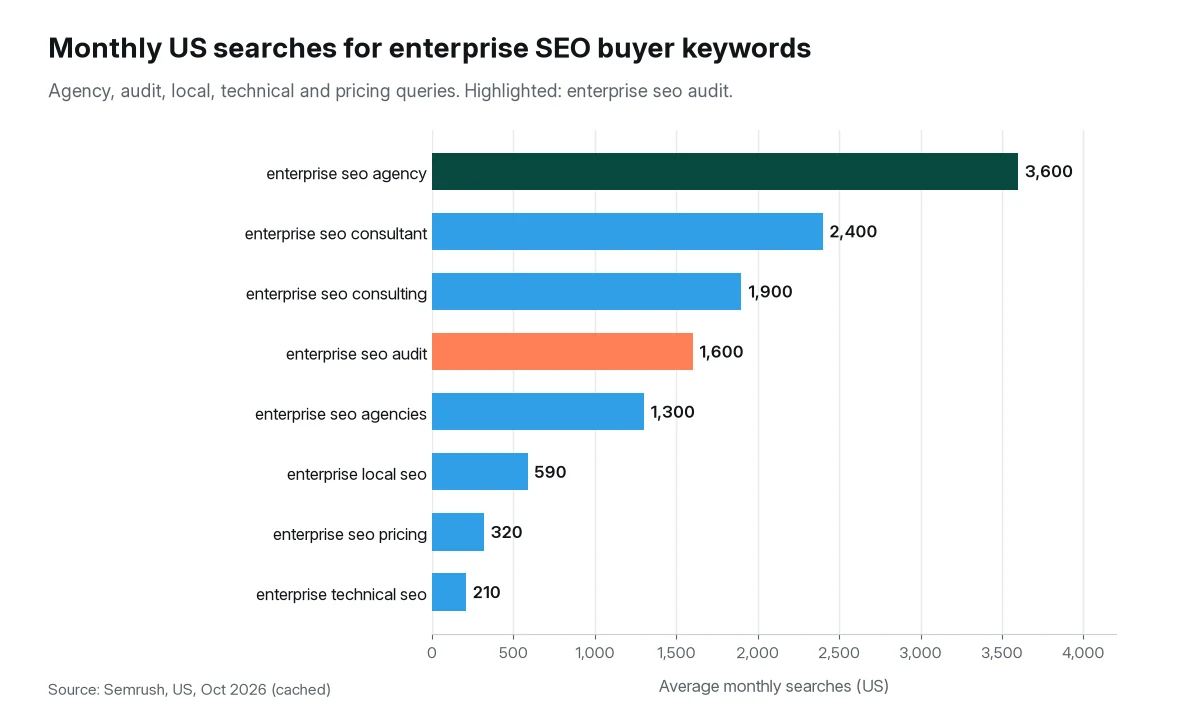
Monthly US searches for enterprise SEO buyer keywords. Source: Semrush, US, Oct 2026 (cached).
| Search term | US monthly searches | What buyers usually mean |
|---|---|---|
| enterprise seo agency | 3,600 | Hiring a partner (own post; link only) |
| enterprise seo consultant | 2,400 | Senior advice, often before a full program |
| enterprise seo consulting | 1,900 | Ongoing advisory or hybrid support |
| enterprise seo audit | 1,600 | Diagnostic roadmap before or during engagement |
| enterprise seo agencies | 1,300 | Plural compare-and-choose search |
| enterprise local seo | 590 | Multi-location and franchise local signals |
| enterprise seo pricing | 320 | Budget bands and engagement shapes |
| enterprise technical seo | 210 | Crawl, index, rendering and template health |
"Enterprise seo agency" already has its own post. This article covers the audit process those buyers need, then links out instead of competing for the same primary.
Layer 1: How Do You Scope an Enterprise SEO Audit?
Scope the audit around revenue templates, markets and owners before you open a crawler. Write a one-page brief that names the page types that drive leads or revenue, the properties and locales in scope, the last 18 months of migrations or redesigns, and the teams who can change templates, content, redirects and robots rules.
Ask for access on day one: verified server logs (30 to 90 days), Search Console on every property (API or BigQuery export, not the 1,000-row UI cap), analytics, staging, CMS settings and CDN configuration. Log access is the most common delay on large audits because security teams often need weeks to approve it. Chase it while you run the steps that do not need it.
Exit criteria for Layer 1: a signed scope page, a data-access tracker with owners and dates, and a short list of revenue templates that will drive prioritization later.
Layer 2: What Should Crawl and Log Analysis Cover?
Crawl and log analysis shows where Googlebot actually spends time, not where a crawler thinks it could go. Pull 30 to 90 days of requests and keep only verified Googlebot (reverse DNS), as Google describes in its crawling docs. Join those logs to your URL inventory tagged by template.
Look for crawl waste on parameters, facets, soft 404s, redirect chains and low-value archives. Check host health: rising latency and 5xx or 429 responses lower crawl capacity. Compare discovery crawls versus refresh crawls so you know whether Google is finding new URLs or only revisiting old ones.
This is the core of enterprise technical SEO at audit time. For how marketFX packages ongoing technical work after the audit, see technical SEO services.
Exit criteria for Layer 2: a crawl-waste table by template, a host-health note, and System-tagged tickets for the worst inventory problems.
Layer 3: How Do You Audit Indexation at Enterprise Scale?
Indexation audits compare three sets: URLs you want indexed, URLs submitted in sitemaps, and URLs Search Console reports as indexed. Explain every material gap. Soft 404s, noindex accidents, canonical conflicts and orphan URLs are the usual culprits.
Check canonicals and hreflang for conflicts across markets. Enterprise sites often ship the right content with the wrong self-canonical, or a hreflang cluster that points to redirected or missing locales. Validate XML sitemaps against the wanted set: stale sitemap entries burn crawl attention and confuse the index picture.
Exit criteria for Layer 3: a wanted/submitted/indexed reconciliation for each revenue template, plus Template or System tickets for canonical and hreflang defects.
Layer 4: How Do You Audit Templates and Rendering?
Template audits beat page audits on large sites. Run segmented crawls per major template (products, categories, articles, locations) with JavaScript rendering where the template needs it. Diff raw HTML against rendered HTML on a fixed sample so you catch content that only appears after client-side rendering.
Pull Core Web Vitals field data by template, not as one site-wide average. Validate structured data against visible content. Map internal link rules, click depth and orphans so important templates are not stranded behind filters or infinite scroll.
Every finding here should carry an STP tag. A missing H1 pattern on the location template is a Template fix. A one-off H1 typo on a single city page is a Page fix. Do not mix them in the same ticket.
Exit criteria for Layer 4: a template scorecard (status, canonical, robots, title, schema, rendered main content, CWV) and tickets with acceptance tests your engineers will accept.
Layer 5: How Do You Audit Content Quality Without Reading Every URL?
Sample by template and by revenue, then score duplication, thin variants, cannibalization and answer coverage. Enterprise content problems usually come from generated variants and overlapping ownership, not from a shortage of words.
Build a cannibalization map for the queries that drive the most revenue. When two templates compete for the same intent, pick a winner, consolidate or differentiate, and record the decision in the SEO changelog. Check whether money pages lead with a direct answer, name entities clearly and include the FAQs buyers actually ask.
Page-level rewrites belong after System and Template work. Otherwise you polish pages that still cannot be crawled or indexed reliably.
Exit criteria for Layer 5: a sampled quality score by template, a cannibalization decision log, and a short list of Page fixes that only start after higher STP work ships.
Layer 6: What Does an Enterprise Local SEO Audit Include?
Enterprise local SEO is a Template and System problem dressed up as a listings problem. Audit the location page template first: unique NAP, consistent entity names, local business schema, internal links from hubs, and no doorway-style thin copies. Then audit Google Business Profile hygiene at scale: categories, hours, services, photos, review response process and suspension risk.
Check NAP consistency between the website, GBP and major directories. For franchise and multi-location brands, confirm territory logic so one unit's pages and profiles do not cannibalize another. Our local SEO playbook for multi-location brands covers the operating detail; the audit needs the template scorecard and a sample of live profiles.
Exit criteria for Layer 6: location-template defects tagged Template, a GBP sample scorecard, and owners for listings versus on-site fixes.
Layer 7: How Do You Add AI Search Readiness and Governance?
AI search readiness belongs in the enterprise audit because click behavior on the results page has already changed. Pew's July 2025 analysis found traditional result clicks fell from 15% to 8% of visits when an AI summary appeared. Large brands with huge keyword footprints feel that shift across whole sections of the site.
Check AI crawler access in robots.txt and whether important templates are eligible to be cited. Sample whether your brand appears inside AI answers for revenue queries. Add share-of-model style tracking next to classic organic reporting. For a dedicated AI-focused pass, use our AI search audit and SEO and AI visibility consulting.
Governance closes the audit. Require an SEO acceptance test in the release pipeline on a fixed URL sample per template, an SEO-readable changelog, and CMS guardrails (required fields, character limits, blocked patterns). Without governance, the same System defects return with the next release.
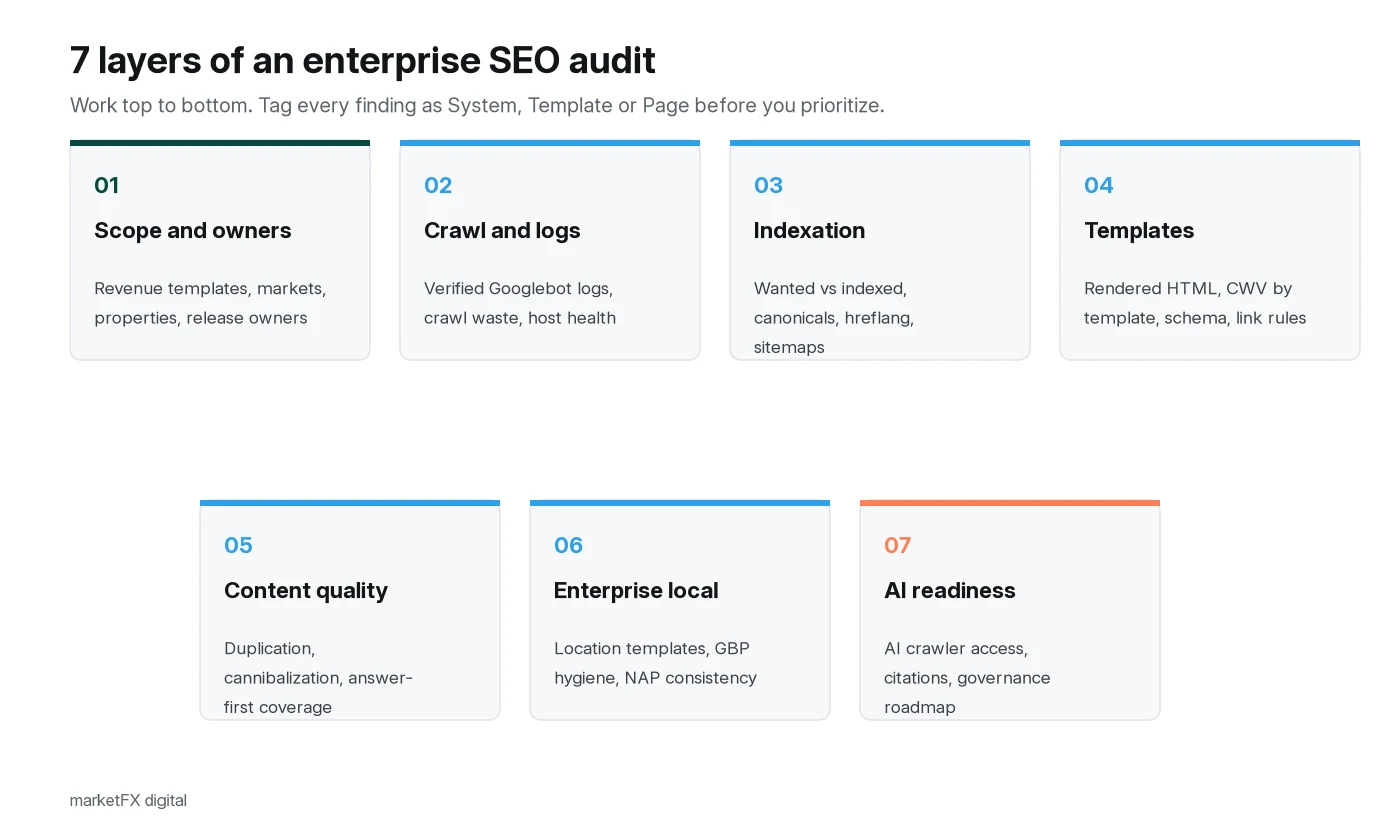
Seven layers of an enterprise SEO audit. Work top to bottom and tag every finding as System, Template or Page.
| Layer | Main question | Primary STP unit | Exit artifact |
|---|---|---|---|
| 1. Scope and owners | What is in, who can ship, which templates earn? | System | One-page scope, access tracker |
| 2. Crawl and logs | Where does Googlebot actually spend time? | System | Crawl-waste table, host-health note |
| 3. Indexation | Wanted vs submitted vs indexed, and why? | System / Template | Reconciliation by template |
| 4. Templates | What does each page type render and measure? | Template | Template scorecard, acceptance tests |
| 5. Content quality | Where are duplication and cannibalization? | Template / Page | Sampled score, decision log |
| 6. Enterprise local | Do location templates and GBP scale cleanly? | Template | Location scorecard, GBP sample |
| 7. AI readiness | Can AI systems access and cite you, and will fixes stick? | System | Crawler access check, changelog, release gates |
How Should You Prioritize Findings After the Audit?
Score every finding on reach, impact, confidence and effort, then sort by STP unit. System and Template tickets with high reach and clear revenue impact go first. Page tickets wait unless a single URL is both broken and material to revenue right now.
Write engineering tickets with evidence (URL samples, screenshots, log rows) and acceptance criteria an SEO acceptance test can check. Present three summaries: executives get revenue risk and the 90-day roadmap; engineering gets tickets and tests; content gets the cannibalization and answer-coverage decisions.
Re-measure at 30, 60 and 90 days against the baselines you saved in Layers 2 and 3. An audit without re-measurement is a story, not a program.
How Much Does an Enterprise SEO Audit Cost?
Enterprise SEO audit pricing is usually a fixed-fee diagnostic scoped to the number of properties, templates, markets and data sources in play. Some firms fold the audit fee into the first months of a retainer. Others sell the audit alone so you can take the roadmap in-house or to another partner.
Public agency pages rarely publish comparable enterprise numbers because scope varies so widely. Treat any figure you see online as a starting band, not a quote. Ask every provider to price the same brief: the same properties, the same template list, the same log window and the same 30/60/90 re-measurement plan.
Compare proposals on what you own at the end: the scope page, the STP-tagged backlog, the template scorecards, the tickets with acceptance criteria and the re-measurement plan. A low-cost crawl export with no owners is a different product from a four-to-eight-week enterprise audit.
How marketFX Runs an Enterprise SEO Audit
We run enterprise audits with the STP Fix Units™ so leadership can see leverage, not just issue volume. The work sits next to our enterprise SEO agency programs and our SEO and AI visibility consulting when AI answer presence is part of the brief.
Across our client work we report 94% client retention, more than 20 years driving growth, and more than $20 million in revenue tracked. If you want a second opinion on which System and Template fixes should lead your roadmap, book a strategy call. We will tell you what we would audit first, even if you do not hire us.
Related services
FAQs
Frequently Asked Questions
- What is an enterprise SEO audit?
- An enterprise SEO audit is a structured review of a large website that finds which fixes will move organic revenue most, who owns each one, and how to ship them. It uses logs, Search Console, template crawls and samples rather than checking every URL by hand, and it ends in a prioritized roadmap with evidence and acceptance criteria.
- How is an enterprise SEO audit different from a regular site audit?
- A regular site audit often dumps every crawler warning. An enterprise audit scopes to revenue templates, works from verified logs and Search Console exports, tags findings as System, Template or Page, and produces tickets your engineering and content teams can ship. Scale and governance are the difference.
- How long does an enterprise SEO audit take?
- Most credible enterprise audits take about four to eight weeks, depending on property count, log access delays and how many templates are in scope. Faster "audits" that skip logs and template sampling usually produce a warning list, not a roadmap.
- What are the marketFX STP Fix Units™?
- STP Fix Units™ sort every finding by reach: System (site-wide rules), Template (one change that multiplies across a page type) and Page (hand-tuned single URLs). System and Template work usually comes before Page rewrites so developer hours hit the most URLs.
- What should an enterprise technical SEO audit include?
- At minimum: verified Googlebot log analysis, crawl-waste inventory, indexation reconciliation, canonical and hreflang checks, rendered vs raw HTML diffs on key templates, Core Web Vitals by template, structured data validation and internal link mapping. Tag each finding STP before you prioritize.
- What does enterprise local SEO mean in an audit?
- It means auditing the location page template and Google Business Profile operations at scale, not spot-checking a few cities. Check NAP consistency, local business schema, thin doorway risk, GBP categories and hours, and territory logic so units do not cannibalize each other.
- How much does an enterprise SEO audit cost?
- Cost is usually a fixed fee scoped to properties, templates, markets and data sources. Some providers credit the fee toward a retainer. Ask every bidder to price the same brief and compare what you own at the end: STP-tagged backlog, template scorecards, tickets with acceptance criteria and a 30/60/90 re-measurement plan.