
Google Ads vs Meta Ads: Which Is Better for Your Business?
Google Ads vs Meta Ads compared on intent, cost per lead, targeting and measurement, with 2025 benchmarks and a 5-question test for which should lead.
Quick Answer
Google Ads is usually the better choice when people already search for what you sell, because it captures demand at the moment of intent. Meta Ads is usually better when you need to create demand, reach people before they search, or sell something visual. Most growing brands run both, with Google capturing the demand Meta creates, and judge each on cost per qualified lead or sale.
Google Ads vs Meta Ads is one of the first budget questions every growing brand asks, and most of the advice online answers it with a click price. That is the wrong unit. Google Ads and Meta Ads do different jobs. Google puts your ad in front of people who are already searching for what you sell. Meta, which runs ads across Facebook, Instagram, Messenger and its Audience Network, puts your ad in front of people who fit a profile but are not searching yet. One captures demand. The other creates it.
The cost data shows how different those jobs are. Across US search campaigns, the average Google Ads cost per lead was $70.11 in WordStream by LocaliQ's 2025 benchmarks (WordStream, Google Ads Benchmarks 2025). For Facebook lead campaigns, the average was $27.66 (WordStream, How Much Do Facebook Ads Cost?). A Meta lead looks cheaper on paper. Whether it is cheaper per customer depends on how many of those leads close, and that is the number most comparisons skip.
This guide compares the two platforms on intent, cost, targeting, creative, automation and measurement, shows where each tends to win by business type, and gives you a five-question test, the marketFX Capture or Create Test™, to decide which platform should lead your budget. If you want to see how we run each platform, start with our Google Ads agency and Meta Ads agency pages.
Which Is Better, Google Ads or Meta Ads?
Neither platform is better in general; the better one is the one that matches how your buyers find you. If people already type your product or service into Google, Google Ads usually produces higher-intent leads and should come first. If your buyers do not know they need you yet, or your product sells on how it looks, Meta usually produces cheaper reach and should come first.
Most brands that grow past one channel end up running both, because the two platforms feed each other. Someone sees your ad on Instagram, remembers the name, and searches for you on Google two weeks later. If you judge each platform only on the conversions it reports for itself, you will underrate Meta's role in creating that search and overrate Google's role in closing it. The answer is to decide which platform leads, fund the second one deliberately, and measure them together.
Google Ads vs Meta Ads Compared
The two platforms share the same auction model, but almost everything else about them differs: why people see the ad, what the ad looks like, and what a conversion is worth.
| Factor | Google Ads | Meta Ads |
|---|---|---|
| Main job | Captures existing demand from people searching | Creates demand by reaching people before they search |
| Why the ad shows | The keyword or product someone searched for | Who the person is, what they do and what Meta predicts they will respond to |
| Where ads show | Google Search, Shopping, Maps, YouTube, Gmail and the Display Network | Facebook, Instagram, Messenger and the Audience Network |
| Ad format | Mostly text and product listings, plus video and display | Images, video, carousels and Reels in a feed |
| Average cost per click (2025) | $5.26 on search | $1.92 on lead campaigns, $0.70 on traffic campaigns |
| Average cost per lead (2025) | $70.11 on search | $27.66 on lead campaigns |
| Typical lead quality | Higher intent, because the person was looking | Needs qualification, especially with instant forms |
| Creative demand | Lower, ads can run for months | Higher, creative needs regular refreshes |
| Ceiling on scale | Limited by how many people search | Limited by audience size and creative |
| Main automation | Smart Bidding and Performance Max | Advantage+ campaigns and audiences |
Cost figures: WordStream by LocaliQ 2025 benchmarks for US campaigns. Google search: 16,446 campaigns, April 2024 to March 2025. Facebook: April 2024 to June 2025. Both report medians.
How Much Do Google Ads and Meta Ads Cost?
Meta clicks and leads cost less on average, but Google leads usually come with more intent, so the cheaper platform per lead is not always the cheaper platform per customer. Here is what the 2025 benchmarks show across all industries.
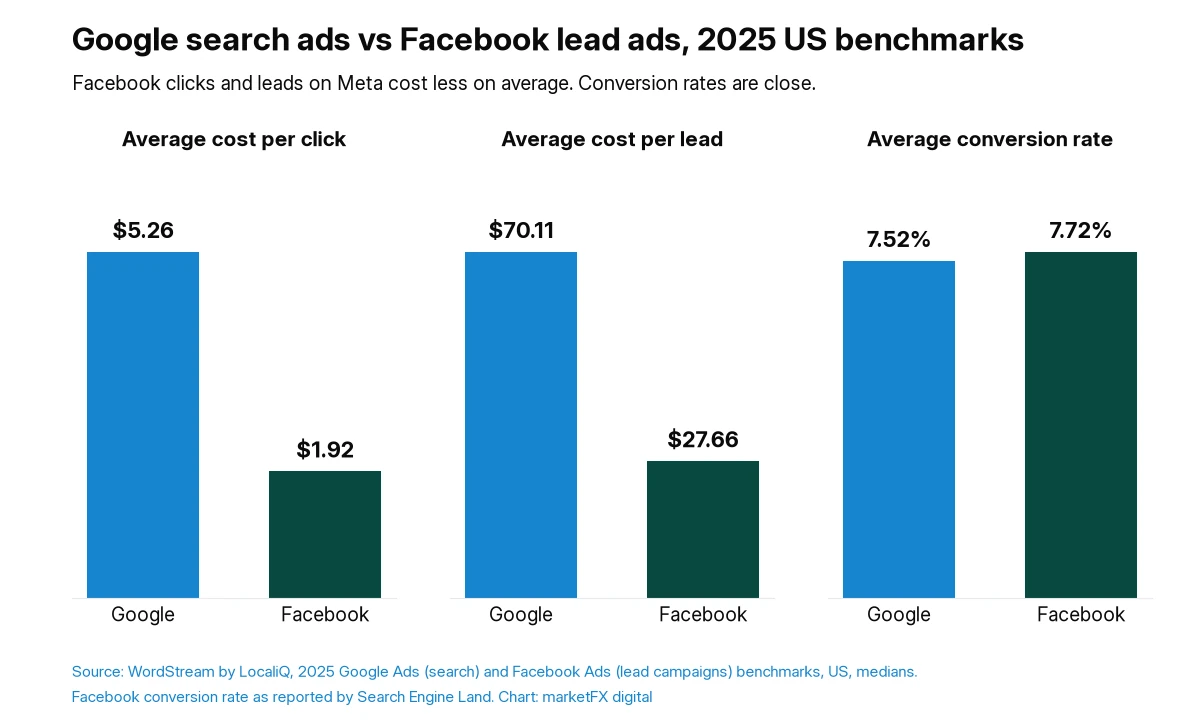
| Metric | Google Ads (search) | Facebook Ads (lead campaigns) |
|---|---|---|
| Average cost per click | $5.26 | $1.92 |
| Average conversion rate | 7.52% | 7.72% |
| Average cost per lead | $70.11 | $27.66 |
Sources: WordStream, Google Ads Benchmarks 2025; WordStream, How Much Do Facebook Ads Cost?; Facebook conversion rate as reported by Search Engine Land.
Three cautions before you move budget on those numbers:
- A Meta lead is often a different kind of lead. Many Meta lead campaigns use instant forms that fill in the person's details for them. That makes the form easy to submit and the lead cheap, but it also lets in people who were curious rather than ready. A Google lead usually started with a search for the thing you sell.
- Averages hide your industry. The gap between the two platforms changes a lot by business type, as the next chart shows.
- Benchmarks are not your account. Use them to sanity check a plan, not to set a target. Your own cost per qualified lead, close rate and customer value decide which platform pays.
The way to compare fairly is to carry each platform's leads through to the sale. If Meta leads cost $28 and one in ten becomes a customer, each customer costs $280 in media. If Google leads cost $70 and one in three becomes a customer, each customer costs $210. Those close rates are illustrative, not benchmarks. The point is that the platform with the cheaper lead can still be the more expensive way to win a customer, and you only know which is which once leads are tracked into your CRM.
Where Does Each Platform Win by Industry?
Meta's cost per lead advantage is large in some industries and small in others, which is why the same budget split does not work for everyone. In the 2025 benchmarks, the gap ranged from almost none in dental to more than six times in real estate.
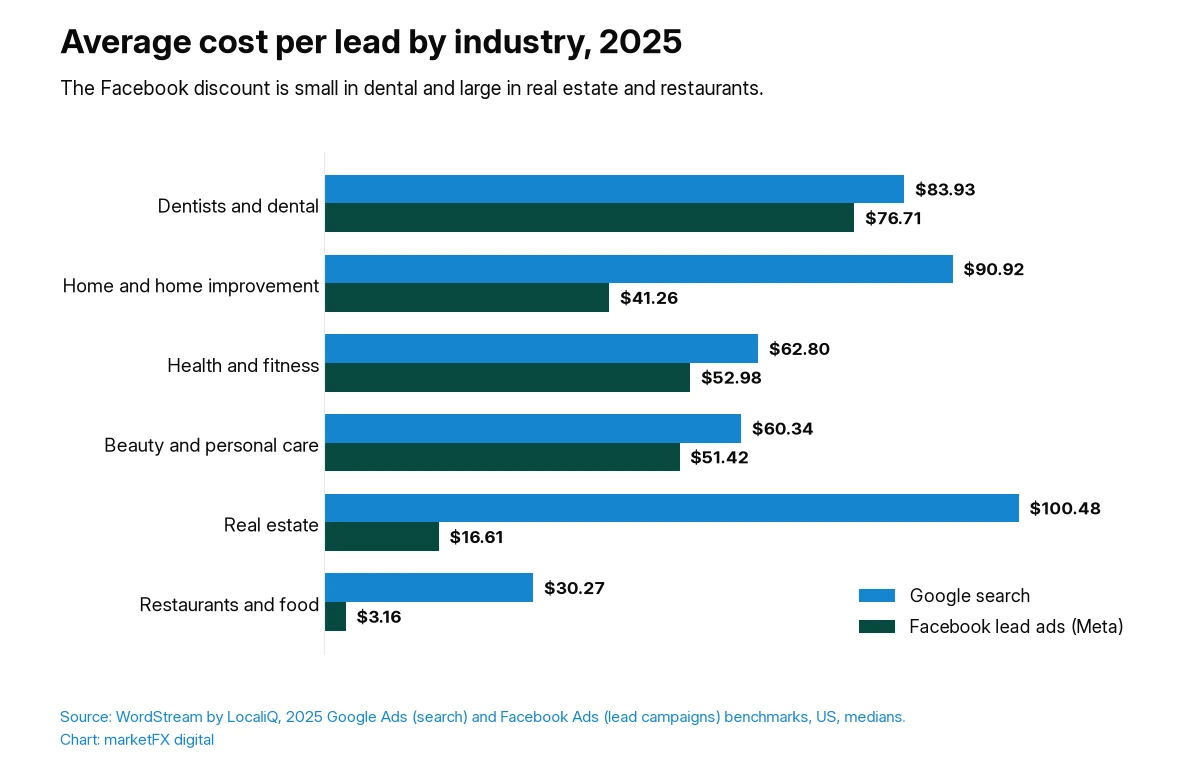
| Industry | Google Ads cost per lead | Facebook Ads cost per lead |
|---|---|---|
| Dentists and dental services | $83.93 | $76.71 |
| Home and home improvement | $90.92 | $41.26 |
| Health and fitness | $62.80 | $52.98 |
| Beauty and personal care | $60.34 | $51.42 |
| Real estate | $100.48 | $16.61 |
| Restaurants and food | $30.27 | $3.16 |
Source: WordStream by LocaliQ, 2025 Google Ads and Facebook Ads benchmarks, US campaigns, medians.
A few patterns are worth noting. Where the need is urgent or specific, such as a dentist or a home repair, the Meta discount shrinks or the Google lead is simply more likely to book. Where buying is driven by browsing and timing, such as real estate or a restaurant, Meta's reach is far cheaper and the feed is a natural place to be seen. Your own numbers will differ, but the direction usually holds.
When Should You Choose Google Ads First?
Choose Google Ads first when buyers already search for what you sell and act soon after they search. That covers most local services, most B2B services with a clear category name, emergency and urgent needs, and products people compare by name or specification.
Google is also the stronger first channel when:
- Your budget is small. Search lets you spend only on the queries that matter, and a few hundred well-chosen keywords can be enough to learn.
- You sell in many locations. Searches with local intent, including "near me" searches, show ads tied to Maps and location extensions. For multi-location and franchise brands, that is often the most direct path to calls and bookings. See our multi-location and franchise marketing approach.
- You need leads this month. Search campaigns usually generate their first conversions faster than a new Meta account, because the demand already exists.
The limit of Google is volume. Once you are buying most of the relevant searches at a cost you can carry, spending more mostly raises your cost per click. That is the point where a second channel, Meta or Microsoft Ads, starts to earn its place.
When Should You Choose Meta Ads First?
Choose Meta Ads first when your buyers do not search for your product yet, or when seeing the product is what sells it. That covers new product categories, visual and lifestyle products, offers with a strong hook, events, and consumer brands that grow by being discovered.
Meta is also the stronger first channel when:
- Search volume is thin. If only a few hundred people a month search for your category, Google cannot scale far, while Meta can reach a much larger audience that matches your best customers.
- You have creative to work with. Meta rewards strong video, images and testing. A brand that can produce new creative every few weeks gets more out of it than one with a single image.
- You want to fill the top of the funnel. Meta can build the audience that later searches for you, clicks a retargeting ad or joins your email list.
The limit of Meta is qualification. Cheap leads that never answer the phone are not cheap. If you run Meta for leads, build in qualification questions, send leads to your CRM quickly and teach the platform which ones turned into customers.
Targeting, Creative and Automation: What Is Different?
Google targets by intent and Meta targets by person, and that difference shapes how each campaign is built and how much creative it needs.
Targeting
On Google, the keyword or product search is the targeting. Audience signals help, but the search itself tells you most of what you need. On Meta, there is no search, so the targeting is the audience: location, demographics, interests, behaviors, custom audiences built from your customer lists and website visitors, and lookalikes built from those. Meta increasingly asks advertisers to give it broad audiences and let its delivery system find the people most likely to convert.
Creative
On Google search, the ad is mostly text, and a good ad can run for months. On Meta, the creative is the ad. It competes with friends, creators and news in a feed, so it has to stop the scroll in a second or two, and it wears out faster. Budget for creative production when you plan Meta, not only for media.
Automation
Both platforms now push automation hard. Google's Smart Bidding and Performance Max decide bids and placements across its network. Meta's Advantage+ campaigns decide audiences, placements and creative combinations. In both cases, the automation is only as good as the conversion data it learns from, which is why tracking comes before scaling. We cover what to check in each in our guide to PPC management services.
How Do You Measure Google Ads and Meta Ads Fairly?
You measure them fairly by using the same conversion definitions on both, sending real outcomes back to each platform, and judging the total against your CRM rather than adding up what each platform reports.
Each platform counts conversions its own way, with its own attribution window, and each will happily claim a sale the other also claims. If you add up the conversions in Google Ads and Meta Ads Manager, the total is often higher than the number of customers you actually won. A fair setup has four parts:
- One definition per conversion. A qualified lead means the same thing in Google Ads, Meta, GA4 and the CRM.
- Clean signals. Google enhanced conversions and the Meta Conversions API, with deduplication, so each platform sees the conversions it drove without double counting. Our server-side tracking services cover this setup.
- Outcomes, not form fills. Qualified leads, booked appointments and revenue sent back to both platforms as offline conversions, so bidding learns which leads matter.
- A blended view. Total revenue against total ad spend, and cost per customer by platform from the CRM, reviewed alongside each platform's own numbers. Where budgets allow, holdout or geo tests show what each platform adds on top of the other.
For a deeper look at why platform reports disagree, see why your Google Analytics dashboard is lying to you.
The marketFX Capture or Create Test™
The marketFX Capture or Create Test™ is a five-question test we use to decide which platform should lead a paid media budget. Answer each question for your business, then count which side wins.
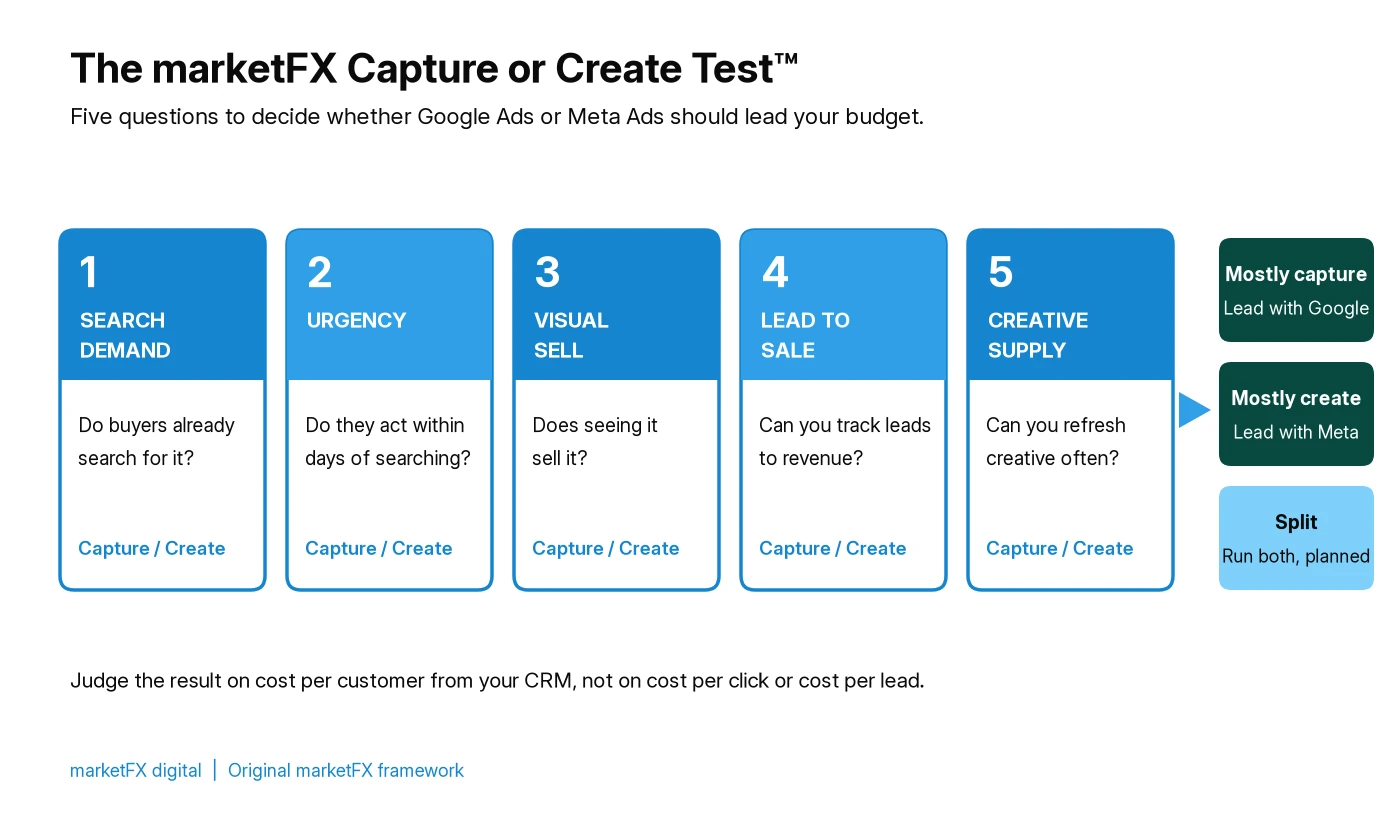
| Question | Points to Google (capture) | Points to Meta (create) |
|---|---|---|
| 1. Search demand: do buyers already search for what you sell? | Yes, with real monthly volume | Rarely, or the category is new |
| 2. Urgency: do buyers act within days of searching? | Yes, the need is urgent or specific | No, they browse and decide over time |
| 3. Visual sell: does seeing the product sell it? | Not really, it sells on fit, price or trust | Yes, it sells on how it looks or feels |
| 4. Lead to sale: can you track leads through to revenue? | Not yet, so start where intent is highest | Yes, so you can qualify cheaper leads |
| 5. Creative supply: can you refresh creative every few weeks? | No, creative is limited | Yes, video and images are easy to produce |
How to read the result:
- Four or five capture answers. Lead with Google Ads. Add Meta later for retargeting and to build demand once search is close to its volume limit.
- Four or five create answers. Lead with Meta Ads. Run branded and core category search on Google from the start so you catch the demand Meta creates.
- A split. Run both with a planned split, and review it on cost per customer every quarter.
Attribution: the marketFX Capture or Create Test™ is an original marketFX framework for paid media planning. It is not a vendor ranking.
How Should You Split Budget Between Google and Meta?
Split budget by giving the platform that matches your demand the larger share, giving the second platform enough to learn, and moving money each quarter based on cost per customer, not cost per lead.
There is no correct ratio for every business, and any fixed split you read online is a starting point at best. A practical way to set yours:
- Fund the lead platform first. Give it enough budget to buy most of the demand you can profitably serve, based on the Capture or Create Test™.
- Give the second platform a real test. A budget too small to produce conversions every week will not teach the platform anything. Set a test budget, a target cost per qualified lead and a review date before launch.
- Keep branded search running. Whatever leads, people who see your Meta ads will search for your name. Protecting branded search is usually cheap and catches that demand.
- Rebalance on marginal results. Ask where the next dollar earns more, not which platform has the best average. A platform with a great average can be close to its ceiling.
Can Google Ads and Meta Ads Work Together?
Yes, and for most brands that grow past a single channel they should, because Meta builds the demand that Google then captures. The two platforms cover different moments in the same buying journey.
A typical joined-up setup looks like this. Meta introduces the brand or offer to people who match your best customers. Some of them click, many do not, but they remember. Google search catches them when they search for your name or category. Retargeting on both platforms brings back people who visited and did not convert. And one measurement setup, from tracking through the CRM, shows the whole path instead of two competing reports. That is the reason we run paid media as one program across Google Ads, Meta Ads and the rest of the paid media mix, rather than as separate platform silos.
How marketFX Plans Google and Meta Budgets
We plan Google and Meta as one budget with one set of conversion definitions, and we decide the split from your demand and your CRM data, not from platform reports. That starts with a review of both accounts and your tracking, then a written plan for which platform leads, how much the second gets to test, and what the review rule is. Across managed paid media portfolios, marketFX reported an average 4.1x ROAS in 2025, and across our client work we report 94% client retention and more than $20 million in revenue tracked.
If you already run one or both platforms and want an outside view first, our paid media audit and strategy service reviews every account and gives you a prioritized plan.
Related services
FAQs
Frequently Asked Questions
- Is Google Ads or Facebook Ads better for small businesses?
- It depends on whether customers search for what you sell. Local service businesses usually do better starting with Google Ads, because people search when they need a plumber, dentist or salon. Businesses with a visual product or a new idea often do better starting with Facebook and Instagram. With a small budget, pick one platform and run it well before adding the second.
- Why are Facebook leads cheaper than Google leads?
- Facebook leads are cheaper because the clicks cost less and lead forms make it easy to submit details without leaving the app. In 2025 benchmarks, the average Facebook lead campaign cost per lead was $27.66 against $70.11 for Google search. The trade-off is intent: many Facebook leads were not searching for you, so they need more qualification.
- Is Meta Ads the same as Facebook Ads?
- Yes. Meta Ads is the current name for advertising across Meta's apps, managed in Meta Ads Manager. One campaign can run on Facebook, Instagram, Messenger and the Audience Network. People still say Facebook Ads, but the same campaigns and budgets usually cover Instagram too.
- Which has better ROI, Google Ads or Meta Ads?
- Neither has better ROI for every business. Google often returns more per click because the buyer is already searching, while Meta often wins on cost per lead and reach. The only reliable answer comes from your own data: cost per customer and revenue by platform, measured in your CRM, not the return each platform reports for itself.
- Should I run Google Ads and Meta Ads at the same time?
- Often, yes, once the first platform is tracked properly and working. Running both lets Meta build demand that Google then captures through search. Start with the platform that matches how your buyers find you, give the second platform a real test budget, and judge both on blended results.
- How much should I spend on Google Ads vs Meta Ads?
- There is no standard split. Give the larger share to the platform that matches your demand, give the second enough budget to produce conversions every week, and keep branded search running. Then rebalance each quarter based on cost per customer and where the next dollar earns more.
- Is Google Ads or Meta Ads better for multi-location businesses?
- Google Ads usually leads for multi-location businesses, because local searches and Maps drive calls, directions and bookings for each location. Meta adds value for local awareness, offers and openings, targeted by radius around each location. The best results come from running both with location-level tracking so you can see which markets each platform helps.