
LLM Advertising Platforms: Where You Can Buy Ads in AI Answers
Where you can buy ads in AI answers in 2026: ChatGPT Ads, Google AI Overviews and AI Mode, Copilot, Amazon Rufus prompts and AI ad networks, and how to choose.
Quick Answer
LLM advertising platforms are the ad systems that place sponsored messages next to AI generated answers. In 2026 you can buy them in five places: ChatGPT Ads, Google ads in AI Overviews and AI Mode, Microsoft Advertising in Copilot, Amazon's Rufus prompts, and independent AI ad networks. Perplexity and Claude sell no ads. Choose by where your buyers ask questions and what you can measure.
At the start of 2026, ChatGPT carried no ads at all. Today there are self-serve ad managers, published bid guidance, and real budgets moving. There is also a lot of confusion about what these placements are, what they cost, and whether buying one gets your brand mentioned in the answer itself. OpenAI and Google both say it does not.
This guide lists where you can buy ads in AI answers as of October 2026, using each platform's own documentation, and shows how to decide where to start. It does not rank vendors.
What Is an LLM Advertising Platform?
An LLM advertising platform is a system that matches ads to the context of a conversation with an AI assistant, then shows a clearly labeled sponsored unit beside or inside the response. Unlike classic search ads, matching is based on the meaning of the whole conversation rather than exact keywords alone.
There are two kinds:
- Ad products run by the AI platform owner. OpenAI, Google, Microsoft, and Amazon sell placements in their own assistants through their own ad accounts.
- Independent AI ad networks. These companies sell placements inside third party chatbots, agents, and AI apps that plug in their ad layer, much like a programmatic network does for websites.
OpenAI reported more than 900 million weekly active ChatGPT users in February 2026, more than 1 billion by August 31, 2026, and 1.2 billion by late September, as reported by The Verge.
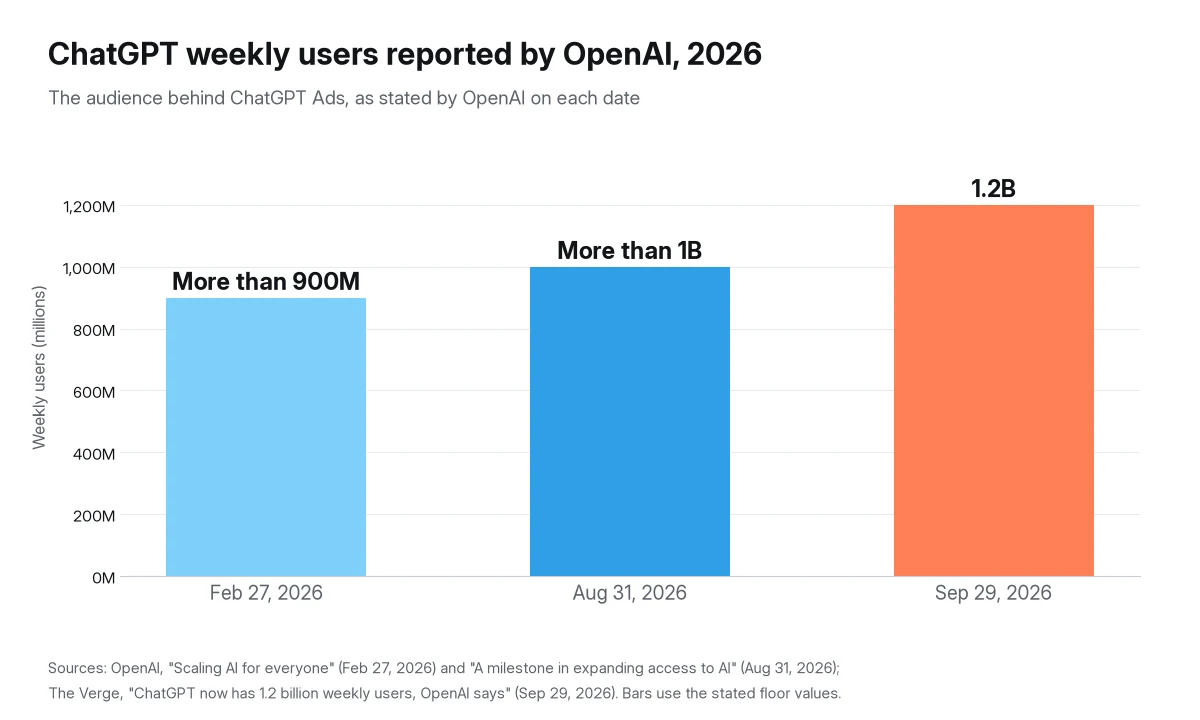
ChatGPT weekly users as reported by OpenAI in 2026. Sources: OpenAI (Feb 27 and Aug 31, 2026); The Verge reporting OpenAI's figure (Sep 29, 2026).
| Date reported | Weekly users | Source |
|---|---|---|
| February 27, 2026 | More than 900 million weekly active users | OpenAI |
| August 31, 2026 | More than 1 billion weekly active users | OpenAI |
| September 29, 2026 | 1.2 billion weekly users | The Verge, citing OpenAI |
Which LLM Advertising Platforms Can You Buy in 2026?
Five options are open to advertisers today, and a sixth group of major assistants sells no ads at all. The map below shows how each one is bought, followed by the details.
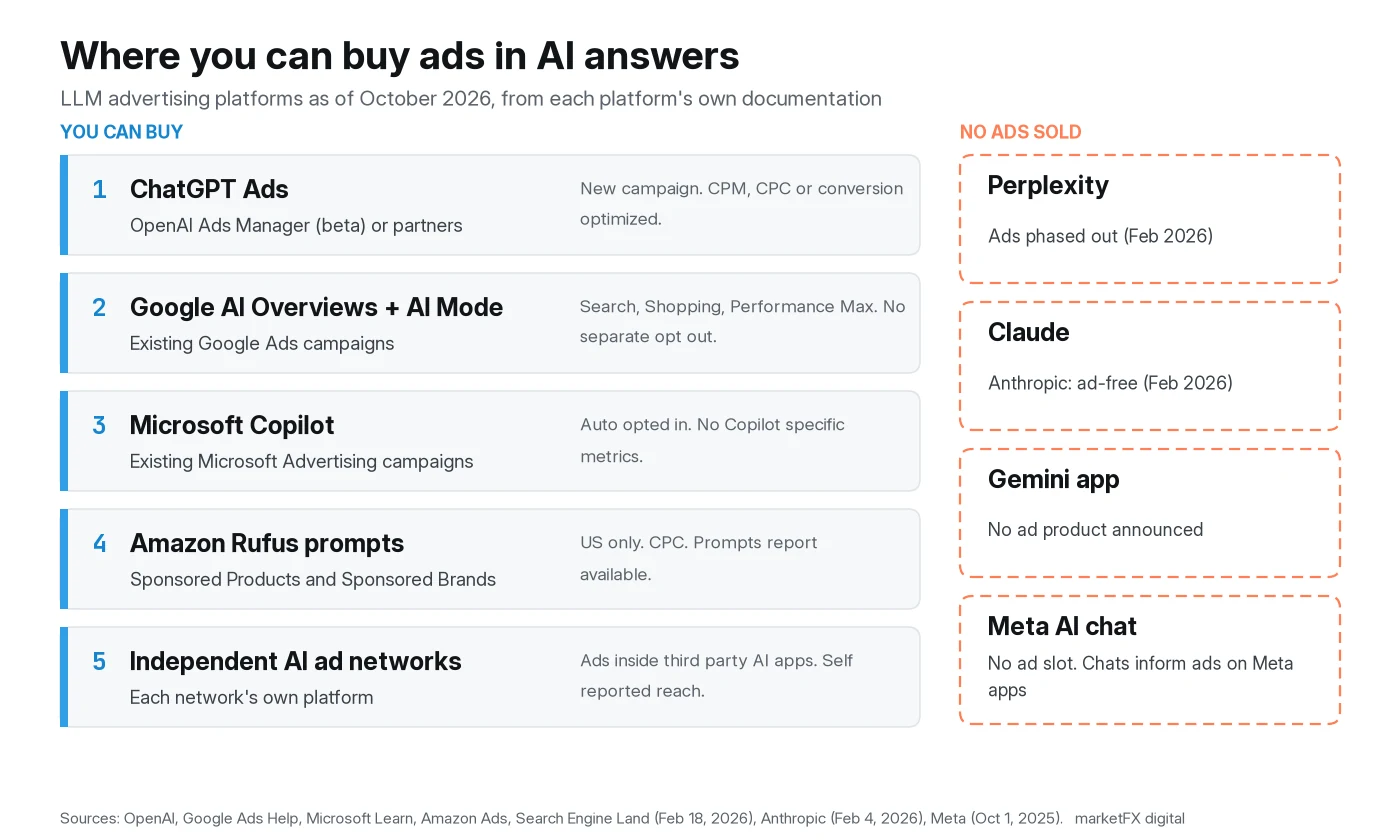
Where ads can and cannot be bought in AI answers, October 2026. Sources: platform documentation linked in the table below.
| AI surface | Can you buy ads? | How you buy | Source |
|---|---|---|---|
| ChatGPT | Yes | OpenAI Ads Manager (beta) or OpenAI partners | OpenAI |
| Google AI Overviews and AI Mode | Yes | Existing Google Ads Search, Shopping, and Performance Max campaigns | Google Ads Help |
| Microsoft Copilot | Yes | Existing Microsoft Advertising campaigns | Microsoft Learn |
| Amazon Rufus | Yes, in the US | Sponsored Products and Sponsored Brands prompts | Amazon Ads |
| Third party AI apps and chatbots | Yes | Independent AI ad networks | Vendor sites |
| Perplexity, Claude, Gemini app, Meta AI chat | No | No ad placement sold | See item 6 |
1. ChatGPT Ads: How Do You Buy Ads in ChatGPT?
You buy ChatGPT ads through OpenAI's self-serve Ads Manager, which entered beta on May 5, 2026, or through OpenAI's agency and technology partners. Ads appear below ChatGPT's response and are labeled as sponsored.
OpenAI began testing ads on February 9, 2026 with logged-in adult users in the US on the Free and Go plans. Plus, Pro, Business, Enterprise, and Education accounts do not see ads, and OpenAI says ads are not eligible near sensitive topics such as health, mental health, or politics. The pilot expanded to Canada, Australia, and New Zealand, then to the UK, Mexico, Brazil, Japan, and South Korea, and by October 21 OpenAI said ChatGPT Ads were available in 89 countries.
According to OpenAI's advertiser basics, each ad includes the advertiser name, logo, headline, description, landing page, and an image. Instead of keywords, you write "context hints" at the ad group level that describe the conversations where your offer is relevant. OpenAI is clear that these hints are not exact match keywords and do not guarantee delivery.
Best fit: brands with a clear offer and conversion tracking ready to install.
2. Google AI Overviews and AI Mode: Can You Run Ads Inside Google's AI Answers?
Yes, and you may already be. Google says existing Search, Shopping, and Performance Max campaigns are automatically eligible to show ads within AI Overviews and AI Mode, with no new campaign or separate budget.
You cannot target AI Overviews or AI Mode on their own or opt out of them separately from Search. Matching depends on your targeting. Broad match, AI Max for Search, Shopping, and Performance Max can match to the context of the question and the AI response. Exact and phrase match keywords only qualify when the query itself shows direct commercial intent.
Ads inside these answers serve in English in the US and several English-speaking markets, including Canada, Australia, and India. On October 28, 2026, Google said it is expanding ads in AI Mode to 10 new countries and launching multiturn ads in the US, so ads can also appear in follow-up queries. Results are blended into your standard campaign and search terms reports. If you already run Google Ads, this is the lowest effort entry point, and the Google Ads agency work that keeps those campaigns healthy now carries into AI answers.
Best fit: any advertiser already running Search, Shopping, or Performance Max.
3. Microsoft Copilot: How Do Ads Get Into Copilot?
Ads in Copilot come from your existing Microsoft Advertising campaigns. Microsoft says all eligible campaign and ad types are automatically opted in, advertisers cannot opt out, and delivery is not guaranteed.
Eligible formats include Multimedia ads, Product ads from Shopping and Performance Max campaigns, Search ads that carry a logo extension, and some vertical formats such as Property promotion and Tours and Activities ads. Microsoft recommends Performance Max as the best way to increase exposure in Copilot. Your negative keywords still apply.
The tradeoff is reporting: Microsoft does not currently support specific metrics for ads served in Copilot.
Best fit: advertisers already running campaigns on Microsoft Advertising.
4. Amazon Rufus Prompts: Can You Advertise in Amazon's Shopping Assistant?
Yes, if you sell on Amazon in the US. Amazon's Sponsored Products prompts and Sponsored Brands prompts moved to general availability in the US on March 25, 2026 after an open beta that began in November 2025.
Prompts are AI generated suggestions that appear in shopping results and on product detail pages. When a shopper clicks one, it may open a conversation in Rufus, Amazon's shopping assistant, or answer the question on the page. Eligible campaigns are enrolled automatically, use their existing targeting, and are charged on your normal cost per click basis. You can pause individual prompts and pull a Prompts report with impressions, clicks, spend, sales, ACOS, and ROAS.
Best fit: brands and sellers already running Sponsored Products or Sponsored Brands on Amazon.
5. Independent AI Ad Networks: What Are the Options Outside the Big Platforms?
A newer group of companies sells ad placements inside third party chatbots, AI search tools, and agents that install their ad layer. For example, Thrad describes itself as "the DSP and SSP for LLMs" and Gravity calls itself "the ad network for AI".
These networks reach AI apps the big platforms do not cover, but inventory and reach figures are largely self reported. Before testing one, ask which apps your ads will appear in, how ads are labeled, what brand safety controls exist, and whether you can verify conversions in your own analytics.
Best fit: brands willing to run small, tightly measured tests in newer inventory.
6. Where You Cannot Buy Ads: Perplexity, Claude, Gemini, and Meta AI
Several major assistants do not sell ad placements as of October 2026:
- Perplexity phased out the ads it began testing in 2024 and, as Search Engine Land reported in February 2026 citing the Financial Times, has no plans to bring them back.
- Claude. Anthropic announced on February 4, 2026 that Claude will remain ad-free.
- Gemini app. Google's ad documentation covers AI Overviews and AI Mode in Search. Search Engine Land noted in February 2026 that Google runs ads there but not in Gemini. Google has since signaled that ads are coming to agentic experiences: on its Q3 2026 earnings call its chief business officer said Google is confident it can offer advertising models for agentic use cases, as reported by Android Headlines. It has announced no Gemini app ad product as of October 31, 2026.
- Meta AI. There is no ad slot inside Meta AI chats, but Meta began using people's Meta AI interactions to personalize content and ads on its apps from December 16, 2025. Your Facebook and Instagram campaigns may therefore reach people based on what they asked Meta AI.
On these surfaces the only way to appear in answers is to be cited organically, which is the second lane of the model later in this guide.
How Do LLM Advertising Platforms Compare?
The biggest differences are how much control you get and how much you can measure. The table summarizes each platform's own documentation as of October 31, 2026.
| Platform | Separate campaign needed? | Targeting input | Buying models | Can you opt out of the AI placement? | AI specific reporting |
|---|---|---|---|---|---|
| ChatGPT Ads | Yes, in OpenAI Ads Manager | Context hints, countries, regions, platforms, custom audiences | CPM, CPC, conversion optimized (billed per click or per 1,000 impressions) | Not applicable, the whole account is ChatGPT | Yes: impressions, clicks, spend, CTR, CPC, CPM, conversions |
| Google AI Overviews and AI Mode | No, uses Search, Shopping, Performance Max | Keywords (broad match for contextual), AI Max, product feeds | Same CPC and conversion based bidding as Search | No | No, blended into campaign and search terms reports |
| Microsoft Copilot | No, uses existing campaigns | Existing keywords, assets, feeds | Same as Microsoft Advertising | No | No Copilot specific metrics |
| Amazon Rufus prompts | No, uses Sponsored Products and Sponsored Brands | Existing campaign targeting | CPC | Individual prompts can be paused | Yes, Prompts report |
| Independent AI ad networks | Yes, with each network | Varies by network | Varies by network | Varies | Varies, check pixel and server-side support |
Sources: OpenAI Help, Google Ads Help, Microsoft Learn, Amazon Ads.
How Do You Advertise on ChatGPT?
You advertise on ChatGPT by opening an account at OpenAI Ads Manager, completing verification and billing, then building a campaign, ad groups with context hints, and ads that pass review. Based on OpenAI's help center, the steps are:
- Set up the account. Register your business, add payment details, and complete verification. Some new self-serve accounts can only advertise in their home country at first.
- Install measurement first. Set up OpenAI's pixel or Conversions API and add UTM parameters to your landing page URLs, which OpenAI says persist on ad clicks. Our guide to UTM parameters covers naming conventions.
- Create a campaign. Choose an objective: Views (CPM), Clicks (CPC), or Conversions. The objective cannot be changed later, so pick it carefully.
- Set budget and location. Choose a daily or campaign total budget. The minimum daily budget is $25 USD (25 CAD in Canada). Include the United States explicitly if you want US only delivery, since excluding other countries alone does not restrict it.
- Build ad groups. Write context hints for each theme, set a maximum bid, and keep themes distinct so you can see what works.
- Write the ads. Headline, description, image, and a landing page that matches the conversation the ad will appear in.
- Launch and review early data. OpenAI says impressions and clicks refresh about every 15 minutes, while spend can lag 7 to 8 hours.
How Much Do ChatGPT Ads Cost?
ChatGPT ads run on a relevance weighted, second price auction, so the cost depends on your bid, your ad's relevance, and competition. OpenAI's own guidance is to start CPC campaigns with a maximum bid of $3 to $5 USD per click, with a minimum daily budget of $25 USD.
These are OpenAI's published starting points, not benchmarks for what you will pay. Other cost rules:
- Conversion campaigns do not bill per conversion. You choose to pay per valid click (oCPC) or per 1,000 impressions (oCPM).
- Daily budgets average over a week. OpenAI paces a daily budget across a 7 day period, so spend on one day can reach up to twice the daily amount.
- Google and Microsoft AI placements cost the same as regular search. Google says there is no extra charge to appear in AI Overviews or AI Mode. Ads there use the same auction and bidding as standard Search ads.
- Amazon prompts bill as CPC inside your existing Sponsored Products and Sponsored Brands budgets.
Agency management fees are separate. Compare proposals by what they include: measurement setup, testing plan, creative, and reporting. Our guide to PPC management services explains how paid media fees are usually structured.
Do Ads Get Your Brand Mentioned in the AI Answer?
No, not on ChatGPT or Google. OpenAI states that advertising does not influence the answers ChatGPT provides, and Google states that buying ads does not influence organic AI answers. Microsoft displays ads within Copilot's responses, and some independent networks place labeled sponsored text inside partner apps' answers, but in every case the ad is a paid, labeled unit. To be named in the answer as a recommendation or source, your brand has to be cited on its own merits.
That is why we plan AI visibility with the marketFX Two-Lane AI Visibility Model. Every AI answer has two lanes a brand can occupy, and each is earned differently:
- The paid lane is the labeled sponsored unit that appears with the answer. You buy it with bids, budget, relevant creative, and clean conversion data. It turns on quickly and stops when spend stops.
- The cited lane is the answer itself: the brands, sources, and links the AI chooses to mention. You earn it with crawlable pages, clear structured content, entity signals, and third party mentions, which is the work of generative engine optimization. It builds slowly and keeps working when budgets pause.
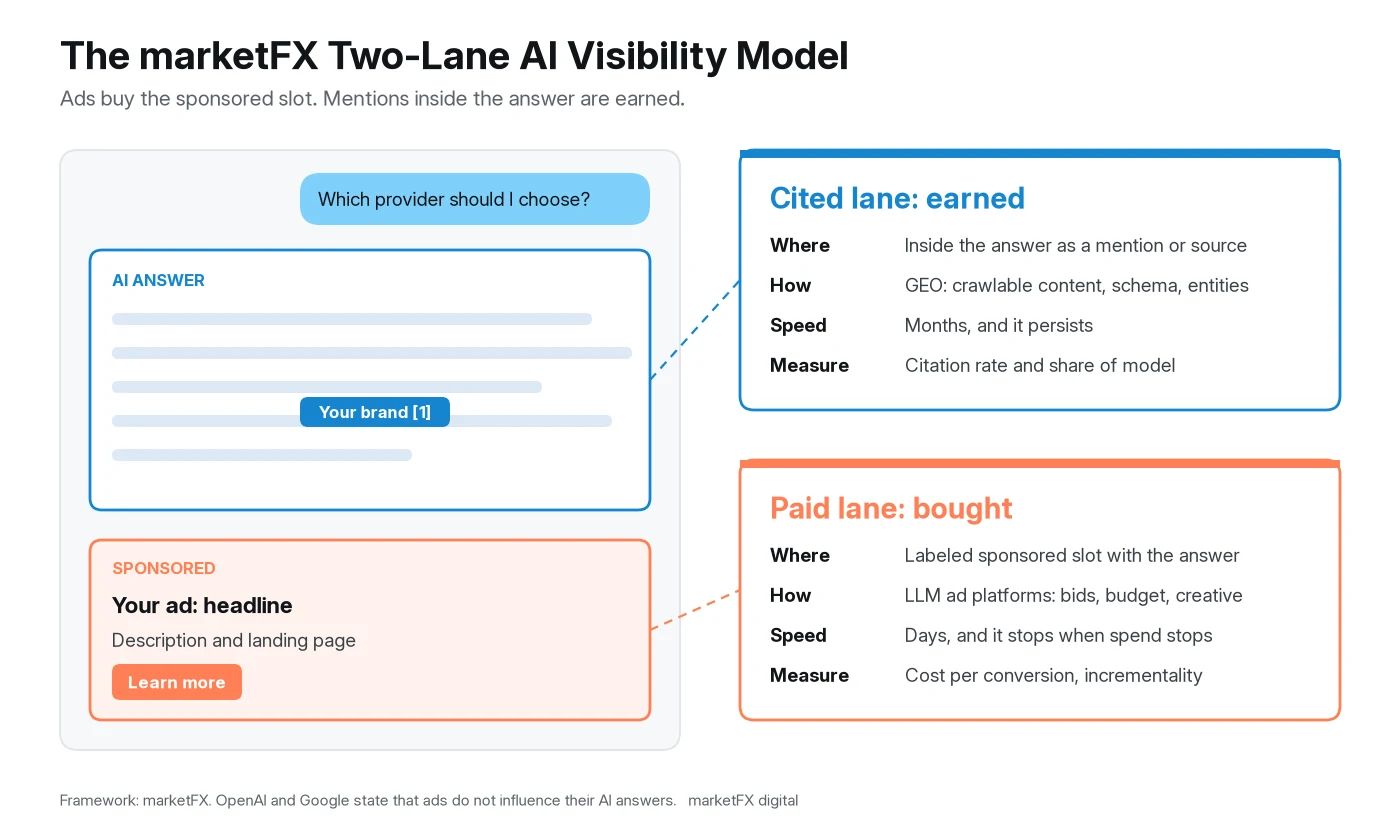
The marketFX Two-Lane AI Visibility Model. Ads buy the sponsored slot; citations inside the answer are earned.
| Lane | Where it appears | How you get there | Speed | When it stops | Main measure |
|---|---|---|---|---|---|
| Paid lane | Labeled sponsored slot beside or below the AI answer | LLM ad platforms: bids, budget, context hints or keywords, creative, conversion tracking | Days | When spend stops | Cost per conversion and incremental revenue |
| Cited lane | Inside the AI answer as a mention or source link | Generative engine optimization: crawlable content, structured data, entity and third party signals | Months | Persists while content stays relevant | Citation rate and share of model |
The lanes support each other, and on platforms with no ads, such as Perplexity and Claude, the cited lane is the only lane. Our AI citations and share of model definitions explain how to track it.
How Should You Choose an LLM Advertising Platform?
Start where your current campaigns already reach, then test the newest inventory only once measurement is in place. Five questions decide the order:
- Where do your buyers already ask? Match the platform to channels you already use: Google for any brand running Search or Shopping, ChatGPT for a dedicated test, Rufus prompts if you sell on Amazon, and Copilot if you already advertise with Microsoft.
- What can you measure? ChatGPT Ads and Amazon prompts report on their own placements. Google and Microsoft blend AI placements into standard reports. If you cannot tie spend to first-party data such as leads or sales, fix that first.
- How much control do you need? Google and Microsoft give you no separate switch for AI placements. Regulated or brand sensitive categories should review negative keywords and, for ChatGPT, whether they qualify for Negative Phrases.
- Can you meet the minimums and run a real test? A test needs enough budget and time to reach meaningful conversion volume. A $25 daily minimum is the floor for ChatGPT Ads, not a test plan.
- Is your cited lane in place? Paid placements send people to your site. If your pages are thin or AI engines cannot read them, the click will not convert and the answer will still name someone else. An AI search audit shows where you stand.
For most advertisers the order is: tidy existing Google and Microsoft campaigns, add a measured ChatGPT Ads test, then consider Amazon prompts or independent networks.
How Do You Measure LLM Ads?
Measure LLM ads like any new channel: against conversions and revenue in your own systems, with a holdout where possible.
- Tag everything. Use UTM parameters on ChatGPT ads and confirm they reach GA4 and your CRM. Google and Microsoft AI placements will not show as a separate source.
- Send conversions server side. OpenAI's Conversions API and Google's offline conversion imports give bidding better signals. Our marketing attribution work covers how to reconcile them.
- Test for incrementality. A geographic or time based holdout, explained in our incrementality definition, shows whether AI placements add customers you would not have won anyway.
What Should Multi-Location and Franchise Brands Know?
Local brands can target AI placements more precisely than many expect. For ChatGPT Ads, OpenAI says campaigns that are not product feed campaigns can target states, cities, markets, and postal codes where available. Google says it is also experimenting with local inventory ads inside AI Overviews and AI Mode.
The harder part is consistency. A conversational ad sends someone who has already described what they want, so each location page needs accurate hours, offers, and answers.
How marketFX Approaches AI Advertising
At marketFX, paid media and AI search visibility sit with the same team, so we plan both lanes together. Our paid media services start with clean measurement: conversion tracking, server side events, and CRM parity are in place before spend scales. Since AI Overviews and AI Mode ads come from your existing Search, Shopping, and Performance Max campaigns, keeping those campaigns healthy is the first step for most brands.
If you are considering ChatGPT Ads or another LLM advertising platform, a paid media audit is a practical place to start. It shows whether your tracking, landing pages, and budget can support a fair test. For the cited lane, our GEO agency work makes your content readable and quotable by AI engines.
If you want a clear plan for where AI advertising fits in your budget, book a strategy call. We will review your current campaigns, your measurement, and where your buyers are already asking AI for answers.
Related services
FAQs
Frequently Asked Questions
- What is an LLM advertising platform?
- An LLM advertising platform is an ad system that places sponsored messages next to answers from an AI assistant or AI search experience. In 2026 the main options are ChatGPT Ads, Google ads in AI Overviews and AI Mode, Microsoft Advertising in Copilot, Amazon's Rufus prompts, and independent AI ad networks. The ads are labeled as sponsored.
- How much does it cost to advertise on ChatGPT?
- ChatGPT ads use a relevance weighted, second price auction, so cost depends on your bid, relevance, and competition. OpenAI's help center recommends starting CPC campaigns with a maximum bid of $3 to $5 USD per click, and the minimum daily budget is $25 USD. These are OpenAI's published starting points, not benchmarks.
- How do I advertise on ChatGPT?
- Create an account in OpenAI Ads Manager, set up billing and verification, and install the OpenAI pixel or Conversions API plus UTM parameters. Then create a campaign with a Views, Clicks, or Conversions objective, set a budget and locations, write context hints for each ad group, and submit ads for review.
- Can I run ads in Google AI Overviews?
- Yes. Google says existing Search, Shopping, and Performance Max campaigns are automatically eligible to show ads within AI Overviews and AI Mode, with no separate campaign or budget. You cannot target or opt out separately, and results appear in standard reports. On October 28, 2026, Google said it is expanding ads in AI Mode to 10 new countries and launching multiturn ads in the US.
- Does Perplexity have ads?
- No. Perplexity tested ads starting in 2024 but phased them out, and Search Engine Land reported in February 2026, citing the Financial Times, that it has no plans to bring them back. To appear in Perplexity answers, a brand has to be cited organically through content the engine can find and trust.
- Do ads in ChatGPT influence its answers?
- OpenAI states that advertising does not influence the answers ChatGPT provides. Ads appear below the response and are labeled as sponsored. Google makes the same commitment for AI Overviews and AI Mode. Being named inside the answer itself depends on organic signals, which is the work of generative engine optimization.
- How long does it take to see results from ChatGPT ads?
- Delivery data arrives quickly once ads pass review: OpenAI says impressions and clicks refresh about every 15 minutes, while spend can lag 7 to 8 hours. Judging results takes longer, because you need enough conversions to compare against your other channels, ideally with a holdout test. Plan the test length before launch.