
AI Search Optimization Services: What to Buy and How to Compare
What AI search optimization services include, how ChatGPT, Perplexity, Google and Copilot find sources, how the work is sold, and how to compare providers.
Quick Answer
AI search optimization services help your brand get found, cited and described accurately in AI answers from ChatGPT, Perplexity, Google AI Overviews, AI Mode, Gemini and Copilot. Good providers check that each platform can reach your pages, build answer-first content and entity signals, earn mentions on sources AI engines trust, and report citation share against a baseline. No honest provider guarantees citations.
Your buyers now ask full questions and get one written answer back. Google says the Gemini app has reached one billion users (Alphabet), and OpenAI says more than 1 billion people use ChatGPT (OpenAI). Which brands those answers name depends on what each platform can find and trust.
Demand for help is growing too. US searches for "ai search optimization services" average about 720 a month, and the latest month is the highest in Semrush's 12 month trend (Semrush, US, November 2026). The trouble is that the same work is sold under at least five names, at very different scopes. This guide explains what to buy, how each AI platform finds sources, and how to compare providers.
What Are AI Search Optimization Services?
AI search optimization services are the strategy and hands-on work that make your brand easy for AI platforms to find, understand and cite when buyers ask questions in your category. The work combines technical access, answer-first content, entity clarity, third party mentions and measurement. The goal is to be named in the answer, and named correctly.
The work sits on top of SEO rather than replacing it. Google says the best practices for SEO remain relevant for AI Overviews and AI Mode, and that there are "no additional requirements to appear in AI Overviews or AI Mode, nor other special optimizations necessary" (Google Search Central). What changes is the target. SEO aims for a ranked link, while AI search optimization aims for a mention or citation inside the answer, often for longer and more specific questions.
GEO services, AI SEO services and AEO: is it the same thing?
Mostly, yes. Generative engine optimization (GEO), AI SEO, answer engine optimization (AEO), AI visibility optimization and AI search optimization all describe the same job: getting your brand cited when AI engines answer your buyers' questions. The labels differ more in marketing than in method.
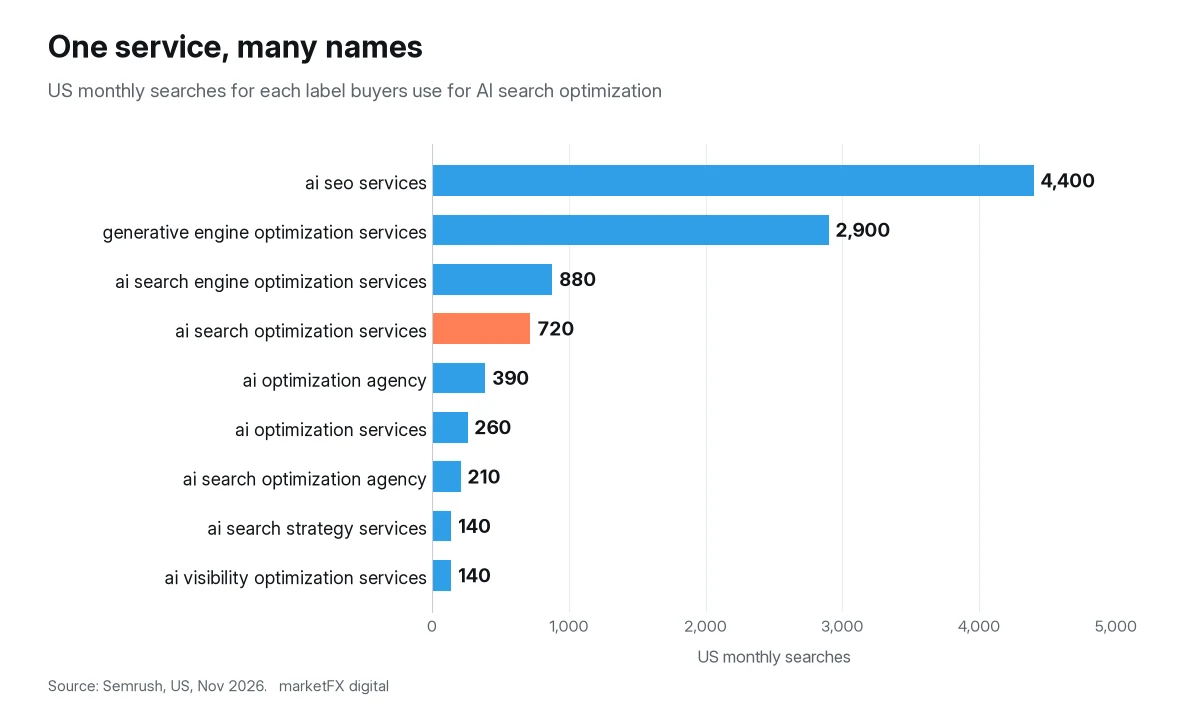
One service, many names. US monthly searches by label. Source: Semrush, US, Nov 2026.
| Search term | US monthly searches | What buyers usually mean |
|---|---|---|
| ai seo services | 4,400 | SEO with AI visibility added to the scope |
| generative engine optimization services | 2,900 | Citations in ChatGPT, Perplexity, Gemini and Google AI answers |
| ai search engine optimization services | 880 | The same work, described as SEO for AI search |
| ai search optimization services | 720 | The same work across all AI platforms |
| ai optimization agency | 390 | A provider that does the work |
| ai optimization services | 260 | Often mixed with AI tools for marketing teams |
| ai search optimization agency | 210 | A provider that does the work |
| ai search strategy services | 140 | Planning and advice more than execution |
| ai visibility optimization services | 140 | Tracking and improving brand presence in AI answers |
The label tells you little about scope, so read the deliverables. Two practical differences do show up. "AI SEO" proposals often lead with classic SEO and add AI tracking, while "GEO" and "AEO" proposals tend to start from AI answers and work back. Our guides to AEO services and GEO vs SEO cover those angles in depth.
What Should AI Search Optimization Services Include?
A complete AI search optimization service includes seven parts: a buyer prompt set and baseline, platform access checks, indexing in Google and Bing, answer-first content, entity and structured data work, third party mentions, and reporting. Smaller engagements can cover fewer parts, as long as the proposal says which ones.
- A buyer prompt set and baseline. A fixed list of the questions your buyers ask, run across named platforms, recording who gets cited and what is said about you. Without a baseline, nobody can show progress later.
- Platform access checks. Each AI platform uses its own crawlers and indexes, so access has to be checked platform by platform. The next section maps them.
- Indexing in Google and Bing. Google requires a page to be indexed to appear as a supporting link in AI Overviews and AI Mode, and Bing's guidelines cover how content is indexed and surfaced in Copilot. Pages that are not indexed are out of the running.
- Answer-first content. Pages that answer the question in the first lines, with question style headings, tables and plain facts that an engine can quote accurately.
- Entity and structured data work. Consistent business details across your site and profiles, plus schema markup that matches the visible page.
- Third party mentions. Reviews, directories, industry publications and communities that AI engines cite in your category, earned honestly.
- Reporting tied to the business. Citation share and accuracy for the prompt set, plus traffic and leads from AI referrals, measured against the baseline.
For a deeper look at deliverables and red flags, see our guide to AEO services. If you want to see where you stand before buying anything, start with an AI search audit.
How Do ChatGPT, Perplexity, Google and Copilot Find Sources?
Each AI platform finds sources through its own crawler or index, and each gives site owners different controls and reports. ChatGPT search uses OAI-SearchBot, Perplexity uses PerplexityBot, Google AI Overviews and AI Mode use the Google Search index, and Copilot runs on Bing. A service that treats them as one channel misses fixable problems.
We call the way we check this the marketFX Engine Door Map. For every platform in scope, it asks three questions: which door your content has to pass through, what rule the platform publishes for that door, and where you can read the results.
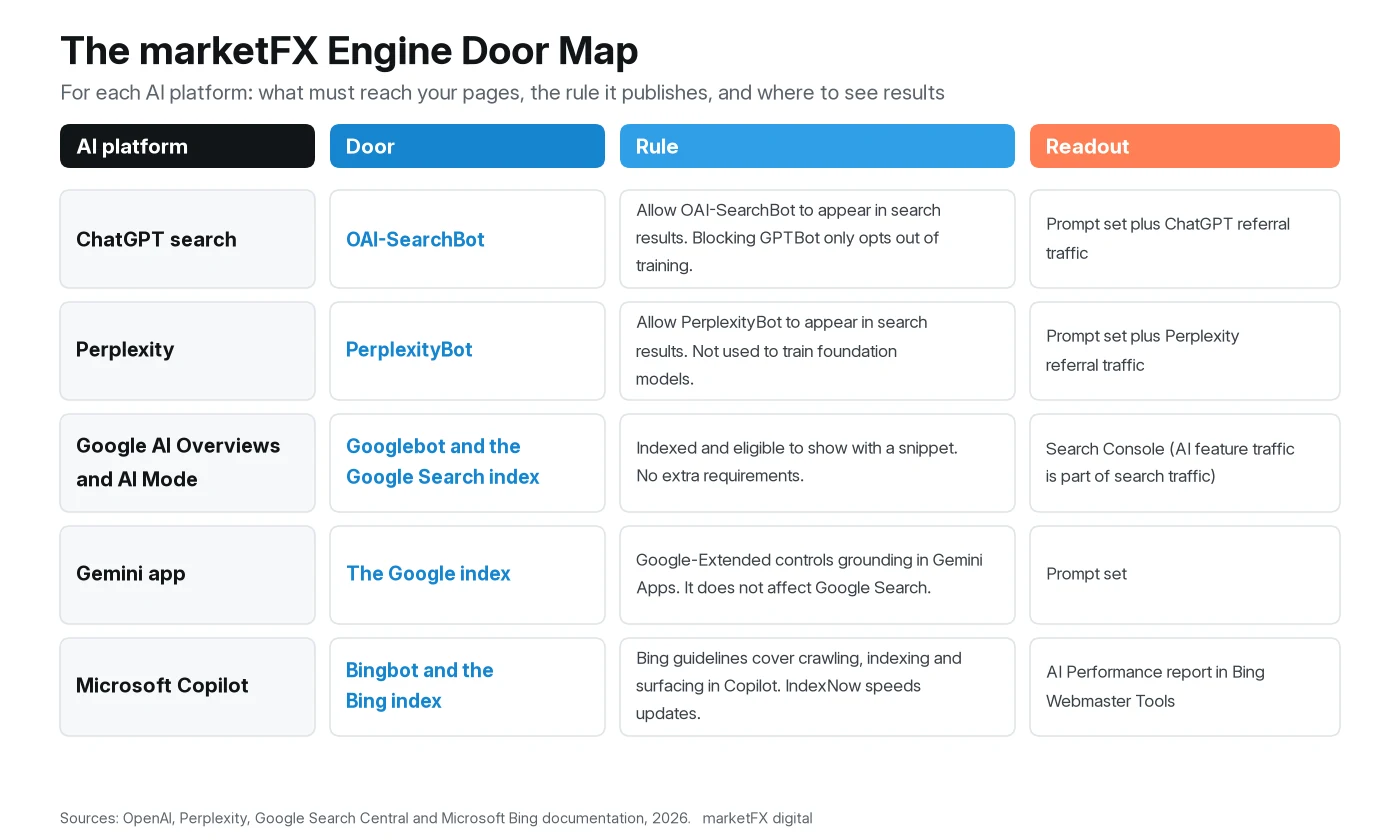
The marketFX Engine Door Map. Sources: OpenAI, Perplexity, Google Search Central and Microsoft Bing documentation.
| AI platform | Door | Rule | Readout |
|---|---|---|---|
| ChatGPT search | OAI-SearchBot | Allow OAI-SearchBot to appear in search results. Blocking GPTBot only opts out of training. (OpenAI) | Prompt set plus ChatGPT referral traffic |
| Perplexity | PerplexityBot | Allow PerplexityBot to appear in search results. Not used to train foundation models. (Perplexity) | Prompt set plus Perplexity referral traffic |
| Google AI Overviews and AI Mode | Googlebot and the Google Search index | Indexed and eligible to show with a snippet. No extra requirements. (Google) | Search Console (AI feature traffic is part of search traffic) |
| Gemini app | The Google index | Google-Extended controls grounding in Gemini Apps. It does not affect Google Search. (Google) | Prompt set |
| Microsoft Copilot | Bingbot and the Bing index | Bing guidelines cover crawling, indexing and surfacing in Copilot. IndexNow speeds updates. (Bing guidelines, Bing) | AI Performance report in Bing Webmaster Tools |
Three findings come up again and again when we run this map:
- The wrong bot gets blocked. OpenAI separates its crawlers: a site can allow OAI-SearchBot "in order to appear in search results while disallowing GPTBot" for training (OpenAI). A blanket block on every AI bot can remove you from ChatGPT search without anyone noticing.
- Bing is ignored. Many teams verify Google Search Console and never set up Bing Webmaster Tools. Bing's AI Performance report shows total citations, cited pages and the "grounding queries" behind them across Copilot and Bing's AI summaries (Bing Webmaster Blog).
- Google-Extended is misunderstood. Blocking it does not remove you from Google Search or AI Overviews, but it does control grounding in the Gemini app (Google Search Central). Decide on purpose.
Google also notes that AI Overviews and AI Mode may use "query fan-out," running several related searches across subtopics to build one answer (Google Search Central). Read more about query fan-out. Pages that answer the follow-up questions, not just the headline one, have more chances to be picked. For Google specifically, see our guide to visibility in Google AI Overviews.
Should You Hire an Agency or Do AI Search Optimization In-House?
Hire an agency when you need speed, cross-platform tracking and outside authority building. Keep the work in-house when you already have strong SEO, content and development capacity and mainly need a method. Many brands split it: an outside audit and plan, then an in-house team that ships the fixes.
| Factor | Agency | In-house team |
|---|---|---|
| Speed to a baseline | Fast, with prompt sets and tracking tools already in place | Slower, the team has to choose tools and build the prompt set |
| Platform coverage | Usually tracks several AI platforms side by side | Often limited to Google at first |
| Site changes | Needs your developers or CMS access to ship | Ships faster when the team owns the site |
| Third party mentions | Brings outreach and PR capacity | Depends on existing relationships |
| Business knowledge | Has to learn your buyers and offers | Already knows them |
| Best fit | Teams without SEO depth or with many locations or brands | Teams with strong SEO, content and dev resources |
Whichever route you choose, keep ownership with you. Search Console, Bing Webmaster Tools, analytics, tracking tool accounts and the prompt set itself should sit in your accounts, with the provider given access. Our broader comparison of marketing agencies vs an in-house team covers cost and control in more detail.
How Are AI Search Optimization Services Priced?
AI search optimization services are usually sold in five ways: tracking software, a fixed-fee audit, an implementation project, a monthly program, or advisory time for an in-house team. Cost depends on how many platforms and prompts are in scope, how much of your site needs fixing, and how much third party authority work is included.
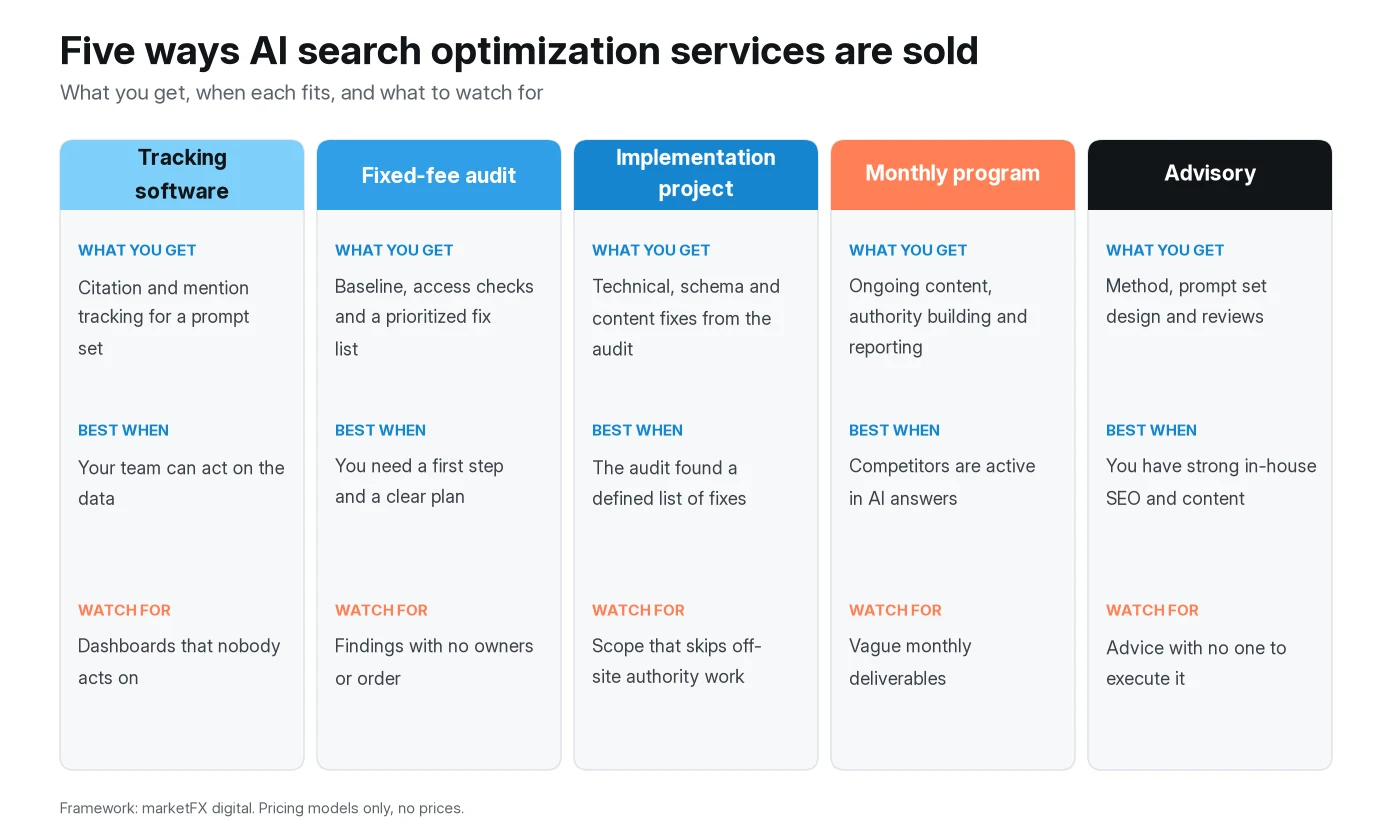
Five ways AI search optimization services are sold, and what to check in each.
| Model | What you get | Best when | Watch for |
|---|---|---|---|
| Tracking software | Citation and mention tracking for a prompt set | Your team can act on the data | Dashboards that nobody acts on |
| Fixed-fee audit | Baseline, access checks and a prioritized fix list | You need a first step and a clear plan | Findings with no owners or order |
| Implementation project | Technical, schema and content fixes from the audit | The audit found a defined list of fixes | Scope that skips off-site authority work |
| Monthly program | Ongoing content, authority building and reporting | Competitors are active in AI answers | Vague monthly deliverables |
| Advisory | Method, prompt set design and reviews | You have strong in-house SEO and content | Advice with no one to execute it |
Compare proposals on the same scope: the same platforms, the same number of prompts, and the same mix of on-site and off-site work. A low monthly fee that covers tracking only is a different product from a program that ships fixes and earns mentions. Treat performance-based pricing tied to citations with care, since AI engines change how they pick sources without notice. For tracking tools, our review of generative engine optimization tools explains what each type measures, and our breakdown of marketing agency cost covers fee structures more broadly.
How Do You Evaluate an AI Search Optimization Agency?
Evaluate an AI search optimization agency by asking it to show its method on your brand, not by its label or its pitch deck. A strong provider shows a sample baseline, explains platform differences, names its tracking tools, separates on-site from off-site work, and refuses to guarantee citations.
Questions worth asking in the first call:
- Which AI platforms are in scope, and how do you track each one? Listen for named platforms and a fixed prompt set, run on a schedule.
- Can we see a sample baseline for our category? Even a small one shows whether they understand your buyers' questions.
- How do you check crawler access per platform? A good answer separates OAI-SearchBot from GPTBot and covers Bing.
- What share of the work happens off our site? Mentions on trusted sources often matter as much as on-site changes.
- How will you tie AI visibility to leads? Citation share is a leading indicator. The report should also show referral traffic, leads and revenue where your CRM allows.
- What do we own if we stop working together? Prompt sets, tracking data and accounts should stay with you.
Walk away from anyone who guarantees a citation or a ranking in ChatGPT, claims a special relationship with an AI company, or will not explain what they change on your site. For a scored checklist you can use across several pitches, see our guide to choosing an LLM SEO agency.
What about "best AI SEO agencies 2026" lists?
Lists of the best AI SEO or GEO agencies can help you build a long list, but many are published by agencies that rank themselves first. Run every name, including us, through the questions above.
How Long Do AI Search Optimization Services Take?
Technical fixes can be confirmed within days, while changes in citation share usually take weeks to months. OpenAI says it can take about 24 hours for ChatGPT search systems to reflect a robots.txt change (OpenAI), but being chosen as a source depends on authority and competition, which build more slowly.
In our own SEO and AI visibility engagements, technical and schema fixes usually start showing up in AI engines within two to six weeks as the major bots crawl again, and content and topical authority work compounds over 60 to 120 days, as described on our SEO and AI visibility consulting page. These are typical patterns, not promises. Agree on leading indicators for the first 90 days, such as pages fixed, bots confirmed, and a citation baseline, so nobody judges the work on month one revenue.
How marketFX Approaches AI Search Optimization
We run AI search optimization as an audit, a scoped build and ongoing measurement, on the same technical SEO and content foundation that earns rankings. Our GEO audit is a fixed-fee, two week diagnostic. We crawl your site as GPTBot, ClaudeBot, PerplexityBot, Googlebot and a regular Chrome browser to see what each one actually gets, then map your signals against the 50 prompts your buyers ask.
The audit produces a prioritized fix list, usually 15 to 25 items split into this week, the next 30 days and the next 90 days. Implementation is scoped from that list, and ongoing work covers content, authority building and monthly citation share across ChatGPT, Perplexity, Gemini and Google AI Overviews. We use tracking tools alongside manual checks, and we never promise a citation, because no one can.
Across all our work we report 94% client retention, more than 20 years driving growth and more than $20 million in revenue tracked for clients. See our GEO agency service for the full method, our AI SEO agency work if you want SEO and AI visibility run together, or read what clients say on our testimonials page.
If you are comparing AI search optimization providers now, put us through the same questions.
Related services
FAQs
Frequently Asked Questions
- How long do AI search optimization services take to work?
- Technical fixes can be confirmed within days, and OpenAI says ChatGPT search reflects a robots.txt change in about 24 hours. Being chosen as a source takes longer. In our engagements, technical and schema fixes usually show up in AI engines within two to six weeks, and content and authority work compounds over 60 to 120 days. These are typical patterns, not promises.
- How much do AI search optimization services cost?
- Cost depends on how many AI platforms and buyer prompts are in scope, how much of your site needs fixing, and how much third party authority work is included. The work is usually sold as tracking software, a fixed-fee audit, an implementation project, a monthly program or advisory time. Ask every provider to price the same scope so proposals are comparable.
- Do ChatGPT, Perplexity, Google AI Overviews and Gemini need different optimization?
- The content work is largely shared, but access and measurement differ. ChatGPT search relies on OAI-SearchBot, Perplexity on PerplexityBot, Google AI Overviews and AI Mode on the Google index, and Copilot on Bing. Google-Extended controls grounding in the Gemini app. A good service checks each platform separately and tracks each one with its own prompt runs.
- What is the difference between AI search optimization and SEO?
- SEO aims to rank pages in search results and earn clicks. AI search optimization aims to get your brand cited and described accurately inside AI answers. The foundation overlaps: Google says normal SEO best practices apply to AI Overviews and AI Mode with no extra requirements. AI search optimization adds prompt tracking, platform access checks, answer-first content and third party mentions.
- Is AI search optimization the same as AEO or GEO?
- In practice, yes. AI search optimization, answer engine optimization (AEO), generative engine optimization (GEO) and AI SEO all describe getting your brand cited when AI engines answer buyer questions. The labels differ more than the methods. Judge a provider by its deliverables: a prompt baseline, platform access checks, content and entity work, third party mentions and reporting tied to leads.
- Can an agency guarantee citations in ChatGPT or Google AI Overviews?
- No. AI platforms choose their sources on their own and change how they choose without notice, and Google says meeting every requirement does not guarantee its content will be shown. An honest provider commits to the work, such as access fixes, answer-first content, structured data and authority building, then measures citation share against a baseline and adjusts based on what moves it.
- Should we block GPTBot and other AI crawlers?
- Decide bot by bot. OpenAI lets you allow OAI-SearchBot, which surfaces sites in ChatGPT search, while blocking GPTBot, which relates to model training. PerplexityBot powers Perplexity search results and is not used for training. Blocking Google-Extended does not affect Google Search, but it does control grounding in the Gemini app. A blanket block can remove you from AI search.